
Instant CRS Calculator 2026 — Free Express Entry Score Calculator
Calculate your Comprehensive Ranking System (CRS) score instantly, based on the official IRCC criteria for Express Entry. Updated to reflect the March 2025 removal of job offer points.
How these points are calculated
Cut-offs shift every round. See all 2026 draws
Why Use Our CRS Calculator for Express Entry
The CRS Calculator is your fast, accurate, and easy to use tool for estimating your Comprehensive Ranking System score for Canada’s Express Entry program. Our CRS Calculator follows the latest IRCC criteria, including the March 2025 update removing job offer points, to provide a reliable score estimate.
Whether you’re planning to create an Express Entry profile or looking for ways to improve your ranking, this CRS Calculator gives you an instant breakdown of your points. Simply enter your details to see how factors like age, education, language proficiency, and work experience affect your total.
With this free CRS Calculator, you can identify opportunities to increase your score and stay competitive for upcoming Express Entry draws. Start using the CRS Calculator today to understand your current standing and plan your Canadian immigration journey with confidence. You can also convert your language test results with our CLB Calculator, or browse our full Tools & Resources hub for more calculators and guides.
Table of Contents

What Is the Comprehensive Ranking System (CRS)?
The Comprehensive Ranking System, usually shortened to CRS, is the points-based formula that Immigration, Refugees and Citizenship Canada (IRCC) to rank every candidate inside the Express Entry pool. Express Entry itself is the online application management system that governs three major economic immigration categories: the Federal Skilled Worker Program, the Federal Skilled Trades Program, and the Canadian Experience Class. Not sure which NOC code or TEER category applies to your job? Use our free NOC TEER Finder tool to look it up in seconds.
Every profile submitted to the pool is scored out of a maximum of 1,200 points, and IRCC periodically invites the highest-ranking candidates to apply for permanent residence through what is known as an Express Entry draw. Your CRS score is not a measure of eligibility on its own; it is a ranking tool that determines your position relative to everyone else already sitting in the pool.
The 1,200 available points are split across two broad groups. Up to 600 points come from core human capital and skill transferability factors, such as age, education, language ability, and work experience. The remaining 600 points come from additional factors, the single largest of which is a provincial nomination. Understanding how these categories interact is the key to knowing where you stand and what you can realistically do to raise your ranking before the next round of invitations.

How This CRS Score Calculator Works
This free CRS calculator Canada mirrors the official IRCC point grid so you can get an instant, unofficial estimate of your Express Entry score. Simply enter your marital status, age, education, first and second official language test results, Canadian and foreign work experience, and any spouse or common-law partner details, plus additional factors like a provincial nomination or a valid job offer.
The tool recalculates your total in real time as you adjust each field, and it also shows a breakdown of exactly how many points came from each category, so you can immediately see which factor is holding your score back and which one offers the fastest path to improvement. This CRS calculator is also known as the Express Entry Points Calculator or PR Score Calculator.
CRS Points Calculator Breakdown: Core Human Capital Factors
Core human capital factors are worth up to 500 points if you are single, or up to 460 points if you have a spouse or common-law partner who will accompany you to Canada (the remaining 40 points shift to a separate spouse factors category). These factors reward candidates who are younger, more educated, and stronger in English or French.
| Factor | Maximum Points (Single) | Maximum Points (With Spouse) |
|---|---|---|
| Age | 110 | 100 |
| Level of Education | 150 | 140 |
| First Official Language | 136 | 128 |
| Second Official Language | 24 | 22 |
| Canadian Work Experience | 80 | 70 |
Age is scored on a sliding scale, with candidates between 20 and 29 years old receiving the maximum points and scores gradually declining after age 30, reaching zero at age 45. Education points increase with credential level, from a high school diploma through to a doctoral degree, and a valid Educational Credential Assessment (ECA) is required for any credential earned outside Canada. Language ability is measured using Canadian Language Benchmark (CLB) levels derived from approved tests such as IELTS, CELPIP, TEF Canada, or TCF Canada, with CLB 9 and above unlocking the highest point bands.
Spouse or Common-Law Partner Factors
If you have a spouse or common-law partner who will immigrate with you, up to 40 additional CRS points are available based on their profile: up to 10 points for their level of education, up to 20 points for their first official language proficiency, and up to 10 points for their Canadian work experience. These points exist separately from your own core human capital factors, which is why the maximum core score for candidates with a spouse (460) is slightly lower than for single applicants (500), with the difference reallocated to this dedicated spouse category.

Skill Transferability Factors
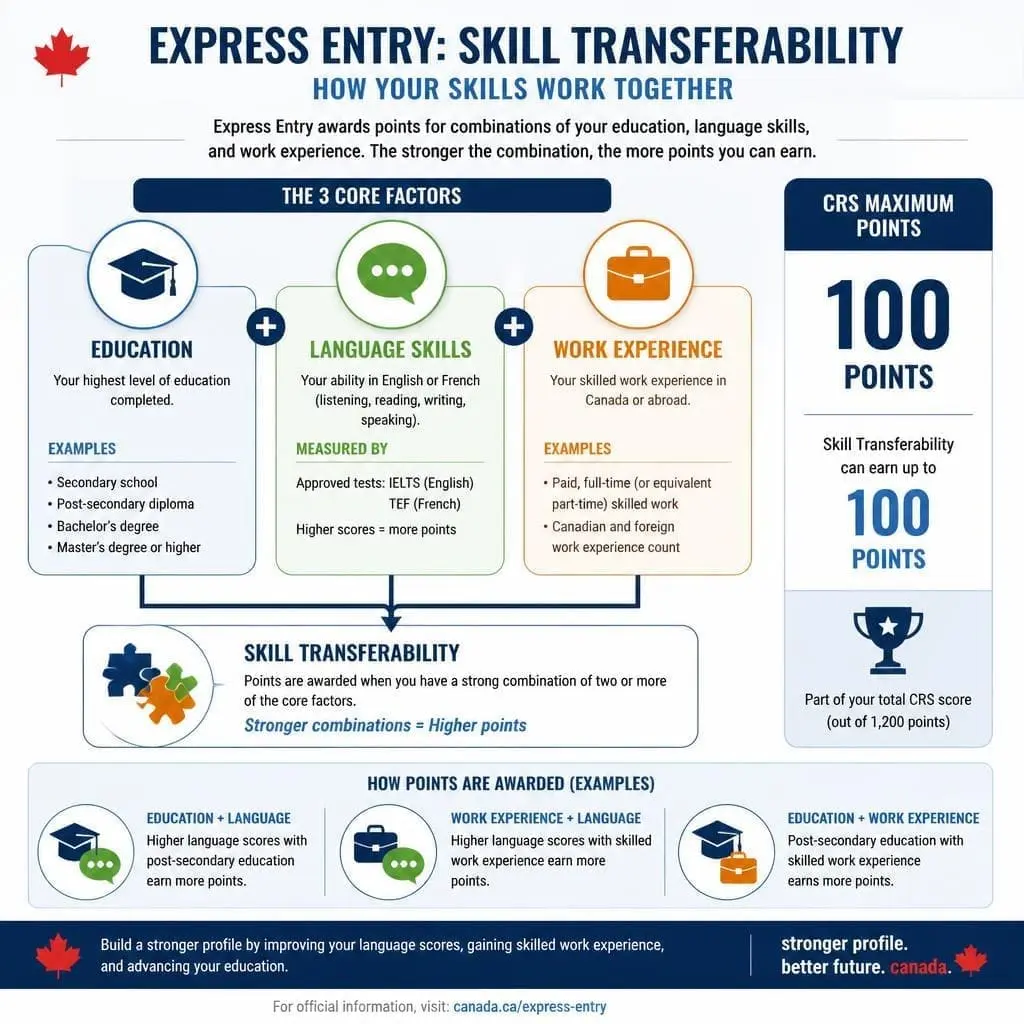
Skill transferability factors reward candidates whose strengths reinforce each other, and they are worth up to 100 combined points. There are four transferability combinations recognized by IRCC. Education combined with strong official language ability can add up to 50 points, while education combined with Canadian work experience can add up to 50 points as well, though the two education-based combinations are capped at 50 points total.
Foreign work experience combined with strong language ability, or foreign work experience combined with Canadian work experience, can each add up to 50 points, capped at 50 points total between them. A certificate of qualification in a skilled trade combined with strong language ability can add up to 50 points. These transferability factors are often overlooked, yet they can be worth as much as a full jump in education level, so it is worth checking every combination that applies to your situation using the CRS calculator above.
Additional CRS Points (Up to 600)
Additional points make up exactly half of the total 1,200-point CRS scale, and a provincial nomination is by far the most powerful factor available to any candidate.
| Additional Factor | CRS Points |
|---|---|
| Provincial or Territorial Nomination (PNP) | 600 |
| Sibling living in Canada (citizen or PR, age 18+) | 15 |
| French language ability (NCLC 7+ on all four abilities) | 25 to 50 |
| Canadian post-secondary education credential | 15 to 30 |
A provincial nomination through a Provincial Nominee Program instantly adds 600 points, which all but guarantees an invitation to apply in the next Express Entry draw, since it pushes the candidate’s total score above almost every cut-off ever recorded. French language ability has become an increasingly significant lever since IRCC began running dedicated category-based draws for strong French speakers, rewarding candidates who score NCLC 7 or higher on all four language abilities with meaningful bonus points even if English remains their first official language.
Canadian post secondary credentials, whether a certificate, diploma, or degree completed at a recognized Canadian institution, also add points on top of the core education score already earned.
Express Entry Draws and CRS Cut-Off Trends
IRCC does not invite every candidate in the Express Entry pool at once. Instead, it runs periodic draws, typically every two to four weeks, and invites a set number of candidates ranked above a specific CRS cut-off score for that round. General draws that consider every program together have historically produced cut-offs anywhere from the low 300s to the mid 500s, depending on pool size and IRCC’s annual admissions targets.
Since 2023, IRCC has also run program-specific and category-based draws, targeting candidates with French language proficiency, healthcare occupations, trades occupations, STEM backgrounds, transport occupations, agriculture and agri-food experience, or existing Canadian work experience through the Canadian Experience Class.
These targeted draws often carry noticeably lower cut-offs than general draws, which can make them an important opportunity for candidates who might not otherwise clear a general round. Because cut-offs shift with every round and depend on who else is in the pool at that moment, candidates should treat any specific number as a moving target rather than a fixed goal, and should recheck their standing regularly using this CRS calculator.

How to Improve Your CRS Score
Most candidates can meaningfully raise their score by focusing on a small number of high impact changes rather than trying to improve everything at once. Retaking a language test to move from CLB 7 to CLB 9 or higher is often the single fastest way to add points, since language ability is counted twice, once on its own and again inside the skill transferability factors. Completing an additional credential, such as a two-year diploma instead of a one-year certificate, or a master’s degree instead of a bachelor’s degree, can unlock a higher education point band.
Gaining one additional year of skilled Canadian work experience, up to the three year cap, steadily increases both the core human capital score and the transferability points tied to it. Securing a provincial nomination remains the single largest lever available, worth more than every other factor combined, and is worth actively pursuing through the many Provincial Nominee Program streams that align with different occupations and regions across Canada. Finally, if you have a spouse or common law partner, improving their language score or having them complete additional education can add points that are easy to overlook.
Who Should Use This CRS Calculator?
This CRS calculator is built for anyone considering Express Entry as a pathway to Canadian permanent residence, including prospective applicants who have not yet created an Express Entry profile and simply want to understand where they would likely rank, candidates who already have an active profile in the pool and want to model how a new language test result, job offer, or provincial nomination would change their score, and licensed immigration consultants or advisors who need a fast, transparent way to illustrate scoring scenarios to their clients.
It CRS calculator is equally useful for candidates comparing pathways, such as deciding between applying directly through a Provincial Nominee Program or waiting for a stronger general draw, since the score breakdown shows exactly which factors are limiting your total at a glance.

Frequently Asked Questions About the CRS Calculator
Comparing Express Entry to Other Canadian Immigration Pathways
Express Entry is Canada’s fastest federal economic immigration system, with most complete applications processed in around six months once an invitation to apply is issued, but it is not the only route into the country. Provincial Nominee Programs can operate through Express Entry-linked streams, which award the full 600-point nomination bonus, or through base streams that lead to permanent residence outside the Express Entry system entirely, typically with longer processing times. The Atlantic Immigration Program and various rural and francophone community immigration pilots offer additional pathways for candidates targeting specific regions of Canada, often with lower language or work experience thresholds than federal programs.
Family sponsorship remains a separate stream entirely, based on relationship to a Canadian citizen or permanent resident rather than points. For most skilled workers without a family connection already in Canada, Express Entry combined with a strong CRS score, or a provincial nomination layered on top of an existing profile, remains the most direct and predictable path to permanent residence, which is why understanding and actively managing your CRS score is worth the effort well before you plan to apply.
Ready to see where you stand? Scroll back up and enter your details into the CRS calculator above, or explore our in depth guides on moving to Canada, the Federal Skilled Worker Program, and how to immigrate to Canada for a complete picture of your options.

Tracking Your CRS Score Over Time
Your CRS score is not fixed the moment you calculate it. Many candidates spend months, or even a year or more, actively working to raise their score before submitting an Express Entry profile, and revisiting this CRS calculator periodically is one of the simplest ways to track that progress.
A new IELTS or CELPIP attempt that pushes a language ability from CLB 8 to CLB 9, an additional year of full-time skilled work, or a change in marital status can each shift your total by a meaningful margin, and small changes in more than one factor at once often compound into a much larger overall gain. Bookmarking this page and checking back after every major life or career milestone, such as finishing a credential, changing jobs, or receiving a provincial nomination invitation, helps ensure your Express Entry profile always reflects your strongest possible CRS score before the next draw takes place.
This CRS calculator provides an CRS estimate based on IRCC’s published criteria. It is not legal or immigration advice. See how we calculate this.