
CRS Score Mismatch: Calculator vs Profile Explained (2026)
You ran a free CRS calculator, then checked your official Express Entry profile, and the two numbers don’t match. Sometimes it’s a few points; sometimes it’s forty or fifty. Either way, it’s confusing to see a different number. The gap can feel alarming, but it almost always comes down to a handful of well-known causes.
Here is what usually creates the mismatch, and how to track down exactly where the difference in your case is coming from. The question worth answering first is simple: why does my CRS score differ from my profile, and which single field is responsible?
This guide focuses on the most common causes we see, but every profile is different, so it’s worth being patient and methodical rather than assuming the first explanation you find applies to your specific case. Before working through the list, it helps to know how we calculate your score — our calculator takes every point value straight from IRCC’s published tables, so any gap you find is almost always an input difference rather than a scoring one.
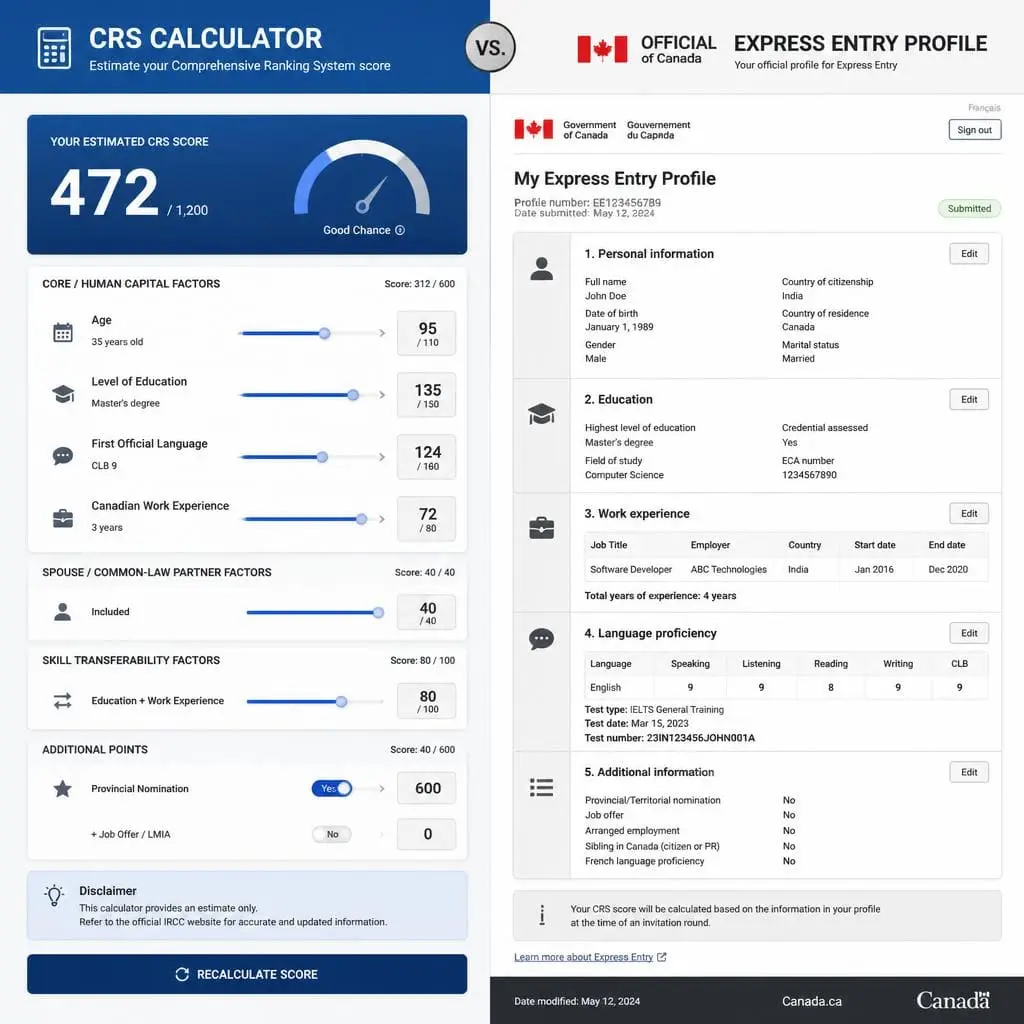
Common Reasons CRS Score Differ From My Profile
1. Age Calculated on a Different Date
Your age for CRS purposes is based on your date of birth at the time your profile is submitted, not the date you happened to use a calculator. If your birthday falls between the two calculations, your age points can shift, sometimes by five or more points if you cross a bracket boundary like turning 30 or 40.
2. NOC / TEER Classification Differences
Work experience only counts if it matches an eligible NOC TEER category correctly. A calculator that lets you pick a generic “years of experience” without checking eligibility can overstate your real points compared to your official profile, which cross-checks your job title and duties against the National Occupational Classification system.
3. Language Test Score Conversion Errors
Every CRS calculation depends on converting your IELTS, CELPIP, TEF, or TCF results into CLB or NCLC levels. A single mis-entered band score can change your CLB level, which then changes multiple sections of your score at once, including skill transferability, since that section depends directly on your language benchmark.
4. Spouse Factors Entered Incorrectly
If your spouse is not accompanying you, or is already a citizen or permanent resident, their factors should be excluded entirely. Leaving this section active by mistake, or filling it in when it should be exempted, is one of the most frequent sources of a mismatch, since it silently switches you onto the lower “with spouse” scale for your own core factors.
5. Missing Additional Points
Sibling points, French-language points, a Canadian post-secondary credential, and a provincial nomination each require specific eligibility. It is easy to forget one of these in a quick calculator, even though your official profile applies it automatically once documented.
6. Outdated Calculators
Some calculators online have not been updated since job offer points were removed from the CRS on March 25, 2025. If a tool still asks you about a job offer and adds points for it, every score it produces will be inflated compared to your real, current profile.
7. Profile Not Yet Updated
Your official Express Entry profile only recalculates your score when you update it. If you took a new language test or finished a credential but have not yet updated your profile, the two numbers will disagree until you do, sometimes for months if the update is overlooked.
Take your time working through each of these seven causes. Rushing to a conclusion before checking every section is itself one of the most common reasons candidates misdiagnose their own score gap.
A Worked Example of a Mismatch
Consider a candidate who calculates 465 points using a quick online tool, but sees 430 on their official profile. Walking through each section, they find their calculator used CLB 9 for writing, based on a test band they misread, when their actual result converts to CLB 8.
That single mistake cost 7 points on the first official language table, plus it disqualified them from a skill transferability combination worth 25 points, accounting for almost the entire 35-point gap once added together. For this candidate, the question “why does my CRS score differ from my profile?” had a single answer: one misread language band.
This kind of chain reaction is common. A single language band or an incorrectly included spouse can ripple across two or three sections of the score at once, which is why small input errors often produce gaps larger than they first appear.

How to Reconcile the Difference
Start by comparing each section side by side: age, education, both official languages, Canadian and foreign work experience, spouse factors, and additional points. Recheck your CLB conversion tables carefully, confirm your NOC TEER category is correct, and make sure your official profile reflects your most recent test results and credentials. Going section by section is the reliable way to find the one field that makes my CRS score differ from my profile.
If the gap remains after checking every section, it is worth reviewing the official IRCC CRS criteria page directly to confirm you are using the current point values, since minor policy changes do happen and not every calculator updates immediately.
Documents Worth Double-Checking
Before assuming a calculator is wrong, pull out your actual test results, your Educational Credential Assessment report, and your employment reference letters. Comparing the exact numbers on these documents against what you entered is usually faster than re-guessing your way through the sections again, and it catches transcription errors, like a swapped CLB level or a missed year of experience, that are easy to make when entering data from memory.
When a Small Difference Is Normal, and When to Dig Deeper
A gap of five points or less is common and usually reflects rounding, a slightly different age calculation date, or a minor difference in how foreign versus Canadian experience was categorized. It is rarely worth extensive troubleshooting for a gap this small. Put simply, should my CRS score differ from my profile by only a few points, the profile number is the one that counts.
A gap of twenty points or more usually means one section was miscalculated outright, most often the language conversion, the spouse section, or a missed additional-points factor. These larger gaps are worth resolving carefully, since a 20-point miscalculation can be the difference between qualifying for a category-based round and missing it entirely.
Step-by-Step Checklist to Find Your Mismatch
Work through your score methodically rather than guessing which section is wrong. First, confirm your exact age on the date you plan to submit or last updated your profile, and check it against the official age table. Second, confirm your highest completed credential and whether it needs an Educational Credential Assessment, since foreign credentials score zero until assessed.
Third, pull your actual language test results and convert each of the four abilities, speaking, listening, reading, and writing, using the current official conversion table rather than relying on memory. Fourth, add up your Canadian work experience in complete years only, since partial years below twelve months do not count.
Fifth, if you have a spouse or common-law partner, confirm whether they are actually eligible to contribute points, since a citizen or permanent resident spouse, or a spouse not accompanying you, should be excluded entirely. Sixth, check every additional point source individually: siblings, French ability, Canadian education, and provincial nomination, since official profiles apply these automatically but manual calculators can easily miss one.
Going through these six checks in order usually isolates the exact section causing the discrepancy within a few minutes, rather than needing to recalculate your entire score from scratch multiple times.

Why Small Errors Matter More Near a Cutoff
A five or ten point miscalculation rarely matters if your score is either far above or far below every recent cutoff. But if your score sits close to a cutoff, the same small error can be the difference between an invitation and another few weeks of waiting.
This is exactly why it is worth reconciling any gap carefully once your score is within striking distance of recent rounds, rather than only when the numbers look wildly different. Close to a cutoff, watching my score differ from my profile by even seven points is reason enough to recheck every field.
It also means that if you are close to a cutoff, you should recheck your calculation immediately after any life change, a birthday, a new test result, a finished credential, or a change in job title, since any one of these can move you from just below a cutoff to just above it, or the reverse.
Related Reading
For the full breakdown of how each factor is scored, see our guide on how to calculate your CRS score. To see what your corrected number actually means in practice, check whether your CRS score is good and compare it against the latest Express Entry draws and CRS cutoffs.
Typical Mismatch Sizes and What They Usually Mean
| Gap size | Most likely cause |
|---|---|
| 1 to 5 points | Rounding, a birthday between calculations, or a minor difference in how a partial work year was counted. |
| 6 to 15 points | A missed additional-points factor, such as a sibling in Canada or a Canadian post-secondary credential. |
| 16 to 30 points | A single language ability misconverted, shifting one CLB band on your first official language. |
| 31 to 60 points | An incorrectly included or excluded spouse, or a NOC/TEER classification error affecting work experience. |
| 60+ points | An outdated calculator still including job offer points, or a fundamental misunderstanding of eligibility for a whole factor group. |
This table is a general guide, not a diagnosis. Always work through the checklist above to confirm the actual cause rather than assuming based on the size of the gap alone.
Tools and Resources to Verify Your Score
Beyond a calculator, IRCC’s own Express Entry profile shows a detailed points breakdown once submitted, section by section, which is the most reliable single source for your real score. Your language testing body (IELTS, CELPIP, TEF, or TCF) also provides an official results report with your exact band scores, which you should reference directly rather than relying on memory when entering data anywhere.
If your credential was earned outside Canada, your Educational Credential Assessment report will state clearly which Canadian credential level it is equivalent to, and that exact wording should guide which education bracket you select, rather than guessing based on the number of years you studied.
Language testing bodies occasionally update their own conversion methodology too, so even a correctly entered band score from a couple of years ago could translate to a different CLB level under today’s rules. When in doubt, request a fresh official results report rather than relying on an old score report from a previous test sitting.
When to Simply Trust the Official Number

Ultimately, your official Express Entry profile is the number that matters for invitations, not any calculator, including this one. Free calculators are built to give you a fast, accurate estimate so you can plan ahead, track trends, and test scenarios like a language retest or a new credential before committing time to the official process.
But once your profile is submitted, that official figure is authoritative, and any calculator, however carefully built, should be treated as a planning tool rather than a final answer.
If you’ve gone through every check above and the gap still doesn’t make sense, it’s worth reviewing your profile with a licensed immigration consultant or lawyer who can review your specific documents line by line, rather than continuing to guess on your own.
Preventing Future Mismatches
Once you’ve reconciled your score, it helps to build a habit of updating your official profile the same week anything changes, rather than waiting until your next scheduled check. Set a reminder for your birthday, since that’s the one factor guaranteed to change every single year regardless of anything else in your profile.
If you’re actively retesting your language ability or finishing a credential, update your profile within days of receiving the result, so your ranking in the pool reflects your real, current standing rather than an outdated one. A profile that is always current is the simplest way to stop seeing my score differ from my profile in the first place.
It’s also worth recalculating your score with a trusted, current calculator every time a new Express Entry round is announced, simply to confirm your number still matches what you expect. This small habit catches most mismatches early, before they have a chance to affect a real invitation decision.
Keep a simple record each time you recalculate, noting the date, your score, and which factors changed. Over a year in the pool, this record makes it much easier to spot exactly when and why your score shifted, rather than trying to reconstruct the history from memory months later.
A Note on Third-Party Calculators
Not every calculator online is built or maintained the same way. Some are abandoned after launch and never updated when IRCC changes the rules, such as the March 2025 removal of job offer points. Others simplify certain sections, like skill transferability or spouse factors, in ways that produce a rough estimate rather than an accurate one.
Before trusting any calculator’s number enough to make a decision, such as whether to wait for a better round or take action now, it’s worth confirming the tool states clearly when it was last updated and cross-checking one or two sections manually against the official IRCC criteria page. An unmaintained tool is the single most likely reason to see my CRS score differ from my profile by a large margin.
Recalculate with the most current 2026 point values using our free CRS calculator, built directly from the official IRCC criteria.
A regulated Canadian immigration consultant (RCIC) or an immigration lawyer can also confirm whether a specific job title truly matches a NOC TEER category, which is one of the more subjective judgment calls in the entire scoring system.
How IRCC Calculates Your Official CRS Score Behind the Scenes
Your official Comprehensive Ranking System score is generated inside your Express Entry profile using the exact same formula published in the Comprehensive Ranking System criteria on the IRCC website, but it draws directly from the answers you entered when you created your profile rather than from a separate calculator tool. That means every date of birth, language test result, and years of work experience gets pulled straight from your profile fields, converted into the corresponding point value, and summed automatically the moment you submit or update your profile.
Because the system recalculates instantly whenever you edit a field, even a small typo, such as entering “3” years of experience instead of “5,” produces an official score that looks wrong compared to a calculator that assumed the correct number. Understanding that IRCC’s number is a live reflection of your profile data, not a one-time snapshot, is the first step in figuring out where a mismatch is actually coming from.
Common Data Entry Mistakes That Inflate or Deflate Your Score
The most common cause of a lower-than-expected official score is simply under-reporting something in the profile that a calculator assumed more generously, such as entering only Canadian work experience and forgetting to also claim foreign skilled work experience, which is worth separate points when combined with a Canadian credential or a valid Educational Credential Assessment.
On the other side, applicants sometimes see an official score higher than their calculator estimate because they forgot to include a valid job offer with the correct NOC/TEER code and LMIA status in the calculator, or because they underestimated their spouse’s education or language ability when doing the calculation by hand. Double-checking each profile field against the exact wording IRCC uses, rather than assuming your own interpretation of “years of experience” or “highest credential” matches the official definition, resolves the majority of these mismatches.
Understanding CRS Score Bands and What They Mean for ITAs
Recent Express Entry draws have generally issued Invitations to Apply somewhere in the 470 to 550 range for general (all-program) draws, though category-based draws for occupations like healthcare, trades, transport, agriculture, French-language proficiency, and STEM fields have at times gone significantly lower, sometimes into the 400s, since candidates only compete against others who qualify for that specific category.
A candidate a handful of points below the most recent cutoff should not assume they are far from an invitation, since draws happen roughly every two weeks and cutoffs move up and down depending on the size and composition of the pool at the time. Watching several consecutive draws, rather than reacting to a single round, gives a much better sense of whether your score realistically puts you in range this year, and whether a small boost, like retaking a language test or securing a provincial nomination, would meaningfully change your odds.
How Provincial Nominations and Job Offers Change the Math
A provincial nomination through a program like the Ontario Immigrant Nominee Program, British Columbia PNP, or Saskatchewan Immigrant Nominee Program adds a flat 600 points to your CRS score, which all but guarantees an invitation in the next draw, since it pushes almost any candidate’s total comfortably above recent cutoffs.
This is by far the single largest point boost available and explains why a candidate’s score can jump from the 450 range to over 1,050 practically overnight. A valid, LMIA-supported job offer at TEER 0, 1, 2, or 3 also adds points, though the amount depends on whether the position is a senior management role (TEER 0) or another skilled occupation, and the job offer must be genuine, full-time, and non-seasonal to qualify. If your calculator estimate did not account for one of these two factors, or accounted for them using outdated point values from before a policy update, that alone can explain a very large discrepancy from your actual profile score.
The Role of Education Credential Assessments in Your Score
Foreign educational credentials only count toward your CRS score once they have been assessed by an approved organization such as World Education Services (WES), the International Credential Assessment Service of Canada (ICAS), or the International Qualifications Assessment Service (IQAS), and the specific equivalency level assigned, such as “three-year degree” versus “master’s degree,” can materially change your points.
Applicants sometimes estimate their own credential level informally when using a calculator, then receive an official assessment that categorizes their degree differently than expected, particularly for three-year bachelor’s degrees from countries where four-year degrees are the norm, or for combined bachelor’s-and-master’s programs. Because an ECA report can take several weeks to arrive and typically remains valid for five years, it is worth obtaining one early and using the exact category it assigns, rather than a personal estimate, when comparing your calculator score to your official profile.
What to Do If You Believe IRCC Made an Error
If you have carefully reviewed every field in your profile, confirmed your language test conversion table, verified your NOC/TEER code, and the official score still seems inconsistent with what the CRS criteria should produce, the appropriate next step is to use the “Web form” contact option on the IRCC website to request a review, providing your profile number and a clear explanation of the specific figure you believe is wrong.
Genuine calculation errors on IRCC’s side are extremely rare, since the scoring is automated and applied identically to every profile, so in the overwhelming majority of cases a careful re-check of your own entered data resolves the mismatch before you would ever need to contact IRCC. Keeping a saved copy of your profile answers alongside your supporting documents makes it much easier to spot exactly which field is driving the difference if you do need to reach out.