
Express Entry Category-Based Draws 2026: The Ultimate Guide
Category-based draws have become the main way Canada invites skilled workers into permanent residence, and 2026 has been the busiest year yet for this system. Ten separate categories now decide who gets an Invitation to Apply, each with its own cutoff score, its own occupation list, and its own draw schedule. If you only watch the general CRS cutoff, you are missing most of what actually determines your chances this year.
This guide breaks down every active Express Entry category-based draw for 2026, including the two brand-new ones for senior managers and physicians with Canadian experience. You’ll find real cutoff scores pulled from recent rounds, a plain-language explanation of who qualifies for each category, and a step-by-step path to get your profile ready before the next round opens. We’ve also flagged what changed since 2025, since two categories were quietly removed from the priority list.
We built this page around the questions candidates actually ask us: which category fits your job, how low the cutoff can realistically go, what happens if your occupation isn’t targeted, and how to stack a category eligibility on top of your existing CRS score. Keep the CRS Calculator open in another tab while you read, so you can check exactly where your own profile stands against each cutoff below.
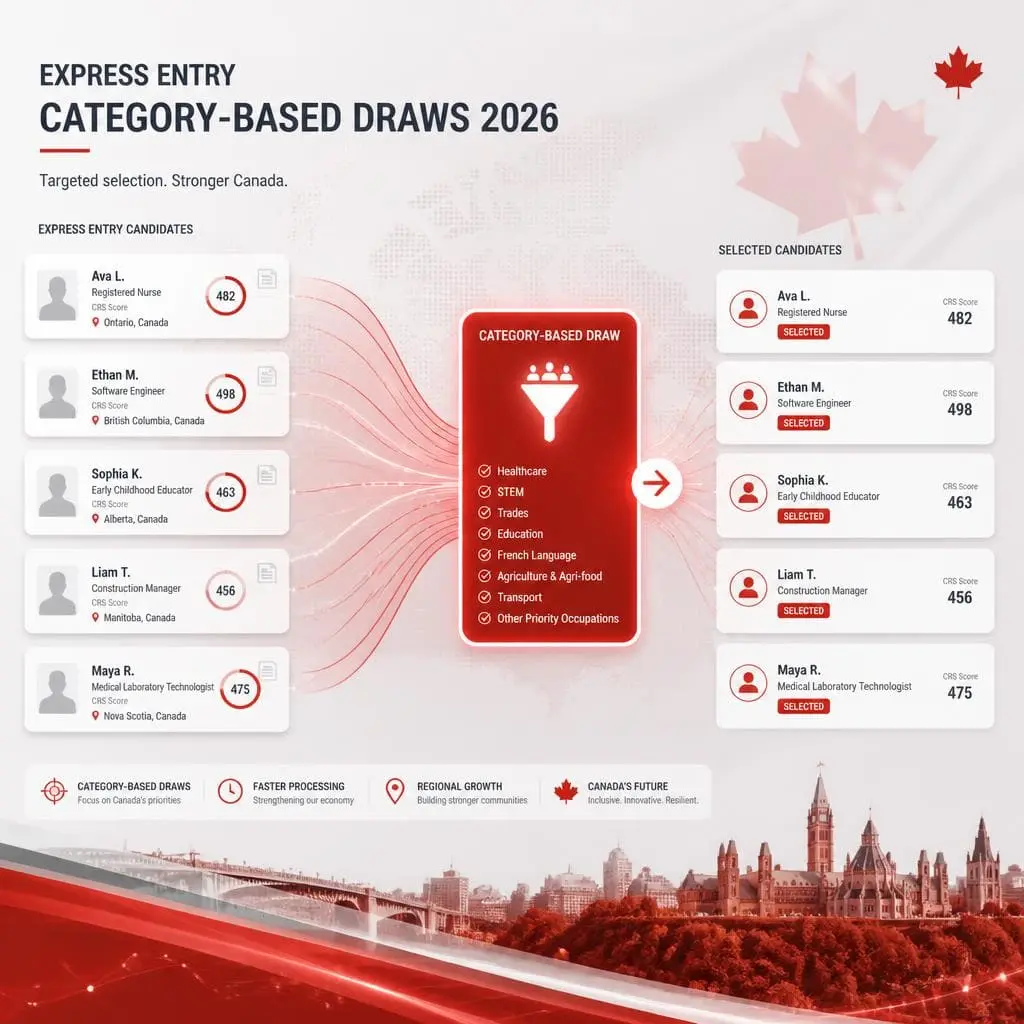
What Is an Express Entry Category-Based Draws 2026 Round?
A category-based draw is a round of invitations that targets candidates with specific work experience, education, or language skills, instead of pulling from the entire Express Entry pool by rank alone. IRCC sets these categories once a year, guided by labour market analysis from Employment and Social Development Canada and consultations with provinces, employers, and sector groups.
Each round only invites candidates who meet that category’s occupation or language requirement, on top of holding an active, complete Express Entry profile. This is why cutoff scores for category draws often look completely different from general draws. Sometimes they run lower, because the eligible pool is smaller. Sometimes they run higher, because a category like Healthcare or Trades attracts a deep pool of well-qualified applicants.
Category-based selection was introduced in 2023 as an amendment to the Immigration and Refugee Protection Act, giving the Minister of Immigration the legal authority to target specific groups within the Express Entry pool. Before that, every draw was a general draw, ranked purely by CRS score with no occupation or language filter attached.

How Category Draws Differ From General Draws
A general draw ranks every eligible candidate in the pool and invites strictly by CRS score, highest first, with no regard for occupation or language ability beyond what’s already baked into the score itself. A category draw filters the pool down to a smaller group first, based on NOC code or language test results, and only then invites by rank within that smaller group.
That filtering step explains a pattern that confuses a lot of candidates: someone with 420 points can receive an ITA in a healthcare draw the same week that a general draw closes at 480 points. Your NOC code and language scores decide which lines you’re actually standing in, and standing in the right line can matter more than chasing another five or ten CRS points.
It’s also worth noting that general draws haven’t disappeared. IRCC still runs them throughout the year, usually inviting the highest-ranked candidates regardless of category. Candidates who don’t qualify for any 2026 category are not locked out of Express Entry; they simply compete exclusively in general rounds.
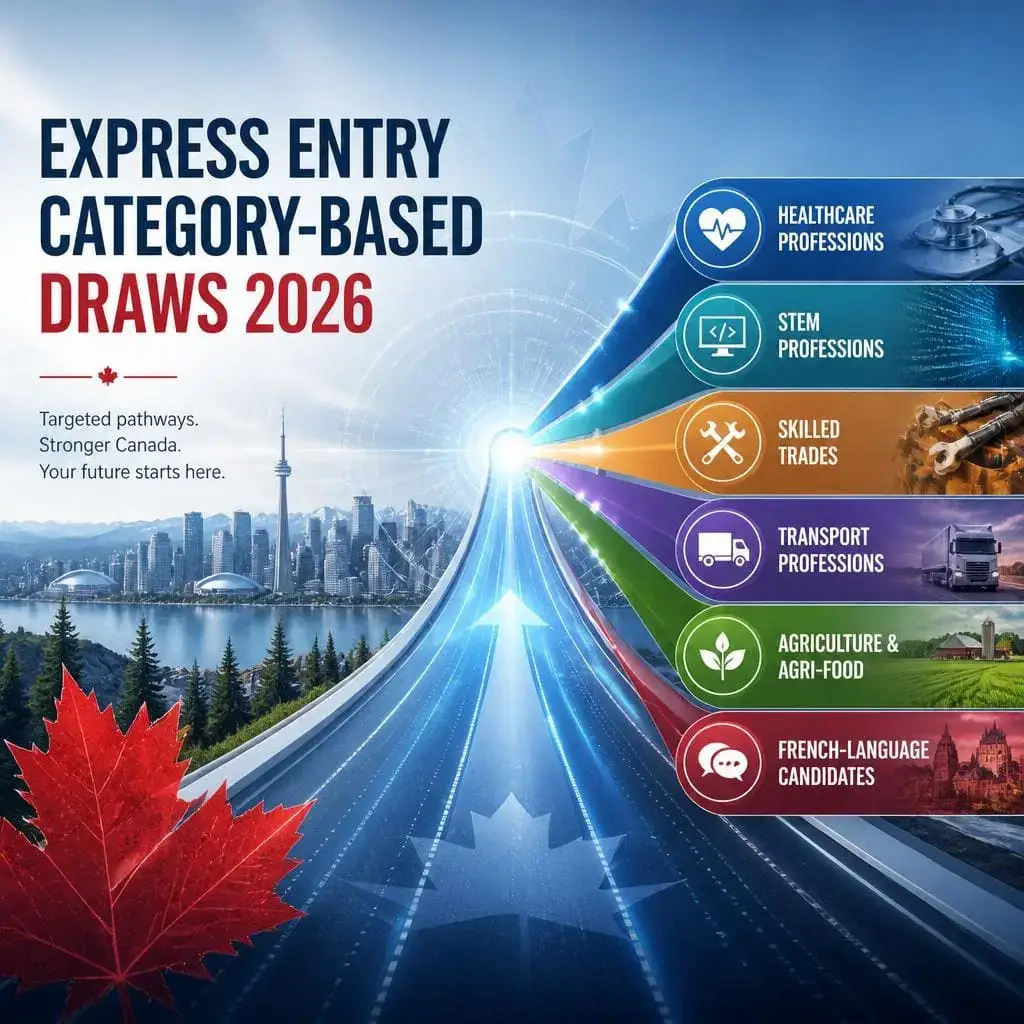
The 10 Express Entry Categories for 2026
IRCC confirmed ten active categories for 2026 following the Minister’s announcement on February 18, 2026. Two are brand new, two were removed from the priority list compared to 2025, and the remaining six carry over with adjusted occupation lists and updated eligibility windows.
French-Language Proficiency
Candidates need Canadian Language Benchmark (CLB) 7 or higher in French across all four language abilities: speaking, listening, reading, and writing. There’s no minimum English requirement attached to this category, which makes it accessible to francophone candidates from outside Canada as well as bilingual candidates already living here.
This category draws more often than any other, sometimes multiple times in a single month, and typically issues the largest invitation batches of any category, occasionally exceeding 6,000 in one round. Cutoffs have ranged from the mid-370s to the high 480s over the past two years, which makes it one of the more genuinely accessible entry points if your French test results clear the CLB 7 threshold across the board.

Healthcare and Social Services Occupations
This category covers a wide range of roles: physicians, registered nurses, licensed practical nurses, dentists, pharmacists, psychologists, social workers, paramedics, and several allied health occupations. Demand for this category has stayed strong through 2026, with cutoffs generally sitting between 460 and 510 depending on how large the eligible pool has grown since the last round.
Invitation batches here tend to run large, often 2,500 to 4,000 candidates per round, reflecting how many roles Canada’s health system still needs to fill across provinces. If you’re a healthcare worker with a clean NOC match, this is usually one of the higher-volume, higher-frequency categories to track closely.
Trade Occupations
Electricians, plumbers, welders, carpenters, HVAC technicians, and other Red Seal-eligible trades fall under this category. Cutoffs have historically run higher than healthcare, often in the high 400s to low 500s, because fewer candidates qualify under the strict NOC codes attached to skilled trades, even though demand for tradespeople remains high across the country.
Trade draws happen less frequently than French-language or Healthcare rounds, sometimes with several months between invitations, so tradespeople need to be patient and keep their profile updated in the meantime.
Transport Occupations
Truck drivers, transportation officers, and rail and marine occupations qualify under this category. It’s one of the smaller-volume categories on the list, with invitation batches usually under 1,000 candidates and cutoffs hovering around 430 to 470 in recent rounds.
Because Canada’s trucking and logistics sector has faced persistent labour shortages, this category tends to run steadily even when other categories go quiet for extended stretches.
Education Occupations
Teachers, early childhood educators, and other education-sector professionals were added back to the priority list for 2026 after a quieter 2025. Rounds have been infrequent so far this year, generally issuing 1,000 to 2,500 invitations per draw, with cutoffs in the high 400s.
Agriculture and Agri-Food Occupations
This category targets farm supervisors, food processing workers, and related occupations that support Canada’s food supply chain. It has run less frequently than the categories above, but it remains officially active for 2026 candidates who hold a qualifying NOC code and recent, relevant work experience.
Physicians With Canadian Work Experience (New)
New for 2026, this category is narrower than the general Healthcare and Social Services category. It’s built specifically for physicians, both general practitioners and specialists, who already hold recent, verifiable work experience in Canada rather than experience earned abroad.
Cutoffs so far have come in surprisingly low, in the 160s to 220s range, since the eligible pool is small and highly specific. If you’re a physician who has already worked in Canada, this category can be dramatically more accessible than competing through general Healthcare or a general draw.
Senior Managers With Canadian Work Experience (New)
Also new for 2026, this category targets candidates in senior management NOC codes, think operations directors, financial managers, and similar leadership roles, who have already worked in Canada. Cutoffs so far have landed between roughly 390 and 430, with invitation batches in the 250 to 500 range, smaller than Healthcare or French-language but meaningfully more frequent than Transport or Agriculture.
Researchers With Canadian Work Experience
This category exists on the official 2026 list but had not issued a single invitation as of the most recent published round. It remains one to watch closely if you hold Canadian research experience and a matching profile, since a first draw could open with very little competition once it activates.
Skilled Military Recruits
A very small, specialized category for candidates with skilled military service in Canada. Rounds are rare and invitation numbers are tiny, sometimes only a handful of candidates in a single draw, but the category exists year-round for the small pool of eligible candidates.
What Changed for Category-Based Draws in 2026
IRCC refreshes the category list roughly once a year, and the February 18, 2026 announcement brought real, practical changes for anyone tracking their eligibility against the previous year’s list.
New Categories Added
Physicians with Canadian work experience and Senior managers with Canadian work experience both launched as new categories in 2026. Both require the candidate to already hold recent, verifiable Canadian work experience, not just a matching NOC code on paper, which sets them apart from most of the other eight categories on the list.
This shift signals a broader pattern: IRCC appears to be favouring candidates who have already proven themselves in the Canadian labour market over candidates applying entirely from abroad, at least for these two specific, high-value occupation groups.
Categories Removed or Deprioritized
STEM occupations, one of the most active categories back in 2023 and 2024, did not carry over as a standalone priority category for 2026. Agriculture and Agri-Food’s status has also narrowed compared to prior years. Many STEM-adjacent roles still qualify indirectly through Healthcare or through general Express Entry draws, so it’s worth double-checking your exact NOC code rather than assuming you’re excluded entirely just because the category name disappeared from the headline list.
If your occupation was previously covered under STEM, don’t panic. Review the current Healthcare, Trades, and Transport lists carefully, since NOC code overlaps happen more often than most candidates expect.
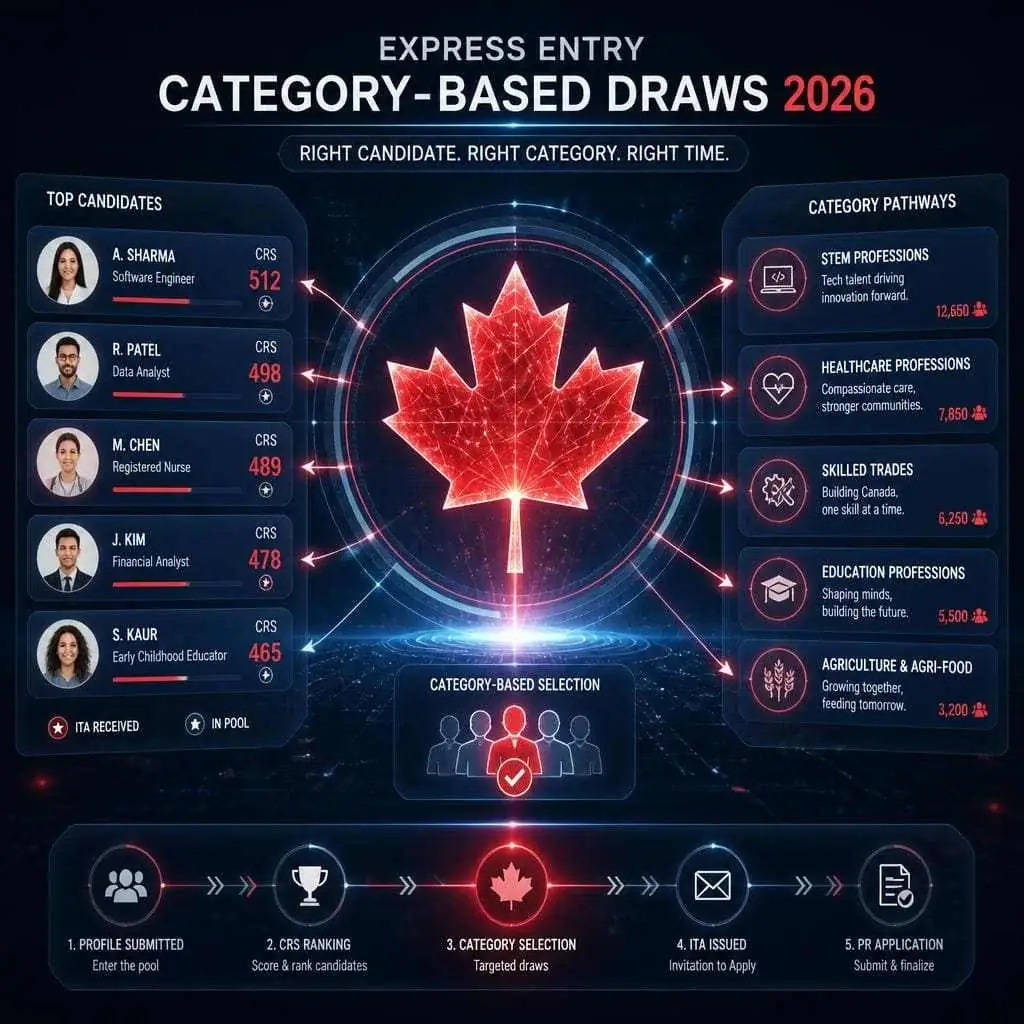
Express Entry Category-Based Draws Cutoffs 2026
The table below shows the most recent draw for each active category as of August 19, 2026, along with the CRS cutoff and number of invitations issued. Scores shift with every round, so treat this table as a current snapshot rather than a permanent benchmark.
Category | Latest Draw Date | CRS Cutoff | Invitations Issued |
French-Language Proficiency | Aug 19, 2026 | 382 | 5,000 |
Healthcare and Social Services | Jun 25, 2026 | 475 | 4,000 |
Trade Occupations | Apr 2, 2026 | 477 | 3,000 |
Transport Occupations | Aug 7, 2026 | 470 | 300 |
Education Occupations | Sep 17, 2025* | 462 | 2,500 |
Senior Managers (Canadian Experience) | Jul 10, 2026 | 392 | 500 |
Physicians (Canadian Experience) | Jun 24, 2026 | 223 | 271 |
Skilled Military Recruits | Jul 23, 2026 | 368 | 4 |
Agriculture and Agri-Food | No 2026 round yet | — | — |
Researchers (Canadian Experience) | No round held yet | — | — |
*Most recent Education round on record; no newer 2026 round published as of this writing. Note: cutoffs and invitation volumes change with every round. Always confirm current figures against the official IRCC rounds of invitations page before making decisions based on a specific score.
Older cutoffs for the same categories often ran higher or lower depending on pool size at the time of the round. Healthcare, for example, cleared above 500 points in mid-2025 before settling back into the 460s to 475 range by mid-2026 as more candidates built qualifying profiles. That kind of swing is normal and reflects how many eligible candidates accumulate in the pool between rounds, not a sign that the category is becoming permanently harder or easier to enter.
French-language cutoffs show the widest swings of any category, moving from the high 300s to the high 400s across 2025 and 2026 depending on how many candidates test into CLB 7 in a given window. If your French score is borderline, timing your profile submission around a lower-cutoff stretch can meaningfully improve your odds.

How to Qualify for a Category-Based Draw
Getting an ITA through a category draw comes down to four practical steps, and skipping any one of them is the most common reason candidates miss invitations they were otherwise eligible for.
Step 1: Confirm Your NOC Code
Your National Occupational Classification code has to match one of the occupations listed for your target category exactly. A close match isn’t enough; IRCC checks the specific code tied to your primary occupation in your Express Entry profile, not a general job title or industry. Use our NOC TEER Finder to confirm your code before you do anything else, since an incorrect code can silently disqualify you from a category you’d otherwise clearly meet.
Step 2: Meet the Work Experience or Language Window
Most categories require at least one year of qualifying work experience within the past three years, in a listed NOC code, at TEER 0, 1, 2, or 3. The French-language category swaps this requirement entirely for a CLB 7 or higher result across all four language skills instead. The two newest categories, Physicians and Senior Managers, add an extra layer: that work experience specifically needs to have been earned in Canada.
Step 3: Build a Complete, Active Express Entry Profile
An incomplete or expired profile can’t receive an ITA no matter how well your score or category eligibility looks on paper. Keep your language test results, educational credential assessment, and work history documentation current inside your profile, and confirm your profile status shows as active in your account before each expected draw date.
Step 4: Watch for Your Category’s Draw Pattern
Each category runs on its own rough schedule, and learning that rhythm is one of the most underrated parts of Express Entry strategy. French-language and Healthcare draws happen frequently, sometimes weekly or biweekly. Transport, Education, and Agriculture run less often, sometimes with gaps of two to three months between rounds. Check our Latest Express Entry Draws page regularly so you know roughly when your category is likely to open next, and so you’re not caught with an incomplete profile when it does.
Which Category Should You Target?
If you qualify for more than one category, IRCC’s system automatically considers you for every round you’re eligible for, so there’s no strategic need to pick just one and ignore the others. That said, understanding which category realistically fits your profile helps you focus your preparation time and testing budget where it matters most.
Candidates with strong French should prioritize meeting CLB 7 across all four skills, since this category draws the most often and offers the widest invitation volume of any category on the 2026 list. Healthcare and skilled trades candidates should focus on locking in an exact NOC code match first, since eligibility in these categories is strict and unforgiving of small classification errors, even when the underlying job duties are clearly a fit.
Candidates who already have Canadian work experience in a senior management or physician role should look closely at the two new 2026 categories before assuming they need to compete in a general draw. The lower observed cutoffs in these categories, particularly for physicians, make them worth pursuing even if your overall CRS score looks modest by general-draw standards.
How Category Draws Affect Your CRS Score Strategy
Category-based draws don’t replace general Express Entry rounds; they run alongside them. That means your CRS score still matters for the general pool, but a category match can get you an invitation at a score that would never clear a general-draw cutoff. This is the single biggest strategic shift category draws introduced to the system.
That said, your CRS score is still the deciding factor within a category when the pool of eligible candidates is larger than the number of invitations available. A higher CRS score inside your category moves you toward the front of the line, so it’s still worth improving your score through better language test results, additional education credentials, or a provincial nomination even if you already qualify for a category.
If you’re not sure where your score currently stands, run your numbers through our free CRS Calculator to get an exact score before comparing it against the category cutoffs above. Small changes, like retaking a language test or adding a sibling’s presence in Canada, can shift your score enough to change which draws you qualify for.
What to Do If Your Occupation Isn’t Targeted
Not every occupation fits into one of the ten 2026 categories, and that’s normal. The category system was built to target specific labour gaps, not to cover every NOC code in the pool. If your job isn’t listed under any category this year, you’re not shut out of Express Entry altogether.
You remain fully eligible for general Express Entry draws, which invite by CRS rank regardless of category and typically run every two to four weeks. You can also look at Provincial Nominee Programs, since many provinces nominate candidates in occupations the federal category list doesn’t cover. A provincial nomination adds 600 CRS points, which is enough to guarantee an invitation in almost any round.
Quebec operates its own selection system outside Express Entry entirely, so if you’re open to settling there, it’s worth reviewing Arrima and the Quebec Skilled Worker Selection process separately. And before you conclude your occupation truly isn’t covered, double-check your exact NOC code using our NOC TEER Finder, since job titles can be misleading and the official code is what actually determines category eligibility.
Frequently Asked Questions
Category-based draws have become one of the fastest ways to reach Canadian permanent residence, and the categories will likely shift again next year as labour needs change. Bookmark this page and check back after every round, and use our CRS Calculator whenever your circumstances change so you always know exactly where you stand.