
FSW Points Calculator 2026 – Federal Skilled Worker 67-Point Test
Check your Federal Skilled Worker Program eligibility instantly. Our free FSW points calculator uses the official IRCC 67-point grid to score your age, education, language ability, work experience, arranged employment, and adaptability factors.
Language Skills
Education
Skilled Work Experience
Age
Arranged Employment
Adaptability
Why Use an FSW Points Calculator
The FSW points calculator is a free tool that estimates your score under Canada’s Federal Skilled Worker Program (FSW), one of three federal economic immigration programs managed through Express Entry. Unlike the Comprehensive Ranking System (CRS), which ranks every candidate already inside the Express Entry pool against each other, the FSW points calculator grid is a pass-or-fail eligibility test. You either clear the 67-point mark and qualify to enter the pool under this program, or you fall short and need to look at whether the Canadian Experience Class or Federal Skilled Trades Program fits your background instead.
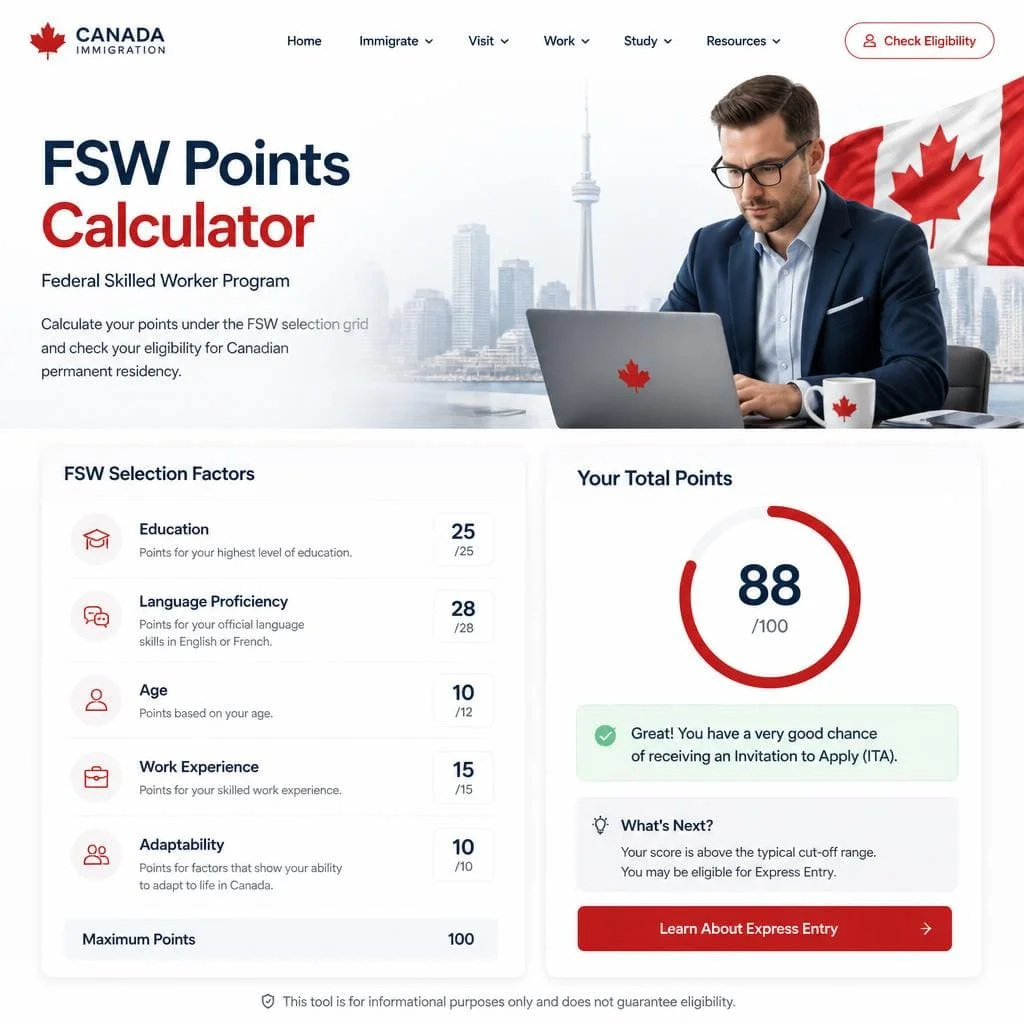
This FSW points calculator mirrors the official IRCC six selection factors grid: language skills, education, skilled work experience, age, arranged employment, and adaptability. Enter your details and the tool totals your score in real time, out of a maximum of 100 points, so you can see immediately whether you clear the 67-point pass mark and by how much. If you already know you qualify under FSW, use our main CRS Calculator to see how you’d actually rank inside the Express Entry pool, since a strong FSW score and a strong CRS score are not the same thing.
What Is the Federal Skilled Worker Program (FSW)?
The Federal Skilled Worker Program is one of three programs Immigration, Refugees and Citizenship Canada (IRCC) uses to select economic immigrants through Express Entry, alongside the Federal Skilled Trades Program (FSTP) and the Canadian Experience Class (CEC). FSW was designed for skilled workers with foreign work experience who have never worked in Canada, which makes it the most common entry point for applicants applying from outside the country.
To even be considered under FSW, IRCC first checks whether you meet four minimum requirements, then scores you against the six selection factors below. You need a combined score of 67 points or more out of 100 to pass the FSW grid and become eligible to enter the Express Entry pool under this program. Passing the FSW grid does not by itself guarantee an Invitation to Apply (ITA); it only makes you eligible to join the pool, where your separate CRS score determines whether and when you actually receive an invitation.
FSW Minimum Requirements
Before the six-factor grid even applies, IRCC checks four baseline requirements. You must meet all four to be assessed under FSW at all:
Skilled work experience: at least one year of continuous, full-time (or equivalent part-time) paid work experience in the last ten years, in a TEER 0, 1, 2, or 3 occupation under Canada’s National Occupational Classification (NOC) system.
Language ability: a minimum of CLB 7 in all four abilities (speaking, listening, reading, writing) in your first official language, based on an approved test such as IELTS General, CELPIP General, TEF Canada, or TCF Canada, taken within the last two years.
Education: a Canadian secondary or post-secondary credential, or a foreign credential accompanied by an Educational Credential Assessment (ECA) from an IRCC-approved organization confirming its Canadian equivalency.
Proof of funds: unless you already have a valid job offer or are legally authorized to work in Canada, you must show enough settlement funds to support yourself and any accompanying family members after you arrive.
If you fall short on any one of these four baseline requirements, and not just the point total, IRCC will not consider you eligible under FSW regardless of how many points the six-factor grid produces.
FSW 67-Point Grid Explained: The Six Selection Factors
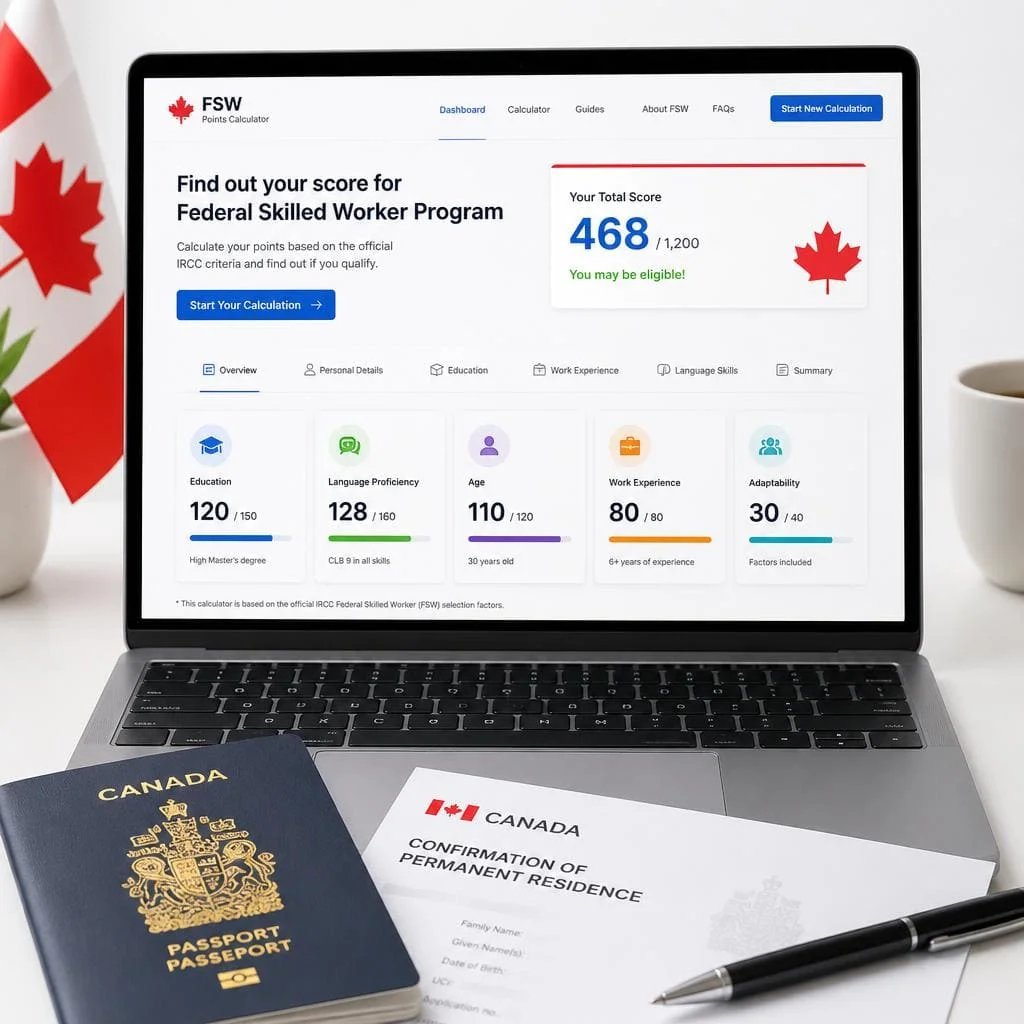
The FSW points calculator’s selection grid awards points across six factors, up to a combined maximum of 100 points. You need 67 or more to pass.
1. Language Skills (Maximum 28 Points)
Language is the single largest factor in the FSW grid, worth slightly more than education. Your first official language is scored out of 24 points, split evenly across speaking, listening, reading, and writing, and it is the only factor in the entire FSW points calculator grid with a hard floor: score below CLB 7 in any one of the four abilities and you are not eligible for FSW at all, no matter how the rest of your profile looks.
| CLB Level (per ability) | Points per ability | Total (4 abilities) |
|---|---|---|
| CLB 9 or higher | 6 | 24 |
| CLB 8 | 5 | 20 |
| CLB 7 | 4 | 16 |
| Below CLB 7 | Not eligible | Not eligible |
A second official language can add up to 4 more points if you score CLB 5 or higher in all four abilities of French or English, whichever is not your first official language.
2. Education (Maximum 25 Points)
Points are assigned based on the highest credential you hold, evaluated against the official IRCC equivalency table. If your credential was earned outside Canada, you need an ECA report to confirm which Canadian equivalency level it falls under before these points can be counted.
| Credential Level | Points |
|---|---|
| Doctoral degree (PhD) | 25 |
| Master’s degree, or a first professional degree needed to practise in a licensed profession (medicine, veterinary medicine, dentistry, optometry, law, chiropractic medicine, or pharmacy) | 23 |
| Two or more certificates, diplomas, or degrees, with one being three years or longer | 22 |
| Bachelor’s degree, or a three-year (or longer) diploma, trade certificate, or apprenticeship | 21 |
| Two-year diploma or certificate | 20 |
| One-year diploma or certificate | 19 |
| Secondary school (high school) diploma | 16 |
| Less than secondary school | 5 |
3. Skilled Work Experience (Maximum 15 Points)
This factor scores your total years of skilled, full-time (or equivalent part-time) work experience in a TEER 0, 1, 2, or 3 occupation, gained within the last ten years, in any country. Not sure which TEER category your job falls under? Use our NOC TEER Finder tool to look up your exact NOC code and TEER level before you calculate your score.
| Years of Experience | Points |
|---|---|
| 1 year | 9 |
| 2 to 3 years | 11 |
| 4 to 5 years | 13 |
| 6 or more years | 15 |
4. Age (Maximum 12 Points)
Age points peak for candidates between 18 and 35, then decline roughly one point per year of age after 35, reaching zero at 47 and above.
| Age | Points |
|---|---|
| 18 to 35 | 12 |
| 36 | 11 |
| 37 | 10 |
| 38 | 9 |
| 39 | 8 |
| 40 | 7 |
| 41 | 6 |
| 42 | 5 |
| 43 | 4 |
| 44 | 3 |
| 45 | 2 |
| 46 | 1 |
| 47 or older | 0 |
5. Arranged Employment in Canada (Maximum 10 Points)
You can claim the full 10 points if you have a valid, qualifying job offer for continuous, full-time work of at least 30 hours per week for a minimum of one year, in a TEER 0, 1, 2, or 3 occupation. Since the March 2025 policy change removed arranged employment from the CRS grid, this factor now matters more for FSW points calculator scoring than it does for your overall Express Entry ranking.
6. Adaptability (Maximum 10 Points)
Adaptability rewards ties that make it more likely you and your family will successfully settle in Canada. Points can only be claimed once per item, and the total is capped at 10 points even if multiple items apply.
| Adaptability Factor | Points |
|---|---|
| Spouse or common-law partner’s language ability (CLB 4 or higher) | 5 |
| Your previous study in Canada (minimum two academic years) | 5 |
| Spouse or common-law partner’s previous study in Canada (minimum two academic years) | 5 |
| Your previous skilled work experience in Canada (minimum one year, TEER 0 to 3) | 10 |
| Spouse or common-law partner’s previous work experience in Canada (minimum one year) | 5 |
| Arranged employment in Canada (if already claimed under Factor 5) | 5 |
| Relative living in Canada (parent, grandparent, child, sibling, aunt, uncle, niece, or nephew who is a citizen or permanent resident, aged 18 or older) | 5 |
FSW Candidates in the Express Entry Pool
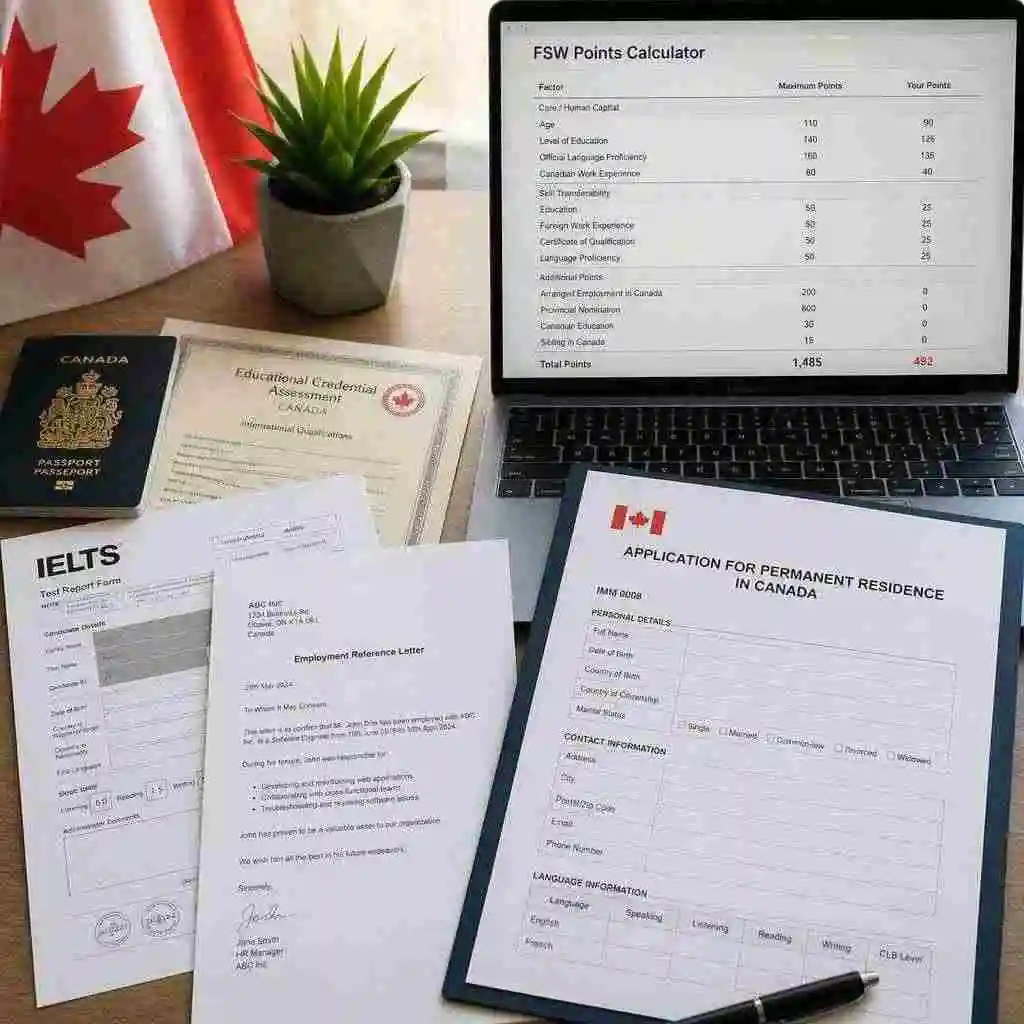
Federal Skilled Worker candidates make up a large share of the overall Express Entry pool, since FSW is the only one of the three programs open to applicants with no Canadian work experience at all. This matters for two practical reasons. First, because IRCC’s general draws pull from all three programs at once, FSW candidates compete directly against CEC and FSTP candidates purely on CRS score, so a strong FSW grid score with a modest CRS score can still mean a long wait for an invitation.
Second, IRCC has increasingly used category-based draws targeting specific occupations, French-language ability, or particular sectors such as healthcare, STEM, and trades, and FSW candidates are eligible for these targeted rounds too, provided their occupation or language profile matches that round’s criteria.
Because FSW eligibility (the 67-point grid) and Express Entry ranking (the CRS score) are assessed independently, many candidates find it worthwhile to check both numbers side by side before deciding when to apply. A candidate who barely clears 67 FSW points but has an exceptionally strong CRS score, for example, from a provincial nomination, may still receive an invitation quickly, while a candidate who scores well above 67 on the FSW grid but has a comparatively low CRS score may need to wait for a lower-cut-off targeted draw or work on improving specific CRS factors such as language or education first.
FSW 67 Points vs. CRS Score: What’s the Difference?
This is the single most common point of confusion for Express Entry candidates, so it’s worth explaining clearly. The FSW 67-point grid and the CRS score are two completely different systems that happen to both apply to Federal Skilled Worker candidates.
The FSW grid is a pass-or-fail eligibility test, scored out of 100, with a fixed 67-point pass mark. It exists purely to determine whether you qualify to enter the Express Entry pool under the Federal Skilled Worker Program in the first place. It does not change over time and does not depend on who else is in the pool.
The CRS score, scored out of 1,200, is a competitive ranking tool. Once you’re in the pool, whether through FSW, FSTP, or CEC, your CRS score determines your position relative to every other candidate, and IRCC invites candidates from the top down in each draw. A candidate can score well above 67 on the FSW grid yet still have a modest CRS score, and vice versa, because the two grids weigh factors differently and the CRS score also accounts for factors FSW does not, such as provincial nominations worth 600 points on their own.
In short: use the FSW calculator on this page to check whether you’re eligible to apply under this specific program, and use our full CRS Calculator to see where you’d actually rank in the Express Entry pool and how close you are to a recent cut-off.
What Happens After You Score 67 or More FSW Points?
Clearing the 67-point mark on the FSW grid means you meet the eligibility bar for this program, but it is not the end of the process. From here, the typical path looks like this: first, create an Express Entry profile on the IRCC website and formally enter the pool, where your CRS score is calculated automatically from the information you provide.
Second, IRCC runs regular draws, generally every two to four weeks, inviting the highest-ranked candidates above that round’s CRS cut-off. Third, if you receive an Invitation to Apply, you have 60 days to submit a complete application for permanent residence, including police certificates, medical exams, and proof of funds. Finally, IRCC processes complete applications with a service standard of around six months for most Express Entry applications.
Scoring comfortably above 67 does not guarantee a fast invitation on its own, since the FSW grid and the CRS score operate independently, which is exactly why understanding both matters.
How to Improve Your FSW Score
If your FSW score currently falls short of 67, a few targeted changes tend to move the needle fastest. Retaking your first official language test to push every ability from CLB 7 to CLB 9 or higher can add up to 8 points, since language is scored per ability and CLB 9 unlocks the maximum band across all four skills. Completing an additional credential, such as moving from a one-year certificate to a two-year diploma, or from a bachelor’s degree to a master’s degree, moves you up the education point table in steps of one to four points.
Gaining an additional year of skilled work experience, particularly moving from the 1-year band into the 2-to-3-year band, adds 2 points, and continuing on to the 6-year-plus band adds a further 4 points on top of that. If you have a spouse or common-law partner, their language test results, Canadian study history, or Canadian work experience can unlock adaptability points you might otherwise overlook, worth up to 10 additional points combined. Finally, securing a qualifying job offer adds 10 points under arranged employment and can unlock a further 5 points under adaptability, making it one of the highest-value single factors available if it’s realistically within reach.
Who Should Use This FSW Calculator?
This FSW points calculator is built for anyone assessing whether they qualify for Express Entry through the Federal Skilled Worker Program specifically, including candidates applying from outside Canada with no prior Canadian work experience, who are the group FSW was primarily designed for.
It’s equally useful for candidates who already know their CRS score and want to confirm they also clear the separate FSW eligibility bar, since the two are not interchangeable, and for candidates deciding between FSW, the Federal Skilled Trades Program, and the Canadian Experience Class, since comparing your score across each program’s specific criteria shows which pathway you qualify for most easily. Licensed immigration consultants and advisors can also use this tool as a fast way to illustrate FSW eligibility scenarios to clients before starting formal documentation.
Tracking Your FSW Score Over Time
Your FSW score is not something you calculate once and forget. Many candidates check it repeatedly over months while they work on a language retest, finish a credential, or accumulate another year of qualifying work experience, since even small changes in one factor can be the difference between falling short of 67 and clearing it comfortably. A single CLB band improvement across all four language abilities, for instance moving from CLB 7 to CLB 9, can be worth up to 8 additional points on its own, which is frequently enough by itself to take a borderline profile from ineligible to eligible.
It’s worth revisiting this FSW points calculator after any of the following changes: a new IELTS, CELPIP, TEF Canada, or TCF Canada result; the completion of an additional diploma, certificate, or degree; crossing a new work experience threshold, particularly the two-year and six-year marks where the point jumps are largest; receiving a qualifying job offer; or a change in your spouse or common-law partner’s language test results, study history, or Canadian work experience. Bookmarking this page and checking back after each milestone helps ensure you have an accurate, current picture of your FSW eligibility before you invest time in preparing a full Express Entry profile.