
Canadian Citizenship by Descent Calculator (Bill C-3)
Did you inherit Canadian citizenship?
Five questions. Nothing you enter is saved or sent anywhere.
2. Was either of your parents a Canadian citizen on the day you were born?
3. Where was that Canadian parent born?
4. Your parent was born outside Canada. Was your grandparent a Canadian citizen on the day your parent was born?
5. Going back as far as you know, was every ancestor in the line a Canadian citizen when the next one was born, with no gaps and nobody giving it up?
Canada changed its rules on citizenship by descent on 15 December 2025, and a lot of people became Canadian citizens that day without ever hearing about it. Some are still paying for visitor visas and study permits they do not need.
There are two tools below. The first checks whether you have a citizenship by descent claim. The second counts the 1,095 days of physical presence that decide whether your own children inherit it from you. Nothing you enter is saved or sent anywhere.
What Bill C-3 actually did
Almost every article on this says Bill C-3 “removed” the first-generation limit. That is not quite right, and the difference matters if you are having children now.
It replaced an absolute bar with a conditional one. Read section 3 of the Citizenship Act and you will see the old blanket rule is gone, but a new subsection 3(3) took its place: a child born abroad to a Canadian parent who was also born abroad is excluded only if that parent was not physically present in Canada for at least 1,095 days before the birth.
So for anyone born before 15 December 2025 the limit is effectively gone. For births on or after that date it still exists. It just has a way through it now.
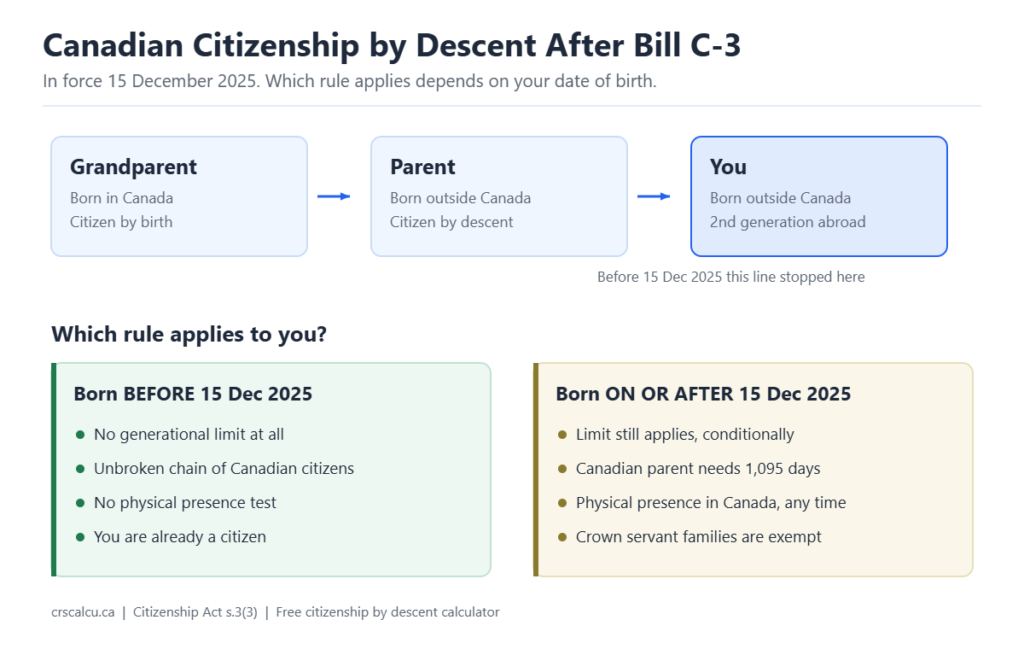
If you were born before 15 December 2025
No generational cap applies to you. If you can trace a line of Canadian citizens back through your family, you are a citizen. Second generation, third, fourth, it does not matter, and there is no physical presence test to pass.
The catch is that the line cannot have a break in it. Each person had to be a Canadian citizen on the day the next person was born. If your grandfather became a citizen in 1975 but your mother was born in 1972, that link does not work.
Most claims that fail, fail on timing rather than on relationships. Check the dates printed on the certificates instead of going from memory.
If you were born on or after 15 December 2025
The substantial connection test applies, and it is measured against your parent, not against you.
If your Canadian parent was born outside Canada, they need 1,095 days of physical presence in Canada before your birth or adoption. Three years’ worth of days.
Here is the part most pages get wrong: there is no time limit on when those days were accumulated. The statute says only “physically present in Canada for at least 1,095 days before the person’s birth.” No age threshold, no rolling window, no requirement that they be recent or consecutive. IRCC’s own form runs the count from the parent’s own date of birth, so a parent who spent their childhood in Canada and left at twelve has already banked more than enough.
The exception that gets missed
Subsection 3(5) waives the presence requirement completely in Crown servant cases. If the parent, or that parent’s own parent at the relevant time, was employed outside Canada with the Canadian Armed Forces, the federal public administration, or a provincial public service, and not as a locally engaged person, no days need to be counted at all.
If anyone in your line was posted abroad by a Canadian government or served in the forces overseas, check this before counting a single day.
What has not changed
If you were born outside Canada and one of your parents was born in Canada, you have always been a citizen. Same if your parent became a citizen while living in Canada. The first-generation limit never applied to you, so none of this affects you.
1,095-day substantial connection calculator
For a child born on or after 15 December 2025. Counts the Canadian parent’s days of physical presence in Canada before the child was born.
Parent’s time in Canada
One row per trip or period of living there. Arrival and departure days both count. Anything after the child’s birth is ignored.
| Arrived in Canada | Left Canada | Days |
|---|
Which days count toward the 1,095
This is a different test from the residency requirement for a citizenship grant, and it is more generous. Our physical presence calculator handles that other one, where you must be a permanent resident and where time as a temporary resident counts as only half a day up to a cap of 365.
None of that machinery appears in the descent test. Subsection 3(3) says “physically present in Canada” and nothing else. On the wording of the Act there is no status condition and no half-day weighting, so days spent in Canada as a visitor or a student appear to count as full days.
One warning on that: IRCC has not published a policy manual defining physical presence for this particular test, so nobody can promise you how an officer will read it. Keep the evidence for every day you claim.
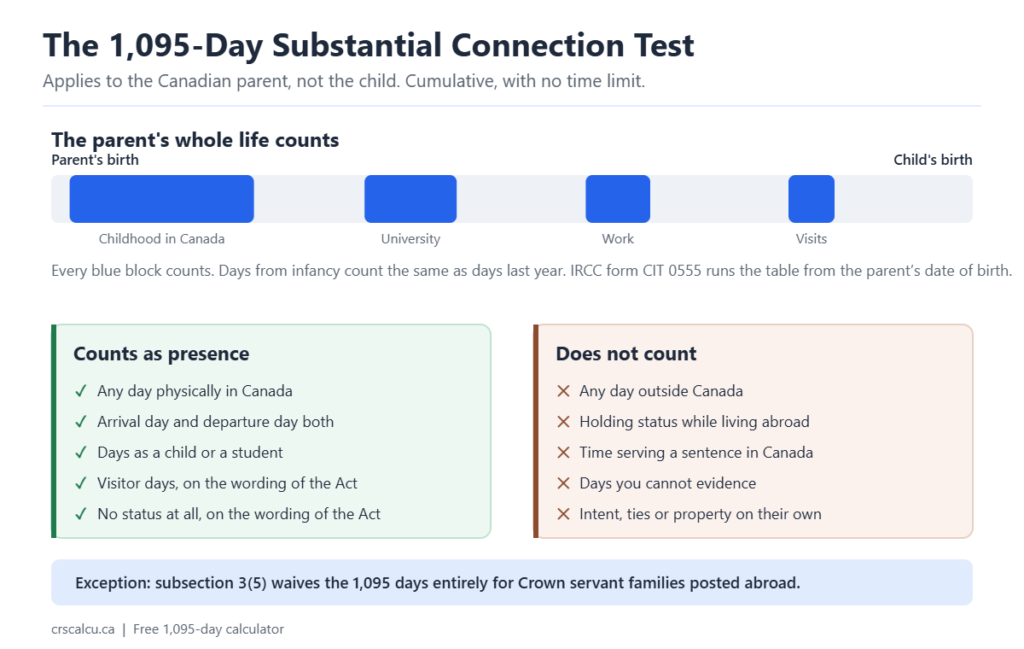
Counts:
- Any day physically in Canada, including the day you arrived and the day you left
- Days as a child, before the parent had any say in where they lived
- Days in any immigration status, and on the face of the Act, days with none
Does not count:
- Any day spent outside Canada, whatever the reason
- Time holding Canadian status while living abroad, because status is not presence
- Time serving a sentence in Canada, including imprisonment, probation or parole, with limited exceptions for conditional discharges and completed youth sentences
- Days you cannot evidence, which in practice are the same as days that never happened
For proof: border entry and exit records, passports and stamps, school enrolment records and transcripts, employment records and T4s, CRA notices of assessment, leases and provincial health records.
Order the CBSA travel history early. It is free, it takes a few weeks, and it picks up the short trips people always forget.
The form almost nobody mentions
If you were born outside Canada on or after 15 December 2025 and your Canadian parent was also born abroad, your application must include form CIT 0555, “How to calculate physical presence in Canada for a Canadian parent.” The current edition is 08-2026 and IRCC added it to the application package on 25 August 2026.
It is a mandatory attachment, not an optional worksheet. The table runs from the parent’s date of birth to your birth or adoption date, and it asks for contacts who can verify the periods claimed. Any guide written before September 2026 will not mention it.
Proving the chain for a citizenship by descent claim
A descent claim is paperwork, not argument. For each generation you are proving three things: the person existed, they were Canadian at the right moment, and they connect to the next person by birth or adoption.
- A long-form birth certificate showing the parent’s name
- Proof the ancestor held Canadian citizenship on the date the next one was born, meaning a Canadian birth certificate, a citizenship certificate, or naturalisation records
- Marriage certificates or legal name-change records wherever a surname changes
- Death certificates where an ancestor has died and records need tying together
Anything not in English or French needs a certified translation.
Records from before 1947 usually are not with IRCC at all. Try provincial vital statistics first, then Library and Archives Canada, and give those requests a few months.
Document quality now carries real weight. In June 2026 IRCC reviewed roughly a hundred certificates it had already issued under the new rules, sent surrender letters, then reversed itself on about a third of them and conceded that its own internal guidance on acceptable documentation had been unclear. Show where each record came from, and keep a note of what you did to obtain properly sourced ones.
Ancestors who lost citizenship before 1977
Canada allowed dual citizenship from 1977. Before that, an ancestor who took another nationality could lose their Canadian citizenship, and families often assume that kills the claim.
Usually it does not. A 2009 amendment restored citizenship to almost everyone who lost it, and subsection 3(7)(d) deems them to have been a citizen from the moment they ceased to be one. That retroactivity is what saves the chain, because the ancestor is treated as having held citizenship on the day the next child was born abroad.
Two things are still fatal: a formal renunciation filed with the Canadian government, and revocation for fraud or misrepresentation. Losing it automatically by operation of an old law is not the same as giving it up on purpose.
You still have to apply for the certificate
Bill C-3 does not mail anyone anything, and a citizenship by descent claim does not produce a certificate on its own. If you qualify you are already a citizen, but you cannot prove it to a passport office, an employer or a border officer until you hold a citizenship certificate, and that means filing an application for proof of citizenship. The fee is $75.
It is slow, and it has got dramatically slower. The published wait ran at roughly three months in September 2025, five months by December, twenty-one by April 2026, and jumped to about 33 months in early September 2026 as the queue built past 130,000 files. Check the current processing time on canada.ca before you plan around any number, including that one.
Applying from outside Canada or the United States takes longer again, and going through an embassy or consulate adds three to four months of mailing on top.
If you have a move, a job or a school year riding on this, the certificate timeline is your real constraint, not the eligibility rules.
This is not permanent residence
Worth spelling out, because people mix the two up constantly.
If you are a citizen by descent you skip PR completely. No Express Entry profile, no provincial nomination, no landing, no residency obligation. Your CRS score does not apply to you at all.
If the tool says you do not qualify, the economic routes are what is left, and Canadian relatives still count for something there. A sibling who is a citizen or permanent resident living in Canada is worth 15 CRS points, and family in a province can open provincial nominee streams that are closed to candidates with no ties.
If your parent falls short of the 1,095 days, IRCC’s own guide points to the alternative: the Canadian parent sponsors the child for permanent residence, and a citizenship grant follows later. There is also a narrow grant under subsection 5(5) for a child born abroad after 15 December 2025 who has always been stateless, is under 23, and has 1,095 days of presence in the four years before applying.
And if your relative is Canadian and you want to join them rather than claim citizenship yourself, look at the Parents and Grandparents Program and the Super Visa instead.
For the official summary of what changed, see IRCC’s page on the 2025 rule change.
Common questions
General information only, not legal advice. crscalcu.ca is a free tool, is not affiliated with the Government of Canada, and does not sell immigration services. Rules change and processing times move monthly. Verify anything that matters on canada.ca before acting on it.