
Latest Express Entry Draws & CRS Cutoffs
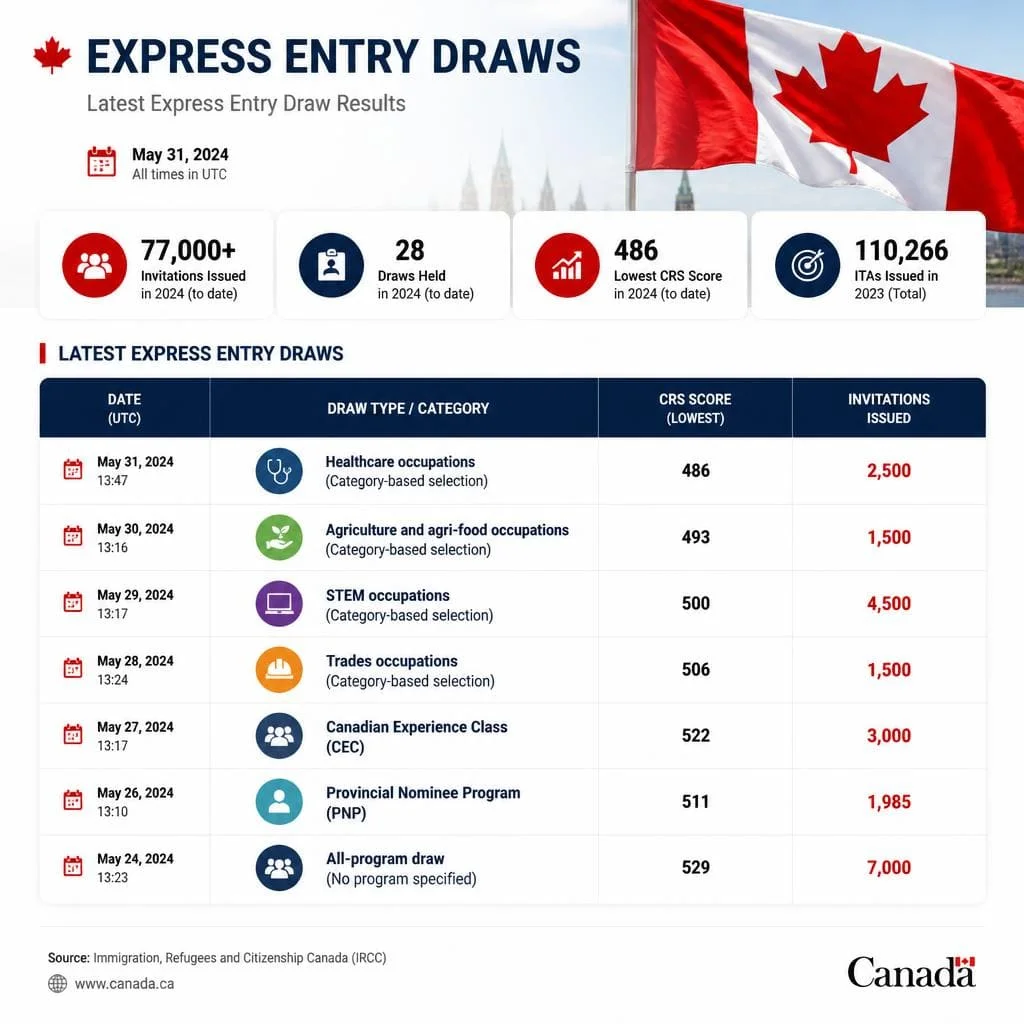
IRCC invites candidates from the Express Entry pool roughly every two weeks, in rounds targeting different programs and categories. Each round sets a new CRS cutoff based on who is in the pool at that moment. The Express Entry pool statistics behind each cutoff show how many candidates sit in every CRS band. Below is a snapshot of the most recent Express Entry draws: CRS cutoffs, invitation counts, and dates from each round, along with the latest one in detail.
Whether you’re weeks away from your first profile submission or you’ve been waiting in the pool for months, understanding how Express Entry draws, CRS cutoffs, and round types fit together turns a confusing list of numbers into a practical planning tool. For broader policy news beyond cutoffs, see our CRS & Immigration Updates page, and if you’re exploring Quebec’s separate points system, see our Arrima & Quebec Skilled Worker guide.
Latest Round of Invitations
| Detail | Value |
|---|---|
| Date | August 19, 2026 |
| Round type | French-Language Proficiency |
| Invitations issued | 5,000 |
| CRS cutoff (lowest-ranked invited) | 382 |
Source: IRCC Express Entry rounds of invitations, accessed August 24, 2026.

Recent Express Entry Draws: CRS Cutoffs by Round
| # | Date | Round type | Invitations | CRS cutoff |
|---|---|---|---|---|
| 437 | Aug 19, 2026 | French-Language Proficiency | 5,000 | 382 |
| 436 | Aug 18, 2026 | Canadian Experience Class | 1,000 | 523 |
| 435 | Aug 17, 2026 | Provincial Nominee Program | 442 | 760 |
| 434 | Aug 7, 2026 | Transport Occupations | 300 | 470 |
| 433 | Aug 6, 2026 | French-Language Proficiency | 5,000 | 391 |
| 432 | Aug 5, 2026 | Canadian Experience Class | 3,000 | 516 |
| 431 | Aug 4, 2026 | Provincial Nominee Program | 507 | 768 |
| 430 | Jul 23, 2026 | Skilled Military Recruits | 4 | 368 |
| 429 | Jul 22, 2026 | French-Language Proficiency | 5,000 | 399 |
| 428 | Jul 21, 2026 | Canadian Experience Class | 2,000 | 516 |
| 427 | Jul 20, 2026 | Provincial Nominee Program | 511 | 744 |
| 426 | Jul 10, 2026 | Senior Managers with Canadian Work Experience | 500 | 392 |
| 425 | Jul 9, 2026 | French-Language Proficiency | 5,000 | 420 |
| 424 | Jul 7, 2026 | Canadian Experience Class | 2,000 | 517 |
| 423 | Jul 6, 2026 | Provincial Nominee Program | 534 | 708 |
| 422 | Jun 25, 2026 | Healthcare and Social Services | 4,000 | 475 |
| 421 | Jun 24, 2026 | Physicians with Canadian Work Experience | 271 | 223 |
| 420 | Jun 23, 2026 | Canadian Experience Class | 4,000 | 516 |
Source: IRCC ministerial instructions, Express Entry rounds of invitations. Data accessed August 24, 2026 and updated periodically; always confirm against the official IRCC website before making decisions.
How Rounds of Invitations Work
IRCC first decides which type of round to hold and how many candidates it needs to invite. It then identifies the highest-ranking eligible candidates in the pool for that round type and sends Invitations to Apply to those candidates.

General Rounds
These invite top-ranking candidates eligible for any of the three programs managed through Express Entry, without targeting a specific group. Among all Express Entry draws, CRS cutoffs in general rounds tend to sit highest, since the entire pool competes together at once.
Program-Specific Rounds
These target one program only, such as the Provincial Nominee Program or Canadian Experience Class, inviting just the top-ranking candidates eligible for that program.
Category-Based Rounds
These focus on a specific economic goal, such as healthcare, trades, or French-language proficiency, inviting top-ranking candidates who are eligible for that category. IRCC introduced these rounds to address specific labour market needs, and across recent Express Entry draws, CRS cutoffs in category rounds have run noticeably lower than in general rounds.
Keep in mind that this table reflects a rolling window of recent rounds, not the complete history of Express Entry. For a full historical archive, IRCC’s own website maintains every round of invitations dating back to the program’s launch.
What Recent Express Entry Draws & CRS Cutoffs Show
Looking across these Express Entry draws, CRS cutoffs from rounds #420 through #437 reveal three clear patterns. Provincial Nominee Program rounds still carry the highest cutoffs, ranging from 708 to 768 in this window, since a nomination alone contributes 600 points on top of a candidate’s human capital score. Canadian Experience Class rounds have stayed within a narrow band, holding between 516 and 523 across five separate rounds between June and August 2026, with the August 18 round ticking up to 523, which still suggests a stable pool of CEC-eligible candidates.
French-Language Proficiency rounds show the most movement, ranging from 391 to 420 across four rounds, and remain one of the more accessible entry points for candidates without a nomination or extensive Canadian experience. Meanwhile, the appearance of a Skilled Military Recruits round with a cutoff of just 368, alongside a Senior Managers with Canadian Work Experience round at 392, shows how dramatically category-specific rounds can differ from general benchmarks, since these categories draw from intentionally narrow, highly specific pools.
How to Track Express Entry Draws & CRS Cutoffs Going Forward
The most reliable way to plan around these numbers is to identify which round types you are actually eligible for, then track only those specific cutoffs rather than the full list. If you have Canadian work experience, focus on Canadian Experience Class rounds. If you have a provincial nomination in progress, watch the PNP rounds closely, since they run less predictably but offer the highest odds once a nomination is secured. If your strongest asset is a language ability, especially French, keep an eye on category-based rounds built around that skill.

This page records past Express Entry draws; CRS cutoffs for upcoming rounds are covered in our next Express Entry draw prediction and trend analysis, which breaks down where each round type appears to be heading based on this same data.
Related CRS and Express Entry Guides
To understand whether a specific cutoff is good news for your own profile, see our guide on what counts as a good CRS score, or start with how to calculate your CRS score if you haven’t worked out your number yet.
What Counts as an Invitation to Apply
Each round of invitations, or “draw,” is a snapshot moment where IRCC ranks every eligible candidate currently in the Express Entry pool by CRS score, then invites enough candidates from the top down to reach its target invitation number for that round. Candidates who receive an Invitation to Apply (ITA) then have a limited window, typically 60 days, to submit a complete application for permanent residence.
Across Express Entry draws, CRS cutoffs are simply the score of the lowest-ranked candidate who still received an invitation in that round. Anyone with that score or higher, within the eligible pool for that round type, was invited. This is why the cutoff moves up and down with the size and composition of the pool rather than following any fixed schedule.
Historical Context: How These Express Entry Draws & CRS Cutoffs Compare
Before category-based rounds were introduced, nearly all invitations came through general rounds with a single cutoff applying to every eligible candidate. The current system, with general, program-specific, and category-based rounds running in parallel, has made cutoffs far more varied than in previous years, since a candidate can now be competitive in one round type while sitting well below the bar in another during the very same month.
This is also why simply searching for “the CRS cutoff” without specifying a round type can be misleading: across Express Entry draws, CRS cutoffs and eligibility rules shift by round family. The honest answer is almost always “it depends which round,” which is exactly why this page breaks the recent rounds down individually rather than quoting a single number.
What to Do Before the Next Draw
If you are already in the pool, there is little to actively do before a draw beyond keeping your profile accurate and up to date. Recalculate your score if anything has changed, a birthday, a new test result, or a finished credential, and update your official profile promptly so you are ranked correctly when the next round runs.

If you are not yet in the pool, use the time before the next round to strengthen your application: retake a language test if you’re close to a higher CLB threshold, finish a credential assessment if it’s still pending, or pursue a provincial nomination stream if your profile fits one. Since rounds run roughly every two weeks, small improvements made now can meaningfully change which round you first become competitive for.
The bottom line: treat every cutoff on this page as belonging to its own specific lane. A general improvement to your score helps across every lane at once, but a targeted move, like pursuing a nomination or qualifying for a category, can be the fastest route if your human capital score alone isn’t quite competitive yet for a general or CEC round.
Category-Based Rounds Explained in Depth
Category-based selection was introduced to let IRCC respond directly to labour market and economic priorities, rather than relying solely on general human capital rankings. Each year, IRCC publishes which categories will run, based on factors like labour market shortages, francophone immigration goals, and economic sector needs.
Healthcare and social services categories target occupations like nurses, personal support workers, and social workers, groups considered essential given ongoing shortages in the Canadian healthcare system. Trades occupations categories cover skilled trades such as electricians, plumbers, and welders, addressing construction and infrastructure labour needs; candidates in these fields may also qualify directly through the Federal Skilled Trades Program. French-language proficiency categories invite candidates who score NCLC 7 or higher across all four language abilities, supporting Canada’s francophone immigration targets outside Quebec. Categories can also target transport, agriculture, and science, technology, engineering, and mathematics occupations depending on the year’s priorities.
Because these categories are re-evaluated periodically, a category that ran frequently one year may not appear at all the next, so it’s worth checking official IRCC announcements alongside the historical data on this page rather than assuming a category will always be available.
Some candidates mistakenly assume category eligibility is automatic once they meet the occupational description. In practice, IRCC checks your profile against detailed NOC TEER codes and work history evidence, so it’s worth confirming your specific occupation code qualifies before counting on a particular category round.
Provincial Nominee Program Rounds in Detail
Provincial Nominee Program rounds only invite candidates who already hold a nomination certificate from a participating province or territory. Since a nomination adds 600 CRS points, these sit at the very top of all Express Entry draws: CRS cutoffs here typically run 700 to 800 or higher, regardless of the candidate’s underlying human capital score.

Because eligibility depends entirely on already holding a nomination, the size of these rounds is directly limited by how many nominations provinces have issued recently, which is why PNP round invitation numbers (often in the low hundreds) are usually much smaller than general, CEC, or category-based rounds, which can each invite several thousand candidates at once.
Provinces also periodically adjust their own nomination criteria and quotas, which indirectly shapes how many PNP-linked candidates appear in future federal rounds. Keeping an eye on your specific province’s nominee program updates, alongside this federal data, gives the most complete picture available.
Glossary of Terms Used on This Page
| Term | Meaning |
|---|---|
| Round of invitations | A single event where IRCC invites a batch of candidates from the Express Entry pool to apply for permanent residence. |
| CRS cutoff | The lowest CRS score among candidates invited in a specific round. |
| Invitation to Apply (ITA) | A formal invitation allowing a candidate to submit a complete permanent residence application, usually within 60 days. |
| General round | A round open to all eligible candidates across all three Express Entry programs. |
| Category-based round | A round targeting a specific occupation group or attribute, such as healthcare or French-language ability. |
Comparing Express Entry Draws & CRS Cutoffs by Round Family
It helps to see the three main round families next to each other rather than scattered through a long table. Canadian Experience Class rounds in the recent data cluster tightly between 516 and 523, showing a stable, predictable pool of candidates with Canadian work experience. Category-based rounds vary far more widely, from 368 for a narrow Skilled Military Recruits round up to 470 for the August 7 Transport Occupations round, reflecting how differently sized and skilled each targeted group is. Provincial Nominee Program rounds sit apart entirely, ranging from about 708 to 768 in the current window, since the 600-point nomination bonus dominates every other factor in the score.
This comparison matters because it shows that “the cutoff” is really three or four different numbers running in parallel, not one moving target. Knowing which family applies to you, based on your work experience, nomination status, and eligible categories, is far more useful than tracking every single number on this page.
A Note on Invitation Volumes
Across recent Express Entry draws, CRS cutoffs get most of the attention, but invitation volumes vary just as much. Category-based and Canadian Experience Class rounds have recently issued as many as 4,000 to 4,500 invitations at once, while Provincial Nominee Program rounds typically issue only a few hundred, limited by how many nominations provinces have granted. A large invitation volume in a round doesn’t necessarily mean a lower cutoff, since it also depends on how many eligible candidates were ranked above that point in the pool at the time.
Ministerial instructions published alongside each round also occasionally introduce new eligibility criteria or adjust existing categories, so it’s worth skimming the official instructions themselves if a round type you’re relying on suddenly stops appearing.

Where This Data Comes From, and How Often It’s Updated
The Express Entry draws, CRS cutoffs, and invitation figures on this page come directly from IRCC’s official rounds of invitations records and ministerial instructions, which the government publishes after every round. We review this page against that official source on a rolling basis so the table reflects genuinely recent rounds rather than a static list from when the page was first written.
Because new rounds are announced roughly every two weeks, it’s worth checking the date at the top of this page against today’s date. If it has been more than a few weeks since the last update, the general patterns described here, such as which round types tend to run higher or lower, are still useful, but you should confirm the exact latest cutoff on the official IRCC website before making any time-sensitive decision.
Curious how your own profile compares to these cutoffs? Get your score with our free CRS calculator.
How to Read a Rounds of Invitations Announcement Correctly
Every time IRCC publishes new Express Entry draws, CRS cutoffs headline the announcement, but it also includes several pieces of information that are easy to misread if you only glance at that number. Alongside the minimum CRS score, IRCC publishes the exact number of invitations issued in that round, the date and time the Express Entry pool was tied-and-ranked, and, for targeted rounds, the specific category the round addressed, whether that’s a language category, an occupation-based category, or a program like the Provincial Nominee Program or Canadian Experience Class.
The tie-break rule matters too: when multiple candidates share the exact cutoff score, IRCC uses the date and time their profile entered the pool to decide who gets invited, meaning two candidates with the identical CRS score in the same round do not automatically both receive an invitation. Understanding these details, not just the single cutoff number, gives a much more accurate read on where you actually stand.
Why Cutoffs Differ So Much Between Program Streams in the Same Month
It is common to see a general draw with a cutoff in the high 500s the same month a Canadian Experience Class round invites candidates in the mid-400s, or a French-language category round invites candidates well below both. This happens because each of these draw types pulls from a different sub-pool of eligible candidates, not the entire Express Entry pool at once.
A CEC round only considers candidates who meet Canadian Experience Class eligibility criteria, a much smaller group than the full pool, so the cutoff needed to fill that round’s invitation quota is naturally lower. The same logic applies to every category-based round: a smaller eligible group means a lower score can still place you near the top of that specific group, even if the same score would fall well short of a general round’s cutoff.
What to Do If You’ve Been in the Pool for Over a Year
An Express Entry profile is valid for twelve months from the date it’s submitted, and if you have not received an invitation within that window, your profile expires and you need to create an entirely new one, re-verifying your documents and re-entering your details from scratch.
If you’re approaching that one-year mark without an invitation, this is a good moment to systematically review each factor in your profile for possible improvement: retesting a language exam, checking whether a recent job promotion changed your NOC classification, confirming your education points still reflect your most recent credential assessment, and checking whether any provincial nomination stream has opened that fits your occupation. Letting a profile expire without addressing the underlying score gap just resets the clock without changing your actual competitiveness.
Frequently Cited Historical Draws Worth Understanding
Certain draws get referenced repeatedly in immigration forums and discussions because they represented unusual moments in the program’s history, such as the exceptionally low cutoffs seen briefly during pandemic-era travel restrictions when in-person landing requirements created a temporary backlog, or the introduction of category-based selection itself in 2023, which represented the biggest structural change to Express Entry selection since the program launched in 2015.
Knowing this broader history helps put any single month into context: across Express Entry draws, CRS cutoffs that look unusually low or high in isolation often reflect a specific policy circumstance rather than a permanent new normal, which is exactly why we track patterns across many rounds rather than reacting to any one data point.
How This Page Differs From Our Draw Prediction Page
This page is a record of what has already happened, updated after each confirmed round of invitations, while our separate draw prediction page attempts to forecast what might happen next based on the patterns documented here. We keep these as two distinct pages intentionally: this page is meant to be a reliable historical reference you can cite with confidence, while the prediction page is explicitly framed as an estimate that carries more uncertainty.
If you’re deciding whether to submit a profile now or wait for a specific factor to improve first, we’d suggest reading both, starting with the confirmed history on this page before moving to the more speculative trend analysis on the prediction page.
What Happens to Candidates Who Are Never Invited
Not every candidate who enters the Express Entry pool eventually receives an invitation, and understanding why helps set realistic expectations. Candidates with lower CRS scores relative to the current competitive range, particularly those without Canadian work experience, a strong language score, or a provincial nomination, can sit in the pool for the full twelve months without being invited, especially during periods when category-based rounds don’t align with their specific occupation or background.
This isn’t necessarily a reflection of an ineligible profile; it often simply reflects a scoring gap relative to that year’s cutoffs. For candidates in this position, the practical options are usually to work on specific factors, language retesting, further education, gaining more skilled work experience, or pursuing a Provincial Nominee Program stream matched to their occupation, rather than repeatedly resubmitting an unchanged profile and hoping for a lower cutoff round.
How Many Rounds Typically Happen in a Given Year
The total number of rounds of invitations in a calendar year has varied over time, generally ranging from roughly two dozen to well over thirty rounds annually once category-based selection expanded the total number of draw types running in parallel. Some months see multiple rounds, a general round plus one or more category-specific rounds, while others see a single round or occasionally none at all.
This pacing is driven by the annual Immigration Levels Plan targets and by how quickly IRCC is progressing toward those targets throughout the year, which is why the frequency of rounds can shift noticeably from one year to the next even when the underlying CRS scoring formula stays the same.