
Alberta PNP Points Calculator 2026: Your AAIP Worker EOI Score
Education
Language Ability
Work Experience
Age
Family in Alberta
Alberta Job Offer
Why Use This Alberta PNP Points Calculator
If you’re planning a move to Western Canada, this Alberta PNP points calculator gives you an instant, estimate of your Expression of Interest score under the Alberta Advantage Immigration Program (AAIP). Rather than digging through a government PDF and adding up numbers by hand, you can enter your age, education, language test results, work experience, and job offer details directly into the Alberta PNP points calculator above and see your score update in real time.
This Alberta PNP points calculator follows the same 100 point EOI grid that AAIP officers use to rank Worker Stream candidates, so you get a realistic picture of where you stand before you ever submit a profile. Whether you’re comparing Alberta against other provinces or checking whether a new credential or job offer would move your score, this Alberta PNP points calculator 2026 is built to make that decision easier.

What Is the Alberta Advantage Immigration Program (AAIP)?
The Alberta Advantage Immigration Program, formerly known as the Alberta Immigrant Nominee Program (AINP), is Alberta’s provincial nominee program (PNP). It allows the province to nominate foreign nationals for Canadian permanent residence based on Alberta’s specific labour market needs. Nominees typically fall into one of several streams, including the Worker Stream, the Alberta Express Entry Stream, the Rural Renewal Stream, the Tourism and Hospitality Stream, and entrepreneur-focused streams.
Most candidates using an Alberta PNP points calculator are checking their eligibility for the Worker Stream, which uses a transparent, points based Expression of Interest (EOI) system scored out of 100. Candidates submit an EOI, are ranked against the pool, and the highest-scoring profiles receive an invitation to apply for nomination. Unlike some provinces, Alberta does not require Express Entry participation for its base Worker Stream, although an Alberta nomination adds 600 points to a candidate’s Express Entry CRS score if they are also in the federal pool.
How This Alberta PNP Points Calculator Works
This Alberta PNP points calculator mirrors the official AAIP Worker EOI Points Grid published by the Government of Alberta. You enter your highest completed education level and where it was earned, your English CLB or French NCLC language scores, your total work experience (broken down by location), your age, any qualifying family connection in Alberta, and details of an Alberta job offer if you have one.
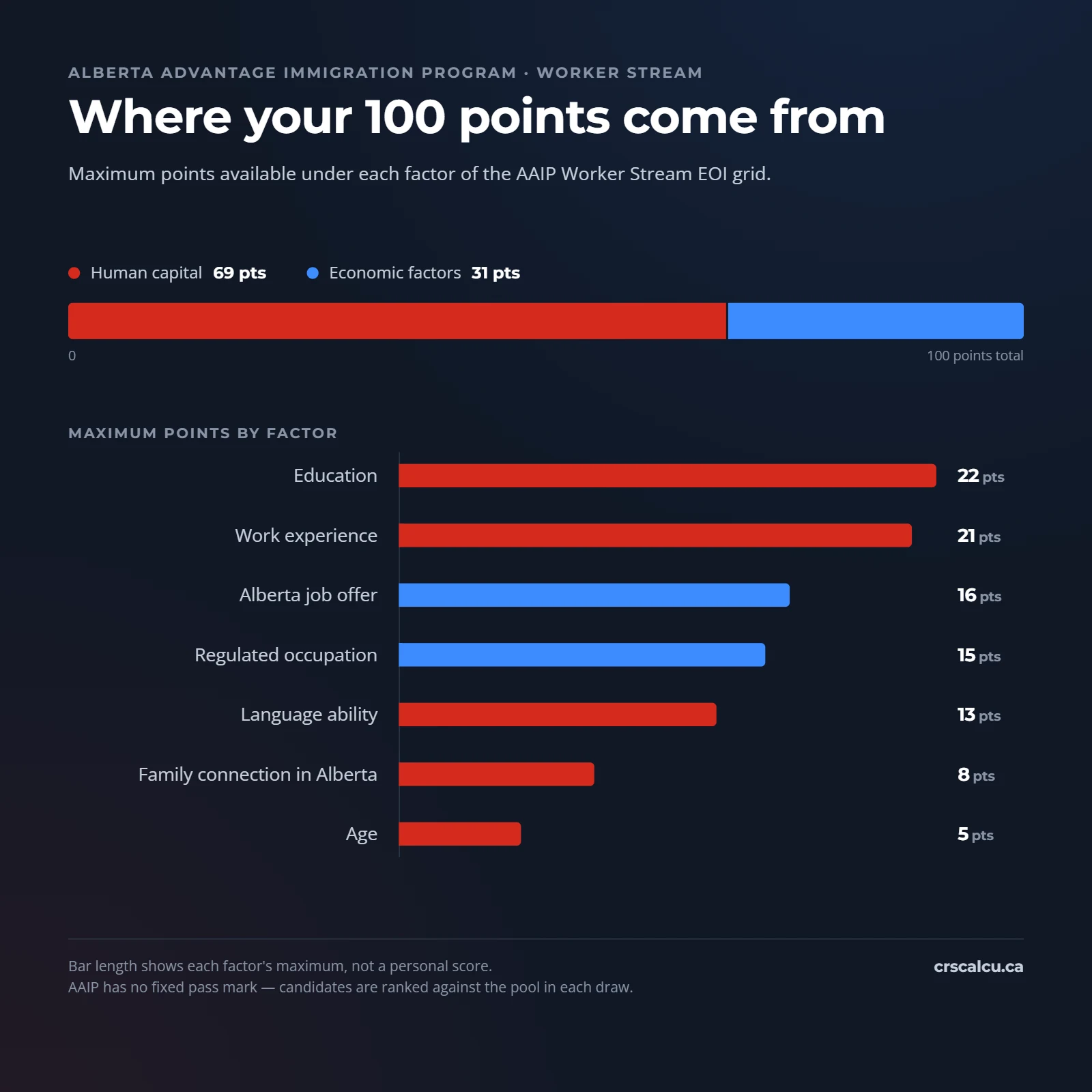
As you fill in each field, the Alberta PNP points calculator adds up your score across two main groups: Human Capital Factors (worth up to 69 points) and Economic Factors (worth up to 31 points), for a combined maximum of 100 points. Seeing the breakdown by category is often more useful than the final number alone, since it shows you exactly which factor is capping your score and which one offers the quickest points to add.

Score Breakdown: Human Capital Factors (Max 69 Points)
Education (Max 22 Points)
Education points depend on your highest completed credential and, separately, where you completed it. Credentials completed abroad, even if verified through an Educational Credential Assessment (ECA), do not qualify for location points, and this rule also applies if a lower-level credential was completed in Canada while your highest credential was earned abroad.
| Highest Credential | Points |
| Doctorate Degree | 12 |
| Master’s Degree | 10 |
| Bachelor’s Degree | 7 |
| Trades Certificate/Diploma | 7 |
| Diploma/Certificate | 4 |
| Secondary School and lower | 0 |
| Location of Highest Credential | Points |
| Completed in Alberta | 10 |
| Completed in another Canadian province or territory | 6 |
| Completed outside Canada | 0 |
Language Ability (Max 13 Points)
Language points reward whichever official language score is higher, English or French, but with an important twist: French can add slightly more on its own scale. Candidates who test CLB 4 or higher in English and NCLC 4 or higher in French simultaneously qualify for a 3-point bilingual bonus. A minimum of CLB 4 or NCLC 4 across all four competencies, listening, reading, writing, and speaking, is required just to submit an EOI.
| English CLB | Points | French NCLC | Points |
| CLB 6 or higher | 10 | NCLC 6 or higher | 8 |
| CLB 5 | 8 | NCLC 5 | 5 |
| CLB 4 | 5 | NCLC 4 | 3 |
| CLB 3 or lower | 0 | NCLC 3 or lower | 0 |
Work Experience (Max 21 Points)
Work experience is scored twice: once for the total amount accumulated anywhere, and again specifically for time worked inside Alberta or another Canadian province. For location-specific experience, AAIP awards the higher of the two figures rather than stacking them.
| Total Work Experience | Points |
| 12 or more months | 11 |
| 6–11 months | 7 |
| Less than 6 months | 3 |
| Work Experience Location | Points |
| 6 or more months in Alberta | 10 |
| 6 or more months in another province or territory | 6 |
| No Canadian work experience | 0 |
Age (Max 5 Points)
Age scoring peaks in the prime working years. Age carries far less weight in the Alberta PNP points calculator than it does under the federal CRS grid, which is worth remembering if you’re comparing scores between the two systems.
| Age | Points |
| 18–20 years | 3 |
| 21–34 years | 5 |
| 35–49 years | 4 |
| 50 years and older | 3 |
Family Connection in Alberta (Max 8 Points)
If you or your accompanying spouse or common law partner have a parent, child, or sibling who is a Canadian citizen or permanent resident living in Alberta and is 18 years of age or older, you can claim 8 points. This definition was narrowed in a January 2025 update to AAIP policy, extended family such as aunts, uncles, cousins, and in-laws no longer qualify, so it’s worth double-checking your relative’s exact relationship before assuming you’ll receive these points.

Score Breakdown: Economic Factors (Max 31 Points)
Alberta Job Offer (Max 16 Points)
A permanent, full time job offer in Alberta is worth up to 16 points, split across two components. The base job offer earns 10 points, and an additional up to 6 points is available depending on where the job is located or which sector it falls under. Separately, a one-time 6-point bonus is available if the offer comes with an endorsement letter from a designated Rural Renewal community, falls under the Tourism and Hospitality Stream through a qualifying sector association, or is a law enforcement role with an employer belonging to the Alberta Association of Chiefs of Police.
| Job Offer Location | Points |
| Calgary or Edmonton census metropolitan area | 0 |
| Rural Renewal Stream designated community | 6 |
| Other Alberta community outside Calgary/Edmonton CMA | 6 |
Regulated Occupation (Max 15 Points)
If your Alberta job offer is in a regulated occupation, meaning a profession or trade that legally requires a licence or certificate to practise, such as engineering, nursing, or a designated skilled trade like electrical work, and you already hold the required Alberta Qualification Certificate or an AIT-recognized trade certificate, you can claim an additional 15 points. This factor rewards candidates who have already cleared Alberta’s regulatory hurdles rather than simply holding a job offer on paper.
Minimum Score & Eligibility Requirements
There is no single published “passing score” the way there is for the federal 67-point Comprehensive Ranking System grid used by some Express Entry linked PNP streams. Instead, AAIP ranks every Expression of Interest against the current pool and periodically invites the highest scoring candidates, meaning the effective cut-off moves with every draw depending on how many people have applied and how many nominations Alberta has available that period.
That said, most successful Worker Stream candidates score somewhere in the 70s to 80s out of 100, and a strong Alberta job offer combined with solid language and education scores is usually what separates an invited profile from one still waiting in the pool. Regardless of your target score, every candidate must still meet the baseline eligibility rules, including the CLB 4 or NCLC 4 minimum language requirement across all four competencies, before an EOI can even be submitted.
It’s also worth remembering that the number of invitations issued in any single round depends on Alberta’s overall annual allocation from the federal government, which can shift year to year, so a target score that felt safe in a previous cycle is not guaranteed to remain safe going forward.
AAIP Streams Overview
The Worker Stream, which this Alberta PNP points calculator is built around, is only one path under AAIP. The Alberta Express Entry Stream nominates candidates who already hold an active federal Express Entry profile, instantly adding 600 CRS points once nominated. The Rural Renewal Stream targets applicants with a job offer in one of Alberta’s designated rural communities and offers its own community-specific endorsement process.
The Tourism and Hospitality Stream is aimed at workers with offers from employers in that sector, while the Rural Entrepreneur Stream and Graduate Entrepreneur Stream serve business owners and recent graduates looking to invest in and operate a business in the province. Each stream has its own eligibility rules, and some, like the entrepreneur streams, don’t use the same 100-point EOI grid at all, so it’s worth confirming which stream actually matches your profile before relying on any Alberta PNP points calculator result.
Alberta PNP vs Express Entry CRS Score: Key Differences
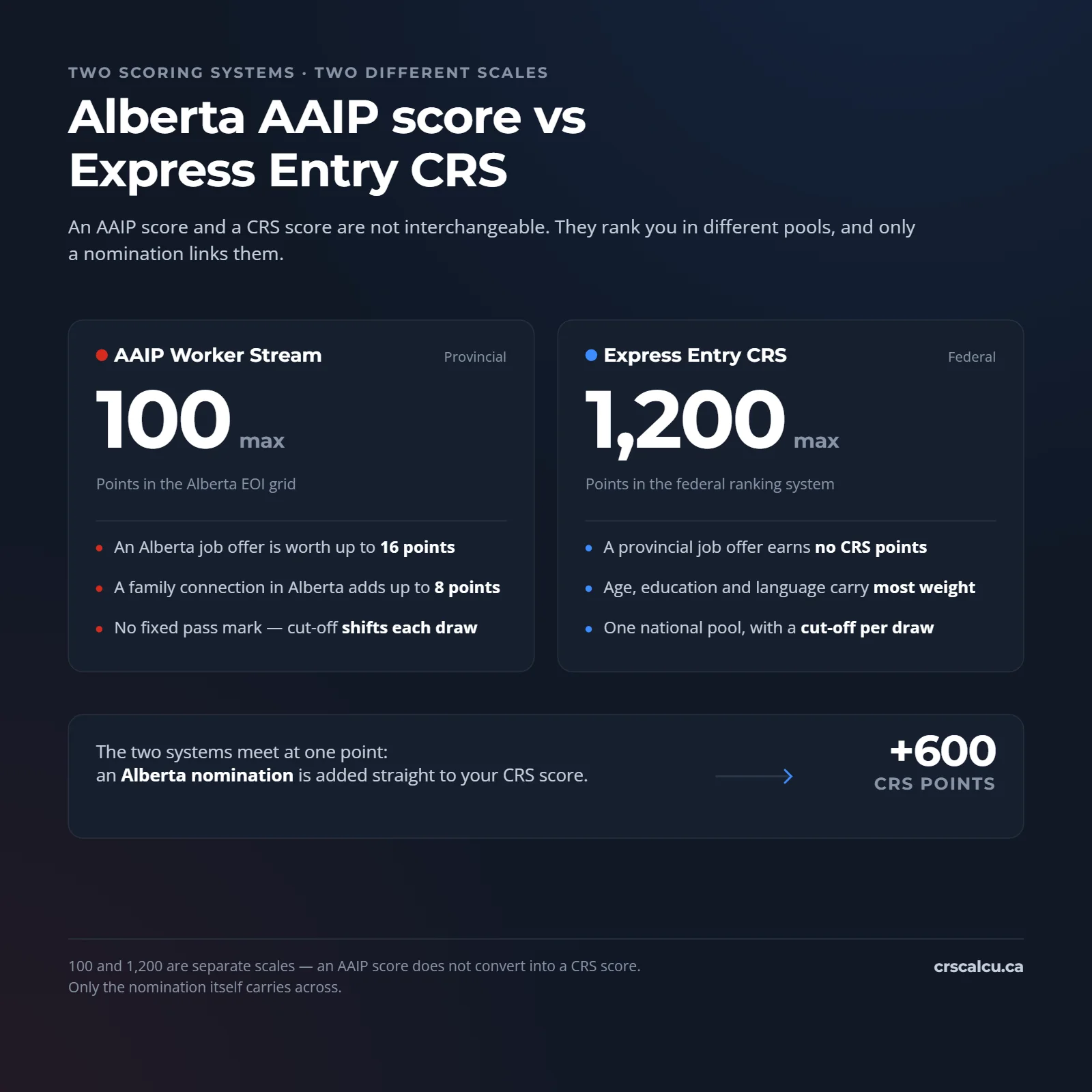
It’s easy to conflate an AAIP score with a federal Express Entry CRS score, but the two systems measure different things on different scales. The Alberta PNP points calculator scores candidates out of 100 based on factors AAIP considers relevant to provincial labour needs, most notably a real, existing Alberta job offer and family ties to the province.
The CRS, by contrast, scores candidates out of 1,200 and puts far more weight on age, education, and language ability on a national scale, with no scoring credit at all for a provincial job offer under the CRS grid itself. The two systems intersect at exactly one point: an Alberta nomination adds a flat 600 points to your CRS score, which is often enough on its own to guarantee an Express Entry invitation at the next draw. If you want to see how an Alberta nomination would change your federal ranking, our CRS Calculator lets you plug in that 600-point boost alongside your other factors to model the combined outcome.
Recent AAIP Draw Trends
AAIP does not publish a fixed schedule, but the Worker Stream and Express Entry Stream have historically issued invitations multiple times per month, with Alberta prioritizing certain in-demand occupations and sectors, including healthcare, skilled trades, and agriculture, in specific rounds. Minimum scores invited in past draws have fluctuated based on pool size and occupational targets, occasionally dipping lower for priority sector draws and climbing higher during general rounds. Because these cut-offs move constantly, treating any single historical number as a guaranteed threshold is risky.
The more reliable approach is to check your current Alberta PNP points calculator score regularly and compare it against your target stream’s recent invitation pattern rather than a number you saw months ago. For instance, healthcare and skilled trades occupations have periodically seen invitations issued at slightly lower thresholds than general rounds, reflecting Alberta’s effort to address specific labour shortages rather than simply admitting the highest overall scorers. Keeping an eye on which occupations a given round targets can help you gauge whether your profile is likely to be prioritized in an upcoming invitation cycle.
How to Improve Your Alberta PNP Score
Most candidates find the fastest points to add come from an Alberta job offer, since it’s worth up to 16 points on its own and can unlock another 15 through the regulated occupation bonus if applicable. Retesting your language ability to clear the CLB 6 or NCLC 6 threshold is the next highest-leverage change, particularly if you’re currently sitting at CLB 4 or 5; our CLB Calculator can help you convert a new IELTS or CELPIP result into the CLB level AAIP uses.
Gaining additional months of work experience specifically inside Alberta, rather than elsewhere in Canada or abroad, also moves the needle more than accumulating the same time in a foreign role. Finally, if you have a parent, child, or sibling already living in Alberta as a citizen or permanent resident, confirming and documenting that relationship can add a straightforward 8 points that many candidates overlook when they first run the numbers.
Common Mistakes to Avoid With This Alberta PNP Points Calculator
Even with a reliable Alberta PNP points calculator, it’s easy to overestimate your score by misreading how a factor is actually defined. One frequent mistake is assuming an Educational Credential Assessment automatically unlocks location points; an ECA verifies your foreign credential’s Canadian equivalency, but it does not convert a degree earned abroad into one completed in Alberta, so those location points still remain unavailable regardless of how the credential is assessed.
Another common error is claiming the three-point bilingual bonus without actually meeting the CLB 4 and NCLC 4 thresholds in both languages at the same time, since a strong score in only one language does not qualify you for that bonus no matter how high it is. Candidates also sometimes add their total work experience score and their location-specific work experience score together, when AAIP actually awards whichever of those two categories is higher rather than stacking them on top of each other.
Family connection points are another area where applicants trip up, since the qualifying relative must be 18 years of age or older and fall within the immediate family definition, so a teenage sibling, an aunt, an uncle, or an in-law will not qualify even though they might have seemed eligible under older program rules.
Finally, many applicants forget that different AAIP streams use entirely different criteria, so a result generated for the Worker Stream on this Alberta PNP points calculator won’t necessarily reflect eligibility for the Rural Renewal, Tourism and Hospitality, or entrepreneur focused streams, each of which comes with its own separate application requirements and, in some cases, no points grid at all.
Who Should Use This Alberta PNP Points Calculator?
This tool is built for prospective applicants who haven’t yet submitted an EOI and want a realistic starting estimate, candidates already in the AAIP pool who want to model how a new job offer, language result, or family connection would change their ranking, and licensed immigration consultants who need a fast way to walk clients through different scoring scenarios. It’s equally useful if you’re deciding between Alberta and another province; our BC PNP Points Calculator uses a different grid entirely, so comparing both is often the clearest way to see which province your profile is naturally stronger under.

Frequently Asked Questions
Final Thoughts
Your Alberta PNP points calculator result is a snapshot, not a fixed outcome, and it’s worth revisiting every time a factor in your profile changes. If you’re also holding or planning to submit an Express Entry profile, it’s worth checking the latest Express Entry draws and CRS cutoffs to see how an eventual Alberta nomination would affect your federal ranking. For a wider view of your options, our guide on how to immigrate to Canada provides useful context alongside this Alberta PNP points calculator.
And if Alberta isn’t the only province you’re considering, our BC PNP Points Calculator can show you how your same profile scores under British Columbia’s system. For the official, authoritative version of this points grid, always cross-check your numbers against the Government of Canada’s Provincial Nominee Program overview from IRCC.