
Is My CRS Score Good? CRS Score Ranges Explained
There is no single “good” CRS score. What counts as competitive depends entirely on which type of Express Entry round is running when you are in the pool. A score that misses a general round easily could still win an invitation in a category-based round a week later. Our Express Entry category-based draws 2026 guide lists every category and its latest cutoff.
Below, we break your score into ranges using real, recent Express Entry cutoffs, so you can see where you actually stand right now rather than guessing. If you are not sure the score you are comparing is accurate, here is how we calculate it, point by point.
Instead of chasing a single “magic number,” it helps to think of your CRS score as a moving target that you compare against the specific type of round most relevant to your situation, whether that’s a general draw, Canadian Experience Class, a category you qualify for, or a provincial nomination stream.
CRS Score Ranges At a Glance

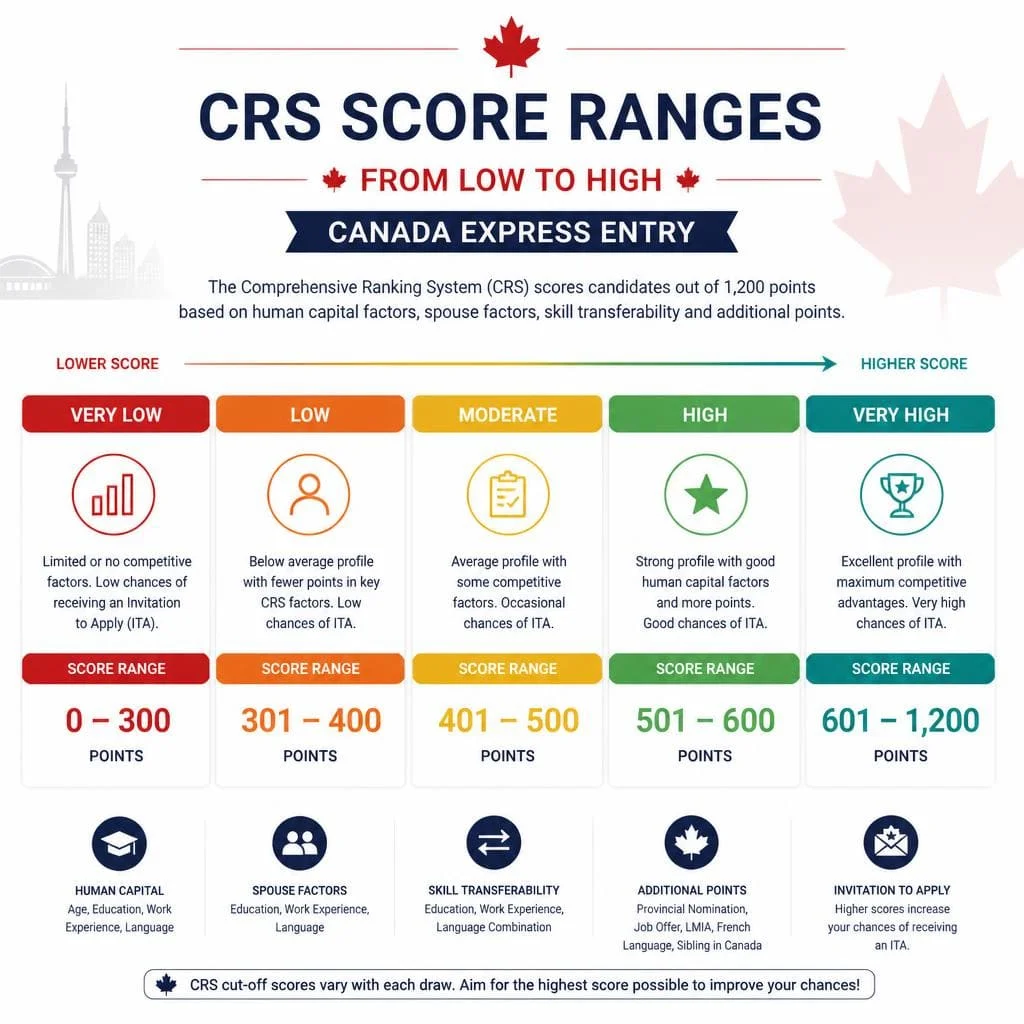
| Your score | What it typically means in 2026 |
|---|---|
| 750+ | Exceptional. Competitive for almost every round, including the highest Provincial Nominee Program cutoffs. |
| 600 – 749 | Very strong. Usually only reached with a provincial nomination (worth 600 points) or an outstanding human capital profile. |
| 500 – 599 | Competitive for most recent general and Canadian Experience Class rounds. |
| 450 – 499 | Competitive for several category-based rounds, such as trades or healthcare occupations. |
| 350 – 449 | Below most general cutoffs, but may qualify for certain category-based rounds like French-language proficiency draws, which recently accepted scores around 393 to 419. |
| Below 350 | Unlikely to be invited soon without a provincial nomination or a category-based match. Worth focusing on the improvements covered in our CRS score guide. |
Is My CRS Score Good For Immigration Program
Your score is not judged against one single bar. IRCC runs several types of Express Entry rounds, each with its own cutoff, and they can differ by well over 100 points in the same month.
General rounds draw from all three Express Entry programs at once (Federal Skilled Worker, Federal Skilled Trades, and Canadian Experience Class) and usually carry the highest cutoffs, since every eligible candidate in the pool competes together. Canadian Experience Class rounds are limited to candidates with Canadian work experience, and their cutoffs tend to sit somewhat lower than general rounds, though still firmly in the mid-400s to low-500s range recently.
Category-based rounds target a specific occupation group or attribute, such as healthcare, trades, transport, agriculture, or French-language ability. These rounds exist specifically to invite strong candidates who might otherwise be buried under general-round competition, which is why their cutoffs can run 50 to 150 points lower than a general round in the same season. Provincial Nominee Program rounds sit at the opposite end, since a nomination alone adds 600 points, pushing nearly every candidate in these rounds well above 700.
Recent Express Entry Rounds and Their Cutoffs

| Date | Round type | Invitations | CRS cutoff |
|---|---|---|---|
| May 28, 2026 | French-Language Proficiency | 4,500 | 409 |
| May 27, 2026 | Canadian Experience Class | 3,000 | 518 |
| Apr 28, 2026 | Canadian Experience Class | 2,000 | 514 |
| Apr 2, 2026 | Trades Occupations | 3,000 | 477 |
| Mar 31, 2026 | Canadian Experience Class | 2,250 | 509 |
Source: IRCC Express Entry rounds of invitations, accessed July 2026. See the full draws and cutoffs page for more rows, or our next draw prediction for where cutoffs may be headed next.
Why Your Score Might Not Feel “Good Enough” Yet
A score that feels low is often just temporarily out of range for general rounds. Category-based rounds, provincial nomination programs, and Canadian Experience Class rounds all run at different cutoffs, so your same score can look very different depending on which round appears next.
Your score is also not fixed. Small changes, like retaking a language test or finishing a credential, can move you into a much more competitive range within weeks, not months. It is worth treating your CRS score as something you actively manage while you wait in the pool, rather than a number you check once and forget about. Our Express Entry pool statistics page shows exactly what percentage of the pool your score currently beats.
What a Good Score Looks Like at Different Life Stages
A recent graduate in their early twenties, with a bachelor’s degree, one year of foreign work experience, and CLB 8 language scores, often lands somewhere in the 400 to 440 range. That is not competitive for most general rounds yet, but it is a realistic starting point, and age is on their side for years to come.
A mid-career candidate in their early thirties, with three years of skilled work experience (including some gained in Canada), a bachelor’s degree, and CLB 9 language scores, typically scores in the 470 to 520 range. This profile is often competitive for Canadian Experience Class rounds and many category-based rounds without needing a nomination at all.
An experienced worker with a provincial nomination in hand jumps into the 700 to 900+ range almost automatically, since the nomination alone contributes 600 points on top of whatever human capital score they already had. This is why so many candidates who feel stuck below 500 pursue a Provincial Nominee Program stream instead of waiting for their human capital score to climb.
A married candidate whose spouse is also a strong contributor, holding their own credential and CLB 7 or higher, often scores similarly to a single candidate with a slightly stronger core profile, since spouse points of up to 40 help offset the lower “with spouse” scale used in the core factors. This is why couples sometimes find it worth comparing their combined numbers both ways, single scale versus spouse-included scale, before deciding who should be the primary applicant.

Common Misconceptions About a “Good” CRS Score
One common misconception is that there is a fixed “passing” score, like a test grade. In reality, the cutoff changes every round based on who else is in the pool and which category IRCC is drawing from that week, so the same score can be a clear miss one week and a clear win the next.
Another misconception is that job offers still help. Job offer points were removed from the CRS grid entirely as of March 25, 2025, so a job offer no longer changes your score directly, even though it can still support other parts of an application in some cases.
A third misconception is that a “good” score for someone else is automatically a good score for you. A single candidate’s 480 might be excellent, while a married candidate with the same human capital profile scores lower on the core factors alone, before their spouse’s points are added back in. Comparing your score to your own program and category is far more useful than comparing it to a stranger’s number online.
How to Check Where You Stand Right Now
The fastest way to know if your score is good is to compare it directly against the most recent rounds in your likely category, not against a general rule of thumb. Use the calculator above to get your exact number, then check it against our latest draws and cutoffs page to see how it lines up with real, recent invitations.
How CRS Cutoffs Have Trended Through 2026
Looking at the rounds above, a clear pattern emerges: Canadian Experience Class cutoffs have held fairly steady in the 505 to 520 range for most of the spring, while category-based rounds swing much more widely depending on which occupation or attribute IRCC is targeting that month. Trades rounds have generally landed lower than CEC rounds, often in the high 400s, reflecting a smaller and more specific eligible pool.
French-language rounds stand out as the most accessible entry point for candidates with a lower human capital score, since scoring NCLC 7 or higher across all four abilities can qualify you for a round with a cutoff more than 100 points below a typical general or CEC round. This is one of the few places in the entire system where a specific, learnable skill can meaningfully outweigh age or education.
If you are tracking your own score against these trends, it helps to check in after every round rather than only once. A single round rarely changes the overall pattern, but a string of three or four rounds in the same category can reveal whether cutoffs are climbing, holding steady, or easing, which affects how urgently you should work on improving your profile.
Good Score Benchmarks by Candidate Type

Candidates without Canadian experience or a nomination, relying purely on foreign work history, education, and language ability, typically need a score above 480 to be competitive for category-based rounds, and well above 500 for general rounds. This group benefits the most from maximizing language scores, since it is usually the fastest lever available without needing to relocate or gain new work experience.
Candidates with one to three years of Canadian work experience but no nomination often sit in the most competitive natural range for CEC draws, typically 480 to 530, especially when paired with a post-secondary credential and CLB 9 or higher. This is frequently the strongest position to be in without pursuing a provincial nomination at all.
Candidates who already hold a provincial nomination are almost always competitive regardless of their underlying human capital score, since the 600-point bonus dominates the total. For this group, the main planning question shifts from “how do I raise my score” to “how quickly can I get my profile updated once the nomination is confirmed,” since PNP-linked rounds are typically small and specific.
Should You Wait for a Better Round or Improve Your Score First?

If your score is within roughly 30 to 50 points of recent cutoffs in your likely category, it is often worth simply waiting, since cutoffs do fluctuate round to round and a favorable category-based draw may reach you without any changes on your part. If your score is more than 100 points below recent cutoffs, waiting alone is unlikely to close the gap, and it is usually more effective to actively improve a specific factor, most commonly language ability or Canadian work experience, rather than hoping for a uniquely low round.
A useful middle-ground approach is to make one meaningful change, such as retesting your language ability, while your profile remains active in the pool. Since profiles last a full year and scores update automatically, you lose nothing by improving your profile while continuing to wait for a matching round.
There is also no penalty for checking too often. Recalculating your score every few weeks, especially right after a birthday, a new test result, or a finished credential, costs nothing and keeps your expectations grounded in your actual current standing rather than an old estimate.
Category-based rounds are announced by IRCC roughly once a year and can change which occupations or attributes are prioritized, so a category that helped candidates last year may not run again exactly the same way. Keeping an eye on official IRCC announcements alongside this page gives you the fullest picture of where your score realistically stands.
Why Your Calculator Score and Your Official Profile Score Can Differ
It’s common to run a free calculator, get one number, then see a slightly different figure in your actual Express Entry profile. This usually comes down to small details: rounding differences in your language test conversion, a work history that spans a partial year rather than a clean 12 months, or a credential that hasn’t been formally assessed yet through an ECA. None of these mean the calculator is wrong; they usually mean one input needs a closer look. Our dedicated guide on why your CRS score might differ from your profile walks through each of these cases in detail.
Related Reading
Once you have a sense of whether your score is competitive, it helps to understand exactly how each factor is calculated and where recent cutoffs have landed. See our full breakdown of how to calculate your CRS score, the latest Express Entry draws and CRS cutoffs, and our next draw prediction and trend analysis for a data-based look at where cutoffs may be headed.
How Often These Benchmarks Are Updated
Express Entry cutoffs shift with every round, so a benchmark that felt accurate three months ago can already be out of date. We review the rounds table above against IRCC’s official rounds of invitations data on a rolling basis, so the figures reflect genuinely recent draws rather than a single snapshot from early in the year. If you are reading this guide several months after it was last updated, treat the general patterns (which round types tend to run higher or lower) as more reliable than any single exact cutoff number, and check the latest draws page for the most current figures.
Not sure where your score stands? Use the CRS calculator above and compare it to the latest cutoffs instantly.
How Much a Provincial Nomination Changes What Counts as “Good”
A provincial nomination adds a flat 600 points to a candidate’s CRS score, which is more than double even the strongest possible combination of core human capital, spouse, and skill transferability points. This means that for a candidate willing to pursue a provincial nomination through a program like the Ontario Immigrant Nominee Program’s Human Capital Priorities stream, British Columbia’s Skilled Worker stream, or Saskatchewan’s Occupation In-Demand category, a starting score in the 400s is effectively “good enough,” since the nomination alone pushes the total well past 1,000 and guarantees an invitation at the next available draw.
This is why many candidates with scores that look uncompetitive for general draws still receive an invitation within a matter of months by pairing their profile with a provincial nomination application rather than waiting for their unassisted score to rise through age, language retesting, or additional education.
Category-Based Draws: A Different Definition of “Good”
Since 2023, IRCC has run targeted category-based Express Entry draws for candidates with strong French-language proficiency, and for occupations in healthcare, education, trades, transport, agriculture and agri-food, and STEM fields, and cutoffs in these targeted rounds have often been substantially lower than general draws, since only candidates who meet the category’s specific criteria are eligible to be invited in that round.
A candidate whose score would be considered mediocre in a general draw may find themselves comfortably competitive in a category they qualify for, particularly the French-language category, which has repeatedly issued invitations at scores meaningfully below the general cutoff. Checking which categories IRCC has announced for the current year, and honestly assessing whether your language ability, occupation, or education fits one of them, is one of the fastest ways to reassess whether your score is actually “good” for your specific situation rather than relying on general draw cutoffs alone.
Age and the Shrinking Window: Why Timing Affects What’s “Good”
Core human capital points for age peak between 20 and 29 and decline gradually afterward, reaching zero at age 45, which means a score that looks solidly competitive at age 28 can quietly erode by 20 to 30 points over just a few years without the candidate changing anything else about their profile. This is one of the most common reasons a candidate who felt their score was “good enough” a year or two ago finds themselves falling behind current cutoffs, purely due to birthdays passing rather than any change in qualifications.
Candidates in their early-to-mid thirties approaching an age-related point threshold should treat their current score as a moving target and consider whether locking in a profile submission now, or pursuing a language retest or additional credential in the near term, makes more sense than waiting, since the age penalty only grows over time while other factors remain within the candidate’s control.
Using a Points Improvement Plan Instead of Guessing
Rather than wondering abstractly whether a score is “good,” it is more useful to build a concrete improvement plan comparing your current score against the specific cutoff you are targeting, then identifying the two or three highest-yield changes available to you. For most candidates this means, in order of typical impact: retaking a language test to move from Canadian Language Benchmark 7 to 9 across all four abilities, which can add 15 to 25 points.
Depending on marital status; obtaining an additional credential evaluation if a second degree or diploma was never assessed; securing a valid job offer or provincial nomination; or improving a spouse’s language score and education credential if applicable, since spouse factors are often left unoptimized. Working through this list systematically, rather than repeatedly checking a calculator without acting on the results, is what actually moves a borderline score into truly competitive territory.
Comparing Your Score Against the Right Pool, Not Just the Overall Average
One subtle mistake candidates make when judging whether their score is “good” is comparing themselves against the wrong benchmark entirely. The overall Express Entry pool includes candidates eligible for the Federal Skilled Worker Class, Federal Skilled Trades Class, and Canadian Experience Class all mixed together, but general draws invite from across all three programs using a single combined ranking, while category-based and provincial draws pull from specific, much smaller sub-groups.
A tradesperson comparing their score only against general draw cutoffs may be underselling their real chances, since skilled trades candidates are sometimes included in dedicated draws with different dynamics. Likewise, a candidate already living in Canada with strong Canadian work experience is competing in a pool where CEC candidates often cluster at higher average scores than first-time applicants abroad, simply because Canadian experience itself contributes meaningfully to the score.
Understanding which specific draw types you are realistically eligible for, and tracking the cutoffs for those exact categories rather than the headline number from the most recent general round, gives a far more accurate answer to whether your score is genuinely competitive for your situation.
A Simple Monthly Check-In Habit Worth Building
Rather than checking your score once and drawing a permanent conclusion, many successful applicants build a simple habit of reviewing their profile and the latest draw results once a month. This takes only a few minutes, since it just means comparing your current CRS total against the most recent two or three draw cutoffs for the categories you qualify for, and noting whether anything in your own circumstances, such as an upcoming birthday, an expiring language test, or a newly completed credential assessment, is about to change your number.
This habit catches small, time-sensitive opportunities, like a category-based draw opening for your occupation, well before they close, and prevents the common mistake of only checking in once every six months and missing a window where your score was briefly competitive.