
Arrima & Quebec Skilled Worker Selection: Complete Guide (2026)
Arrima and the Quebec Skilled Worker Program: Overview
Quebec is the only province with a special agreement that lets it choose its own economic immigrants independently of federal Express Entry. If you’re aiming for this province, you need to understand the Quebec Skilled Worker selection process. The Arrima & Quebec Skilled Worker stream runs separately from federal programs. The province has full control over who gets an invitation.
How Arrima Works
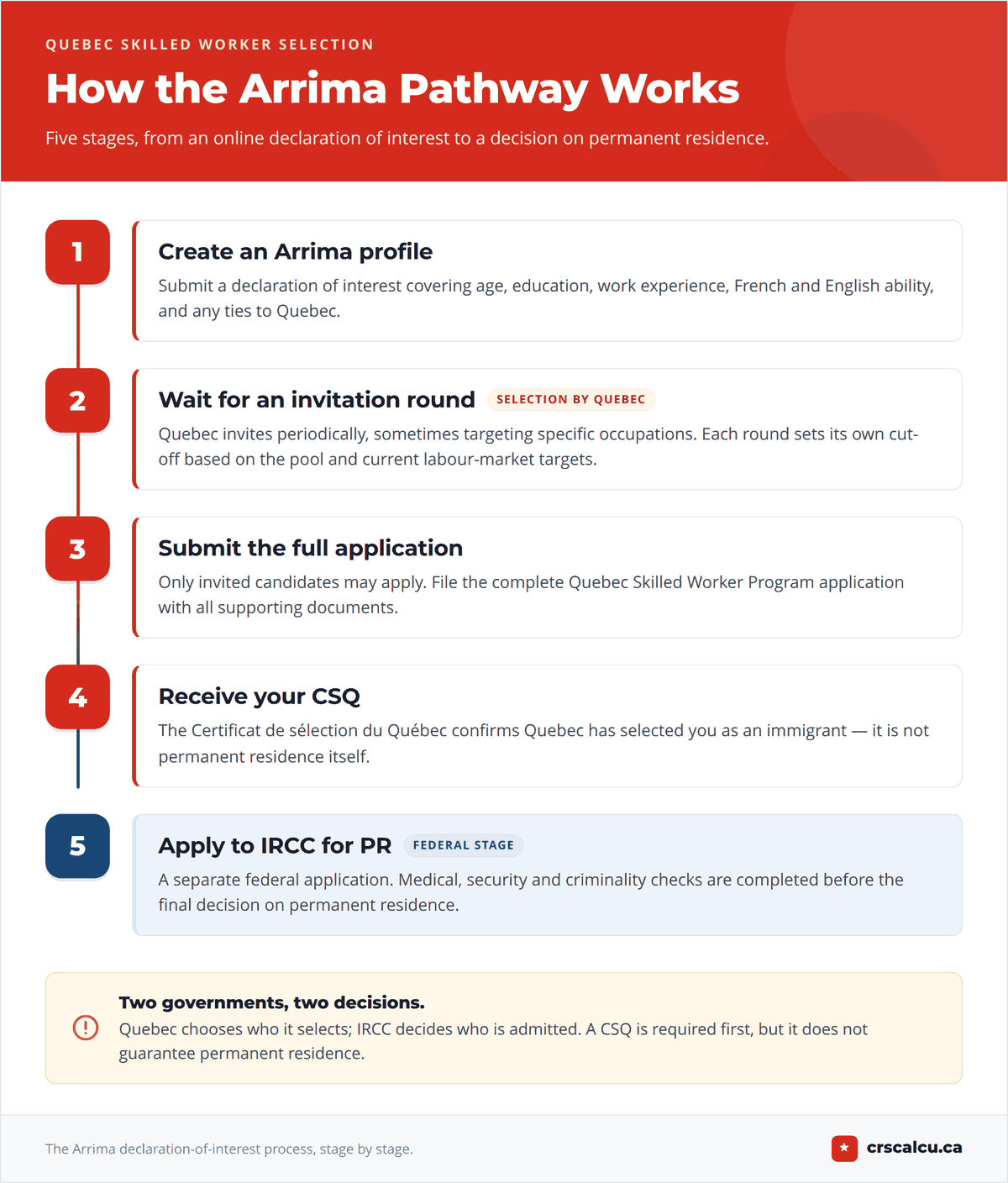
Arrima is Quebec’s online portal for declarations of interest. It’s separate from the federal Express Entry and immigration system. You create a profile and answer detailed questions about your age, education, work experience and French and English skills. You also list any ties to Quebec, such as a job offer, family or past study or work there. Quebec runs invitation rounds from time to time. Some target certain jobs or profiles based on the province’s job needs. Only invited candidates can apply for a Quebec Selection Certificate, known as the CSQ. Most successful Quebec Skilled Worker applicants get to know the Arrima portal well before they submit.
The Quebec Skilled Worker Program Points Grid
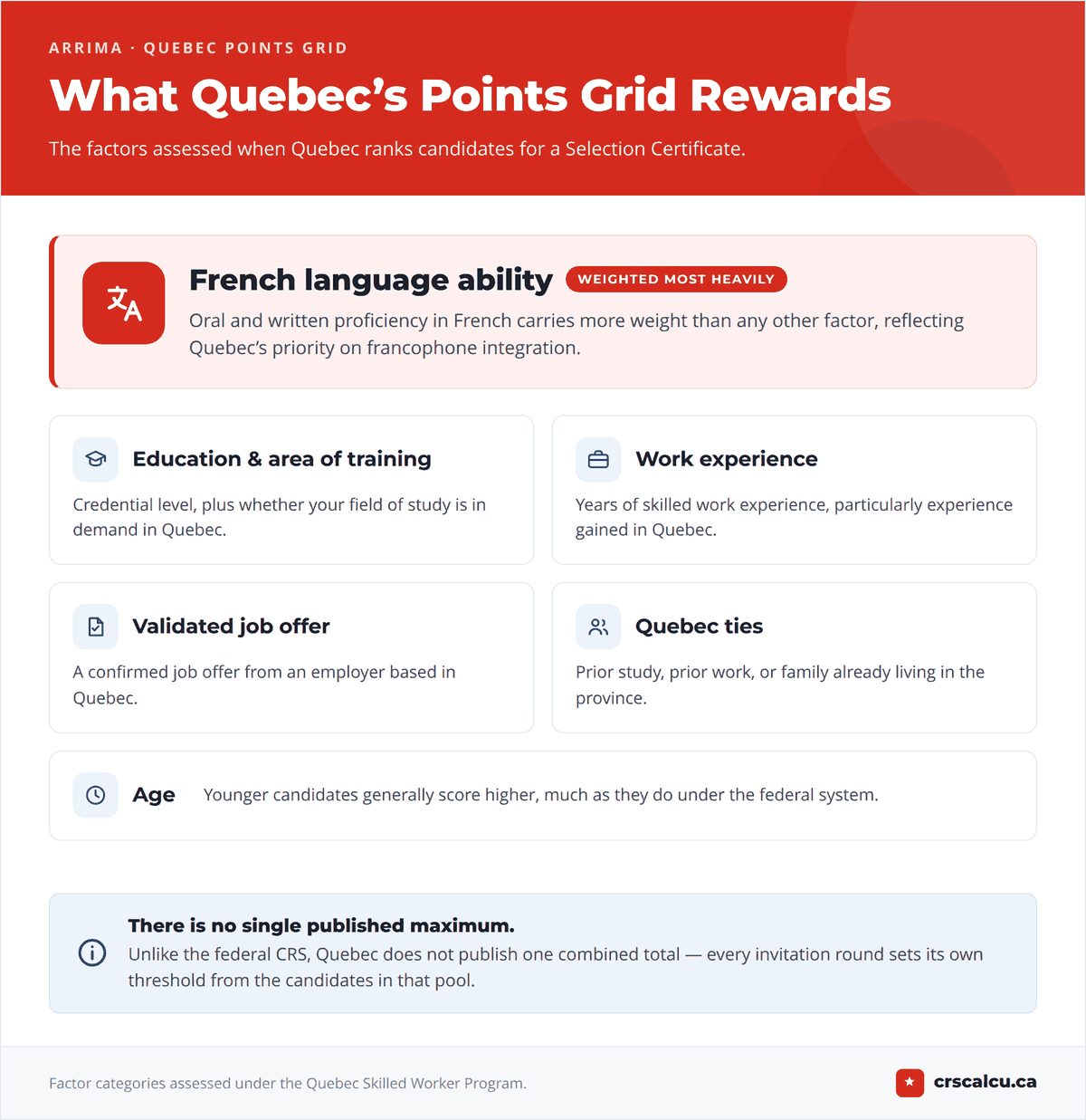
Quebec’s points system looks at several factors, and French is weighted very heavily. This reflects the province’s focus on French-speaking newcomers. Points are also given for age, education and field of training, and work experience. You can earn more for a validated job offer in Quebec, past study or work there, and family in Quebec. Unlike the federal CRS, there’s no single published maximum score. Instead, each round sets its own minimum score based on who is in the pool and the province’s targets.
| Factor Category | What It Rewards |
|---|---|
| French language ability | Oral and written proficiency in French, weighted heavily |
| Education and area of training | Credential level and whether the field of study is in demand in Quebec |
| Work experience | Years of skilled work experience, particularly in Quebec |
| Validated job offer | A confirmed job offer from a Quebec employer |
| Quebec ties | Prior study, work experience, or family already living in Quebec |
| Age | Younger candidates generally score higher, similar to the federal system |
The Quebec Selection Certificate and What Happens After
Once you’re selected through Arrima and approved, you get a Certificat de sélection du Québec (CSQ). This confirms that Quebec has chosen you as an immigrant. The CSQ isn’t permanent residence. After you get it, you apply to the federal government (IRCC) for PR. Standard federal checks then apply, such as medical exams, security screening and police certificates. This two-step setup, provincial selection then federal approval, is unique to Quebec. That’s why applicants often say the Arrima & Quebec Skilled Worker pathway feels more predictable once they have a CSQ. The hardest part is already behind them.

Comparing Quebec’s System to the Federal CRS
The Arrima & Quebec Skilled Worker system and the federal system have some things in common. Both reward youth, education, language skills and work experience. But they differ in key ways. Quebec puts much more weight on French than the federal system does. Quebec also uses its own declaration of interest and invitation cycle through Arrima, not the federal Express Entry pool.
A high federal CRS score doesn’t mean a high score on Quebec’s grid, especially if your French is limited. The reverse is also true. A strong French speaker with modest English may do much better in Quebec than in the federal system. Compare the two carefully before you apply. This helps you decide whether the Arrima & Quebec Skilled Worker route or the federal Express Entry pool suits you better.
Who Should Consider the Quebec Pathway
Quebec’s system tends to favour people with strong or intermediate French and a job offer from a Quebec employer. It also favours credentials in fields the province needs, and ties through past study or work there. If you have no French and no link to Quebec, federal Express Entry or another province’s nominee program may be more realistic. But improving your French can make Quebec a real option over time.
Application Process Overview
The process starts with creating an Arrima profile and submitting a declaration of interest. Then you wait to see if you’re invited in one of Quebec’s selection rounds. If invited, you submit a full Quebec skilled worker application with supporting documents. If it’s approved, you get a CSQ. You then apply separately to IRCC for PR and complete federal medical, security and criminality checks before a final decision.
Quebec Experience Program (PEQ) as an Alternative Route
Alongside the Quebec Skilled Worker Program, Quebec has offered the Programme de l’expérience québécoise (PEQ). It’s aimed at international graduates of eligible Quebec schools and temporary workers with qualifying experience in Quebec. PEQ is often faster than the general skilled worker route, since it targets people already connected to Quebec. It has its own rules based on graduation or work history, not the broader points grid.
French Language Testing for Quebec Applications
French carries so much weight in Quebec’s system that you should take an approved French test, such as TEF Canada or TCF Canada, even if you feel confident. A verified score removes any doubt about your level and makes sure you get full language points. Native French speakers from French-speaking countries may still need a test result or other proof, based on the rules at the time. Language testing is one of the most important steps before you submit an Arrima & Quebec Skilled Worker profile.

Employer-Driven Selection in Quebec
Quebec also runs employer-driven selection. This lets Quebec businesses pick foreign workers directly to fill job needs. For some jobs, it can skip the general Arrima pool entirely. This route can be much faster if you already have a real job offer from a participating Quebec employer, since it relies on the employer’s hiring rather than a general round. Employer-driven applications are one of the fastest ways through the Arrima & Quebec Skilled Worker system when you already have a job offer.
Frequently Asked Questions
The PEQ is a faster, more targeted route for graduates of Quebec schools and workers with Quebec experience. The general Quebec skilled worker program uses the broader Arrima points grid and is open to more people, including those with no link to Quebec. Both are part of the wider Arrima & Quebec Skilled Worker framework, so the right choice depends on your background.
Yes. You can update your Arrima profile at any time with new test results, work experience or a job offer. Your updated profile is what’s assessed in future rounds, much like an Express Entry profile. Keeping your Arrima & Quebec Skilled Worker profile current is one of the easiest ways to improve your chances over time.
French isn’t always strictly required, but it’s weighted very heavily in Quebec’s grid. So candidates without French usually need strong scores elsewhere, such as a validated job offer or an in-demand credential, to compete. French is the biggest factor you control in the Arrima & Quebec Skilled Worker points grid.
You can’t use a Quebec Selection Certificate to enter the federal Express Entry pool. People headed for Quebec apply for PR directly through IRCC after getting a CSQ, outside Express Entry. But nothing stops you from exploring Quebec and a federal or other provincial path at the same time while you decide. Many applicants pursue the Arrima & Quebec Skilled Worker stream alongside a federal profile to keep their options open.

Timelines vary. But expect Arrima selection, the CSQ and then federal PR processing to take longer together than federal Express Entry alone. It often takes two years or more from your first declaration of interest to final approval.
A validated job offer adds useful points and can greatly strengthen an Arrima profile. But it doesn’t guarantee an invitation. Quebec’s rounds still look at your whole Arrima & Quebec Skilled Worker profile and the province’s current targets.
No. In theory, people who get PR through federal Express Entry can move to Quebec later. But Quebec generally expects newcomers who plan to settle there to use its own selection process, not the federal one. So most people planning to live in Quebec apply through Arrima.
Arrima scores you on education, work experience, age and French and English skills. It’s similar to Express Entry but gives much more weight to French. Candidates are ranked in a pool, and the highest-scoring profiles get invitations in regular draws.
Once invited, you usually have a set time to submit a full Quebec Selection Certificate (CSQ) application with documents. After Quebec approves your CSQ, you apply separately to the federal government for PR.
It’s not always harder, just different. Quebec gives much more weight to French and uses its own rules and timelines. Federal Express Entry rewards English or French more evenly through the CRS score.
Yes. If you already have a valid work permit or are otherwise allowed to work in Canada, you can keep working in Quebec while your CSQ and federal PR applications are processed.
Planning to settle outside Quebec? Check your CRS score for the federal Express Entry system, or read about the Federal Skilled Worker Program and other provinces’ nominee streams.
Bringing Family Members Through the Quebec Pathway
As with federal programs, you can include your spouse or common-law partner and dependent children on a Quebec skilled worker application. Your spouse’s education, work experience and language skills can add points to your Arrima profile. Family members usually get their CSQ and later PR along with you. If you’re applying as a family, think about each person’s French, since French skills across the household can make a big difference. Planning ahead as a family is a key part of a strong Arrima & Quebec Skilled Worker application.

Settling in Quebec After Approval
Newcomers who get a CSQ and then PR are expected to settle in Quebec. Quebec offers French classes (francization) and integration programs to help newcomers improve their French and find work. These programs help even if you already speak some French, since everyday and workplace French in Quebec can differ from what’s taught elsewhere. Using them early makes life after an Arrima & Quebec Skilled Worker approval much smoother.
In-Demand Fields Under Quebec’s Selection Priorities
Quebec adjusts which fields and jobs it prioritizes in its rounds. It often favours health care, engineering, IT and skilled trades, where shortages persist. Check the current list of priority training areas before you invest time in an Arrima profile. It shows how competitive your background is likely to be. It may even lead you to earn another credential in a field with more demand. Staying up to date on these priorities is a smart habit if you follow Arrima & Quebec Skilled Worker rounds closely.
Comparing Quebec to Other Provincial Nominee Programs
Every other province and territory takes part in federal Express Entry through PNP streams, which add 600 points to a candidate’s CRS score. Quebec stands apart because it runs fully outside Express Entry. The usual CRS-boosting logic for other provinces doesn’t apply to Quebec at all. If you’re comparing Quebec with, say, British Columbia or Ontario, treat it as a different track, not just another route in the federal system. This is exactly why the Arrima & Quebec Skilled Worker system is worth studying on its own terms.
Common Mistakes Candidates Make With Arrima
A common mistake is underestimating how much French counts and submitting an Arrima profile with no French test at all. This can leave you well below the round’s cutoff, even with strong English, education and work experience. Another common issue is not updating the profile after a change, such as a new credential or a better language score. The profile being assessed then doesn’t show your real, stronger position. Review and update your Arrima profile regularly, just as you would an Express Entry profile, so you don’t miss upcoming rounds.
Final Thoughts on the Quebec Pathway
Quebec’s separate system can feel like extra complexity if you’re already learning federal Express Entry. But for the right person, it can be a very effective route to PR. This is especially true if you have strong French or a real link to the province. It’s sometimes faster than waiting for a competitive federal draw. Honestly assess your French and your ties to Quebec before you put a lot of effort into an Arrima profile. This helps you decide whether Quebec, the federal system or another province is the best fit.

A Quick Recap
Quebec chooses its own economic immigrants through the Arrima portal and the Quebec Skilled Worker Program, not the federal CRS. French is weighted very heavily, along with education, work experience and ties to the province. People who get a Quebec Selection Certificate still apply separately to the federal government for PR. It’s a truly distinct two-step process. Understand it well before deciding if it suits your goals better than federal Express Entry.
Where to Go From Here
If you’re still choosing between Quebec and a federal or other provincial path, start by honestly assessing your French. This one factor often decides which route makes the most sense. Then compare your likely standing on Quebec’s grid with your federal CRS score. Factor in any job offer, education or family ties that might tip the balance. Choose the path that gives you the strongest, most realistic chance.
Staying Current on Quebec’s Requirements
Quebec updates its selection rules, priority training areas and invitation schedule based on job needs and agreements with the federal government. Check the official Quebec immigration ministry website for the latest rules before you submit or update an Arrima profile. Don’t rely only on general guides that may be out of date.
Making a Confident Decision
Choosing between Quebec, federal Express Entry or another province’s stream comes down to matching your strengths to the path most likely to reward them. Your strength might be French, a job offer or an in-demand credential. Research carefully now rather than committing to one route based on incomplete information. This gives you the best chance of reaching PR as efficiently as possible.
A Final Word
Whichever path you choose, keep full records of your language test results, credentials and any Quebec ties from the start. This makes either an Arrima profile or a federal Express Entry profile stronger and easier to prepare when it’s time to apply.