
New rules, November 3, 2026: Job offers earn CRS points again. A job offer no longer needs an LMIA, and a high-wage offer can earn 50, 70 or 100 points as part of a new Labour Market Integration factor worth up to 150 points. That factor also adds up to 70 points for at least 12 months of high-wage Canadian work experience, and you get whichever option scores higher. Our calculator follows these rules. IRCC: Express Entry changes
How We Calculate Your Score
This page explains exactly where our CRS point values come from, how our calculator’s logic is built, and how we keep everything current as Immigration, Refugees and Citizenship Canada (IRCC) updates the Comprehensive Ranking System.
Source of Truth
Every point value in our calculator is taken directly from IRCC’s published Comprehensive Ranking System criteria at canada.ca. We do not estimate, round, or approximate point values, and we do not rely on third-party summaries or outdated PDFs. When IRCC publishes a change to the CRS grid, that is the only source we use to update our tool.
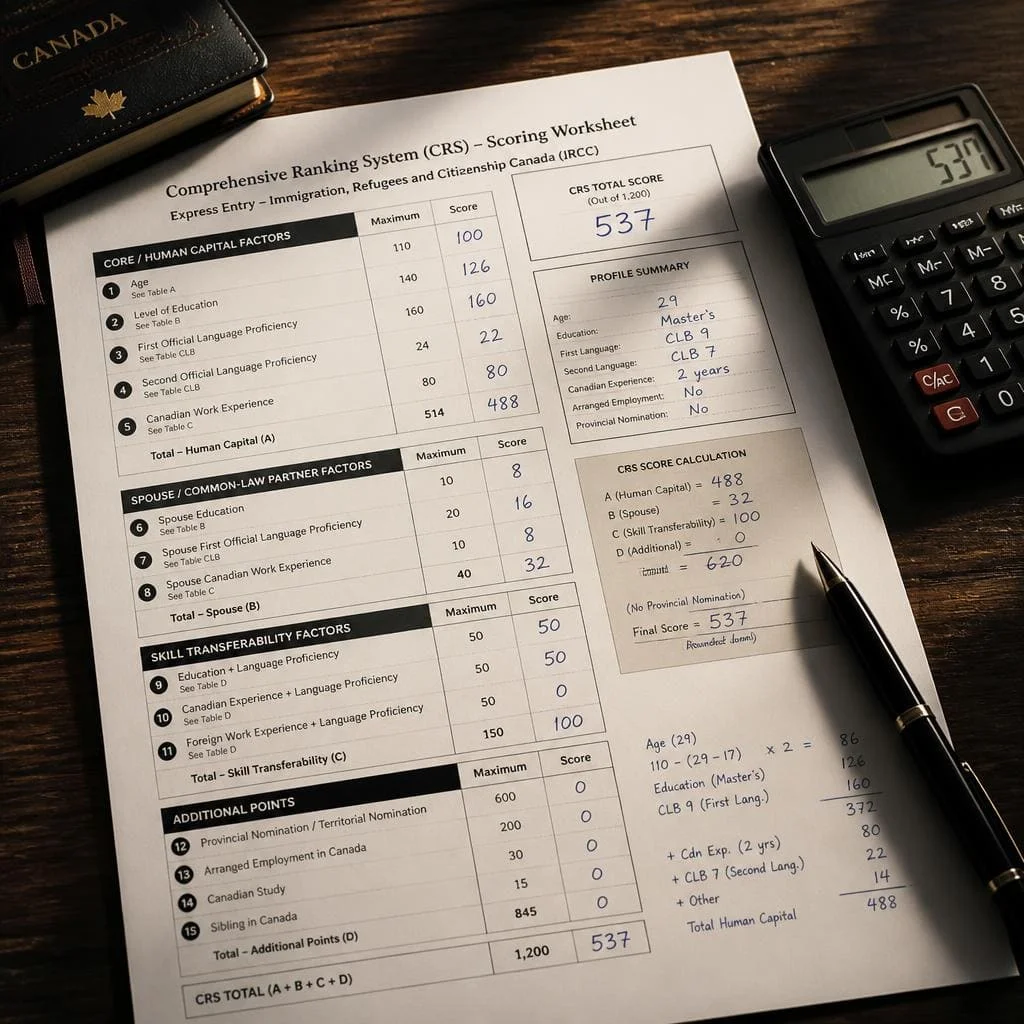
The CRS is built from two main components: core human capital factors (combined with spouse factors, where applicable) and additional points. Our calculator walks through each of these in the same order IRCC does, so your inputs map directly onto the official structure.

How the Score Is Built
Core / Human Capital Factors. These cover age, level of education, official language proficiency (in up to four abilities: speaking, listening, reading, and writing), and Canadian work experience. If you have a spouse or common-law partner who is coming with you, a separate, smaller set of factors applies to them, and the combined household maximum is capped according to IRCC’s published limits.
Skill Transferability Factors. These award additional points for combinations of factors, such as strong language ability plus a post-secondary credential, or foreign work experience plus Canadian work experience. Each combination has its own point cap, and our calculator applies the same caps IRCC uses so you don’t end up with an inflated score from stacking factors incorrectly.
Additional Points. This covers items like a valid provincial nomination, strong French-language ability (NCLC 7 or higher in all four abilities), Canadian post-secondary education, or having a sibling living in Canada. IRCC removed arranged employment points on 25 March 2025. As of 3 November 2026, a job offer in a high-wage occupation earns 50, 70 or 100 points inside the new Labour Market Integration factor, and this calculator applies those values. See the IRCC CRS criteria grid. Each of these is a fixed point value set by IRCC, and we apply the exact figure published in the official grid.
We total these sections the same way IRCC’s own scoring tool does, so the number you see should match what you would get by working through the official criteria yourself.
Review Process
Our team checks the calculator’s logic against the official IRCC criteria on an ongoing basis, and specifically whenever IRCC announces a policy change. This isn’t a one-time build we set and forget: every category weight, cap, and bonus point is re-verified against canada.ca before it goes live in the tool. If we find any discrepancy, however small, we correct it as soon as possible and note the change below.
We also monitor Express Entry draw results and IRCC’s official communications, so we can flag when a policy change is coming and update the calculator ahead of, or immediately following, its effective date.
The Point Tables Our Calculator Uses
These are the values coded into the calculator, copied from the IRCC Comprehensive Ranking System criteria. The first number is for a single applicant, the second for an applicant whose spouse or partner comes to Canada with them.
Age
| Age | Single | With spouse |
|---|---|---|
| 17 or younger | 0 | 0 |
| 18 | 99 | 90 |
| 19 | 105 | 95 |
| 20 to 29 | 110 | 100 |
| 30 | 105 | 95 |
| 31 | 99 | 90 |
| 32 | 94 | 85 |
| 33 | 88 | 80 |
| 34 | 83 | 75 |
| 35 | 77 | 70 |
| 36 | 72 | 65 |
| 37 | 66 | 60 |
| 38 | 61 | 55 |
| 39 | 55 | 50 |
| 40 | 50 | 45 |
| 41 | 39 | 35 |
| 42 | 28 | 25 |
| 43 | 17 | 15 |
| 44 | 6 | 5 |
| 45 or older | 0 | 0 |
Level of education
| Education | Single | With spouse |
|---|---|---|
| Less than secondary school | 0 | 0 |
| Secondary diploma | 30 | 28 |
| One-year post-secondary program | 90 | 84 |
| Two-year post-secondary program | 98 | 91 |
| Bachelor’s degree or 3+ year program | 120 | 112 |
| Two or more credentials, one of them 3+ years | 128 | 119 |
| Master’s or entry-to-practice professional degree | 135 | 126 |
| Doctoral degree (PhD) | 150 | 140 |
First official language, per ability (reading, writing, speaking, listening)
| CLB level | Single | With spouse |
|---|---|---|
| CLB 3 or lower | 0 | 0 |
| CLB 4 or 5 | 6 | 6 |
| CLB 6 | 9 | 8 |
| CLB 7 | 17 | 16 |
| CLB 8 | 23 | 22 |
| CLB 9 | 31 | 29 |
| CLB 10 or higher | 34 | 32 |
Second official language: CLB 5 or 6 gives 1 point per ability, CLB 7 or 8 gives 3, and CLB 9 or higher gives 6, capped at 24 points in total (22 with a spouse).
Canadian work experience
| Years | Single | With spouse |
|---|---|---|
| None or under 1 year | 0 | 0 |
| 1 year | 40 | 35 |
| 2 years | 53 | 46 |
| 3 years | 64 | 56 |
| 4 years | 72 | 63 |
| 5 years or more | 80 | 70 |
Skill transferability and additional points
- Skill transferability combines education, foreign work experience or a certificate of qualification with strong language results or Canadian work experience. Each of the two education and foreign-work groups is capped at 50 points, and the whole section at 100.
- Spouse factors: up to 10 for education, 20 for language and 10 for Canadian work experience (40 in total).
- Provincial nomination: 600 points.
- French at NCLC 7 or higher in all four abilities: 25 points with English at CLB 4 or lower, 50 points with English at CLB 5 or higher.
- Canadian post-secondary education: 15 points for a one- or two-year credential, 30 points for three years or more.
- Brother or sister living in Canada as a citizen or permanent resident: 15 points.
- Job offer: 50, 70 or 100 points for an offer in a high-wage occupation, 0 for other offers (see the change log below).
Test Profiles We Check After Every Update
After each change to the calculator we run these sample profiles and compare the result with a hand calculation from the IRCC grid. If any of them changes unexpectedly, the update does not go live.
| Profile | What it includes | Expected CRS |
|---|---|---|
| 1 | Single, age 29, master’s degree, CLB 9 in all four abilities, 1 year of Canadian work experience | 459 |
| 2 | Profile 1 plus a provincial nomination | 1059 |
| 3 | Single, age 35, bachelor’s degree, CLB 7 in all four abilities, 3 years of foreign work experience, no Canadian experience | 303 |
Official Sources
- IRCC: Comprehensive Ranking System criteria
- IRCC: Changes to Express Entry (November 3, 2026)
- IRCC: Express Entry rounds of invitations
Update History
- March 2025 — Removed arranged employment (job offer) points, following IRCC’s policy change eliminating this factor from the CRS grid.
- 3 November 2026 — IRCC adds a Labour Market Integration factor (up to 150 points single, 140 with a spouse) that brings back points for high-wage job offers (50, 70 or 100, no LMIA needed) and adds up to 70 points for 12+ months of high-wage Canadian work experience. Our calculator uses these rules.
- 19 October 2026 — Published the full point tables, test profiles and official sources on this page.
We’ll continue to add entries to this log whenever a scoring change goes live, so you can see exactly what changed and when.
What This Tool Is Not
This calculator gives an unofficial estimate only. Your official CRS score is calculated by IRCC when you submit a complete Express Entry profile, and it can differ from our estimate based on document verification, the results of your Educational Credential Assessment (ECA), and language test validation. Small discrepancies can also arise from how specific edge cases in your profile are handled.
This page, and this calculator, is not legal or immigration advice. For guidance on your specific situation, consult a licensed Regulated Canadian Immigration Consultant (RCIC) or an immigration lawyer in good standing with a Canadian law society.

Report an Error
If you believe a point value is wrong, contact us with the specific factor and we’ll investigate against the official IRCC criteria and correct it if needed.