
Federal Skilled Trades Program: Your 2026 Guide to Canadian PR
Canada needs electricians, welders, chefs, and heavy-duty mechanics just as much as it needs software developers. The Federal Skilled Trades Program (FSTP) is the Express Entry pathway built specifically for these workers. If you have hands-on trade experience but don’t have a university degree, this program may be your fastest route to permanent residence.
Many skilled tradespeople assume Express Entry is only for office professionals. That’s not true. The FSTP has no formal education requirement, and CRS competition in this category is often lower than in the Federal Skilled Worker pool. That gap is exactly why this guide exists.
Below, you’ll find every eligibility rule, the full application process, real 2026 draw data, and answers to the questions tradespeople ask most. Let’s get into it.

What Is the Federal Skilled Trades Program?
The Federal Skilled Trades Program is one of three programs managed through Express Entry, Canada’s application system for economic immigration. It was created in 2013 specifically for people with a skilled trade background, recognizing that many qualified tradespeople couldn’t meet the points-based criteria designed for the Federal Skilled Worker Program.
Unlike the Federal Skilled Worker Program, the FSTP doesn’t require a university degree or even a high school diploma. What it does require is real, hands-on work experience in an eligible trade, plus either a valid job offer or a certificate of qualification issued by a Canadian province, territory, or federal body.
Once you’re accepted into the Express Entry pool under FSTP, you compete for an Invitation to Apply (ITA) the same way candidates in the other two programs do, either through general CRS ranking or category-based draws. You can check the official definition on canada.ca’s Federal Skilled Trades Program page.
Why the Federal Skilled Trades Program Is Worth Considering
Skilled trades draws have historically had lower CRS cutoffs than Canadian Experience Class or general draws. That means a tradesperson with a modest CRS score sometimes has a realistic shot at an ITA where a general-stream candidate would not.
There’s no minimum education requirement, which removes a major barrier for many qualified workers. You also don’t need a Canadian job offer to enter the pool, though having one strengthens both your eligibility and your CRS score.
Permanent residence through FSTP comes with full settlement rights: your spouse can work, your children can study for free in public schools, and you can live and work anywhere in Canada except Quebec, which runs its own selection process.
Federal Skilled Trades Program Eligibility Criteria (2026)
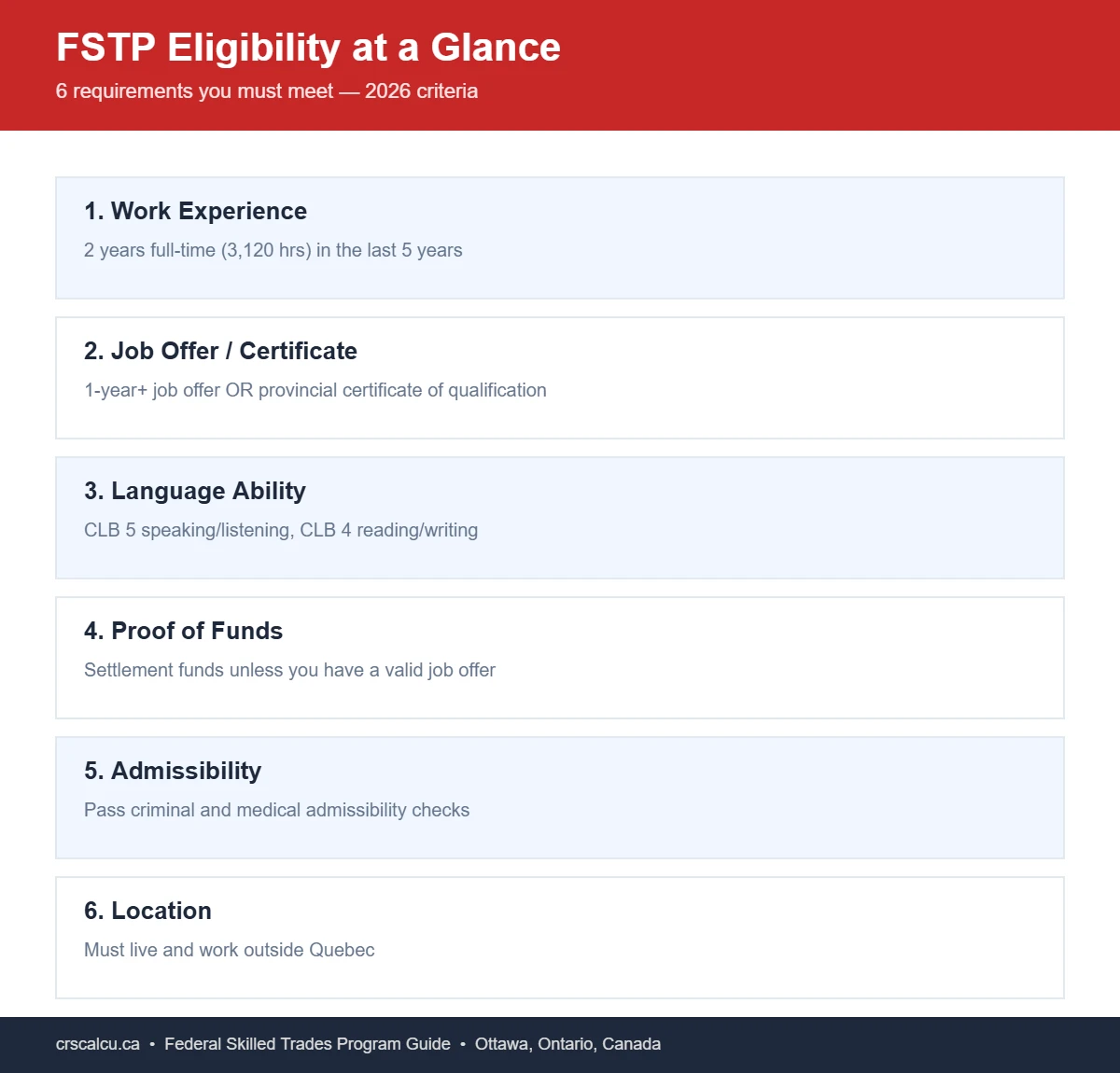
Meeting FSTP eligibility means satisfying six separate requirements at the same time. Missing even one disqualifies your profile, so read each one carefully before you apply.
1. Skilled Work Experience Requirements
You need at least two years of full-time skilled trade experience (or the part-time equivalent of 3,120 hours) within the five years immediately before you apply. Part-time work counts too, but only up to a maximum of 30 hours per week, and it must total at least 1,560 hours.
Your experience must fall under specific National Occupational Classification (NOC) groups: Major Groups 72 (excluding sub-group 726), 73, 82, 83, 92, or 93. This covers construction trades, industrial and equipment operators, natural resources workers, and processing and manufacturing supervisors. Use our NOC TEER Finder to confirm your exact code.
The work has to be paid, and it must reflect the actual lead statement and most of the main duties listed for that occupation. Student work experience, including co-ops and internships, does not count toward this requirement.

2. Job Offer or Certificate of Qualification
You need one of two things: a full-time job offer of at least one year from a Canadian employer, or a certificate of qualification in your trade issued by a provincial, territorial, or federal authority. The certificate route is common because it doesn’t depend on finding an employer first.
Getting certified usually means passing a trade exam through the relevant provincial body, such as a Red Seal exam where applicable. This step can take months, so tradespeople planning ahead often start certification before touching their Express Entry profile.
3. Language Ability (CLB Requirements)
FSTP has one of the more forgiving language thresholds in Express Entry. You need Canadian Language Benchmark (CLB) 5 for speaking and listening, and CLB 4 for reading and writing, in English or French, confirmed through an approved test like IELTS General, CELPIP, or TEF Canada. Use our CLB Calculator to convert your test scores.
This is noticeably lower than the CLB 7 typically expected under the Federal Skilled Worker Program, which is part of why FSTP appeals to tradespeople whose English or French may be conversational rather than academic.
4. Proof of Funds
Unless you already have a valid Canadian job offer or authorization to work in Canada, you’ll need to show proof of settlement funds. The exact amount depends on your family size and is updated periodically by IRCC, so always check the current threshold on canada.ca before applying.
Funds must be readily available, meaning not tied up in property, business investments, or retirement accounts you can’t access quickly. Bank statements covering the last six months are the standard form of proof.
5. Admissibility to Canada
Every applicant must pass standard admissibility checks, covering criminal history, past immigration violations, and medical examinations. A serious criminal record in your home country can result in inadmissibility, though some cases qualify for rehabilitation.
Medical exams are conducted by IRCC-approved panel physicians and check for conditions that could pose a public health or safety risk, or that would place excessive demand on Canada’s health system.
6. Where You Can Live (Quebec Exclusion)
FSTP applicants must intend to live and work outside Quebec. If your trade and your heart are set on Quebec, you’ll need to apply through the Programme de l’expérience québécoise or another Quebec-specific stream instead, since Quebec manages its own selection independently of federal Express Entry.

Who Should Apply Through This Pathway?
This route makes the most sense for a specific kind of applicant, and knowing whether you fit the profile early saves you time. If you’ve spent years on job sites or in a shop rather than a classroom, and your paperwork proves it, this is likely your strongest option compared with other Express Entry streams.
Recent immigrants already working in Canada on a temporary permit in an eligible trade are also strong candidates, since they can often combine local experience with a Canadian job offer to boost their ranking. Overseas applicants with a recognized trade certificate from their home country, plus a Canadian employer willing to sponsor them, fit well too.
On the other hand, if your background is mostly academic or office-based, even in a technical field like engineering, you’re generally better served applying through the worker stream built for professional occupations. Mixing the two profiles rarely helps and can slow down your file if the wrong NOC code gets attached to your application.
Which Skilled Trades Qualify? (NOC TEER Categories)
Not every trade counts, so checking your NOC code before applying saves you from a wasted profile. Eligible trades fall into four broad sectors.
Construction Trades
This group includes electricians, plumbers, carpenters, welders, roofers, and heavy equipment operators. These are consistently among the highest-demand occupations in FSTP draws because provincial infrastructure and housing projects depend on them.
Transportation Trades
Long-haul truck drivers and other transport-sector trades fall under NOC Major Group 73. Demand here has grown steadily as Canada’s freight and logistics sectors face persistent labour shortages.
Manufacturing & Industrial Trades
Machinists, industrial mechanics, and processing equipment operators fall under this category. These roles are concentrated in Ontario, Alberta, and British Columbia’s manufacturing hubs.
Natural Resources & Agriculture Trades
This covers occupations tied to mining, forestry, fishing, and agricultural production, reflecting Canada’s reliance on resource-sector labour outside major urban centres.
Here’s a quick reference for how the sectors map to typical job titles and TEER levels:
| Sector | Typical Occupations | TEER Level |
|---|---|---|
| Construction | Electrician, plumber, carpenter, welder, roofer | TEER 2-3 |
| Transportation | Long-haul truck driver, transport supervisor | TEER 3 |
| Manufacturing & Industrial | Machinist, industrial mechanic, machine operator | TEER 2-3 |
| Natural Resources & Agriculture | Mine labourer, farm supervisor, fishing crew | TEER 2-4 |
If your occupation isn’t listed here, don’t guess. A mismatched NOC code is one of the fastest ways to have an otherwise strong application refused. Confirm the exact code with the official NOC finder tool on canada.ca before moving forward.
How CRS Scoring Works for FSTP Candidates
Once your FSTP profile is accepted into the Express Entry pool, you’re ranked using the same Comprehensive Ranking System as every other candidate. Age, education, language ability, and work experience all contribute points, and a valid job offer can add a meaningful bonus.
You can then be invited either through a general, all-program draw, or through a category-based draw specifically targeting trades occupations. Category-based trades draws have generally had lower cutoffs than general draws, which is where FSTP candidates often gain the biggest advantage.
Not sure where your score lands? Run the numbers through our CRS Calculator and compare against real invitation data below.
Recent FSTP-Related Express Entry Draws
| Draw Date | Draw Type | CRS Cutoff | Invitations Issued |
|---|---|---|---|
| April 2, 2026 | Trade Occupations (Category) | 470 | 3,000 |
| September 18, 2025 | Trades (Category) | 505 | 1,250 |
Trades draws have generally faced less competition than Canadian Experience Class draws, and analysts expect cutoffs to remain in a similar range as Canada continues addressing skilled trade labour shortages. Check our Latest Express Entry Draws & CRS Cutoffs page for the most current numbers, and see how category-based selection affects your odds.
A provincial nomination can also change the picture entirely. Several provinces run trade-specific streams under the Provincial Nominee Program, and a nomination adds 600 CRS points, which effectively guarantees an ITA in the next draw. If your trade is in demand in a specific province, it’s worth checking their nomination stream alongside your federal application.
Ontario, British Columbia, and Alberta have historically run some of the most active trade-focused nomination streams, often targeting occupations facing acute local shortages such as welders, heavy-duty mechanics, and industrial electricians. Provincial requirements differ from federal ones, so a nomination stream might accept a slightly lower CRS score, a different NOC code, or additional proof of a local job offer. Checking both the federal and provincial routes side by side often reveals the fastest realistic path to an invitation, rather than waiting exclusively on general federal draws.
Step-by-Step: How to Apply Through the Federal Skilled Trades Program
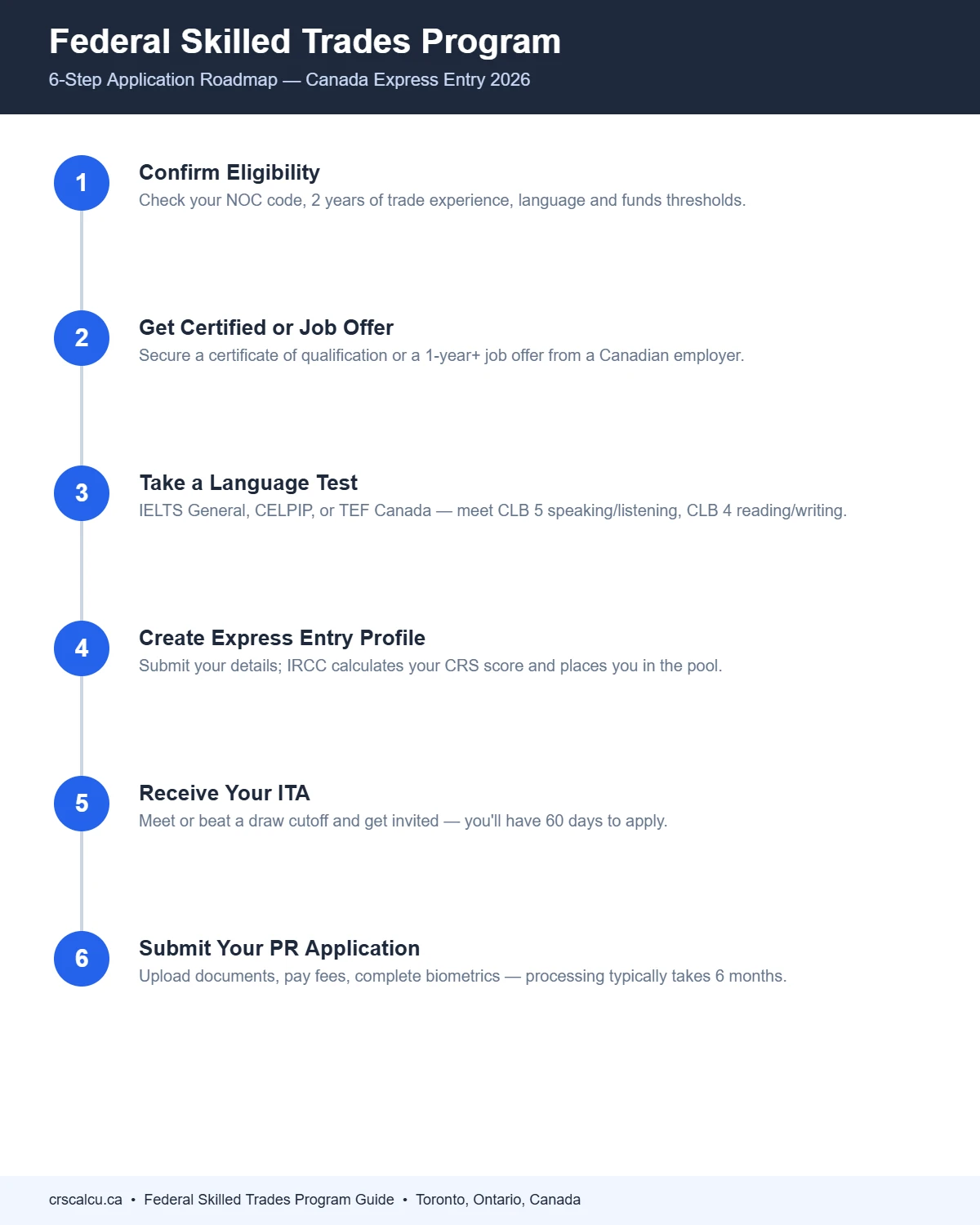
Applying under FSTP follows a defined sequence. Skipping steps or applying out of order is one of the most common causes of delay.
Step 1: Confirm Your Eligibility
Check your NOC code, count your qualifying work experience hours, and confirm you meet the language and funds thresholds before you do anything else. Use our How to Calculate Your CRS Score guide to estimate where you’ll land.
Step 2: Get Your Certificate of Qualification or Job Offer
If you don’t already have a job offer, apply for trade certification through the relevant provincial or territorial authority. This step often has the longest lead time, so start early.
Step 3: Take a Language Test
Book an approved test (IELTS General, CELPIP, or TEF Canada) and get your Canadian Language Benchmark equivalency using the official language testing guidance on canada.ca. Results are typically valid for two years from the test date.
Step 4: Create Your Express Entry Profile
Enter your details into the IRCC Express Entry portal, including your NOC code, certificate or job offer information, language scores, and work history. The system calculates your CRS score automatically and places you in the pool.
Step 5: Wait for an Invitation to Apply (ITA)
Once your CRS score meets or beats a draw’s cutoff, either in a general round or a trades-specific category draw, you’ll receive an ITA. You can track patterns using the official rounds of invitations data on canada.ca. From here, you have 60 days to submit a complete application.
Step 6: Submit Your PR Application
Upload all required documents, pay the processing fees, and complete biometrics. Processing times vary, but most complete applications are finalized within six months.
What Happens After You Submit Biometrics
Once biometrics are complete, your file moves to a visa office for final review. Officers verify your work history, cross-check your certificate of qualification, and may request additional documents if anything looks incomplete or inconsistent with your profile. Responding quickly to these requests, usually within 30 days, keeps your file moving instead of stalling.
If everything checks out, you’ll receive Confirmation of Permanent Residence (COPR). At that point you can finalize your move, arrange housing, and plan your landing date in Canada. Most applicants aim to land within the validity window of their medical exam, which is typically about 12 months.
Documents You’ll Need for the Federal Skilled Trades Program
- Valid passport
- Language test results (IELTS General, CELPIP, or TEF Canada)
- Certificate of qualification or job offer letter
- Proof of funds (bank statements)
- Educational credential assessment (optional but helpful for CRS points)
- Police certificates from every country you’ve lived in for six months or more
- Medical exam completed through an IRCC panel physician
Keep digital copies of everything in one folder from day one. Missing or last-minute paperwork is one of the most preventable reasons applications stall after an ITA is issued, and the 60-day submission window moves faster than most applicants expect.
What Does It Cost to Apply?
Government processing fees for a principal applicant currently run a few hundred dollars for the application itself, plus the Right of Permanent Residence Fee, and additional fees apply for a spouse or dependents included on the application. Language testing, credential assessments, and medical exams are paid separately and vary by provider and country.
Budget for these costs early. Many applicants underestimate the combined total once translation fees, courier costs, and police certificate fees from multiple countries are factored in, and unexpected costs can delay document submission during the tight 60-day ITA window.
Common Mistakes That Get Federal Skilled Trades Program Applications Rejected
The most frequent error is miscounting work experience hours, especially when converting part-time hours or combining experience across multiple employers. Double-check your math against the 3,120-hour full-time threshold before submitting, since even a small shortfall results in an automatic refusal.
Another common mistake is submitting a job offer that doesn’t meet the one-year minimum duration, or that comes from an employer not authorized to make Express Entry job offers. Confirm the offer letter explicitly states full-time status and duration, ideally in writing from HR rather than a verbal promise.
Language test expiry is an easy one to miss. If your test results are more than two years old at the time of your application, they’re no longer valid, and your profile can be refused outright. Set a calendar reminder well before your test’s expiry date so you’re never caught applying with stale scores.
A fourth mistake worth flagging: applying under the wrong NOC code. Some trades look similar on paper but sit in different TEER levels or major groups, and IRCC officers do check this closely. When in doubt, review the official job description line by line rather than relying on your job title alone.
Federal Skilled Trades Program vs. Federal Skilled Worker vs. CEC
FSTP, the Federal Skilled Worker Program (FSW), and the Canadian Experience Class (CEC) are Express Entry’s three main pathways, and each targets a different kind of applicant. FSW is built for candidates with formal education and skilled professional experience abroad, and it requires higher language scores (typically CLB 7).
CEC is designed for people who already have at least one year of skilled work experience inside Canada, usually gained through a work permit. FSTP sits apart from both: no formal education requirement, lower language thresholds, and a specific focus on hands-on trade occupations rather than professional or managerial roles.
If you’re unsure which stream fits your background, compare your work history against our Canadian Experience Class guide and our FSW Points Calculator to see where you score highest.
It’s also worth knowing that qualifying under more than one program at once is possible. Some tradespeople with Canadian work experience meet the requirements for both this trades pathway and CEC simultaneously, and IRCC will rank them under whichever program produces the higher CRS score in the pool, so there’s no downside to meeting multiple sets of criteria.