
Express Entry Guide · Updated October 2026
Your reading is fine, your listening is fine, and one skill keeps your whole score down — so why does your IELTS CELPIP preparation treat all four skills the same?
By Aria Sterling · Checked against IRCC rules · 12 min read
Most IELTS and CELPIP preparation plans fail for a simple reason: they are generic. They never ask which skill is actually costing you points. Express Entry does not work that way. IRCC scores each ability separately, converts it to a Canadian Language Benchmark (CLB) level, and awards points ability by ability. One weak skill can sit there quietly eating 8, 16 or 24 points while you polish skills that are already fine.
This post builds an IELTS CELPIP preparation plan the other way around. You start by finding your weakest ability in CLB terms, you put most of your study time there, and you retake only when practice tests say you are ready. It is written for people who have already taken a test once and are staring at a result that is almost good enough.
Evidence base: IRCC’s CRS criteria page and language-test pages on canada.ca, plus paraphrased reports from public applicant threads. This is general information, not legal advice.
Quick answer:
Convert every result to CLB levels, find the ability with the lowest CLB, and spend roughly 70% of your study time on that one skill. Book a retake only after two timed practice tests in a row clear your target band. Retaking everything equally, or retaking your strongest skill because it feels good, is the most common waste of time and money in this whole process. That is the core of IELTS CELPIP preparation: diagnose, target, retake.
Key takeaways
Start IELTS CELPIP Preparation With Your CLB Profile, Not Your Overall Band
The first step of any serious IELTS CELPIP preparation plan is a conversion exercise, and it takes ten minutes. Take your latest result and write down the CLB level for each ability separately. Do not average anything. IRCC never averages your four abilities for CRS points; it scores them one by one.
This ten-minute conversion is the foundation of IELTS CELPIP preparation: without CLB levels, you cannot see which skill is actually behind.
The IELTS conversions trip people up because the same band means different CLB levels in different skills. Listening 8.0 is CLB 9, but reading 7.0 is also CLB 9, while listening 7.5 is only CLB 8. A candidate with listening 7.5, reading 8.0, writing 6.5 and speaking 7.0 does not have “a 7.5 problem” — they have a writing problem (CLB 8) and a listening problem (CLB 8), with reading and speaking already at CLB 9 and CLB 10 respectively. If that candidate spends a month on reading, they gain nothing.
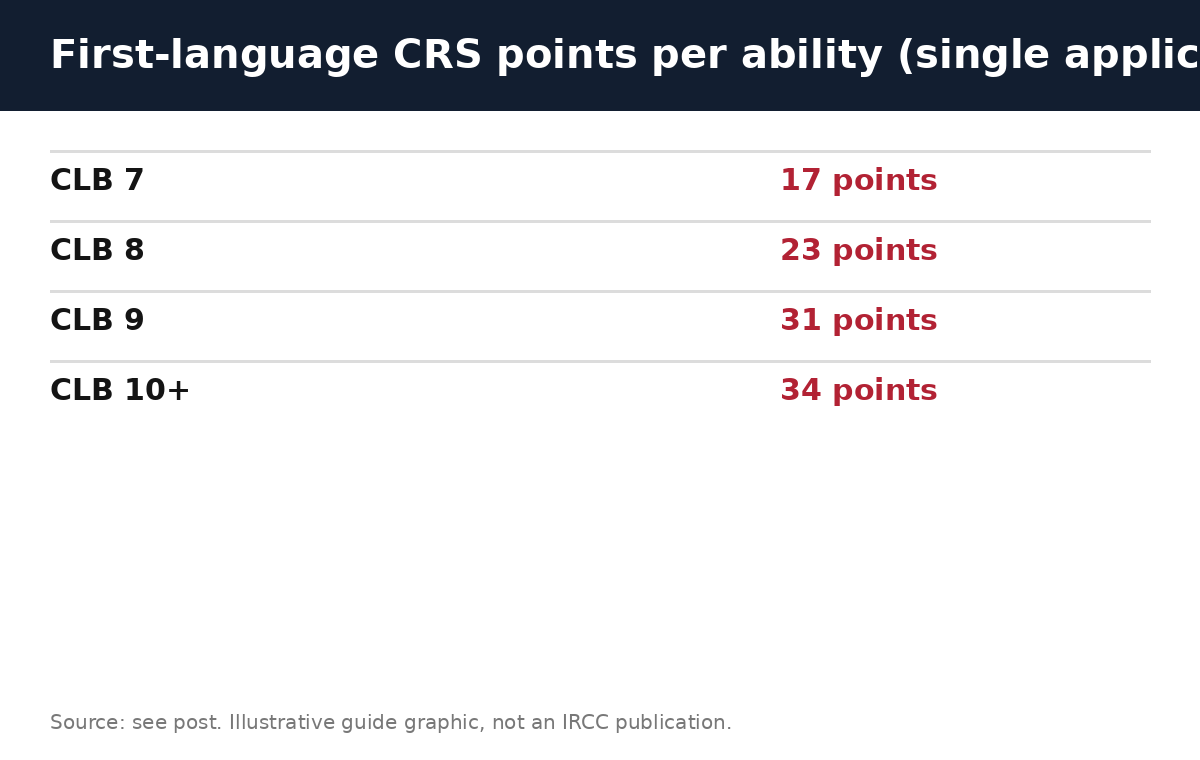
CLB level | IELTS General Training | CELPIP-General | Points per ability (single) | Points per ability (with spouse) |
|---|---|---|---|---|
CLB 7 | 6.0 in each ability | 7 in each ability | 17 | 16 |
CLB 8 | Listening 7.5, Reading 6.5, Writing 6.5, Speaking 6.5 | 8 in each ability | 23 | 22 |
CLB 9 | Listening 8.0, Reading 7.0, Writing 7.0, Speaking 7.0 | 9 in each ability | 31 | 29 |
CLB 10 or higher | Listening 8.5, Reading 8.0, Writing 7.5, Speaking 7.5 | 10 in each ability | 34 | 32 |
Source: IRCC’s CRS criteria page (canada.ca). CELPIP scores map directly onto CLB levels. If your result is older than two years, none of this matters — it cannot be used.
Once you have the four CLB levels, circle the lowest one. That is your target. If two abilities tie at the bottom, pick the one that is closest to the next band — the one where a small improvement crosses a threshold. A writing 6.5 (CLB 8) that needs 7.0 is a better first target than a listening 7.0 (CLB 8) that needs 8.0, because the gap is smaller. Convert your results with our CLB calculator if you want to check the conversion before you plan anything.
Why One Weak Ability Costs More Than You Think in IELTS CELPIP Preparation
Language points are awarded per ability, so the arithmetic is blunt. Moving a single ability from CLB 8 to CLB 9 is worth 8 points for a single applicant (6 points with an accompanying spouse). Moving all four abilities from CLB 8 to CLB 9 is worth 32 points. That is often the difference between sitting in the pool and getting an invitation, and it comes from one test, not from years of extra work experience.
That per-ability arithmetic is why IELTS CELPIP preparation must start from your lowest skill, not your average.
But the direct points are only half the story. CLB 9 is also the key that unlocks skill transferability, the bonus section worth up to 100 points. With CLB 9 in all four abilities, the education-plus-language and foreign-work-plus-language combinations reach their top tiers; with CLB 8, they sit a tier lower. So a single weak ability does not just cost its own 8 points — it can hold back a whole transferability tier worth 25 points.
Combination | At CLB 7 or 8 | At CLB 9 or higher |
|---|---|---|
Post-secondary credential + language | 13 points (one credential) / 25 points (two or more) | 25 points (one credential) / 50 points (two or more) |
Foreign work experience + language | 13 points (1–2 years) / 25 points (3 years) | 25 points (1–2 years) / 50 points (3 years) |
Source: IRCC’s CRS criteria page (canada.ca). The whole transferability section is capped at 100 points, and these tiers are our summary of that page, not IRCC text.
There is a flip side worth knowing before you over-invest. Once you reach CLB 9 in all four abilities, the next level buys very little: CLB 9 to CLB 10 is worth only 3 points per ability. If you are already at CLB 9 everywhere, spend study time on French, a second credential, or a provincial nomination instead. Check the effect of any change in our CRS calculator before you pay for another test.
Build the IELTS CELPIP Preparation Plan Around the Weakest Ability
Here is the plan, step by step. It assumes you have one weak ability and a test date you can choose, not one forced on you.
Work this plan in order, and let IELTS CELPIP preparation follow your weakest ability rather than a generic timetable.
Keep the plan focused: IELTS CELPIP preparation works when most of your time goes to the weakest ability.
Step 1 — Diagnose properly. Do one full timed practice test and mark it harshly, especially writing. Most people over-mark their own writing. If you can, get one or two writing tasks marked by a teacher or a tutor who knows the band descriptors. A vague “your writing is good” is useless; you need to know whether you are losing marks on task response (you did not answer every part), coherence (your paragraphs do not flow), vocabulary, or grammar.
Step 2 — Split your time 70/20/10. Spend about 70% of study time on the weakest ability, 20% keeping the other three warm, and 10% on full timed practice. If writing is the problem, that means most days you are writing a full task under time pressure, not reading about writing. Reading about a skill is not practising it.
Step 3 — Train the skill, not the test in general. Each weak skill has its own drills. For writing: plan each essay before you write and answer every bullet in a letter task. For speaking: record yourself and count hesitations — fluency matters more than rare words. For reading: skim for the main idea first, then scan for details. For listening: practise note-taking with abbreviations, because the recording is played once.
Step 4 — Use the practice-test gate. Do not book the real test because a month has passed. Book it when two timed practice tests in a row, marked strictly, clear your target band in the weak skill without the strong skills dropping. If you cannot clear the band twice in practice, you will not clear it under exam pressure.
Tip:
Keep a one-page log: date, skill practised, time spent, practice score. After three weeks the log tells you the truth about where your hours actually went — and most people discover they spent them on their favourite skill, not their weakest.
IELTS or CELPIP: Pick the Test That Suits Your Weak Skill
Switching tests is sometimes the right move, but only for format reasons, never as a shortcut around a skill gap. The two tests measure the same four abilities and IRCC converts both to the same CLB scale, so a weak writer is a weak writer in either format. What changes is how the weakness shows up.
Choose the format that lets your weak skill show its real level, and IELTS CELPIP preparation becomes a format decision, not a gamble.
CELPIP is fully computer-based, uses Canadian accents, and gives you a word counter and spell-check in writing. Candidates who type faster than they handwrite often do better on CELPIP writing. IELTS General Training can be taken on paper or computer, and its speaking test is a face-to-face conversation with an examiner, which some candidates find more natural than speaking into a microphone. If speaking is your weak skill, try both speaking samples before deciding.
Two hard rules apply whichever test you choose. First, IELTS must be General Training for Express Entry; an Academic result does not count, however high the bands. Second, IELTS One Skill Retake is not accepted for Express Entry — IRCC says so plainly on its language-test page. If only one skill needs work, you still retake the whole test. That makes the practice-test gate in the previous section even more important: a retake costs the full fee either way.
Warning:
Never mix scores from different sittings in your profile. IRCC assesses one test result, with one certificate or report number. Entering your best listening from one test and your best writing from another is not a strategy — it is a mismatch IRCC can verify with the test body.
When to Book the Retake in Your IELTS CELPIP Preparation — and When Not To
Book the retake when three things are true: your practice tests clear the target band twice, your other abilities are stable, and your current result still has enough validity left that you are not racing an expiry date. If your current result expires within a few months, book earlier than you would like and treat the retake as insurance — a lapsed result can freeze a profile at the worst moment.
Booking on evidence, not frustration, is the discipline that makes IELTS CELPIP preparation pay off.
A retake booked too early wastes a fee; IELTS CELPIP preparation means waiting for two clean practice passes.
Do not book a retake the week after a disappointing result “to keep momentum”. Scores do not improve by themselves, and a second result that is the same or lower costs money and confidence. The candidates who break through are usually the ones who waited, worked on one skill properly, and arrived at the test centre having already passed the same test twice at home.
One practical check before you pay: make sure the name on your test booking matches your passport and your Express Entry profile exactly. Name mismatches across booking, ID and profile are a recurring, entirely avoidable delay. And keep your test report number safe — IRCC can verify results with the test body, and you will need it when you enter the profile.
Traps and Mistakes in IELTS CELPIP Preparation
Real Cases
Real case: Writing 6.5 to 7.0, and the transferability tier that came with it (2023)
A candidate reported IELTS listening 8.0, reading 7.5, writing 6.5 and speaking 7.5 — three abilities at CLB 9 or higher, writing stuck at CLB 8. Instead of retaking everything, they spent six weeks on writing only: timed Task 2 essays, feedback on task response, and shorter, clearer paragraphs. The retake gave writing 7.0. Our arithmetic: that one band was worth 8 direct points, and because all four abilities were now CLB 9, the education-plus-language transferability tier rose as well. No outcome was reported beyond the new result.
Real case: Months spent on reading that was already fine (2022)
Another candidate kept retaking the test after improving reading from 7.0 to 8.0, puzzled that the CRS score barely moved. The problem was listening at 7.5 (CLB 8) and writing at 6.5 (CLB 8). Reading was already CLB 9, so improving it bought only the small CLB 9 to CLB 10 step. The thread is a good warning: if you do not convert to CLB levels first, you can work hard on exactly the wrong skill. No outcome was reported.
Real case: Switching to CELPIP for the word counter (2024)
A candidate who handwrote slowly reported that IELTS writing always ran out of time, even though the ideas were there. After a CELPIP practice test, typing with a word counter and spell-check removed the time pressure, and the writing score reached the equivalent of CLB 9. The lesson is narrow: the switch helped because the barrier was format, not language. A candidate whose writing is weak in ideas will be weak in both formats. No outcome was reported.
Frequently Asked Questions
Should I study all four IELTS or CELPIP skills equally?
No. In IELTS CELPIP preparation, once you know your scores, spend most of your study time on the weakest ability, because Express Entry scores each ability separately and your lowest score caps your points. Keep the stronger skills warm with short weekly practice, but the biggest point gains always come from lifting the weakest skill to the next CLB level, not from polishing a skill that is already strong.
Most traps in IELTS CELPIP preparation come from studying everything equally instead of fixing the one skill that caps your score.
How do I know which ability is my weakest?
In IELTS CELPIP preparation, compare your four ability scores against the CLB conversion table, not against each other in raw marks, because IELTS bands and CELPIP scores convert differently. Your weakest ability is the one with the lowest CLB level, and the one furthest from the next threshold. A diagnostic mock test under timed conditions confirms it, since untimed homework often hides the skill that fails under pressure.
Is CLB 9 worth chasing, or should I stop at CLB 8?
Usually yes, because the jump from CLB 8 to CLB 9 is the largest single language gain in the CRS: first-language points per ability rise from 23 to 31 for a single applicant, and transferability combinations jump too. If you are one ability short of CLB 9, targeted study for that single ability is often the highest-return move in your whole profile.
Can I retake just one IELTS skill for Express Entry?
No. IELTS One Skill Retake is not accepted for Express Entry, so a retake means sitting the full test again, all four abilities, and IRCC assesses one complete test result. You cannot mix scores from different sittings. Plan retakes around the full test, and use the waiting time to fix the weakest ability properly rather than rushing back for the same result.
Should I switch from IELTS to CELPIP if one skill keeps failing?
It can help if the test format is the problem rather than your English: CELPIP is fully computer-based with Canadian accents and contexts, while IELTS uses paper or computer with a face-to-face speaking test. Try a CELPIP practice test first and compare your converted CLB levels. Switch only if the practice result is clearly better, not because a forum post said one test is easier.
How long should I study before retaking the test?
Long enough to fix the specific weakness, not a fixed number of weeks: most candidates need four to eight weeks of focused practice on one ability to move a CLB level, though the range varies widely. Book the retake only after a timed mock test shows the higher score consistently. Retaking too early usually reproduces the same result and costs another test fee.
What if my weakest skill is writing?
Writing is the most common sticking point, and it usually fails on task response and organisation rather than grammar alone: candidates answer the wrong question, or structure the essay poorly, and lose marks before vocabulary matters. Fix it with timed practice against the official task types, plus feedback from a teacher or marker who knows the scoring criteria, not just general English correction.
Final Thoughts
A language retake is the fastest lever most candidates control, but only when it is aimed at the right target. Convert to CLB levels, find the lowest ability, spend most of your time there, and retake when practice says you are ready — not when frustration says you should. Test the change before you make it: enter the new result in the CRS calculator and see the score it produces, including the transferability tiers. In short, good IELTS CELPIP preparation is diagnosis first, study second, retake last.
If your case involves a refused application, a previous misrepresentation finding, or a complicated work history, talk to a licensed consultant (RCIC) or lawyer before you act on anything in this post. For everyone else, the next step is small and concrete: write down your four CLB levels today, circle the lowest, and plan this week’s study around that one skill.
Sources
We build free Express Entry tools and track every IRCC draw. This guide was checked against official IRCC sources and real applicant reports. This is general information, not legal advice. For your own case, talk to a licensed consultant (RCIC) or lawyer.
Last reviewed: October 29, 2026
Additional Details — Name: IELTS and CELPIP Prep Plan That Targets Your Weakest Skill · Description: Stop retaking the wrong skill. Build an IELTS or CELPIP preparation plan around your weakest ability and the CLB level that actually moves your CRS score.