Express Entry Draw #432 Results: CRS Cutoff 516 in Aug 5 CEC Round
On August 5, 2026, Immigration, Refugees and Citizenship Canada issued 3,000 invitations to apply for permanent residence in Express Entry Draw #432. The round was reserved for Canadian Experience Class candidates, and the CRS cutoff landed at 516, roughly in line with where CEC draws have sat for most of the summer.
If you have been watching your Comprehensive Ranking System score and wondering whether this was the round that would finally include you, this breakdown walks through exactly what happened, how it compares with the rounds before it, and what a score in the 500s versus a score in the 400s actually means for your chances heading into the fall. This is the first in an ongoing series where we will recap everyExpress Entry Draw and provincial nominee draw as soon as it is announced, so you always know where the cutoff stands without digging through IRCC’s tables yourself.

What Happened in Express Entry Draw #432
Round #432 was a program-specific draw limited to candidates already eligible under the Canadian Experience Class, meaning applicants needed at least one year of skilled Canadian work experience within the past three years to be considered. IRCC invited exactly 3,000 people, and the lowest CRS score among those invited was 516. Anyone ranked 3,000th or better in the CEC-eligible pool at the time of the draw received an invitation to apply, commonly called an ITA.
Because ties are common right at the cutoff score, IRCC also published a tie-breaking rule for this round. Candidates were ranked first by CRS score, and where scores were equal, by the date and time they submitted their Express Entry profile, with anyone who submitted on or before July 3, 2026 at 21:35:13 UTC receiving priority. If your score sits right at 516 and your profile predates that timestamp, this was very likely your round.
How Express Entry Draw #432 Compares to the Last Ten Rounds
Express Entry cutoffs don’t move in a straight line, and the clearest way to see that is to look at the rounds leading up to August 5. Here is what IRCC has run since the start of July:
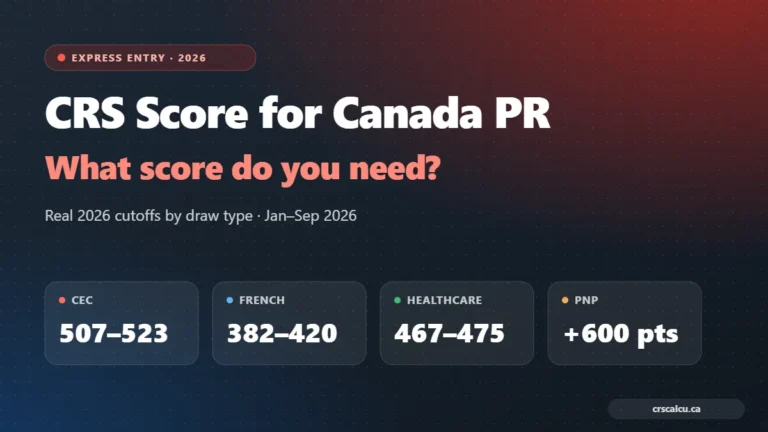
A few patterns jump out. First, CEC-specific cutoffs have barely moved all summer, sitting between 516 and 518 across the last three CEC rounds. That stability is genuinely useful if you are a candidate with Canadian work experience trying to plan your timeline, since it means you can estimate roughly where you need to be without waiting on a single unpredictable draw. Second, Provincial Nominee Program rounds continue to carry much higher cutoffs, typically in the 700s, simply because a provincial nomination adds 600 CRS points on its own, which pushes nominated candidates far above almost everyone else in the pool.
Third, category-based rounds targeting French-language proficiency, healthcare and social services, skilled trades, and other in-demand groups tend to have the lowest cutoffs of all, frequently in the 360 to 480 range, because IRCC is drawing from a narrower, targeted slice of the pool rather than ranking everyone together. August 5 was also the 13th CEC-specific round IRCC has run so far in 2026, underlining how central this category has become to Canada’s Express Entry strategy this year.

Understanding Category-Based Selection in 2026
Since 2023, IRCC has used category-based selection to run Express Entry Draws around specific economic priorities rather than ranking every candidate in the pool together. The categories change from year to year based on labour market needs identified by the Minister, but in 2026 they have included healthcare and social services occupations, French-language proficiency, skilled trades, transport occupations, agriculture and agri-food, and STEM occupations, along with narrower groups like senior managers with Canadian work experience and skilled military recruits, both of which appeared in the July rounds above.
To be considered in a category-based round, a candidate first needs to qualify for one of the three main Express Entry Draw programs, and then meet the specific criteria for that category, such as having recent work experience in a listed occupation or meeting a minimum French test score. Because these rounds pull from a narrower slice of the pool, their cutoffs are often dramatically lower than general or CEC rounds, which is why you will sometimes see a category-based cutoff in the 370s in the same week that a CEC round requires over 500.
What Is Express Entry, and What Is the CRS?
Express Entry is the online system IRCC uses to manage applications for three federal economic immigration programs: the Federal Skilled Worker Program, the Federal Skilled Trades Program, and the Canadian Experience Class. Provincial Nominee Program candidates who receive a nomination linked to Express Entry are also processed through the same system. Rather than approving applications in the order they arrive, IRCC ranks every eligible candidate in the Express Entry Draw pool using the Comprehensive Ranking System, then periodically invites the highest-ranked candidates to formally apply for permanent residence.
The CRS score itself runs on a scale of up to 1,200 points, split across four areas: core human capital factors like age, education, language ability, and Canadian or foreign work experience; spouse or common-law partner factors, if applicable; skill transferability combinations, such as education paired with strong language scores; and additional points for things like a provincial nomination, a valid job offer, French language ability, Canadian post-secondary education, or having a sibling living in Canada. A provincial nomination alone is worth 600 points, which is why nominated candidates dominate the very top of the ranking and why PNP-specific draws show such high cutoffs.
Why the Cutoff Landed at 516 and Not Somewhere Else
IRCC doesn’t publish the exact reasoning behind every cutoff, but the mechanics are straightforward: the department decides how many invitations it wants to issue in a given round, based on its annual Immigration Levels Plan targets and processing capacity, then invites candidates starting from the highest CRS score downward until it reaches that number.
The cutoff is simply the score of the last person invited. IRCC does publish a snapshot of how many candidates sit at each score band in the pool, updated every few days on its Express Entry Draws of invitations page, so if you want to see exactly how crowded the pool is above and below your own score, that is the most current source to check directly.
What This Means If Your CRS Score Is Below 516
A score below 516 doesn’t rule you out, it just means you weren’t in range for this particular CEC round. Looking at the last ten rounds above, candidates with scores as low as the high 300s have still received invitations, just through category-based draws targeting specific occupations or French-language ability rather than general CEC rounds. If your score is closer to 400, it is worth checking whether you qualify for one of the active category-based streams, since those cutoffs run well below general and CEC-specific rounds.
If you are several hundred points away from any recent cutoff, a provincial nomination is usually the fastest way to close the gap, since it adds 600 points on its own. Smaller but still meaningful gains come from retaking a language test to push into a higher CLB band, gaining another year of skilled work experience, or completing additional education. Our CRS calculator lets you plug in different scenarios, like adding a spouse’s language score or an extra year of experience, so you can see exactly how many points each change is worth before you act on it.
How to Track Your Own CRS Score
IRCC’s own official score tool on canada.ca will always be the authoritative source, since it uses the exact formula the department applies when ranking the pool. That said, plenty of candidates find the official tool clunky to experiment with, which is why calculators like ours exist: you can quickly test scenarios such as adding a spouse’s language results, gaining another year of work experience, or completing a French test, and see the point impact instantly, without re-entering your entire profile each time.
If a number you get from a third-party calculator, including ours, differs from what is shown in your official Express Entry profile, the profile score is always the one that counts for invitations; we cover the most common reasons for that kind of mismatch in a separate guide on our site.

What Happens After You Receive an ITA
Once you receive an invitation to apply, you have 60 days to submit a complete electronic application for permanent residence, known as an e-APR. That application needs supporting documents including a medical exam, police certificates from every country you’ve lived in for six months or more since age 18, proof of funds unless you are already working in Canada, and language test results if they weren’t already verified during your profile.
Missing the 60-day window means the ITA expires and you would need to be invited again in a future round, so most successful candidates start gathering documents like police certificates well before they expect an invitation, since those can take the longest to obtain.

When Is the Next Express Entry Draw
IRCC has held rounds roughly every two weeks for general and CEC-specific invitations for most of 2026, with category-based and PNP-specific rounds often slotted in between, sometimes just a day apart, as happened with rounds #431 and #432 in early August. There is no fixed weekly schedule anymore, so the most reliable approach is checking back after each new round is announced rather than assuming a set day. We will publish a fresh breakdown like this one after every draw, so bookmark this page or check our CRS and Immigration Updates hub for the latest cutoff as soon as it is out.

Frequently Asked Questions
Every Express Entry Draw changes the picture slightly, and the gap between a strong CRS score and an actual invitation often comes down to which specific round you happen to be eligible for. If you haven’t checked your own score recently, or want to see how a language retest, extra work experience, or a provincial nomination would move your number, our CRS calculator gives you an exact breakdown in a couple of minutes. We will be back with a full recap as soon as IRCC announces the next round.
Comparing the Three Programs Behind Every Express Entry Draw
Although round #432 was limited to Canadian Experience Class candidates, it is worth understanding how the other two federal programs behind Express Entry differ, since your best strategy depends on which one you actually qualify for. The Federal Skilled Worker Program is built for candidates with foreign work experience who meet a points-based selection grid covering education, language ability, age, and work experience, along with proof of funds unless they already have a valid job offer or authorized Canadian work.
The Federal Skilled Trades Program targets candidates with at least two years of full-time skilled trade experience in an eligible trade, such as construction, electrical, or industrial occupations, and it has looser language requirements than the other two programs but still requires either a qualifying job offer or a certificate of qualification from a Canadian province or territory.
The Canadian Experience Class, the program behind this week’s draw, is for candidates who already have at least one year of skilled work experience inside Canada within the past three years, gained on a valid work permit, and it is generally the fastest route to permanent residence for people already living and working in the country.
Because CEC candidates are already established in the Canadian labour market, IRCC runs CEC-specific rounds frequently, and cutoffs for this program have stayed comparatively predictable through 2026. Candidates under the Federal Skilled Worker Program, by contrast, are more often invited through general rounds.
Combine all three programs together, which tend to have the highest cutoffs of all since every eligible candidate across every program is ranked in a single pool. If you are unsure which program you qualify for, it is worth checking the eligibility criteria for all three before assuming a CEC-specific round like #432 applies to you, since meeting the requirements for the wrong program is one of the most common reasons a completed profile never receives an invitation.
Why Some High-Scoring Profiles Still Don’t Get Invited
Occasionally a candidate with a CRS score comfortably above a published cutoff will still not receive an invitation, and it is rarely a mistake on IRCC’s part. The most common reason is that the candidate is not actually eligible for the program the round was targeting, for example holding a CRS score above 516 but lacking the one year of Canadian work experience required for a CEC-specific round, which would mean waiting for a general round instead.
Expired language test results are another frequent issue, since most language tests are only valid for two years, and a profile with an expired test on file may be ranked incorrectly or flagged during application review.
Outdated proof of funds, an expired passport, or work experience that no longer counts because it fell outside the three-year window can all quietly affect a candidate’s real eligibility even if the CRS score displayed in their profile still looks competitive. Reviewing your Express Entry profile every few months, not just checking your score once and forgetting about it, is the simplest way to avoid discovering one of these issues after an invitation has already gone to someone else.
Whatever your CRS score is today, checking your eligibility across all three programs and keeping your profile documents current are two of the easiest ways to make sure you do not miss the round that was actually meant for you. Use our CRS calculator to see exactly where you stand, and check back for our recap of the next Express Entry draw as soon as IRCC announces it.