Express Entry Guide · Updated September 26, 2026
CRS Score for Canada PR in 2026: What Score Do You Really Need?
Real 2026 cutoffs, real stories from applicants, and a simple plan to raise your points. No fluff, no false promises.
You finally ran the calculator. You got a number. Now you are staring at it and wondering one thing: is my CRS score for Canada PR good enough, or am I wasting my time?
We had the same question, so we went through hundreds of real posts from people on Reddit and Quora. Nurses, software engineers, dentists, students on a PGWP. Some got their PR with scores in the 300s. Some are packing their bags at 510. Their stories taught us more than any brochure.
This guide puts it all in one place. You will see the real 2026 cutoffs, how the points work, the mistakes that quietly cost people 50+ points, and the moves that actually worked. Let’s get into it.
Quick answer: what CRS score do you need for Canada PR?
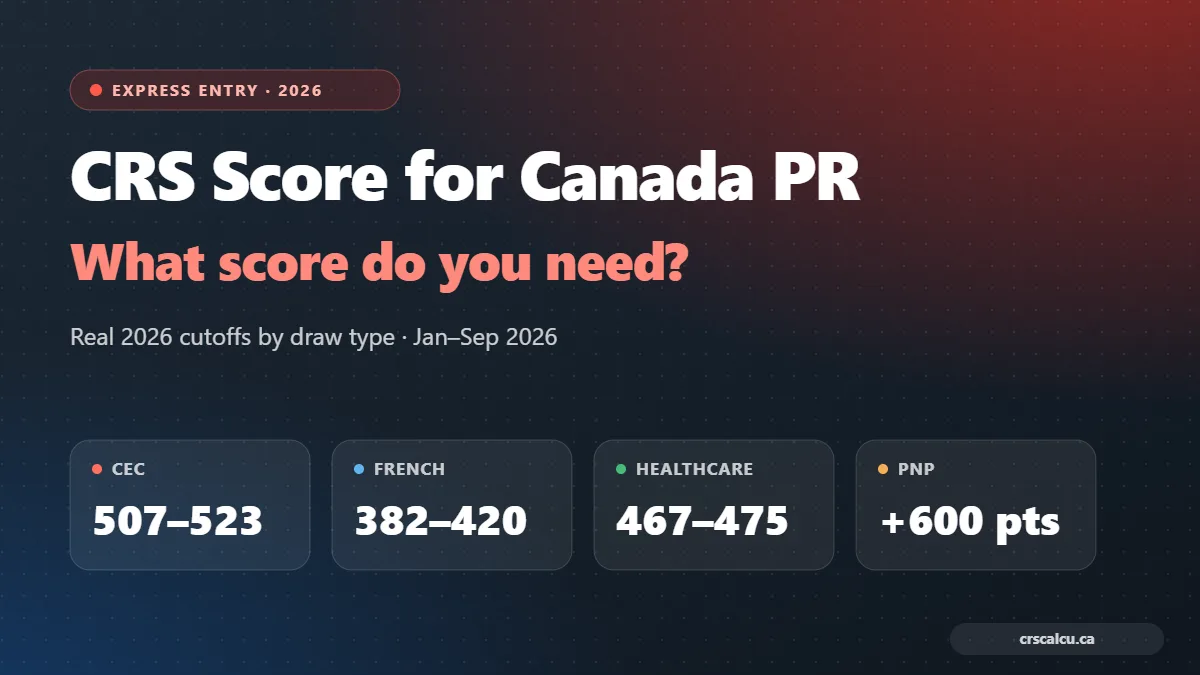
In 2026, there is no single passing score. Canadian Experience Class draws have needed about 507–523 points. French-language draws have gone as low as 382. Healthcare and trades draws landed around 467–477. With a provincial nomination, you get +600 points, which almost guarantees an invitation. Your category matters as much as your score.
Key takeaways
What Is a CRS Score? (Explained Simply)
CRS stands for Comprehensive Ranking System. It is the points system Canada uses to rank people in the Express Entry pool. Think of it like a line at a busy store. The higher your score, the closer you are to the front.
Immigration, Refugees and Citizenship Canada (IRCC) runs draws every few weeks. In each draw, it picks a number of people from the top of the line and sends them an Invitation to Apply (ITA). The lowest score that got picked becomes the “cutoff” for that draw.
Your points come from things like your age, education, English or French test results, and work experience. You can check yours in two minutes with our free CRS calculator, or read how to calculate your CRS score step by step.
Is the CRS score the same as the FSW 67 points?
No, and this confuses a lot of people. The Federal Skilled Worker (FSW) program has its own 100-point grid. You need at least 67 out of 100 just to be eligible to enter the pool. Only after that do you get a CRS score out of 1,200. You can check both with our FSW points calculator.
What CRS Score Do You Need for Canada PR in 2026?
Here is the honest truth: the “right” CRS score for Canada PR depends on which draw you can join. IRCC now runs different draws for different groups. Each group has its own cutoff. Below are the real numbers from 2026 draws so far.
Draw type | 2026 cutoff range | Latest draw | Who can join |
|---|---|---|---|
Provincial Nominee Program (PNP) | 697 – 805 | 734 (Sep 14) | People with a provincial nomination (+600 included) |
Canadian Experience Class (CEC) | 507 – 523 | 519 (Sep 15) | 1+ year of skilled work in Canada |
Trade occupations | 477 | 477 (Apr 2) | 12 months in an eligible trade |
Healthcare & social services | 467 – 475 | 475 (Sep 4) | 12 months in an eligible health job |
Transport occupations | 470 | 470 (Aug 7) | 12 months in an eligible transport job |
French-language proficiency | 382 – 420 | 382 (Aug 19) | NCLC 7+ in all four French skills |
Senior managers (Canadian exp.) | 389 – 429 | 389 (Sep 16) | 12 months as a senior manager in Canada |
Physicians (Canadian exp.) | 169 – 223 | 198 (Sep 3) | 12 months as a doctor in Canada |
Source: IRCC rounds of invitations, compiled by CRS Calculator. PNP scores include the 600 nomination points.
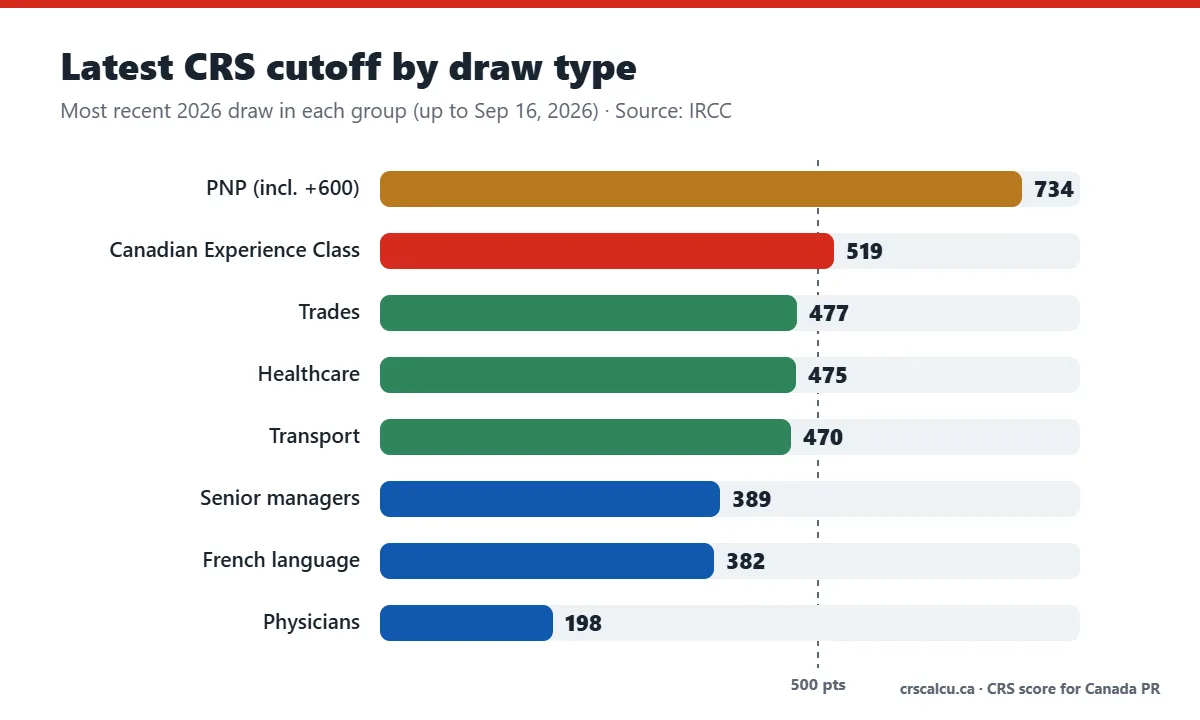
See the pattern? A CEC candidate at 505 is stuck, while a French speaker at 400 gets invited. That is why people on Reddit keep saying the same thing: “category beats score.” For the full list of every round, check our latest Express Entry draws and CRS cutoffs page.
What CRS score do you need for the Canadian Experience Class?
In 2026, CEC draws have stayed in a tight band: 507 to 523. If you have at least one year of skilled work in Canada and a score above 520, you are in a strong spot. Between 505 and 519, it is a coin flip that depends on draw size. Learn how this program works in our Canadian Experience Class guide.
What about Federal Skilled Worker (FSW) candidates outside Canada?
This is the tough one. There has been no general “all-program” draw in 2026. So an FSW candidate with no category and no Canadian experience may wait even with 548 points. One applicant in exactly this spot said the best advice they got was simple: stop waiting and qualify for a category, usually French.
What CRS score do you need for a PNP?
Provinces set their own rules. Some invite people with scores in the 300s if their job is in demand. Once a province nominates you, you get 600 extra points. That pushes almost anyone above the cutoff. See our OINP draw guide and BC PNP draw updates for real provincial numbers.
Is My CRS Score Good? Score Ranges Explained
Let’s make this simple. Find your range in the table below. We based each verdict on 2026 draw results and what real applicants reported.
Your CRS score | Verdict | What to do next |
|---|---|---|
520+ | Strong | Stay ready. Keep documents and test results valid. |
500 – 519 | Borderline | Check every category you qualify for. Small boosts matter. |
470 – 499 | Needs a category | Healthcare, trades, transport or French draws are your path. |
400 – 469 | Low for CEC | French, a better English test, or a PNP. |
Below 400 | Very low alone | PNP streams, French, study, or rural pilots. |
Ranges are a guide, not a promise. Cutoffs change with every draw.
Want a deeper breakdown? Our page on whether your CRS score is good goes range by range. You can also see how many people sit above and below you in our Express Entry pool statistics.
Is 500 a good CRS score for Canada PR?
Yes, but it is not a sure thing on its own. One 25-year-old software engineer had 500 points, mostly thanks to French. People told him he would be fine, because French draws invite people far below 500. Without French or Canadian experience, though, 500 can sit in the pool for months.
Is 450 a good CRS score?
For CEC, no. For a category, maybe. A nurse with 471 points was told she likely could not win a CEC draw. But healthcare draws in 2026 landed at 467 to 475. So the same score can be “too low” and “good enough” at the same time.
Is 400 or less a lost cause?
Not at all. One 35-year-old with 363 points got a provincial nomination from a province where he had never lived. Another person with 370 found that simply retaking IELTS could push him to around 460. Low today does not mean low forever.
How Is the CRS Score for Canada PR Calculated?
Your score comes from four parts. The first three can give up to 600 points together. The fourth part, “additional points,” can add another 600. That is how the total reaches 1,200.
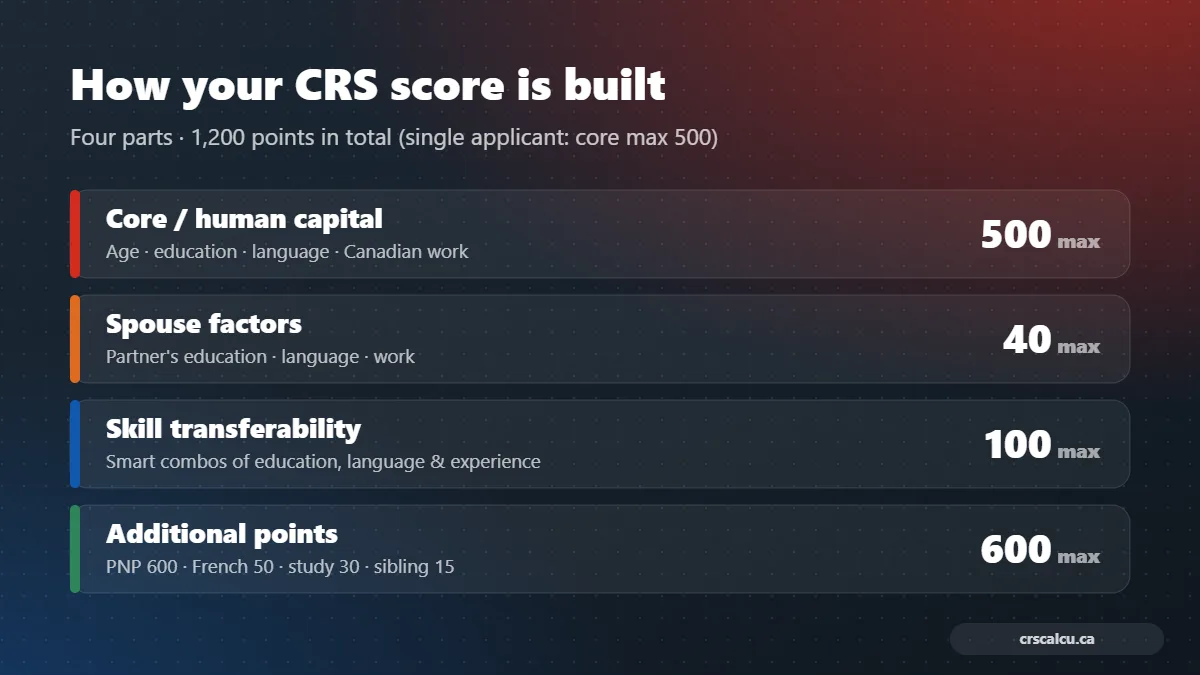
Part | Max (single) | Max (with spouse) | What counts |
|---|---|---|---|
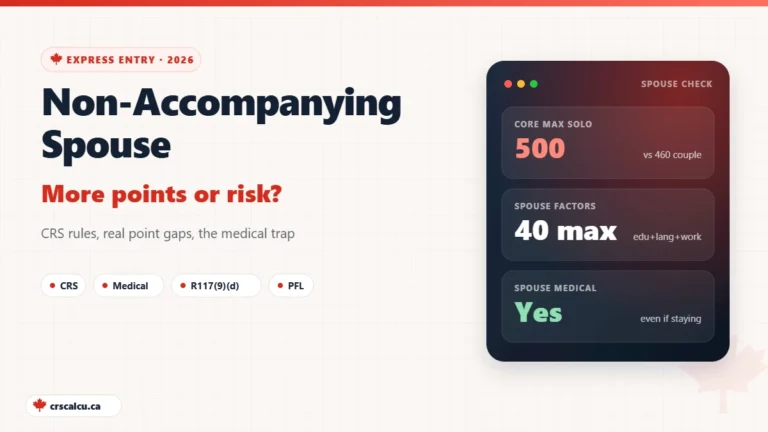
Core / human capital | 500 | 460 | Age, education, language, Canadian work experience |
Spouse factors | 0 | 40 | Your partner’s education, language, Canadian work |
Skill transferability | 100 | 100 | Combos of education, language and experience |
Additional points | 600 | 600 | PNP, French, Canadian study, sibling in Canada |
Based on the official IRCC CRS criteria.
Age points
You get the most points (110 if single) between ages 20 and 29. After 30, you lose a few points each birthday. At 35 you get 77. At 45 and older you get zero. So if you are close to a birthday, do not wait around.
Language points (the biggest lever)
Language is where most people can gain the fastest. Each of the four skills (listening, reading, writing, speaking) earns points. Going from CLB 8 to CLB 9 is a big jump because it also unlocks extra skill transferability points. Use our CLB calculator to convert your IELTS or CELPIP scores.
CLB level | Listening | Reading | Writing | Speaking | Points per skill (single) |
|---|---|---|---|---|---|
CLB 7 | 6.0 | 6.0 | 6.0 | 6.0 | 17 |
CLB 8 | 7.5 | 6.5 | 6.5 | 6.5 | 23 |
CLB 9 | 8.0 | 7.0 | 7.0 | 7.0 | 31 |
CLB 10 | 8.5 | 8.0 | 7.5 | 7.5 | 34 |
CELPIP levels match CLB levels one to one (CELPIP 9 = CLB 9).
Education and work experience points
A bachelor’s degree gives 120 points if you are single. A master’s gives 135. Two or more credentials (one of them three years or longer) give 128. Foreign degrees need an Educational Credential Assessment (ECA) first. For Canadian work, one year gives 40 points and five years gives 80.
Additional points
A provincial nomination adds 600. Strong French (NCLC 7 in all four skills) adds up to 50. Studying in Canada adds 15 or 30, and a sibling in Canada adds 15.
Curious why your number looks different on other sites? Read why CRS calculator scores differ.
Real Story: How One Nurse Went From 598 to 471 Points
Case study: the “598” that was never real
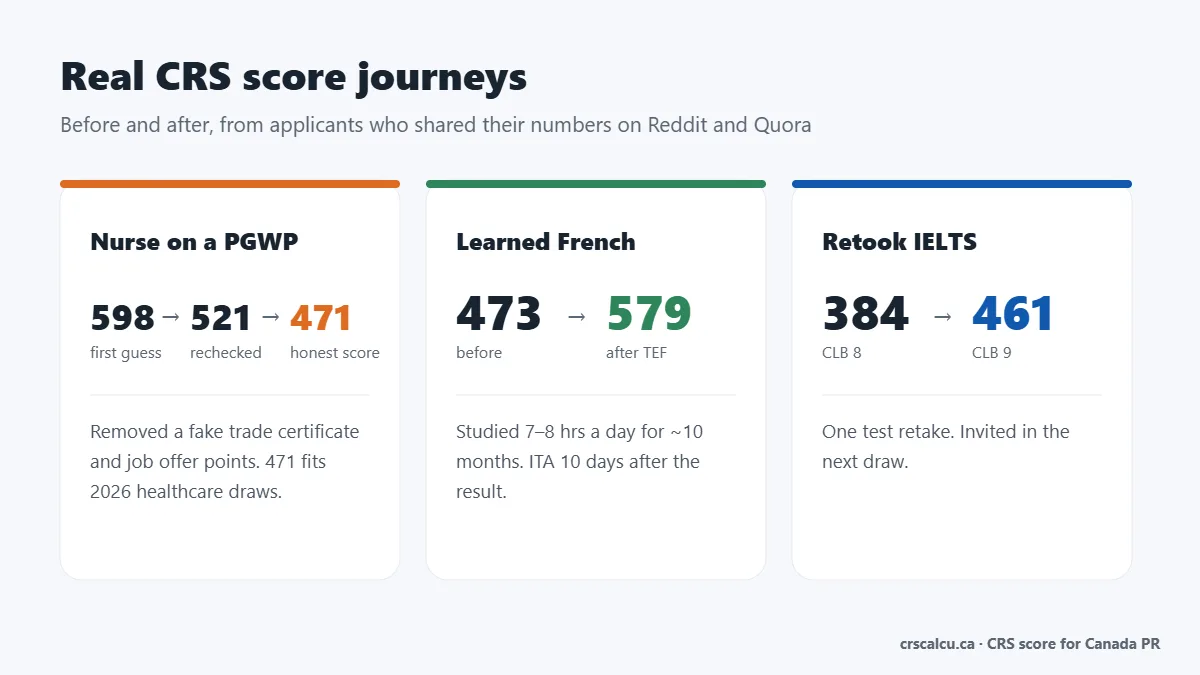
A young nurse in Ontario, working on a PGWP, thought her score was 598. Strangers on Reddit told her it looked too high. She rechecked and got 521. Then she removed points she could not claim and landed at 471.
What went wrong? Two things. First, she counted her nursing license as a “certificate of qualification.” That box is only for skilled trades, like electricians or welders. Second, she claimed job offer points while on an open PGWP. Those points needed an LMIA, and IRCC has since removed job offer points completely.
The good news? At 471, she was right in the range of 2026 healthcare draws (467–475). Her real path was never CEC. It was the healthcare category. The lesson is simple: an honest score plus the right category beats a fake high score every time.
Does a High CRS Score Guarantee PR?
No. A high CRS score for Canada PR only gets you an ITA. After that, an officer checks your documents. If something does not match, you can still be refused.
People on Reddit shared the most common reasons: work letters that do not prove the job duties, proof of funds problems, missing police certificates, and misrepresentation (like hiding a marriage). Officers also send “procedural fairness letters” when they doubt foreign work experience. Only claim what you can prove.
What IRCC checks after your ITA
Why Is My CRS Score 0?
A zero means your profile is not eligible for any program, so the system will not rank you. One applicant saw 516 on the calculator, then 0 on the real profile four times in a row. The fix was an ECA for her degree. Here are the usual causes:
Common reasons for a CRS score of 0
12 Proven Ways to Increase Your CRS Score
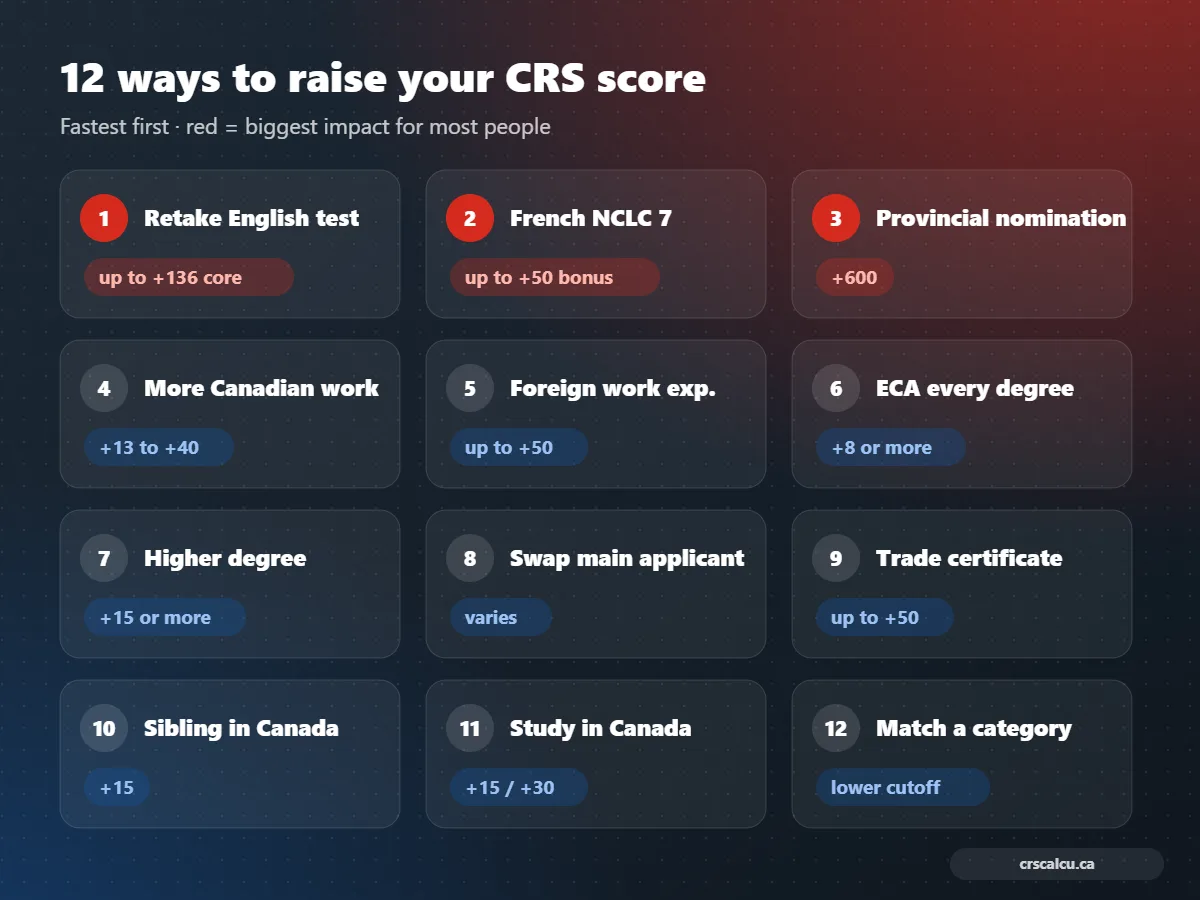
Here is where the real stories get useful. These are the moves that raised real applicants’ CRS score for Canada PR, ranked from fastest to slowest.
1. Retake your English test
This is the fastest win for most people. One Quora user went from 384 points at CLB 8 to 461 points at CLB 9, and got an ITA in the next draw. Aim for IELTS 8-7-7-7 (CLB 9) or higher. Many people find CELPIP easier to max out, so it is worth a try.
2. Learn French to NCLC 7
French is the most powerful boost in 2026. It adds up to 50 extra points and opens French-language draws with cutoffs as low as 382. One applicant studied 7 to 8 hours a day for about 10 months. His score jumped from 473 to 579, and his ITA came 10 days after his test result.
Real tip from a successful applicant
Study every day with a clear plan: grammar, listening, reading and writing blocks, plus 45 minutes of speaking practice with a partner. Do not skip days. Even a few extra French points can help if you are only 4–6 points short.
3. Get a provincial nomination (+600)
A nomination is the single biggest boost. Every province has its own streams, and many look at your occupation first. Check our BC PNP points calculator and Alberta PNP calculator to see where you stand.
4. Gain more Canadian work experience
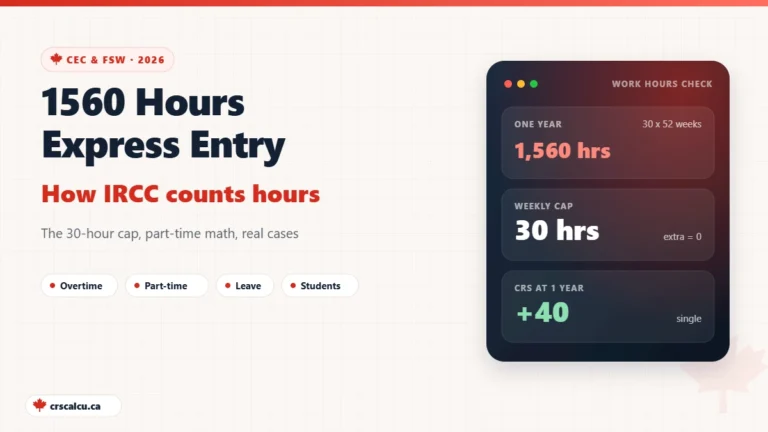
Going from one to two years of Canadian work lifts your core points and can also raise transferability points. Experience is counted in full-time weeks (30 hours a week), so a job that lasted only a few months still counts toward your total.
5. Add foreign work experience
If your permit is ending, one year of skilled work back home can add 25 to 50 transferability points. Several people in our research did exactly this. It is hard, but it works.
6. Get an ECA for every degree
If you have two credentials, get both assessed. Two credentials (one of three years or more) score higher than one. Use an IRCC-designated organization. See the official ECA requirements on canada.ca.
7. Finish a higher degree (even online)
One PGWP holder earned a master’s online from a university in Spain while working full-time in Canada. It added 15 points and helped her get an ITA. But be careful: the ECA must accept your school, and officers may question work done during full-time study. Get advice first.
8. Swap the principal applicant
If your spouse has a better profile, make them the main applicant. Run the calculator both ways. Your spouse’s language test and ECA can also add up to 40 points.
9. Get a certificate of qualification (trades only)
If you work in a skilled trade, a provincial certificate of qualification can add up to 50 transferability points. One tradesperson got a certificate through Skilled Trades BC and received an ITA plus a better-paying job.
10. Claim your sibling in Canada
A brother or sister in Canada who is a citizen or PR, aged 18 or older and living here, is worth 15 points. Many people forget this one.
11. Study in Canada
A Canadian diploma or degree adds 15 or 30 points and makes it easier to gain Canadian work experience after you graduate. It is expensive, so only do it if you want the education anyway.
12. Match your job to a category (NOC)
Not every STEM job is in the STEM category. Your job duties must match an eligible NOC code, and a similar title is not enough. Use our NOC TEER finder to check your code honestly.
Low CRS Score? 6 Other Ways to Get Canada PR
If your CRS score for Canada PR is below 450, you are not out. Many people get PR without a high score. Here are the paths that worked for people in our research.
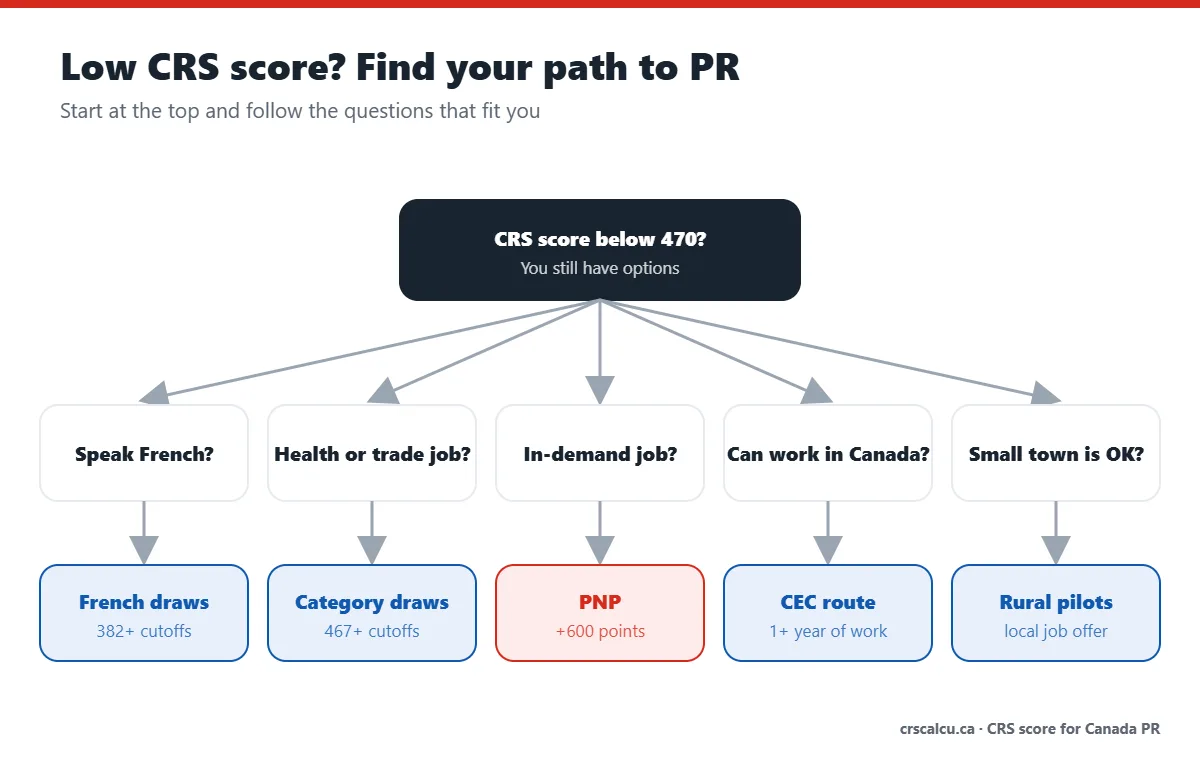
Pathways that do not need a top CRS score
One more thing: do not wait to enter the pool. Making an Express Entry profile is free. You only pay fees after you get an ITA. A profile stays active for 12 months, and you can update it any time your score improves.
Category-Based Draws in 2026: Where the Lowest Scores Are
In 2026, IRCC runs draws for these groups. Most now need 12 months of full-time work experience in an eligible job within the last three years (up from six months in 2025). See the official category list on canada.ca and our category-based draws 2026 guide.
Category | Main requirement | Draws in 2026? |
|---|---|---|
French-language proficiency | NCLC 7 in all four skills | Yes, frequent (382–420) |
Healthcare & social services | 12 months in an eligible job | Yes (467–475) |
Trade occupations | 12 months in an eligible trade | Yes (477) |
Transport occupations | 12 months in an eligible job | Yes (470) |
Physicians (Canadian exp.) | 12 months as a doctor in Canada | Yes (169–223) |
Senior managers (Canadian exp.) | 12 months in Canada | Yes (389–429) |
Researchers (Canadian exp.) | 12 months in Canada | Not yet |
STEM occupations | 12 months in an eligible job | Not yet in 2026 |
Education occupations | 12 months in an eligible job | Not yet in 2026 |
Draw data: January 1 to September 16, 2026.
How Much Does Canada PR Cost?
The profile is free, but the PR application is not. Here are the main government fees and proof of funds amounts listed by IRCC. Always double-check the official IRCC fee list before you pay.
Item | Cost (CAD) |
|---|---|
Processing + right of PR fee (each adult) | $1,590 |
Dependent child | $270 |
Biometrics (one person / family) | $85 / $170 |
Proof of funds, single person | $15,263 |
Proof of funds, family of four | $28,362 |
CEC applicants and people with a valid job offer and work permit do not need to show proof of funds.
On top of this, budget for language tests, ECA, medical exams, police certificates and translations. See the full proof of funds table on canada.ca.
What Happens After You Get an ITA?
Your next steps after an Invitation to Apply
If you miss the 60-day window, the ITA expires and you go back into the pool. Plan ahead so a single missing police certificate does not cost you everything.
Common CRS Mistakes That Cost People Points
Before you trust any CRS score for Canada PR, check it against this list. These errors came up again and again in real threads.
Mistakes we saw again and again
Also, staying in Canada does not give you priority in draws. People inside and outside Canada are ranked the same way.
Your Permit Is Ending and Your Score Is Borderline. Now What?
This part is hard, and we will not pretend it isn’t. Many people with scores around 500 wrote about lost sleep, quitting good jobs, and saying goodbye to friends. One applicant with 510 points spent seven years in Canada and still had to go home to build foreign experience.
The best advice from people who went through it: set a “decision date.” Pick a date when, if nothing changes, you will switch to plan B. Keep improving your score from wherever you are. Many applicants received their ITA from outside Canada and came back.
A line worth remembering
One applicant summed it up: never put your whole life on hold for a decision that is out of your control. Keep building your score, but keep living too.
Will the CRS Change Soon? (2026 Proposed Reforms)
In April 2026, IRCC shared proposals to change Express Entry. Ideas include merging the three programs into one, adding points for high-wage jobs, and bringing back job offer points for high-paying roles. Some existing points, like French or sibling points, could be reviewed.
These are proposals only. No start date has been announced, so today’s rules still apply. We will update our next Express Entry draw prediction page as soon as anything is confirmed.
Frequently Asked Questions
What is a good CRS score for Canada PR in 2026?
For Canadian Experience Class draws, a good CRS score for Canada PR is about 520 or higher. For category draws, it is lower: French draws went as low as 382, and healthcare draws landed around 467 to 475. A provincial nomination adds 600 points.
What is the minimum CRS score for Canada PR?
There is no fixed minimum. The cutoff changes with every draw. In 2026, the lowest cutoffs came from physician draws (169) and French-language draws (382). General CEC draws needed about 507 to 523.
What is the maximum CRS score?
The maximum CRS score is 1,200. Up to 600 points come from core factors, spouse factors and skill transferability. Another 600 can come from additional points, mostly a provincial nomination.
Can I get Canada PR with a CRS score of 400?
Yes, but usually not through a CEC draw. People with around 400 points get PR through French-language draws, provincial nominee programs, or category draws in healthcare and trades.
Does a high CRS score guarantee PR?
No. A high score only gets you an Invitation to Apply. An officer still checks your documents, medical exam and background. Wrong or missing documents can still lead to a refusal.
How can I increase my CRS score quickly?
The fastest options are retaking your English test to reach CLB 9 or 10, learning French to NCLC 7, and applying for a provincial nomination. Getting an ECA for every degree also helps.
Why is my CRS score showing 0?
A score of 0 means your profile is not eligible for any Express Entry program. Common causes are a missing ECA, low language scores, an expired test, or less than one year of skilled work.
Do I need a job offer for Express Entry?
No. Job offer points were removed from the CRS on March 25, 2025. A job offer can still help with some provincial programs, and IRCC has proposed bringing back points for high-wage job offers.
How long is an Express Entry profile valid?
An Express Entry profile is valid for 12 months. If you are not invited in that time, you can create a new profile. You can update your profile any time your score changes.
Does living in Canada help me get an ITA faster?
No. Draws rank people inside and outside Canada the same way. What helps is Canadian work experience, which can make you eligible for CEC draws.
Ready to see where you stand?
Use our free calculator to check your CRS score for Canada PR in two minutes. No sign-up needed.
Final Thoughts
Your CRS score for Canada PR is not a grade on your worth. It is a rank that moves with every draw. The people who made it were not always the ones with the highest scores. They were the ones who found the right category, fixed their mistakes, and kept improving.
Start with an honest score. Then pick one move from this guide and do it this month. Small steps add up faster than you think.