Express Entry Guide · Updated October 2026
You are married to a Canadian — and you are also eligible for Express Entry. Which path gets you permanent residence sooner, and which one is safer?
By Aria Sterling · Checked against IRCC rules · 13 min read
For anyone weighing spousal sponsorship vs Express Entry, this is a genuinely good problem to have, and a genuinely hard choice. On one side, spousal sponsorship: no points race, no draw to wait for, no language test to ace. On the other side, Express Entry: a points race you might win quickly, with a fast post-invitation standard. Couples in the forums ask this question constantly, and the answers they get usually quote one timeline number as if it were the whole story. It is not. Timelines, tests, and risks differ so much between the two paths that the right answer depends on your score, your relationship evidence, and where you live right now.
This post compares spousal sponsorship vs Express Entry on the things that actually decide the choice: who qualifies, what is tested, how long each path takes in practice, what each costs in risk, and which situations favour which path. It does not recommend filing both at once — we could not verify a parallel-filing strategy to an IRCC source, so we do not present one.
We checked this guide against IRCC’s family sponsorship pages and Express Entry guidance on canada.ca, plus public forum threads from couples choosing between the paths. This is general information, not legal advice.
Quick answer: In a spousal sponsorship vs Express Entry comparison, if your CRS score is competitive and you can document it, Express Entry is usually the faster post-invitation route — but the invitation wait is extra and uncertain. If your score is low or your relationship evidence is strong, sponsorship avoids the points race entirely, at the cost of a longer and less predictable wait and a genuineness test that is the whole ballgame.
Key takeaways
Spousal sponsorship vs Express Entry: the comparison at a glance
Question | Spousal sponsorship | Express Entry |
|---|---|---|
Depends on CRS points? | No | Yes — invitation depends on score and round type |
Central test | Genuineness of the relationship | Points, eligibility, and documents |
Language test required? | No, for the sponsorship itself | Yes — approved test, per-ability scoring |
Minimum income? | None for most cases (limited exceptions) | Not an income test, but proof of funds may apply by program |
Work while waiting? | Inland: open work permit possible after acknowledgement of receipt | Depends on your existing status, not on the profile |
Travel while waiting? | Outland: free to travel | Profile does not restrict travel by itself |
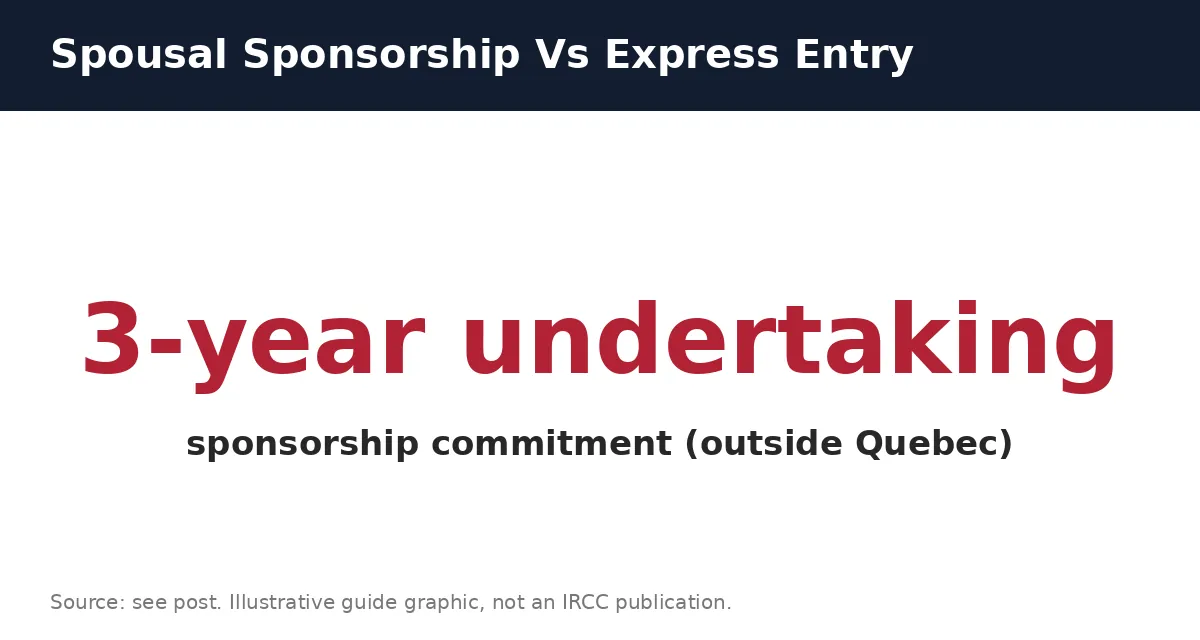
Post-decision commitment | 3-year undertaking (outside Quebec) | None of this kind |
Source: our summary of IRCC’s family sponsorship and Express Entry guidance (canada.ca). The table’s wording is our summary, not IRCC’s text. Quebec sponsorship has separate intake rules — check Quebec’s requirements separately.
Spousal sponsorship: who qualifies and what is tested
For spousal sponsorship vs Express Entry, the sponsorship side starts here: the sponsor must be a Canadian citizen or permanent resident, at least 18 years old. The sponsor must not be receiving social assistance for reasons other than disability, must not be an undischarged bankrupt, and must not be subject to a sponsorship bar (for example, from a previous sponsorship undertaking or a removal order). The sponsored person must be the sponsor’s spouse, common-law partner, or conjugal partner. There is no minimum income requirement for most spousal sponsorships; the limited exception involves cases where the sponsored spouse has a dependent child who themselves has a dependent child.
Then comes the test that decides most sponsorships: genuineness. That genuineness test is what makes spousal sponsorship vs Express Entry such a different choice: one side tests a relationship, the other tests a score. Officers look for a shared life, not a shared certificate. The evidence that matters: photos together over time, communication records, joint bank accounts and bills, travel together, evidence of living together where applicable, and affidavits from family and friends who know the couple. A marriage certificate proves a marriage happened; it does not prove a relationship is genuine. Couples with thin evidence — married quickly, living apart, little shared history — face the hardest sponsorships, even when everything is truthful.
Two sponsorship streams exist in spousal sponsorship vs Express Entry. Inland: the spouse is in Canada, and after acknowledgement of receipt and meeting other eligibility requirements, may apply for a spousal open work permit — a real advantage for couples already living together in Canada. Outland: the applicant is abroad (or in Canada), and remains free to travel during processing. The undertaking — the sponsor’s promise to support the sponsored spouse — lasts 3 years from the date the sponsored person becomes a permanent resident, outside Quebec.
Express Entry: the points race and its clock
In a spousal sponsorship vs Express Entry comparison, Express Entry tests something entirely different: a score, built from age, education, language per ability, work experience, spouse factors, transferability, and additional points. A couple where one partner is Canadian and the other is also Federal Skilled Worker-eligible can enter the pool on their own merits, regardless of the marriage. The marriage helps only in narrow ways — for example, a spouse’s sibling in Canada can add 15 points, and a spouse’s language and education can add spouse factors — but the core test is the applicant’s own profile.
The spousal sponsorship vs Express Entry clock works differently too. Express Entry’s headline standard — finalizing most complete applications within 6 months — starts only after an invitation to apply. Before that, you wait in the pool for a round that invites your score and category, and that wait can be weeks or many months.
A candidate with a strong score may move from pool to permanent residence faster than any sponsorship. A candidate 30 points below the rounds they watch may wait indefinitely, while a sponsorship filed the same day moves steadily forward. That is why “which is quicker” has no universal answer: it depends on the score you actually have. Check yours in the CRS calculator and compare it with recent rounds on our latest draws page before you decide.
Tip:
Do not compare sponsorship’s 12-month standard with Express Entry’s 6-month standard directly. One clock starts at filing; the other starts at invitation. Add your expected pool wait to the Express Entry side before you compare.
Timelines, honestly: standard vs tool
Spousal sponsorship vs Express Entry timelines deserve a careful paragraph, because the numbers you see differ by source. IRCC’s service standard for spousal sponsorship is about 12 months. IRCC’s published program data reported about 15 months for spouse, partner and child applications destined outside Quebec during September 2025 to August 2026. IRCC’s processing-time tool, as shown in October 2026, ran longer: about 18 months outland and about 26 months inland outside Quebec, and longer for Quebec destinations. Those are three different measurements — a standard, a program average, and a live tool estimate — and none of them is a promise for your file. Treat sponsorship as a 12-to-24-month journey in planning, and be pleasantly surprised if it is shorter.
Express Entry has the same honesty problem in reverse: the 6-month post-invitation standard is real, but it covers only the final stage, and only for complete applications. An incomplete application returned for missing documents restarts the clock. A file that draws a procedural fairness letter takes longer. And the pool wait before invitation is entirely outside the standard. When couples say “Express Entry took two years,” they usually mean pool wait plus processing, not processing alone.
Spousal sponsorship vs Express Entry: which path fits which situation
In spousal sponsorship vs Express Entry, choose Express Entry first when: your CRS score is already competitive for the rounds you can enter; you have a valid language test and an ECA in hand; you want the fastest possible post-invitation process; and your relationship evidence is thin enough that a genuineness test worries you more than a points race. Choose sponsorship first when: your score is well below recent rounds with no realistic quick gain; your relationship evidence is deep and well documented; you are already living together in Canada and the inland work-permit route matters; or you simply do not want your future to depend on draw patterns you cannot control.
One more spousal sponsorship vs Express Entry consideration: risk type. Express Entry risk is mostly arithmetic and documentary — a wrong NOC, a missing ECA, an expired test. Sponsorship risk is mostly judgement — an officer’s view of your relationship. Arithmetic risk can be fixed with a calculator and a checklist. Judgement risk needs evidence built over time. Pick the risk you are better equipped to manage.
Real cases
Real case: married to a Canadian, also FSW-eligible (forum thread, 2024)
A candidate married to a Canadian citizen asked whether sponsorship or Express Entry was quicker, given a competitive CRS score. Posters split: sponsorship avoided the points race, but Express Entry’s post-invitation speed appealed to those with strong scores. The thread’s useful advice was to compare the candidate’s actual score against recent rounds before choosing. Outcome: no outcome was reported.
Real case: low score, strong relationship evidence (forum thread, 2023)
A couple with years of shared life, joint accounts, and travel together chose sponsorship despite a low CRS score, reasoning that genuineness evidence was their strength and points were their weakness. Outcome: no outcome was reported.
Real case: inland work permit as the deciding factor (forum thread, 2024)
A couple already living together in Canada chose inland sponsorship largely because the open work permit route after acknowledgement of receipt let the sponsored spouse work legally while waiting — something Express Entry’s pool could not offer. Outcome: no outcome was reported.
Real case: the genuineness interview (forum thread, 2023)
A couple married quickly and living apart for work faced detailed genuineness questions, and posters advised building the evidence file — communication records, visits, shared finances — before filing rather than after. Outcome: no outcome was reported.
Frequently Asked Questions
Can I choose between spousal sponsorship and Express Entry?
Yes, if you qualify for both. A spousal sponsorship vs Express Entry comparison starts here: a person married to a Canadian citizen or permanent resident who is also eligible for Express Entry can compare the two paths and choose the stronger one for their situation. Compare your actual score against recent rounds before choosing, rather than deciding on reputation alone.
Is spousal sponsorship faster than Express Entry?
Not necessarily. In a spousal sponsorship vs Express Entry timeline, sponsorship has a service standard of about 12 months, but recent processing-time tool figures have been longer. Express Entry aims to finalize most complete applications within 6 months after invitation, but the wait for an invitation is extra.
Does spousal sponsorship need CRS points?
No. Sponsorship does not depend on CRS points, age, language scores, or education the way Express Entry does. That is the core spousal sponsorship vs Express Entry difference. Its central test is the genuineness of the relationship. Express Entry’s test is points and documents, while sponsorship’s test is the genuineness of the relationship.
What is the difference between inland and outland sponsorship?
Inland means the spouse is in Canada and may apply for an open work permit after acknowledgement of receipt and meeting other requirements. Outland means the applicant is abroad, or in Canada, and remains free to travel during processing. Outland applicants remain free to travel, while inland applicants trade some travel freedom for the work-permit route.
What evidence proves a genuine relationship?
Photos together, communication records, joint accounts and bills, travel together, affidavits from family and friends, and evidence of shared life. Genuineness is the crux of sponsorship refusals. A marriage certificate proves a marriage happened, not that the relationship itself is genuine.
Can I work in Canada while sponsorship is processing?
Inland applicants may apply for a spousal open work permit after acknowledgement of receipt and meeting other eligibility requirements. Outland applicants do not get that route from the sponsorship alone. Outland applicants do not get that route from the sponsorship alone, so plan work authorization separately.
Should I apply for both paths at once?
We did not verify a parallel-filing strategy to an IRCC source for this guide, so we do not recommend it here. Compare both paths, pick the stronger one, and get professional advice before filing anything twice. A refused application is never free, so get professional advice before filing anything twice.
Final Thoughts
There is no quicker path in general in spousal sponsorship vs Express Entry — only a quicker path for you. If your score is strong and your documents are ready, Express Entry’s post-invitation speed is hard to beat. If your score is weak and your relationship evidence is deep, sponsorship removes the race and replaces it with a test you can pass. Run the numbers, read your own evidence honestly, and then commit to one path and build it properly.
Start with the CRS calculator and our guide to whether your score is good enough. If, after weighing spousal sponsorship vs Express Entry, sponsorship looks like your path, or if your situation mixes the two — a pending sponsorship, a borderline score, a complex relationship history — talk to a licensed consultant (RCIC) or lawyer before you file. The choice is reversible; a refused application is not free.
Sources
This guide was checked against official IRCC sources and real applicant reports. This is general information, not legal advice. For your own case, talk to a licensed consultant (RCIC) or lawyer.
Last reviewed: October 29, 2026