
Express Entry Guide · Updated October 2026
Your child turns 22 while your application is still processing — do they age out, or does the lock-in date protect them?
By Aria Sterling · Checked against IRCC rules · 12 min read
Of all the deadlines in Express Entry, the one parents fear most in a dependent child lock-in case is a birthday. A child who is 21 when you enter the pool, 22 when the invitation arrives, and 23 when the visa is issued — are they still your dependent child, or has the calendar quietly removed them from your application? The forums are full of this fear, and full of wrong answers to it, because the rule that protects children has a name most applicants never hear: the lock-in date.
This post explains the dependent child lock-in age 22 rule properly: what the lock-in date is, what it protects and what it does not, what happens when a child is already over 22, and what changes when the child is from a previous relationship or under a custody arrangement. It is written for parents, not lawyers, but it does not soften the hard parts.
We checked this guide against IRCC’s dependent-child definition and lock-in rules on canada.ca, plus public forum threads about ageing out during processing. This is general information, not legal advice.
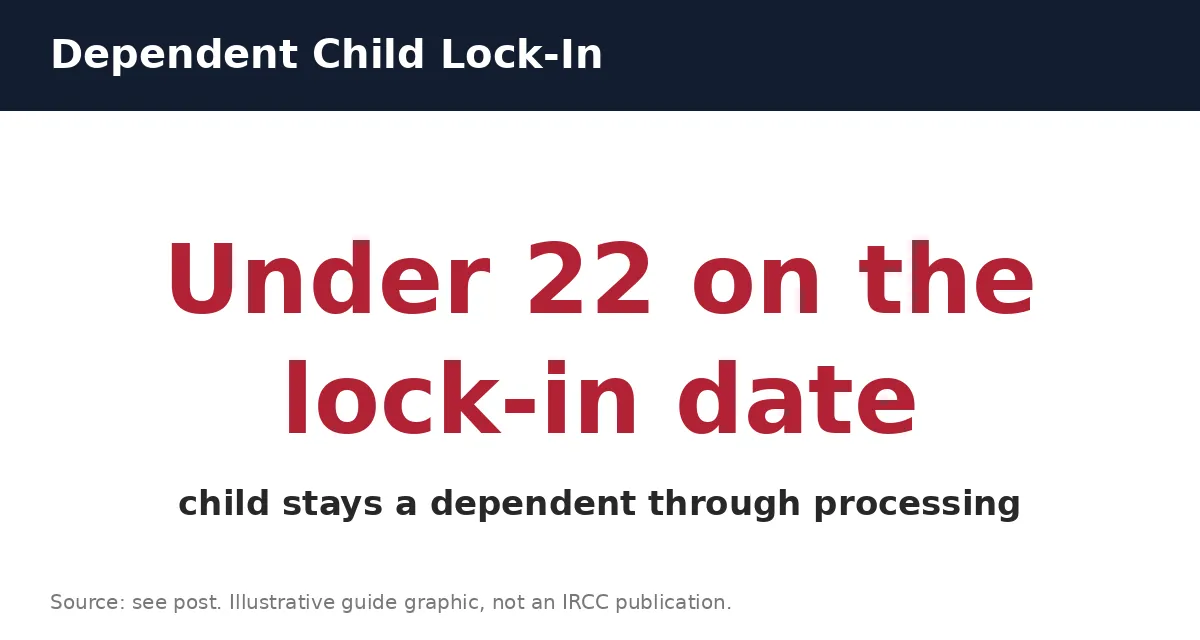
Quick answer: Under dependent child lock-in rules, a dependent child is under 22 and not married or in a common-law relationship, assessed on the lock-in date — the date IRCC receives your complete application. If your child is under 22 on that date, they stay a dependent even if they turn 22, 23, or older during processing. The lock-in protects age, not marriage or common-law status, and an incomplete application that is returned does not lock anything.
Key takeaways
Dependent child lock-in: the date, precisely
IRCC assesses a dependent child’s age on the dependent child lock-in date. For Express Entry, that date is the day IRCC receives your complete permanent residence application — the application you submit after an invitation, with all required documents and fees. It is not the day you created your profile. It is not the day the invitation arrived. It is not the day you started gathering documents. Only the complete application counts, which is why completeness matters so much: an application returned as incomplete — unpaid fees, unsigned forms, a missing document — does not lock the age, and the clock keeps running until a complete application is received.
Worked timeline: a child born on March 10, 2004 turns 22 on March 10, 2026. That is dependent child lock-in in action: a single day changes everything. If your complete application is received on March 9, 2026, the child is 21 on the lock-in date and stays a dependent, even if processing runs into 2027 and the child turns 23. If your complete application is received on March 11, 2026, the child is 22 on the lock-in date and does not qualify under the under-22 rule — the two-condition exception below is the only remaining route. Two days, two different applications. That is why parents with a birthday approaching should treat document readiness as urgent, not routine.
Dependent child lock-in: three birthdays, three outcomes
When the child turns 22 | Outcome |
|---|---|
After the complete application is received | Protected: stays a dependent through processing, at any later age |
While in the pool, before invitation | Not disqualified by itself — but must still be under 22 when the complete application is received, so the 60-day window matters |
Before the complete application is received | Does not qualify under the under-22 rule; only the two-condition exception may apply |
Source: our summary of IRCC’s dependent-child and lock-in rules (canada.ca). The table’s wording is our summary, not IRCC’s text.
The dependent child lock-in middle row deserves emphasis, because it is where panic does the most damage. A child who turns 22 while you wait in the pool has not aged out. Age is not assessed in the pool; it is assessed at the complete application. What the pool birthday does is compress your margin: once the invitation arrives, you have 60 days to submit a complete application, and the child must still be under 22 when it lands. If the birthday falls inside that window, you are racing it. Prepare every document — birth certificate, passport, medical booking, custody papers where relevant — before the invitation, not after.
Warning:
The lock-in protects age only. If your child marries or enters a common-law relationship after the lock-in date, dependency breaks regardless of the locked age. A wedding during processing is not a detail to mention later — it changes the application.
Over 22: the two-condition exception
Under dependent child lock-in, a child aged 22 or older can still qualify as a dependent, but only if both conditions hold together. First, the child has depended substantially on the parent’s financial support since before they turned 22. Second, the child is unable to financially support themselves because of a physical or mental condition. Both must be true, with evidence: medical documentation of the condition, and proof of continuous financial dependence — bank transfers, support payments, living arrangements, tax or school records showing dependence.
Three dependent child lock-in misunderstandings fail here. Full-time study alone is not enough: the old full-time-student basis was removed in 2014 and was not restored in 2017, so a university student over 22 without a qualifying condition does not qualify. Unemployment alone is not enough. Living with parents alone is not enough. And a medical condition alone, without financial dependence, is not enough either. The exception is narrow by design, for children who genuinely cannot support themselves — and the evidence burden reflects that.
Children from previous relationships and custody
Children from previous relationships follow the same dependent child lock-in age rule, with one extra layer: the relationship and custody question. Stepchildren — children of your spouse or common-law partner — can qualify if they meet the dependent definition and the relationship to your spouse is recognized by IRCC. Legally adopted children can qualify if they meet the age and dependency criteria. The practical issue is custody: where the other parent shares custody, be ready to show legal custody documentation or permission, and get advice for contested cases. IRCC will examine whether the child can actually accompany you, not just whether they fit the age definition.
Two dependent child lock-in practical points matter here. First, declare every child, including children from previous relationships and non-accompanying children — leaving a child off the application creates far worse problems than including one. Second, start the custody paperwork early: court orders, consent letters, and adoption papers take time to obtain, and a custody document missing at the lock-in deadline can turn a complete application into a returned one — which, as above, means the age is not locked at all.
The medical rule nobody should skip
Under dependent child lock-in, every declared child needs a medical exam, including non-accompanying children. This is the same rule that applies to non-accompanying spouses, and it carries the same permanent consequence: under IRPR s.117(9)(d), a child who was not medically examined before the parent became a permanent resident may never be sponsored later. Parents sometimes skip a non-accompanying child’s medical because the child “isn’t coming anyway.” That shortcut can close the door forever. Book the medical, even for children who will not travel with you, and keep the proof with the application.
Real cases
Real case: birthday inside the 60-day window (forum thread, 2024)
A parent received an invitation with a child’s 22nd birthday falling inside the 60-day application window. Posters stressed that only the complete application’s receipt date mattered, and advised submitting well before the birthday rather than near the deadline. Outcome: no outcome was reported.
Real case: turned 22 in the pool (forum thread, 2023)
A parent panicked when a child turned 22 while the family waited in the pool, assuming the child had aged out. The thread answer was that pool age is not assessed — what matters is age when the complete application is received. Outcome: clarified in the thread; no final outcome was reported.
Real case: over 22, studying, no condition (forum thread, 2024)
A parent asked whether a 23-year-old full-time university student counted as a dependent. The thread answer was no: full-time study alone is not a qualifying basis, and the exception needs both financial dependence and a physical or mental condition. Outcome: clarified in the thread.
Real case: child from a previous relationship (forum thread, 2023)
A candidate asked whether a spouse’s child from a previous relationship, under shared custody, could be included. Posters advised that the child could qualify if the definition was met, but that custody documentation would be the practical hurdle to prepare early. Outcome: no outcome was reported.
Frequently Asked Questions
My child turns 22 while my application is processing. Do they still qualify?
Yes, if they were under 22 on the dependent child lock-in date and not married or in a common-law relationship. The lock-in protects their age through the rest of processing. Processing can run past the child’s 23rd birthday without changing the locked result.
My child turns 22 in the pool before I get an invitation. Is that a problem?
Not by itself. What matters is their age when the complete application is received. But the 60-day invitation window then matters, so have documents ready before the birthday. Prepare every document before the invitation arrives, not after, because the window is only 60 days.
Does marriage after the lock-in date affect dependency?
Yes. Marrying or entering a common-law relationship after the dependent child lock-in date breaks dependency, even though the age was locked. The lock-in protects age, not every eligibility factor. Tell IRCC promptly if a marriage or common-law relationship begins while your application is still processing.
Can a child over 22 still qualify as a dependent?
Only if both conditions hold: they depended substantially on your financial support since before turning 22, and they cannot support themselves because of a physical or mental condition. Both are required. Gather medical proof of the condition and records of continuous support before you rely on this exception.
What if my application is returned as incomplete?
Then the dependent child lock-in age is not locked. An incomplete application that is returned does not lock the age, and the clock keeps running until a complete application is received. Unpaid fees and unsigned forms are common reasons an application comes back incomplete.
What if the other parent shares custody of my child?
Be ready to show legal custody or permission where the other parent shares custody, and get advice for contested cases. Custody is the practical angle IRCC will examine in previous-relationship cases. Court orders and consent letters take time to obtain, so start the custody paperwork early.
Final Thoughts
The dependent child lock-in date is good news for most parents: a child who is under 22 when your complete application lands stays your dependent, however long processing takes. The danger is not the birthday during processing — it is the birthday before a complete application, the incomplete application that fails to lock anything, and the marriage or common-law relationship that breaks dependency after lock-in. Prepare documents before the invitation, submit complete and early, and declare every child with medicals done.
Check your family’s dependent child lock-in position in the CRS calculator and read how to immigrate to Canada for the wider path. If your case involves a birthday inside the 60-day window, an over-22 exception claim, or a contested custody situation, talk to a licensed consultant (RCIC) or lawyer before you submit — these are the cases where timing and paperwork decide everything.
Sources
This guide was checked against official IRCC sources and real applicant reports. This is general information, not legal advice. For your own case, talk to a licensed consultant (RCIC) or lawyer.
Last reviewed: October 29, 2026