Express Entry Guide · Updated October 2026
An application rejected incomplete was not refused on its merits. It was never assessed at all — because something was missing.
By Aria Sterling · Checked against IRCC rules
“An application rejected incomplete” is the most confusing letter IRCC sends, because it reads like a refusal and it is not one. It means an officer looked at your file, found it did not meet the legal requirements for a complete application, and closed it without ever deciding whether you qualify.
The good news after an application rejected incomplete is real: the fees come back, there is no refusal on your record, and the problem is usually fixable. The bad news is also real: your invitation is gone, your profile number stops being valid, and you must re-enter the pool. This post explains exactly which missing pieces trigger this outcome, so you can audit your file before IRCC does.
Evidence line: we checked IRCC’s completeness-check guidance under sections 10 and 12.01 of the Immigration and Refugee Protection Regulations, IRCC’s Help Centre answers on refunds, and public forum threads from applicants who received these letters. This is general information, not legal advice.
Quick answer: An application rejected incomplete failed IRCC’s upfront completeness check — a required document was missing, in the wrong form, or unreadable. The classic triggers are a translation without an affidavit or original, a black-and-white police certificate scan, a missing ECA report, a police certificate with a gap in its period, and a file that simply never made it into the final PDF. Fees are refunded, but the invitation is lost.
Key takeaways
Application Rejected Incomplete vs Refused: Why the Distinction Matters
IRCC assesses every application for completeness before it assesses eligibility. Completeness is governed by section 10 of the Immigration and Refugee Protection Regulations, with section 12.01 covering Express Entry applications specifically. If the file does not contain the prescribed form, the required information, proof of fee payment and the required documents, the office must record an application rejected incomplete, cancel it in the system and repay the fees.
A refusal is different. A refused application passed completeness, was assessed on its merits, and failed — on eligibility, on points, on admissibility or on credibility. A refusal can affect future applications and, in misrepresentation cases, carry a five-year ban. A completeness rejection does none of that, because nothing was decided about whether you qualify.
That distinction is comforting, but do not let it make you casual. The practical cost of an application rejected incomplete is still severe: the invitation is spent, the profile is dead, and the next invitation may be months away or may never come at the same score.
The Classic Completeness Triggers
Trigger | What IRCC expects | The mistake |
|---|---|---|
Translation | Certified translation, or translation plus translator’s affidavit, plus a certified copy of the original | Translated document only, no affidavit, no original |
Police certificate scan | Colour scan of the original certificate | Black-and-white copy or certified true copy instead |
ECA report | The assessment report itself, for every foreign credential claimed | Profile entry describing the degree, report never uploaded |
Police certificate period | Every country lived in for 6 months or more since age 18 | Certificate that starts late or ends early, leaving a gap |
Missing file in the final PDF | Every document on your personal checklist, present and readable | One employment letter or diploma left out of the merged file |
Unreadable scan | Clear, complete, correctly oriented pages | Cropped, blurry or half-cut pages |
Source note: the completeness rules are IRCC’s (IRPR sections 10 and 12.01). The trigger list is drawn from rejection letters described in public threads.
Two of these deserve extra attention because they feel counterintuitive. First, translations: many applicants assume a professional translation is enough on its own. It is not — IRCC wants the affidavit (or a certified translator) and a copy of the original-language document, so the officer can see what was translated. Second, police certificates: a “certified true copy” sounds more official than a plain scan, but IRCC wants a colour scan of the original itself. Giving them the more formal-looking substitute can still fail the check.
Warning:
A rejection letter usually lists only the first missing item it found, and warns that a full review was not performed. “The letter only mentions one document” does not mean only one document was wrong — audit the whole file, not just the item named.
What Happens After an Application Rejected Incomplete
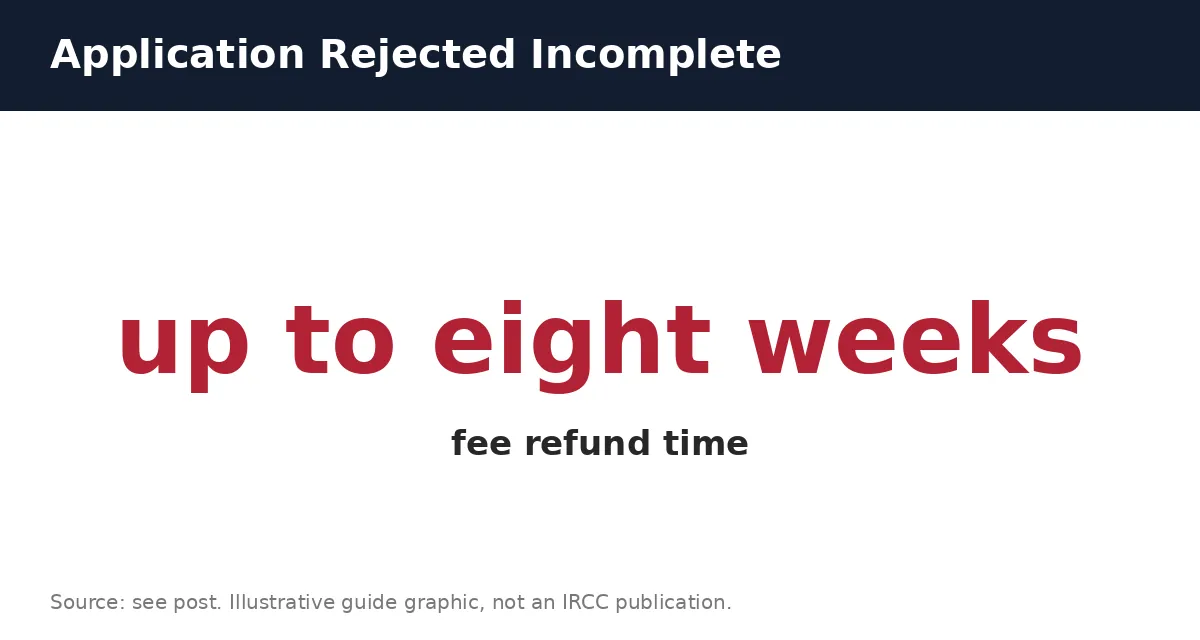
First, the fees. When an application rejected incomplete comes back from IRCC, it refunds the fees you paid. IRCC’s Help Centre says refunds can take up to eight weeks to complete, so do not panic if the money is not back in a few days, and do not re-pay anything until you know where you stand.
Second, the profile. The application rejected incomplete letter will tell you that you are no longer a candidate and your Express Entry profile number is no longer valid. That is the part people miss: there is no “fix and resubmit the same application”. You must create a new Express Entry profile and wait for a new invitation.
Third, the narrow exception. In rare cases IRCC reopens a file — typically where IRCC itself made an error, for example by overlooking a document that was actually present. Applicants usually raise this through the IRCC web form, promptly, with evidence. Reopening is not a second chance to supply a document you forgot; it is a correction of IRCC’s mistake. If your file is reopened after fees were refunded, expect to be asked to pay the fees again, quickly, so the file can continue. If reopening is refused, the only path is a new profile — and for that, re-check your score in the CRS calculator before you re-enter, because scores and circumstances change.
Tip:
Keep the rejection letter. It names the exact completeness reason, and that reason is the first item on your audit list for the next application. It also proves the outcome was a rejection, not a refusal, if anyone ever asks.
Real Cases From Public Threads
Real case: translated marriage certificate only (2021)
An applicant described a Canadian Experience Class application rejected because they supplied only the translated marriage certificate. IRCC required the translation plus an affidavit plus a certified copy of the original. The applicant’s question — whether the file could simply be fixed — got the standard answer: no, a new profile and a new invitation were needed. No outcome was reported for the reapplication.
Real case: missing ECA file (2020)
Another applicant’s file was rejected because the ECA report for immigration purposes was not included, even though the education details were entered in the profile. The profile entry is not the document. This is the single most avoidable item on the list, because the report either exists in your files or it does not — check before you pay.
Real case: one employment letter missing from the final PDF (2021)
A candidate reported that one employment letter was missing from the final merged PDF, although the job offer and pay slips for the same job were included. They asked whether the application could be reopened with the correct letters. The thread’s consensus was pessimistic: reopening is for IRCC errors, and a missing upload is the applicant’s error. No outcome was reported.
Real case: the file that was reopened (2020)
One applicant did report a reopening: after an initial rejection, IRCC re-examined the file, decided it did meet the completeness requirements after all, and reopened it — but asked for fresh processing fees within seven days, because the original fees had already been refunded. The exception proves the rule: reopening happens when the document was there all along, not when it was forgotten.
The Pre-Submit Audit That Prevents This
Do this audit — the one that prevents an application rejected incomplete — the day before you plan to submit, not the hour before. Print your personal document checklist — the one the portal generated for you — and tick off each item against the actual file you will upload, page by page.
If anything fails the audit, fix it before submitting — even if that means declining the invitation instead. A declined invitation keeps you in the pool; an application rejected incomplete does not.
Frequently Asked Questions
Is rejected as incomplete the same as refused?
No. An application rejected incomplete means IRCC found the application did not meet the completeness rules, so it was never assessed on its merits. A refusal is a decision on the merits after assessment. Only a refusal carries the usual consequences of a negative decision.
Do I get my fees back if my application is rejected as incomplete?
Yes. After an application rejected incomplete, the fees are refunded. Refunds can take up to eight weeks to complete, so check the payment account rather than expecting an instant return. Keep the payment receipt and the rejection notice together, since both help if you need to query a refund that has not arrived.
Can I ask IRCC to reopen a rejected application?
You can ask through the IRCC web form, and reopening does happen in rare cases where IRCC made an error, but it is exceptional, not a right. Most people must create a new profile and wait for a new invitation.
What if my police certificate does not cover the full period?
You need a certificate for every country where you lived for six months or more since turning 18. A certificate with a gap in the period it covers can mean rejection, so check the dates before you submit. List every address you held since turning 18 before you request certificates, so no country or period slips through unnoticed.
Does a missing ECA really cause rejection?
Yes. If you claimed points for a foreign credential, the ECA report itself must be included. A profile entry describing the credential is not a substitute for the report, and its absence has caused rejections. The same rule applies to language results and any other credential you claimed points for: the document itself must be in the file.
How long does the completeness check take?
Completeness is assessed up front, often within the first month or two after submission, before any officer assesses eligibility. A rejection at this stage means the merits of your case were never examined. That early timing is why a completeness rejection can feel so abrupt — the file is returned before an officer ever weighs your merits.
If one file is missing from my final PDF, is the whole application rejected?
It can be. The completeness check looks at whether every required document is present. One missing mandatory file can be enough, which is why a page-by-page audit before submission matters so much. Treat the final PDF as a separate document to audit, page by page, rather than trusting that the upload step captured everything.
Does a completeness rejection affect future applications?
No. An application rejected incomplete was never assessed on its merits, so it is not a refusal. You keep no negative decision on your record from it, but you do lose the invitation and must re-enter the pool. You will need a new invitation to apply again, so the practical loss is the invitation itself and the time spent waiting for another.
Final Thoughts
An application rejected incomplete is the most fixable bad outcome in Express Entry — and the most annoying, because it is almost always preventable. The file was probably strong. It was just missing a piece, or a piece was in the wrong form.
Before your next submission, do the page-by-page audit in this post, and treat the rejection letter from last time as your personal checklist of what to get right. For anything uncertain — a translation format, a police certificate gap, a document you cannot obtain — talk to a licensed consultant (RCIC) or lawyer before you submit, not after the letter arrives.
Sources
This guide was checked against official IRCC sources and real applicant reports. This is general information, not legal advice. For your own case, talk to a licensed consultant (RCIC) or lawyer.
Last reviewed: October 29, 2026