Express Entry Guide · Updated October 2026
Your proof of funds is not a simple salary balance — so how do you prove money that arrived as a gift, sits in a fixed deposit, or came from selling a house? The proof of funds gift deed package below shows exactly which documents a gift needs.
By Aria Sterling · Checked against IRCC rules · 13 min read
Most proof-of-funds guides show one tidy picture: a salary, a savings account, a bank letter. Real applicants rarely look like that. Their money is a gift from a parent, a fixed deposit opened years ago, a provident fund from a previous job, or the proceeds of a property sale that landed last month. Each of those can work — but each needs a different paper trail, and the wrong one gets the application returned as incomplete.
This guide builds your proof of funds package by situation. It does not repeat the general funds post: it answers the question behind the forum threads — “my money is not a simple salary balance, so what exactly do I upload?” You will find the current minimum amounts, the bank-letter checklist, four situation packages, the traps that trigger extra questions, and real cases from public threads, retold in our own words.
We checked this guide against IRCC’s proof of funds page and the CRS criteria page on canada.ca, plus public forum threads about gift deeds, fixed deposits and provident funds. Figures below are from the settlement-funds table updated July 7, 2025, still current when checked in October 2026. This is general information, not legal advice.
Quick answer: IRCC does not care what shape your money arrived in. It cares that the money is yours, available, transferable to Canada, and free of debt — and that you can prove each of those with documents. A gift deed, a fixed deposit, a withdrawable provident fund balance and property-sale proceeds can all count, if each part is documented and the total meets your family-size minimum.
Key takeaways
The test IRCC actually applies
Forget the shape of the money for a moment. Every proof of funds package must pass the same four questions: Is it yours? Can you access it now? Can you move it to Canada? Is it free of debt? IRCC’s words for this are available, transferable and unencumbered. A savings balance passes easily. A fixed deposit passes only if you can break it. A provident fund passes only for the withdrawable part. A house you still own fails, because equity in real property is not liquid money — but the cash from a completed sale passes, because it is.
Every package in this guide is judged against those four questions, and a proof of funds gift deed must pass all four, not just one.
The second test is timing. You must have the money when you apply and still have it when the visa is issued. That is why officers look at the six-month average balance, not just today’s figure. A balance that jumped last week looks borrowed until you prove otherwise. Keep the money stable from application to landing, and keep a buffer above the minimum — exchange rates move, and a foreign-currency balance that meets the threshold today can fall below it by the time an officer checks.
How much you need, by family size
Family size | Minimum funds (CAD) |
|---|---|
1 person | $15,263 |
2 people | $19,001 |
3 people | $23,360 |
4 people | $28,362 |
5 people | $32,168 |
6 people | $36,280 |
7 people | $40,392 |
Each additional person | +$4,112 |
Source: IRCC settlement-funds table, updated July 7, 2025, confirmed still current in October 2026. IRCC revises these amounts annually, so re-check the live table before you submit. The figures above are IRCC’s; any buffer you add on top is your own decision, not IRCC’s.
Get the family-size number right first, because a proof of funds gift deed that covers the wrong total still fails.
Count carefully. A couple with one child who is staying behind is a family of three, not two. A single applicant with a non-accompanying spouse is a family of two. This is the single most common arithmetic error in proof of funds threads, and it is also the easiest to avoid: list every spouse and dependent child first, then read across the table.
Package 1: proof of funds gift deed
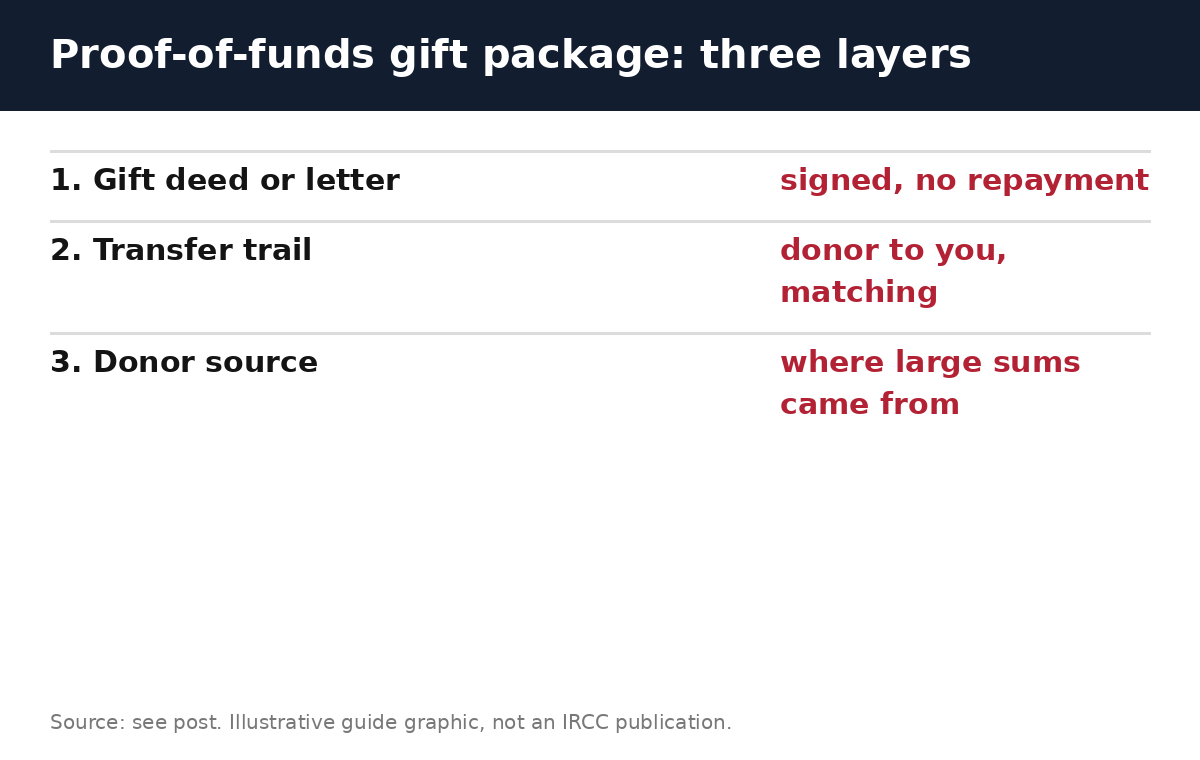
A gift from a parent is the most common non-salary source in the forums, and it is fully acceptable — when it is a real gift. Your package needs three layers. First, the gift deed or gift letter itself: signed, ideally notarised, naming the donor and you, stating the amount, and stating clearly that the money is an absolute gift with no repayment expected. Second, the transfer trail: bank records showing the money leaving the donor’s account and arriving in yours, with matching dates and amounts.
Third, the donor’s source, where the amount is large: a short note or statement showing where the donor got the money. Officers are not being nosy for fun; they are checking that the “gift” is not a loan that will be quietly repaid after landing.
A gift only works as a proof of funds gift deed when the deed, the donor proof and the transfer trail all line up.
If any of those three documents is missing, the proof of funds gift deed package is incomplete, however genuine the gift.
Tip:
Let a large gift sit in your account for several weeks before you apply, and get the bank letter after it has landed. A gift that arrived yesterday, with a letter printed today, invites the exact question you want to avoid.
Watch the wording. A letter that says “for the purpose of immigration” without saying “no repayment” is weak. A letter from a distant relative or a friend raises more questions than one from a parent. And never let the donor keep control of the money — if it sits in the donor’s account, it is not yours yet, no matter what the letter says.
Package 2: fixed deposit
A fixed deposit (term deposit) counts when it is liquid in practice, not just in name. If you can break it on demand, even with a small penalty, it counts: upload the deposit certificate or a bank letter that lists the deposit, its value, and that it can be withdrawn. If it is locked until maturity, pledged against a loan, or held as security for something else, it does not count — or counts only for its free value, which is a fight you do not want.
Fixed deposits are a different package from a proof of funds gift deed, but the same rule applies: the money must be reachable on demand.
The age question comes up constantly: “Must a fixed deposit be a set age before it counts?” There is no published minimum age for a deposit. What matters is the same as everywhere else: the money must be yours, available, and explained. A deposit opened last month with money transferred from your own savings account is fine if the transfer trail is clean. A deposit opened last month with money that arrived from nowhere is not fine until you explain the nowhere.
Package 3: provident fund
Provident fund money — such as an Employees’ Provident Fund balance — is the trickiest package, because part of it may be locked. Only the withdrawable portion counts. Your package needs the fund statement showing the balance, the scheme’s withdrawal rules (or a letter from the fund confirming what you can withdraw and when), and, if you have already withdrawn, the transfer into your bank account. A statement showing a large balance with no proof you can touch it will not carry the day.
Provident funds need the same discipline as a proof of funds gift deed: only the withdrawable part counts, with the rules in writing.
One recurring forum situation deserves a plain answer: leaving your job does not automatically unlock everything, and “I will withdraw it after landing” is not proof of available funds today. If the rules let you withdraw on leaving employment, get that in writing from the fund before you rely on the balance. If they do not, leave that money out of your total and build the package from the rest.
Package 4: property sale
A completed property sale is a clean source — once it is actually complete. Your package needs the sale deed or contract, proof the money reached your account (bank entries matching the sale price, allowing for taxes and fees), and the bank letter showing the balance afterwards. If the price in the deed and the amount in the account do not match, explain the difference (taxes, outstanding mortgage paid off, agent fees) in a short letter of explanation. Do not leave the officer to guess.
A property sale is cleanest once complete, unlike a proof of funds gift deed, which needs the donor’s paper trail instead of a sale trail.
Warning:
An unsold property does not count, and neither does the equity in a property you still own. IRCC is explicit: you cannot use equity in real property as settlement funds. The property must be sold and the cash in hand.
Mixed and spouse packages
Most real packages are mixed: some savings, one fixed deposit, a gift top-up. That is fine. IRCC adds up funds across accounts and institutions, as long as each part is documented. Get a bank letter from every institution, not just the biggest one, and write a one-page cover note that walks the officer through the total: “Account A: $X. Fixed deposit B: $Y. Gift from my father: $Z, deed attached. Total: $W, against a minimum of $V for a family of three.”
Mixed packages are normal, and a proof of funds gift deed can sit inside one as long as every part is documented.
Money in your spouse’s name also counts, with conditions. Funds in a joint account count. Funds in an account held only by an accompanying spouse can count if you can show you have access to them — a consent letter from your spouse plus proof of the relationship is the usual way. Funds in a non-accompanying spouse’s account are harder: you cannot simply claim money you do not control. If your spouse is not coming with you, build the package from accounts you hold or jointly hold.
Traps that trigger questions about a proof of funds gift deed
Four traps appear in thread after thread. First, the dip: you withdrew money for an emergency and later topped it back up. Explain it in your letter of explanation with dates and a reason — a dip with a reason is a story; a dip with no comment is a suspicion. Second, the sudden large deposit: any deposit in the last six months that changes the picture needs its own document.
Most traps come down to one failure: a proof of funds gift deed, deposit or sale with a gap in the paper trail.
When in doubt, explain the money in your cover note: a proof of funds gift deed with a clear explanation beats a silent balance.
Third, debts: the bank letter must list outstanding loans and credit card balances, and an officer can look at net available funds. A large balance next to a large loan is not the same as a large balance. Fourth, currency: if your money is in another currency, IRCC converts at the Bank of Canada rate, and the rate moves. Hold a buffer — our rough guide, not IRCC’s, is $1,000–$2,000 above the minimum for a small family.
Finally, keep your profile figure honest. If you are invited under the Federal Skilled Worker Program or the Federal Skilled Trades Program, you need the funds even if you would have been exempt under the Canadian Experience Class. The invitation’s program decides, not your hope. And if you are exempt — under the Canadian Experience Class, or because you are authorized to work in Canada and hold a valid job offer — do not leave the upload slot blank: upload a short letter explaining which exemption applies.
Real cases
Real case: the gift deed that worked (forum thread, 2024)
A candidate’s father gifted the shortfall for a family of three. The package included a notarised gift deed stating no repayment, the father’s bank statement showing the transfer out, and the candidate’s statement showing it in. The officer asked no further questions about the gift. Outcome: no problem reported with the funds documents.
Real case: the fixed deposit nobody explained (forum thread, 2023)
A candidate listed a fixed deposit as the bulk of their funds but uploaded only a one-line certificate with no maturity or withdrawal terms. The officer requested more documents, and the candidate scrambled for a bank letter mid-process. Outcome: additional document request; the lesson is to include withdrawal terms from the start.
Real case: the emergency dip (forum thread, 2024)
A candidate withdrew funds for a family emergency, then replenished the account before applying. The six-month average dipped below the minimum for their family size, and the thread debated whether to wait or explain. The safer advice in the thread was to wait until the average recovered or to document the emergency fully. Outcome: no outcome was reported.
Real case: the property sale with a gap (forum thread, 2023)
A candidate sold a property and showed the sale deed, but the bank balance was lower than the deed price because a mortgage had been paid off from the proceeds. The candidate’s letter of explanation walked through the arithmetic, and the thread treated that as the correct fix. Outcome: no outcome was reported, but the arithmetic note is exactly what officers need.
Frequently Asked Questions
Does IRCC accept a gift deed as proof of funds?
Yes, if the gift is genuine and non-repayable. A proof of funds gift deed needs a signed deed or letter stating the money is a gift with no repayment expected, plus transfer records showing the money moving from the donor to you. A vague note without a transfer trail is weak evidence.
Does a fixed deposit count as proof of funds for Express Entry?
Yes, if you can withdraw it. A fixed deposit counts when the money is liquid and available to you. A locked deposit you cannot break, or one pledged against a loan, will not count toward your total. Include the deposit certificate and a bank letter confirming withdrawal terms, so the officer does not have to guess.
Can I use my provident fund as proof of funds?
Only the part you can actually withdraw. IRCC counts money that is available and transferable, so a provident fund balance locked until retirement does not count, but a withdrawable balance with proof does. Get the fund’s withdrawal rules in writing before you rely on the balance, and show the transfer into your bank account.
Can I use money from selling a property as proof of funds?
Yes, once the sale is complete and the money is in your account. Show the sale deed or contract, the transfer trail, and the bank letter. Unsold property, or equity in a property you still own, does not count. Explain any gap between the deed price and the bank balance, such as taxes or a mortgage paid off.
How much proof of funds do I need for a family of three?
Under the table updated July 7, 2025, a family of three must show $23,360 CAD. Family size includes your spouse and dependent children even if they are not coming with you to Canada. The table is revised annually, so re-check IRCC’s live figures before you submit your application.
Do I need a bank letter, or are statements enough?
Get the official bank letter. It must be on letterhead and list the bank’s contact details, your name, account numbers, dates opened, current balances, six-month average balances, and outstanding debts. Ask for the letter close to your submission date, and get one from every institution where you hold funds.
Can I combine a gift deed, a fixed deposit and savings?
Yes. A proof of funds gift deed can sit alongside other funds: IRCC adds up funds across accounts and institutions, as long as each part is documented. Get a bank letter from every institution and explain each large deposit in your cover note. Write a one-page cover note that adds the total up and names each document, so the officer follows it easily.
Final Thoughts
Proof of funds is not a test of how rich you are. It is a test of how clearly you can show that real, available money is yours. Build the package around the documents, not around the hope that an officer will take your word for it: one bank letter per institution, one document per large deposit, one short cover note that adds the total up. Then check your score effect separately — see how your CRS score is calculated and run your numbers in the CRS calculator before you rely on any single document. For a gift, that means one thing above all: a proof of funds gift deed package with no gaps — deed, donor proof and transfer trail together.
If your situation is unusual — a locked fund, a disputed gift, a spouse who is not coming — talk to a licensed consultant (RCIC) or lawyer before you submit. A returned application costs months; a short professional review usually does not.
Sources
This guide was checked against official IRCC sources and real applicant reports. This is general information, not legal advice. For your own case, talk to a licensed consultant (RCIC) or lawyer.
Last reviewed: October 29, 2026