PGP Canada: 7 Parents and Grandparents Program Facts for 2026
If your parents or grandparents live outside Canada and you’ve been hoping to bring them here permanently, 2026 has been a confusing year to watch. The Parents and Grandparents Program, known to most families simply as PGP, is the main permanent pathway for this kind of reunification. It has also been paused, reopened, and paused again within the space of a few years.
This guide breaks down exactly where PGP Canada stands right now, what the income rules actually mean in dollars, and what your realistic options are while new applications are on hold. We built this after reviewing IRCC’s own notices alongside dozens of pages written by immigration lawyers and consultants, so you get the complete picture in one place instead of five different tabs.
We’ll also walk through the Super Visa, since it has quietly become the more practical route for most families this year. By the end, you should know which path fits your situation and what to prepare while you wait.
What Is the Parents and Grandparents Program (PGP)?
The PGP is a Canadian immigration stream that lets citizens and permanent residents sponsor their parents or grandparents for permanent residence. Unlike a visitor visa, PGP leads to a permanent resident card, which means the sponsored parent or grandparent can live, work, and access healthcare in Canada indefinitely.
The program does not run on a first-come, first-served basis. Instead, IRCC uses an interest-to-sponsor pool. Interested sponsors submit a short form during a specific window, and IRCC randomly draws a limited number of names to invite for a full application. Being drawn does not guarantee approval. It only means you’re invited to apply.
Because only a small number of people are drawn each round, PGP has always been competitive. In 2026, it became even harder to access, which we cover next.
PGP Canada 2026 Status: Is It Open or Closed?
As of mid-2026, IRCC paused new PGP intake. On July 15, 2026, the department confirmed it would not accept new interest-to-sponsor forms or issue new invitations until further notice. There is no announced reopening date.
This matters because the pool of interest itself has not been refreshed since 2020. Every invitation issued between 2021 and 2025 came from that same original batch of over 200,000 submissions. If you never submitted an interest form in 2020, you currently have no way into the PGP queue at all.
Why Did IRCC Pause New Applications?
IRCC has not published a single detailed explanation, but the pattern points to processing capacity. Roughly 50,000 applications were already sitting in the queue by mid-2026, and the government has set a target of approximately 15,000 new permanent resident admissions per year through 2028 for this category. Pausing new intake lets the department work through the existing backlog without adding to it.
What Happens to Applications Already Submitted?
If you already have a complete application in the system, it keeps moving. IRCC continues processing existing files, though timelines have stretched. Outside Quebec, current processing runs around 18 to 24 months. Inside Quebec, it can take considerably longer, sometimes 46 months or more, because of the province’s separate income assessment process.
PGP Income Requirements: The LICO+30% Rule Explained
Even when PGP intake is open, not everyone qualifies to sponsor. IRCC requires sponsors to prove they earn enough to support the parent or grandparent without that person needing government assistance. This is called the Minimum Necessary Income, or MNI.
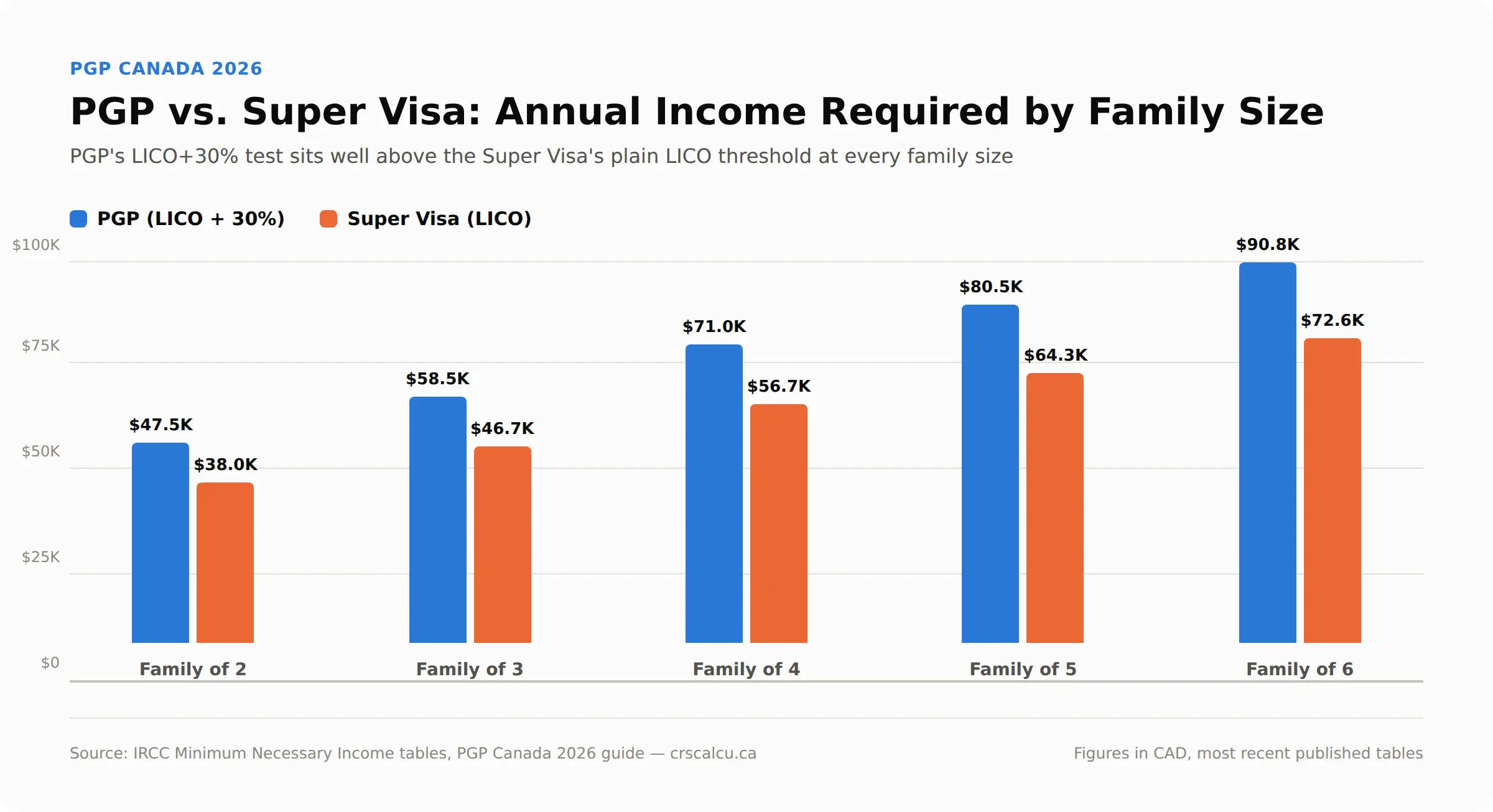
For PGP specifically, the MNI formula is the Low Income Cut-Off, or LICO, plus an additional 30%. This is stricter than the plain LICO threshold used for other sponsorship categories, and it must be met for three consecutive tax years, not just one.
2025 PGP Minimum Necessary Income Table
| Family Size | Approximate MNI (LICO + 30%) |
|---|---|
| 2 persons | $47,549 |
| 3 persons | $58,456 |
| 4 persons | $70,972 |
| 5 persons | $80,496 |
| 6 persons | $90,784 |
| 7 persons | $101,075 |
| Each additional person | Add approximately $10,291 |
Family size in this table includes you, your spouse or partner, your dependent children, the parent or grandparent you want to sponsor, and anyone else you’re already sponsoring or have previously sponsored.
A few points trip people up every intake cycle. There is no averaging across the three years. A strong income in year one and year three cannot offset a weak year two. Only income reported to and assessed by the Canada Revenue Agency counts, so cash income that was never declared will not help your case.
Can Someone Co-Sign If My Income Isn’t Enough?
Yes, in most cases you can add a co-signer, typically a spouse or common-law partner, to combine household income and meet the threshold. The co-signer takes on shared responsibility for the sponsorship undertaking, so this is not a decision to make lightly.
Who Can Sponsor Through PGP Canada: Eligibility Checklist
Before you get attached to the idea of PGP Canada as your family’s path, it helps to confirm you actually meet the base eligibility rules. IRCC checks sponsors against a fixed list of requirements, and missing even one disqualifies the application regardless of income.
To sponsor, you generally need to be at least 18 years old, and either a Canadian citizen, a permanent resident, or a person registered under the Canadian Indian Act. You must live in Canada, or commit to living in Canada once the sponsored parent or grandparent becomes a permanent resident.
- You’re in default on a previous sponsorship undertaking
- You’re receiving social assistance for reasons other than a disability
- You’ve declared bankruptcy and haven’t been discharged
- You have certain unresolved criminal or immigration violations
IRCC reviews these bars carefully, so it’s worth requesting your own file history if you’ve sponsored anyone before.
PGP Canada Application Process: From Interest Form to Approval
Understanding the full sequence helps explain why processing takes as long as it does, even once new intake eventually resumes.
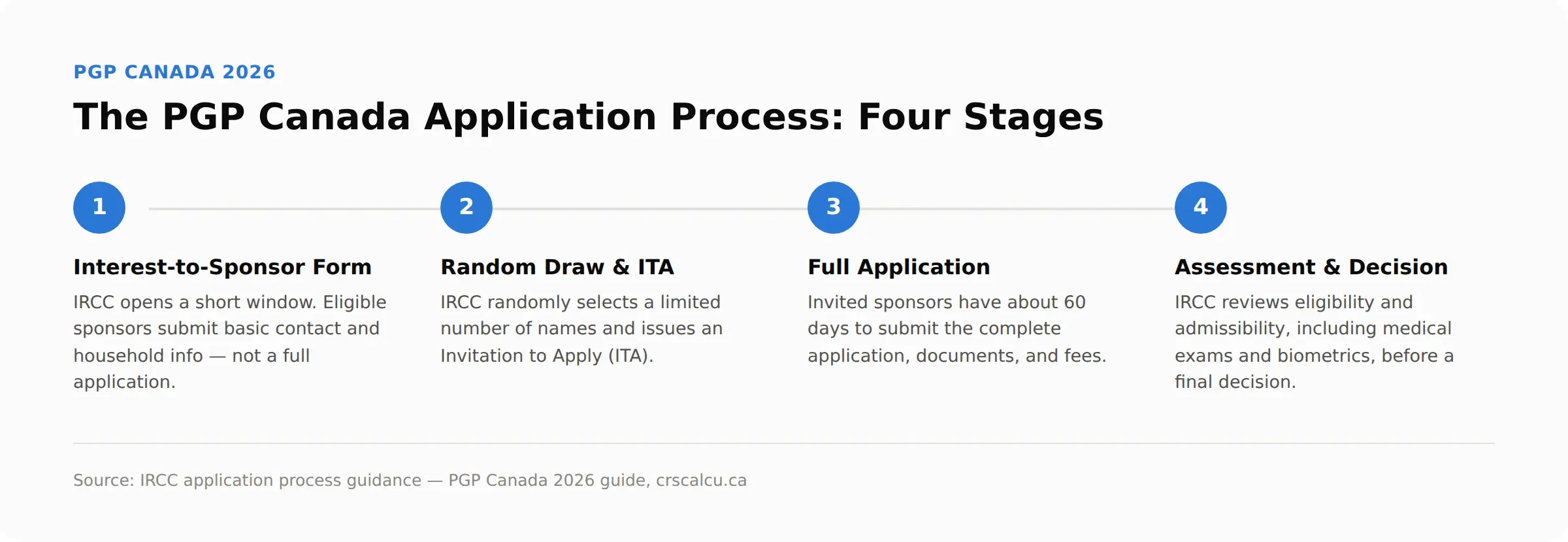
The process typically follows four stages. First, IRCC opens a window for interest-to-sponsor forms, and eligible people submit basic information, not a full application. Second, IRCC runs a random draw and sends Invitations to Apply, commonly called ITAs, to a limited number of people from that pool. Third, invited sponsors have a set window, usually 60 days, to submit the complete application with all supporting documents and fees. Fourth, IRCC assesses the sponsor’s eligibility and the principal applicant’s admissibility, which includes medical exams and background checks, before issuing a final decision.
Medical Exams and Biometrics
Every parent or grandparent being sponsored must pass an immigration medical exam performed by an IRCC-approved panel physician. This checks for conditions that could pose a danger to public health or place excessive demand on Canada’s health and social services. Biometrics, meaning fingerprints and a photo, are also required from the applicant and are typically valid for ten years once submitted.
PGP Canada Government Fees Breakdown
| Fee Type | Approximate Cost (CAD) |
|---|---|
| Sponsorship fee | $85 |
| Principal applicant processing fee | $585 |
| Right of Permanent Residence Fee | $515 |
| Biometrics fee | $85 |
| Total per applicant (approximate) | $1,270 |
These figures are official IRCC fees and can change, so always confirm the current amount on the government fee schedule before submitting payment.
A Realistic Example: How the Numbers Play Out
Consider a family of four in Ontario: two working parents and two dependent children, hoping to sponsor one grandparent. Under the PGP Canada income table, their required family size for the calculation becomes five once the grandparent is included, which puts their MNI at roughly $80,496 across three consecutive years.
If their combined household income was $76,000 in one of those three years, even a strong income the following year won’t fix that gap, because IRCC does not average across years. In this scenario, the family has two realistic choices: add a co-signer to boost the shortfall year, or apply for a Super Visa now, where the income bar for the same family size sits meaningfully lower, and revisit PGP once intake reopens and their income has stabilized above the threshold.
This kind of scenario is exactly why so many immigration advisors recommend running both tracks in parallel rather than waiting on one alone.
The 20-Year Sponsorship Undertaking
This is the part of PGP that catches people off guard. When you sponsor a parent or grandparent, you sign an undertaking with the federal government promising to financially support them for 20 years from the date they become a permanent resident. In Quebec, the commitment is shorter, but still substantial.
This undertaking is not a formality. It’s a binding legal contract. If the sponsored person ever receives provincial social assistance during that period, the government can pursue you to recover the cost, including through wage garnishment or seizing a tax refund. Before you commit to sponsorship, it’s worth having an honest conversation within your family about long-term expectations.
PGP vs. Super Visa: Which Should You Choose?
With PGP closed to new applicants, most families are left comparing two very different tools: wait for PGP to reopen, or use the Super Visa as a temporary bridge. Here’s how they actually compare.
| Feature | PGP | Super Visa |
|---|---|---|
| Status in 2026 | Closed to new applicants | Open |
| Outcome | Permanent residence | Long-stay visitor status |
| Stay duration | Indefinite (PR) | Up to 5 years per entry, renewable |
| Income test | LICO + 30%, 3 years | LICO only, more flexible in 2026 |
| Legal commitment | 20-year undertaking | Shorter-term support letter |
| Healthcare access | Full provincial healthcare | Must buy private insurance |
| Application route | Lottery-based invitation | Direct application, no lottery |
If your family needs a working solution this year, the Super Visa is currently the only door that’s open. If permanent residence is the real goal and you can wait, keeping your name ready for when PGP reopens still matters.
PGP Canada Application Process: From Interest Form to Approval
Understanding the full sequence helps explain why processing takes as long as it does, even once new intake eventually resumes.
The process typically follows four stages. First, IRCC opens a window for interest-to-sponsor forms, and eligible people submit basic information, not a full application. Second, IRCC runs a random draw and sends Invitations to Apply, commonly called ITAs, to a limited number of people from that pool. Third, invited sponsors have a set window, usually 60 days, to submit the complete application with all supporting documents and fees. Fourth, IRCC assesses the sponsor’s eligibility and the principal applicant’s admissibility, which includes medical exams and background checks, before issuing a final decision.
Medical Exams and Biometrics
Every parent or grandparent being sponsored must pass an immigration medical exam performed by an IRCC-approved panel physician. This checks for conditions that could pose a danger to public health or place excessive demand on Canada’s health and social services. Biometrics, meaning fingerprints and a photo, are also required from the applicant and are typically valid for ten years once submitted.
PGP Canada Government Fees Breakdown
| Fee Type | Approximate Cost (CAD) |
|---|---|
| Sponsorship fee | $85 |
| Principal applicant processing fee | $585 |
| Right of Permanent Residence Fee | $515 |
| Biometrics fee | $85 |
| Total per applicant (approximate) | $1,270 |
These figures are official IRCC fees and can change, so always confirm the current amount on the government fee schedule before submitting payment.
A Realistic Example: How the Numbers Play Out
Consider a family of four in Ontario: two working parents and two dependent children, hoping to sponsor one grandparent. Under the PGP Canada income table, their required family size for the calculation becomes five once the grandparent is included, which puts their MNI at roughly $80,496 across three consecutive years.
If their combined household income was $76,000 in one of those three years, even a strong income the following year won’t fix that gap, because IRCC does not average across years. In this scenario, the family has two realistic choices: add a co-signer to boost the shortfall year, or apply for a Super Visa now, where the income bar for the same family size sits meaningfully lower, and revisit PGP once intake reopens and their income has stabilized above the threshold.
This kind of scenario is exactly why so many immigration advisors recommend running both tracks in parallel rather than waiting on one alone.
The 20-Year Sponsorship Undertaking
This is the part of PGP that catches people off guard. When you sponsor a parent or grandparent, you sign an undertaking with the federal government promising to financially support them for 20 years from the date they become a permanent resident. In Quebec, the commitment is shorter, but still substantial.
This undertaking is not a formality. It’s a binding legal contract. If the sponsored person ever receives provincial social assistance during that period, the government can pursue you to recover the cost, including through wage garnishment or seizing a tax refund. Before you commit to sponsorship, it’s worth having an honest conversation within your family about long-term expectations.
PGP vs. Super Visa: Which Should You Choose?
With PGP closed to new applicants, most families are left comparing two very different tools: wait for PGP to reopen, or use the Super Visa as a temporary bridge. Here’s how they actually compare.
| Feature | PGP | Super Visa |
|---|---|---|
| Status in 2026 | Closed to new applicants | Open |
| Outcome | Permanent residence | Long-stay visitor status |
| Stay duration | Indefinite (PR) | Up to 5 years per entry, renewable |
| Income test | LICO + 30%, 3 years | LICO only, more flexible in 2026 |
| Legal commitment | 20-year undertaking | Shorter-term support letter |
| Healthcare access | Full provincial healthcare | Must buy private insurance |
| Application route | Lottery-based invitation | Direct application, no lottery |
If your family needs a working solution this year, the Super Visa is currently the only door that’s open. If permanent residence is the real goal and you can wait, keeping your name ready for when PGP reopens still matters.
Super Visa 2026: What Changed and Why It’s Now the Default Option
Alongside the PGP pause, IRCC made the Super Visa noticeably easier to qualify for in 2026, which is likely not a coincidence. Two changes stand out.
First, sponsors can now meet the income requirement using either of the two tax years before their application, not just the most recent one. This gives families more flexibility if last year was financially tighter than usual.
Second, and more unusually, the visiting parent or grandparent’s own income can now count toward the household total, as long as it’s Canadian-sourced and properly reported. Previously, the sponsor had to meet the threshold alone.
Super Visa Income Table for 2026
| Family Size | 2026 Minimum Income |
|---|---|
| 1 person (sponsor only) | $30,526 |
| 2 persons | $38,002 |
| 3 persons | $46,720 |
| 4 persons | $56,724 |
| 5 persons | $64,336 |
| 6 persons | $72,560 |
| 7 persons | $80,784 |
| Each additional person | Add approximately $8,224 |
Notice this table is meaningfully lower than the PGP table above, since it doesn’t include the extra 30% buffer. That gap is one reason so many families are choosing Super Visa applications this year instead of waiting on a paused lottery.
A Super Visa also still requires proof of a private medical insurance policy covering at least one year, underwritten by a Canadian insurer, with a minimum coverage amount set by IRCC. We cover insurance shopping and requirements in detail on our Canada Super Visa guide.
Common Reasons PGP and Super Visa Applications Get Refused
Understanding why applications fail helps you avoid the same mistakes.
For PGP, the most frequent refusal reason is failing the three-year income test, often because a sponsor assumes gross income qualifies when IRCC actually looks at net income reported on Line 15000 of your tax return. Missing Notices of Assessment for any of the three years is another common gap.
For Super Visa applications, refusals more often come down to insufficient proof of ties to the home country. IRCC wants evidence the visiting parent or grandparent intends to return home eventually, such as property ownership, family remaining in the home country, or a stable pension. Incomplete insurance documentation is the second most common issue.
In both cases, small paperwork gaps cause more refusals than genuine ineligibility. Double-checking every document against the official checklist before submission avoids most of these problems.
What to Prepare While You Wait for PGP to Reopen
Even though new PGP applications aren’t being accepted right now, there’s real value in preparing ahead of a future reopening.
Start by confirming whether you submitted an interest-to-sponsor form during the 2020 window, since that’s currently the only active pool. If you did, keep your contact information with IRCC up to date so you don’t miss an invitation. If you didn’t, there’s nothing to submit yet, but you can still get your finances in order.
Begin tracking three consecutive years of qualifying income now, using your Notices of Assessment as proof. Gather civil documents like birth certificates and marriage certificates for everyone involved, since these often take the longest to obtain, especially from overseas. If your income currently sits below the LICO+30% threshold, look at whether a co-signer could help you clear the bar before intake reopens.
What to Do If Your PGP Canada Application Is Refused
A refusal is not automatically the end of the road. If IRCC refuses your PGP Canada sponsorship application, you generally have the right to appeal to the Immigration Appeal Division, or IAD, within 30 days of receiving the refusal letter.
The IAD can consider both whether the original refusal was legally correct and, in some cases, humanitarian and compassionate factors even if the strict legal test wasn’t met. Appeals typically take well over a year to be heard, so timing matters if your family’s circumstances are urgent. Many families use this waiting period productively by strengthening their finances in case a fresh application becomes the better option.
If your refusal was based on income falling short in one specific year, and that gap has since closed, it may be worth weighing a new application against an appeal, since a stronger, cleaner file sometimes resolves faster than a contested appeal. An immigration lawyer or a Regulated Canadian Immigration Consultant can review your specific refusal letter and advise which route fits your case, since the right call depends heavily on the exact reason IRCC gave.
Should You Wait for PGP or Move to Super Visa Now?
This is the question almost every family lands on eventually, and the honest answer depends on your timeline and your goal.
If your priority is getting a parent or grandparent into Canada this year, for a new grandchild, a health situation, or simply because the distance has gone on long enough, the Super Visa is the only realistic option right now. It won’t give them permanent status, but it can put them in the same city as your family within months rather than years.
If your priority is permanent residence specifically, and your family can manage without them physically present in Canada in the short term, it makes sense to keep preparing documents and income proof while watching for a PGP reopening announcement. Nothing about applying for a Super Visa in the meantime hurts your future PGP eligibility, so for many families, doing both isn’t an either-or decision at all.
Frequently Asked Questions
The Bottom Line
PGP remains the only permanent pathway built specifically for parents and grandparents, but 2026 has made it clear that it’s not a program you can plan around with certainty. New intake is closed, the existing queue is long, and nobody has a firm date for when that changes.
For most families right now, the practical move is to treat the Super Visa as this year’s solution while keeping your documents and finances ready for whenever PGP reopens. Use our CRS Calculator tools to check what other immigration pathways might fit your family’s timeline in the meantime.