Express Entry Guide · Updated October 2026
Your score is in the 300s or 400s and nothing seems to move it. Here is every lever on the CRS table, what it is worth today, and what to do first — a practical look at how to increase CRS score.
By Aria Sterling · Checked against IRCC rules · 12 min read
If you want to know how to increase your CRS score, start with one uncomfortable fact: most of the advice online lists levers without prices. “Learn French”, “get a PNP”, “do another degree” — but nobody tells you whether that lever is worth 8 points or 600, or whether it takes three weeks or three years. That is why people spend a year on the wrong lever.
This post prices every lever from IRCC’s Comprehensive Ranking System criteria, in order of what it usually delivers. It does not cover draw predictions — for current cutoffs, see our latest Express Entry draws and CRS cutoffs and our next draw prediction pages, because any cutoff printed here would go stale.
Evidence base: IRCC’s CRS criteria page (modified June 22, 2026) and public forum threads from candidates describing scores in the 300s and 400s. This is general information, not legal advice.
Quick answer
Quick answer:
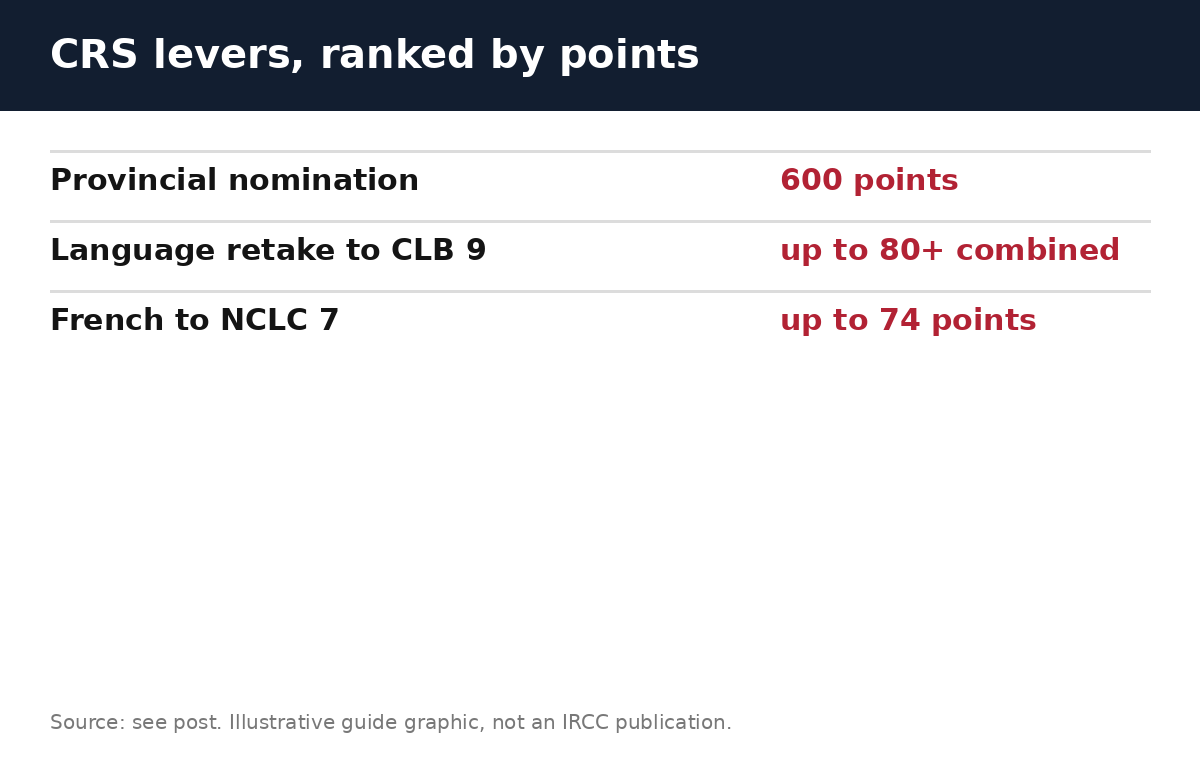
For most candidates stuck in the 300s or 400s, the order is: language retake to CLB 9 first, French second, a provincial nomination in parallel, and everything else after that. A language retake can be worth more than 80 points once transferability is included, French can add up to 74 points, and a nomination adds 600. A second degree, by contrast, is often worth single digits on its own.
Use this order as your plan for how to increase CRS score, and recheck your number after each change.
Key takeaways
How to increase CRS score: every lever, ranked
This table is the full menu for how to increase CRS score — work through it in the order shown in the quick answer.
Lever | Points (single applicant) | Time it tends to take |
|---|---|---|
Provincial nomination | 600 | Months; separate application |
Language retake to CLB 9 (core + transferability) | Up to 80+ combined | Weeks to months of study |
French to NCLC 7 (bonus + second language) | Up to 74 | Months of study |
More Canadian work experience (1 to 5 years) | 40 to 80 | Years; happens anyway if you stay |
Spouse language, education and work | Up to 40 | One test or one assessment |
Canadian education credential | 15 or 30 | 1 to 3 years of study |
Sibling in Canada | 15 | Weeks of documents, if eligible |
Second credential (bachelor’s to two or more) | 8 core points | 1 year or more |
Points from IRCC’s CRS criteria page (modified June 22, 2026), for a candidate without a spouse unless stated. The time column is our rough guide, not IRCC’s.
1. How to increase CRS score with a language retake to CLB 9
CLB 9 is where the maths changes. For a single applicant, each ability at CLB 8 is worth 23 points and at CLB 9 it is worth 31. Moving all four abilities from CLB 8 to CLB 9 therefore adds 32 core points (92 to 124). With an accompanying spouse, the same move adds 28 points (88 to 116).
If you take one step from this post, make it this one: a retake aimed at CLB 9 is the most reliable move in how to increase CRS score.
Then comes transferability, which is where most people undercount. With a post-secondary credential, CLB 9 raises the education-and-language combination from 25 points to 50. With three years of foreign work experience, CLB 9 raises the foreign-work-and-language combination from 25 to 50 as well. A single applicant with a bachelor’s degree and three years of foreign work who moves from CLB 8 to CLB 9 can therefore gain 32 core points plus 50 transferability points — 82 in total.
The practical point: retake the skill that is below the threshold, not the test as a whole. If three abilities are already at CLB 9 and writing sits at CLB 8, all of your study time belongs on writing. Our CLB calculator shows which ability is holding you back, and you can check the effect of any change in our CRS calculator first.
Tip:
Book the retake before your current results expire. Language results must be less than two years old when you create your profile and when you submit your application, so a retake that lands after expiry does not help you.
2. How to increase CRS score with French: the second-biggest lever
French pays twice. First, as a second official language, NCLC 7 or 8 is worth 3 points per ability (12 in total) and NCLC 9 or higher is worth 6 per ability (24 in total), capped at 24 points for a single applicant. Second, the additional French bonus: 25 points if you reach NCLC 7 or higher in all four French abilities and your English is CLB 4 or lower (or you have no English test), and 50 points if your English is CLB 5 or higher in all four abilities.
French is the second-biggest lever in how to increase CRS score because it pays twice: core points plus the bonus.
That means French at NCLC 7 with decent English is worth 50 bonus points plus 12 second-language points — 62 in total — and at NCLC 9 it is worth 74. The catch is absolute: miss NCLC 7 in even one ability and the bonus is zero. There is no partial credit.
French also opens a separate door: the French-language proficiency category draws, which you can only enter with NCLC 7 in all four abilities. For current rounds, see our category-based draws page rather than any number printed here.
3. A provincial nomination: 600 points
A provincial or territorial nomination accepted in your Express Entry profile adds 600 points. Nothing else comes close. But a nomination is not a lever you pull inside your profile: you apply to a province’s stream, the province assesses you against its own criteria, and only then do you accept the nomination in Express Entry.
That 600-point jump is why a nomination dominates any plan for how to increase CRS score — if you qualify for a stream.
Some streams select candidates directly from the pool; others need a job offer in the province or a connection such as work experience or study there. Because each province runs its own streams, the right move is to check the province’s official site for the stream that fits your occupation and history — not to apply everywhere at once. Our BC PNP calculator and Alberta PNP calculator cover two provinces; other provinces need their own research.
Warning:
A nomination does not remove the other requirements. You must still meet the program you were invited under, and a nomination tied to a job or a province can limit where you are expected to settle first.
4. A second credential
On core points alone, a second credential is a small lever. For a single applicant, a bachelor’s degree is worth 120 points and two or more credentials (one of them three years or longer) is worth 128 — a gain of 8 points. A master’s degree is worth 135 and a PhD 150.
A second credential is a slow, small step in how to increase CRS score, so it belongs near the end of the order, not the start.
Where a second credential can matter more is transferability: with CLB 9 or higher, two or more credentials can reach the 50-point education combination. And any foreign credential you claim needs an Educational Credential Assessment (ECA) for immigration purposes, or it scores zero. Do not enrol in a year of study for 8 points without checking the transferability combination first.
5. More Canadian work experience
Canadian skilled work experience, in TEER 0, 1, 2 or 3, is worth 40 points for one year, 53 for two, 64 for three, 72 for four and 80 for five years or more (single applicant). It is a slow lever, but it is also the lever that grows while you do nothing else — provided the work is paid, skilled, and done while authorised to work in Canada. Work done while you were a full-time student, and self-employment, do not count toward the Canadian Experience Class.
Each extra year of Canadian experience adds points, which is why time in Canada is part of how to increase CRS score for workers already here.
6. Spouse factors and who leads
If your spouse or common-law partner accompanies you, their results can add up to 40 points: education up to 10, language up to 20, and Canadian work experience up to 10. A spouse language test or an ECA for a spouse’s credential is often the cheapest point gain available — one test, no study programme, no move.
For couples, checking both directions is a free step in how to increase CRS score — it costs nothing but a recalculation.
Sometimes the bigger move is switching who is the primary applicant. Run both versions through the calculator: the partner with the stronger combination of age, education, language and experience should usually lead, but the answer is arithmetic, not tradition. See our guide to how to calculate a CRS score for the full factor order.
7. The small levers: sibling, Canadian education
A sibling who is a Canadian citizen or permanent resident living in Canada adds 15 points, if you can prove the relationship and their residence. A Canadian post-secondary credential adds 15 points for a one- or two-year programme and 30 for three years or more. Neither lever rescues a score on its own, but either one can close a small gap — and sibling points are the only lever on this list that costs documents rather than months.
Small levers still count when you are asking how to increase CRS score from just below a cutoff.
Traps that waste months
The job-offer trap. A job offer adds 0 CRS points today. From 3 November 2026, a job offer in an eligible high-wage occupation can earn 50, 70 or 100 CRS points under the new Labour Market Integration factor, with no LMIA needed. The same factor also covers Canadian work experience — you get points for one or the other, whichever is higher, not both. Anyone selling you an offer for points today is selling something that does not exist yet.
Avoiding these traps is part of how to increase CRS score sensibly: a wasted year costs more than a missed point.
The wrong-skill retake. Improving reading from CLB 9 to CLB 10 while writing sits at CLB 8 gains 3 points. Improving writing from CLB 8 to CLB 9 gains 8 core points plus transferability. Always fix the lowest ability first.
The new-profile trap. Deleting your profile and starting again resets your profile creation date, which is the tie-breaker when candidates share a score. Update the existing profile instead, unless it has become ineligible for a reason you cannot fix by editing.
The unassessed credential. A foreign degree without an ECA is worth zero education points, however impressive the university. Get the assessment before you count the points.
Real cases
Real case: mid-300s with CLB 8, asking what to do first (forum thread, 2026)
A candidate in the mid-300s with CLB 8 asked what would actually improve their score. The thread’s advice scattered across every lever — French, PNP, a new degree — without pricing any of them. On the grid, the cheapest big move available to that profile was a language retake to CLB 9, worth 32 core points plus transferability. No outcome was reported.
Real case: high-460s, just under the cutoff (forum thread, 2026)
A candidate in the high-460s asked whether they would be invited, with cutoffs sitting just above their score. The useful answer was not a prediction but a gap analysis: at that distance, a single small lever — sibling points, a spouse test, or one more year of Canadian experience — closes the gap, while a new degree does not. No outcome was reported.
Real case: low-350s, asking about real possibilities (forum thread, 2026)
A candidate in the low-350s asked what their real chances were. The honest answer is that no score in the 300s competes in a general or CEC round on points alone: the realistic routes are a category draw the candidate qualifies for, a provincial nomination, or raising the score by 50 or more points. No outcome was reported.
Frequently Asked Questions
What is the fastest way to increase a CRS score?
If you are asking how to increase CRS score quickly, the answer for most people is a language retake to CLB 9. Moving all four abilities from CLB 8 to CLB 9 adds 32 core points for a single applicant, and it can unlock up to 50 more points in skill transferability, depending on your education and work history.
How much does French add to a CRS score?
If you are working out how to increase CRS score with a second language, French at NCLC 7 or higher in all four abilities adds 25 or 50 additional points, depending on your English level, plus up to 24 core points as a second official language. The full 50-point bonus needs English at CLB 5 or higher in all four abilities.
Does a provincial nomination really add 600 CRS points?
Yes. A provincial or territorial nomination accepted in your Express Entry profile adds 600 points. It is the single largest jump on the CRS table, but it requires a separate provincial application and you must meet that province’s stream rules.
Does a job offer increase my CRS score today?
No. As of October 2026 a job offer adds 0 CRS points. From 3 November 2026, a job offer in an eligible high-wage occupation can earn 50, 70 or 100 CRS points under the new Labour Market Integration factor, with no LMIA needed. The same factor also covers Canadian work experience, so you get points for one or the other, whichever is higher, not both.
Is a second credential worth it for CRS points?
Sometimes. Moving from one bachelor’s degree to two or more credentials adds 8 core points, but the bigger gain can come from skill transferability combinations with strong language results. You need an Educational Credential Assessment for any foreign credential you claim.
How many points does a sibling in Canada add?
A sibling who is a Canadian citizen or permanent resident living in Canada adds 15 CRS points, if you can prove the relationship and their residence. The sibling must be a brother or sister related to you or your spouse by blood, marriage, common-law partnership or adoption.
Does Canadian work experience keep adding points every year?
Yes, up to a point. For a single applicant, Canadian work experience is worth 40 points for one year, 53 for two, 64 for three, 72 for four and 80 for five years or more. Only skilled work in TEER 0, 1, 2 or 3 counts.
Final Thoughts
If your score is stuck, price the levers before you pick one. A language retake and French are the two levers most candidates control, a nomination is the biggest lever of all, and everything else is either slow or small. Run each change through the calculator before you commit money or months to it. That order — language first, French second, nomination in parallel — is how to increase CRS score with the least wasted time.
If your situation involves a refusal, a misrepresentation concern or a complicated work history, talk to a licensed consultant (RCIC) or lawyer before you act on this guide.
Sources
We build free Express Entry tools and track every IRCC draw. This guide was checked against official IRCC sources and real applicant reports. Last reviewed: October 29, 2026. This is general information, not legal advice. For your own case, talk to a licensed consultant (RCIC) or lawyer.