Express Entry Guide · Updated October 2026
You did the work, you were paid for it, and the one document IRCC wants most is the one your employer will not write — what now?
By Aria Sterling · Checked against IRCC rules · 12 min read
When an employer refuses reference letter requests for Express Entry, most candidates do one of two things: panic, or give up on claiming the job. Both are mistakes. IRCC knows employers refuse, close down, and hide behind policy. What officers want is not a perfect letter — it is a complete picture, built from documents that together prove the same facts a letter would prove.
This post builds that picture — the complete guide for when an employer refuses reference letter requests. It starts with what a standard letter must contain, so you know exactly what is missing. Then it maps every missing item to a substitute document, shows you how to document the refusal itself, and warns you about the shortcuts that turn a weak file into a refused one.
Evidence base: IRCC’s work-experience document guidance on canada.ca, plus paraphrased reports from public applicant threads. This is general information, not legal advice.
Quick answer:
Ask in writing, keep the refusal, and build a substitute package: employment contract, pay slips, tax records (T4 and Notice of Assessment in Canada, or the local equivalent abroad), promotion or salary letters, a supervisor or colleague letter for duties, and a signed letter of explanation that maps each substitute to the item it replaces. Submit the package as one coherent set, not as a pile of unrelated papers. That is how you respond when an employer refuses reference letter requests.
Key takeaways
What a Standard Letter Must Contain — and What You Are Missing
A standard Express Entry reference letter is printed on company letterhead and signed by a supervisor or personnel officer whose name, title and contact details appear on it. It states your name, every position you held, job titles, main duties and responsibilities, job status if the job is current, dates worked, hours per week, and annual salary plus benefits. That list is your checklist: every substitute you gather should be aimed at one of those items.
Most refusals are partial, not total, and the partial cases are easier than people think. A company that “does not issue detailed letters” will often still confirm dates and title on letterhead. That is a start, not a solution — it proves employment but not skilled duties. A manager who cannot use letterhead may still write a signed letter on plain paper or email. A former supervisor who has left the company can still write about the work they supervised. Each of these fills a different gap, and your job is to collect enough of them that no gap is left empty.
Before you assemble anything, ask properly. Send a short written request to HR and to your direct manager, separately, asking for the full letter with duties. Keep copies of both requests and every reply. If the answer is a policy — “we only confirm dates and title” — ask for that policy in writing too. You will see why in a moment: the refusal itself is evidence, and officers treat a documented refusal very differently from an unexplained missing letter. If that letter never arrives because an employer refuses reference letter requests, the package below is your answer.
Employer Refuses Reference Letter: The Substitute Evidence Package, Item by Item
Think of the package as a table. Each row is a fact IRCC needs; each column is a document that can prove it. Your package is complete when every row has at least one strong document — and stronger when the important rows have two.
Fact IRCC needs | Best substitutes when the letter is refused |
|---|---|
Employer identity and contact | Employment contract on company letterhead; company registration or website printout; the dates-and-title letter, if you can get one |
Job title and positions held | Contract, offer letter, promotion letters, appointment letter, internal transfer memos |
Dates worked | Contract, pay slips spanning the period, tax records, bank salary credits |
Hours per week and full-time status | Contract hours clause, pay slips showing hours, shift records, salary letters stating full-time status |
Salary and benefits | Pay slips, T4 slips and Notices of Assessment (or local tax equivalents), bank statements showing salary credits, salary review letters |
Duties matching the NOC | Supervisor letter, colleague letter, client letter, official job description, performance reviews, project records showing your actual work |
Source: IRCC’s work-experience document guidance (canada.ca). This mapping is our summary of that guidance and of IRCC’s published answers on alternative documents, not IRCC text.
The duties row deserves special attention, because it is where substitute packages usually fail. Pay slips prove you were paid; they do not prove what you did. Tax records prove income; they do not prove a NOC. Only documents that describe your actual tasks — a supervisor’s letter, a client letter, a performance review, an official job description tied to your role — can carry the duties row. If your package has ten pay slips and nothing describing duties, it is still incomplete.
A supervisor letter is the single most valuable substitute. It does not need company letterhead to be useful, though letterhead helps. What it needs is the supervisor’s name, title, contact details, dates they supervised you, and duties written in their own words — not copied from the NOC page. A colleague letter is weaker but still useful, especially when the colleague worked alongside you daily. A client letter works best for consultants and agency staff whose real supervisor was the client. An employer refuses reference letter requests more often than applicants expect, so build this package before you need it.
Tip:
When you ask a former supervisor for a letter, send them a short bullet list of the duties you actually did, and ask them to rewrite it in their own words. You are jogging their memory, not dictating the letter — and the result reads like a real supervisor’s account, because it is one.
Employer Refuses Reference Letter: How to Document the Refusal
Your letter of explanation is the cover page of the package, and it has a specific job: to tell the officer, in order, what you asked for, what you were refused, what you submitted instead, and how each substitute maps to the missing item. Keep it to one or two pages. Officers read hundreds of these; a short, factual letter beats a long, emotional one.
A good structure is: (1) “I requested a reference letter on [date] from [HR/manager]”; (2) “The request was refused on [date] for [reason, quoting the reply if you have it]”; (3) “In place of the letter I submit the following documents” — then a numbered list, each item mapped to the fact it proves; (4) “I declare that the information in this letter is true and complete”, signed and dated. Attach the request and the refusal behind the letter, so the officer does not have to take your word for the refusal.
If the refusal was verbal — a manager who will not put it in writing — write down the date, the person, and what was said, and say so plainly in your letter: “The refusal was given verbally on [date] by [name, title]. No written reply was provided despite my request.” Honesty about a verbal refusal is stronger than inventing a written one. And if you asked twice, say so; two documented attempts show diligence, while one vague attempt looks like you gave up early. A refusal you can show beats a refusal you only describe — that is the core lesson when an employer refuses reference letter requests.
Closed Companies, Colleges and Government Employers
Closed companies are common and survivable. Gather what survives: contracts, pay slips, tax records, bank credits, and letters from former supervisors or clients who can still be contacted. Explain the closure in your letter — company dissolved, office closed, website gone — and list every route you tried: former HR contacts, successor companies, business registries. An officer cannot expect a letter from a company that no longer exists, but they can expect you to show you tried.
Colleges and universities are a special frustration, because they often refuse duties letters for teaching or research staff while freely confirming employment. In that case, lean on appointment letters, course assignments, timetables, research outputs, and letters from department heads or principal investigators who supervised the work. A department head’s letter describing courses taught or research performed is exactly the duties evidence a central HR office will not provide.
Government employers sometimes refuse for security or policy reasons. The same package applies, with one addition: if a government HR office issues a standard service certificate (dates, title, pay scale), take it — it anchors the employment facts — and build the duties evidence from supervisors, posting orders and performance appraisals around it. The same approach works when an employer refuses reference letter requests and the company later disappears.
What Never to Do When an Employer Refuses Reference Letter Requests
Warning:
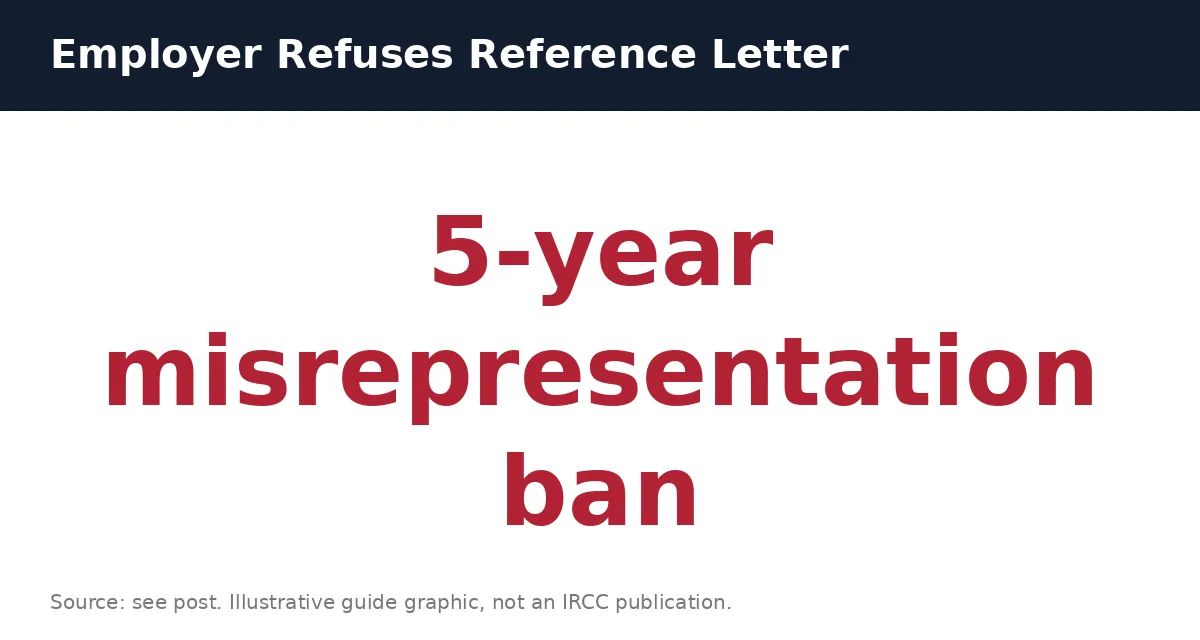
A misrepresentation finding can bar you from Canada for five years. That is the price of a fake letter. A thin but honest package, by contrast, costs you at most the points for the months you cannot prove. That warning matters most when an employer refuses reference letter requests and frustration tempts shortcuts.
Real Cases
Real case: The college that would not write duties (2021)
A candidate who had taught at a college reported that the institution would confirm employment but would not issue a letter with duties. The thread’s advice was to build around the refusal: appointment letters, course timetables, and a letter from the department head who had assigned the courses. The candidate’s own summary of the problem — a central office that confirms jobs but never describes them — is one of the most common refusal shapes in the threads. No outcome was reported.
Real case: “We only confirm dates and title” (2022)
A candidate received exactly that reply from a large employer’s HR department, in writing. Posters advised treating the short letter as the anchor, not the answer: pair it with the original contract (which stated hours and salary), pay slips across the period, and a former supervisor’s letter describing duties. The written refusal itself became part of the package, attached behind the letter of explanation. No outcome was reported.
Real case: Refused for claiming full-time work without duties wording (2020)
A candidate reported a refusal after claiming full-time work where the letter did not carry the duties wording, then waiting a year and reapplying with a rebuilt package. The thread is a cautionary tale about timing: the fix was not a better argument, it was better documents, gathered before the second application rather than during it. No outcome was reported beyond the reapplication.
Real case: Manager’s plain-email letter (2023)
A candidate asked whether a manager’s letter sent by email, without company letterhead, would work. The consensus in the thread was that it could help, especially for duties, as long as the manager’s identity and contact details were verifiable and the letter was paired with pay and tax evidence. Letterhead is preferred, but a verifiable supervisor account beats no account at all. No outcome was reported.
Frequently Asked Questions
What if my employer refuses to give me a reference letter?
You can still prove the work with a substitute package: contract, pay records, tax documents, promotion letters, a supervisor or colleague letter, and a signed letter of explanation documenting the refusal. The package must collectively cover what a standard letter would show — title, dates, hours, pay and duties — because an officer needs the same six facts, whatever documents carry them. That is the standard answer when an employer refuses reference letter requests.
Will IRCC accept a letter from my manager instead of HR?
Yes, if the manager can confirm your role, duties, dates, hours and pay. A supervisor who actually directed your work is often more persuasive than an HR department that only confirms dates and title, because duties are the fact officers scrutinise most. Make sure the manager’s name, title and contact details are on the letter so the officer can verify it.
My employer will only confirm dates and job title. Is that enough?
No, not on its own. Dates and title prove you were employed, not what skilled work you did, and skilled duties are what the NOC test measures. You must supplement it with documents that prove duties, hours and pay — a supervisor letter, contract clauses, pay records — plus an explanation of why the full letter was refused, so the gap reads as documented rather than hidden.
Can a colleague write my reference letter?
A colleague or client letter can support your file, especially for duties, but it is weaker than a supervisor letter and cannot carry the whole claim alone. A colleague describes work they saw you do, which helps on duties, but cannot confirm pay, hours or employment terms. Pair it with pay, tax and contract evidence so every fact in the claim has a document behind it.
How do I document that my employer refused?
Keep your written request and their written reply, note dates and names, and attach them to a signed letter of explanation. A refusal you can show is far stronger than a refusal you only describe, because the officer does not have to take your word for it. If the refusal was verbal, write down the date, the person and what was said, and say so plainly. Keep both, because when an employer refuses reference letter requests, the paper trail is the proof.
Can I write my own duties statement and get it notarised?
A statement you write yourself helps explain your file, but it is not independent proof of your duties. Officers give the most weight to third-party documents: employer records, pay and tax evidence, and letters from people who supervised you. Notarisation proves you signed the statement, not that its contents are true, so it adds formality without adding evidence.
Is a fake or backdated reference letter ever worth the risk?
Never. A false document can lead to refusal and a five-year misrepresentation ban, which is a far worse outcome than losing the points for one job. A thin but honest substitute package is always better than a polished letter that is not true, because officers verify letters by contacting employers and inconsistencies surface quickly.
Final Thoughts
An employer refusal feels like a closed door, but in practice it is a paperwork problem with a known solution. Ask in writing, keep the refusal, and build a package that proves each fact a letter would have proved — with duties evidence at its centre, not just pay evidence around the edges. Then write the short, factual letter of explanation that ties the package together. That is the whole point when an employer refuses reference letter requests: prove the facts another way.
Start now, while you are still in the pool: list every claimed job, note which letters you already have and which you do not, and send the written requests this week. If your history includes a previous refusal or a complicated employer situation, talk to a licensed consultant (RCIC) or lawyer before you submit — and check the points effect of any months you cannot prove in the CRS calculator first. If an employer refuses reference letter requests this week, your written request starts the paper trail.
Sources
We build free Express Entry tools and track every IRCC draw. This guide was checked against official IRCC sources and real applicant reports. This is general information, not legal advice. For your own case, talk to a licensed consultant (RCIC) or lawyer.
Last reviewed: October 29, 2026
Additional Details — Name: Employer Refuses Reference Letter in 2026: Substitutes · Description: Employer refuses reference letter in 2026? Build the substitute evidence package that still proves your work — documents, refusal proof, and traps.