Express Entry Guide · Updated October 2026
Your post-graduation work permit is running out, the invitation has not arrived, and your profile gives you no status at all. This PGWP expiring BOWP guide walks through the timeline that matters.
By Aria Sterling · Checked against IRCC rules
Here is the trap in one sentence: an Express Entry profile is not a status document. It does not let you stay, it does not let you work, and it does not lead to a bridging open work permit (BOWP) on its own. Thousands of graduates discover this only when their post-graduation work permit (PGWP) is weeks from expiry and no invitation has arrived.
This post maps the real timeline: what a PGWP expiring BOWP actually requires, how maintained status works, when a visitor record is the right (if painful) choice, and what happens if the permit has already expired. Read it against your permit’s expiry date, not against the draw calendar — the draw calendar will not save your status.
Evidence line: we checked IRCC’s pages on bridging open work permits, maintained status and restoration of status, plus public threads from graduates facing PGWP expiry. This is general information, not legal advice.
Quick answer: A PGWP expiring BOWP requires four things together: you are in Canada, you hold valid or maintained status, you are the principal applicant on a permanent residence application that has received an acknowledgement of receipt (AOR), and your current work permit expires within four months. An ITA alone gives you none of that. If no ITA is coming before expiry, your options are a work permit extension or employer-supported permit, a visitor record (stay, no work), or — if the permit already expired — restoration within 90 days, during which you cannot work.
Key takeaways
The Status Trap: Profile ≠ Permit
It is easy to see why people confuse the two. You are in the pool, your score is competitive, you may even have a provincial nomination in progress — and it feels as if Canada has already accepted you. Legally, none of that is status. Status comes only from a permit or a visitor record. The pool gives you a ranking, not a right to remain.
The consequences show up in two places. First, work: once your PGWP expires without a pending extension or a PGWP expiring BOWP, you must stop working that day, even if your employer begs you to stay. Second, experience: time worked without authorization does not count as qualifying Canadian work experience, and time on visitor status does not count either. A status gap can therefore cost you both income and the very experience months your Express Entry case depends on.
Warning:
Never work a single shift after your permit expires without a pending application that keeps you authorized. Unauthorized work can harm a future application far more than a gap in employment does.
PGWP Expiring BOWP Rules: Four Conditions, All Required
A bridging open work permit lets you keep working for any employer while IRCC decides your permanent residence application. It is open, so it is not tied to one employer and needs no LMIA and no job offer. But the door only opens when all four conditions are met:
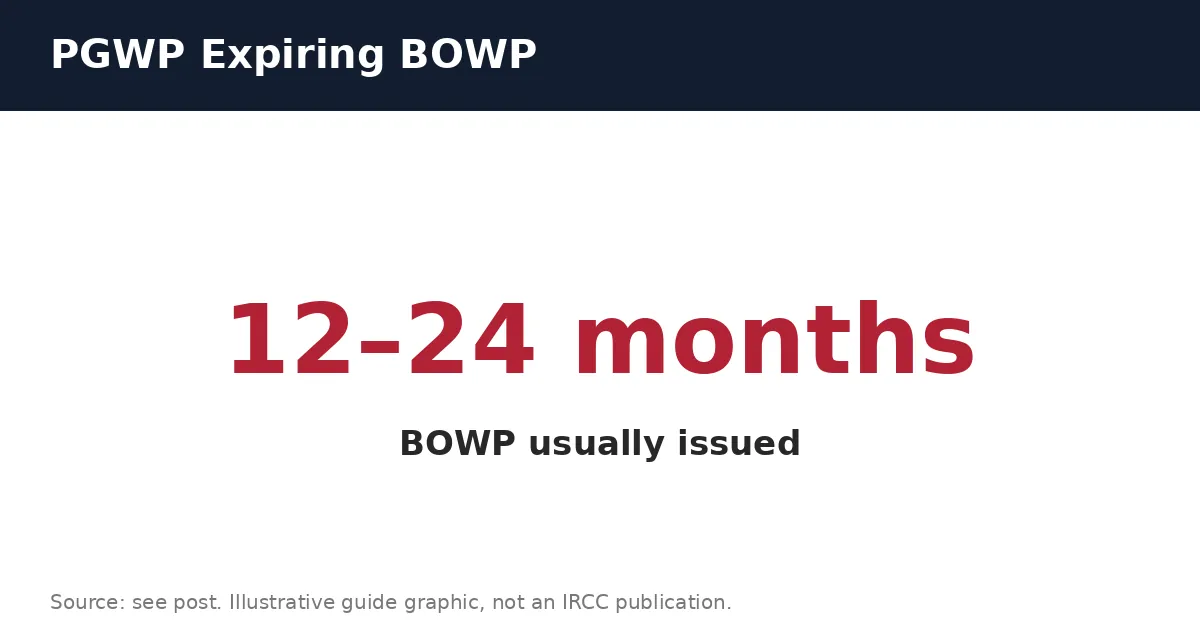
The eligible streams include Express Entry and most Provincial Nominee Program streams; family sponsorship applications do not qualify. If your PR application is under an eligible stream and the other conditions are met, a PGWP expiring BOWP is usually issued for 12 to 24 months and can be applied for again while the PR file is still open — but check the current processing times before assuming a smooth handover, because a PGWP expiring BOWP application itself takes months.
Notice what is missing from the list: an ITA. An invitation, a high score and a nomination do not substitute for an AOR. The sequence that works is ITA → complete application within 60 days → AOR → BOWP inside the four-month window. If your permit expires before the AOR arrives, the PGWP expiring BOWP route is closed for that cycle, and you need one of the options below.
Maintained Status: The Rule That Saves (or Sinks) People
Maintained status — formerly called implied status — is the rule that keeps you in status after your permit expires, provided you applied to extend or change it before it expired and IRCC has not yet decided. For a work permit renewal, you generally keep working under the same conditions: same employer, same job, same hours, until the decision.
Three limits catch people out. First, it only works if the application was made before expiry — even one day late means no maintained status at all. Second, it continues your old conditions: applying for a different kind of status (for example, worker to visitor) means you cannot work while you wait. Third, leaving Canada generally ends maintained status; you return as a new entrant with whatever status the border officer grants, and your work authorization may not come back with you. Do not travel on maintained status without advice.
If the application is refused, status ends on the refusal date. At that point restoration (below) becomes the question, with its own 90-day clock.
PGWP Expiring BOWP: Your Options Compared
Option | Can you work? | Does experience count? | Watch out for |
|---|---|---|---|
BOWP (after AOR, within 4-month window) | Yes, for any employer | Yes, if skilled and authorized | Needs the AOR first; do not file early |
Work permit extension / employer-supported permit | Yes, under its conditions | Yes, if skilled and authorized | May need an LMIA; tied to the employer if closed |
Maintained status (applied before expiry) | Yes, under old conditions | Yes, while authorized | Ends if you leave Canada or the application is refused |
Visitor record | No | No — visitor time is not work experience | Keeps you lawful, but the experience clock stops |
Restoration (within 90 days of losing status) | No, while pending | No, while out of status | Fee on top of the permit fee; not automatic |
Source note: the BOWP conditions, maintained-status rule and 90-day restoration window are IRCC’s. The comparison framing is ours.
If your permit has already expired and no application was pending, you have in most cases 90 days from losing status to apply for restoration, and you must stop working immediately. Restoration is not automatic — an officer must be satisfied you met your original conditions — and you cannot work or study while it is pending. After 90 days, standard restoration is generally unavailable, and you will likely need to leave Canada and seek advice on any other route.
Real Cases From Public Threads
Real case: ITA days before expiry, no AOR in time (2023)
A graduate described receiving an ITA just before the PGWP expired, then discovering that the invitation itself did not extend the permit or qualify them for a BOWP. Only the submitted application with an AOR would do that, and the 60-day application window ran past the permit’s expiry. The thread’s advice was to plan status around the expiry date, not the invitation date. No outcome was reported.
Real case: BOWP filed too early (2022)
Another applicant filed for a BOWP months before the permit’s expiry, hoping to get ahead of the queue, and faced refusal for filing outside the window. The lesson is counterintuitive but firm: for a BOWP, early is not safe — inside four months is the window, and outside it is a refusal risk.
Real case: visitor record, experience clock stopped (2024)
A candidate who switched to a visitor record while waiting in the pool kept lawful status but could not work, and the months on visitor status added nothing to their Canadian experience. They described it as the right call for staying lawful, and the wrong call for anyone counting on those months. No outcome was reported.
PGWP Expiring BOWP: Six Status Mistakes to Avoid
Frequently Asked Questions
Does an Express Entry profile give me status in Canada?
No. A profile is an expression of interest, not a permit. It gives you no right to stay or work, no maintained status, and no bridging work permit by itself. Only a submitted application with an acknowledgement of receipt can lead to a BOWP.
Does an ITA extend my work permit or qualify me for a BOWP?
No. An invitation alone changes nothing about your status, and it does not open a PGWP expiring BOWP route. You need a submitted, complete permanent residence application that has passed the completeness check and received an acknowledgement of receipt before a BOWP is possible. Until that receipt arrives, your permit’s expiry date is the only date that protects you.
When can I apply for a bridging open work permit?
PGWP expiring BOWP timing starts here: when you are in Canada, hold valid or maintained status, are the principal applicant on a permanent residence application with an acknowledgement of receipt, and your current work permit expires within four months. Filing outside that window risks refusal. Mark the four-month window on your calendar the day the AOR arrives, so the timing is planned rather than guessed.
What is maintained status?
If you apply to extend or change your status before your current permit expires, your existing status and conditions continue until IRCC decides. For a work permit renewal, that usually means you keep working under the same conditions while you wait.
Does leaving Canada end maintained status?
Yes. Leaving Canada while on maintained status generally ends it, and you return as a new entrant with whatever status the border officer grants. Do not travel on maintained status without advice. A trip that seemed harmless can leave you unable to resume work on your return.
Can I switch to a visitor record while I wait in the pool?
Yes, if you apply before your status expires. A visitor record keeps you lawfully in Canada, but you cannot work on it, and time on visitor status does not count as Canadian work experience for Express Entry. Apply before expiry, because a visitor application made after status is lost is a restoration case, not a simple change of status.
What if my permit already expired?
You lose status and must stop working immediately. In most cases you have 90 days from losing status to apply for restoration, with a restoration fee on top of the permit fee, and you cannot work while restoration is pending.
What is the single biggest timing mistake?
Waiting for the ITA before thinking about status. The ITA does not protect your status, so the status plan — extension, BOWP window, visitor record or restoration — must be built around your permit’s expiry date, not the draw calendar.
Final Thoughts
PGWP expiry is a calendar problem with a hard edge — the core of any PGWP expiring BOWP plan — and the draw calendar does not respect it. Work backwards from your permit’s expiry date: know your BOWP window, know whether an AOR can realistically arrive inside it, and have a fallback — extension, employer-supported permit or visitor record — ready before the expiry week, not during it.
If your situation is already complicated — a permit that has expired, a refusal on maintained status, a family depending on your work authorization — talk to a licensed consultant (RCIC) or lawyer before you file anything. Status mistakes are the ones that compound fastest, and they are also the ones most worth paying to avoid.
Sources
This guide was checked against official IRCC sources and real applicant reports. This is general information, not legal advice. For your own case, talk to a licensed consultant (RCIC) or lawyer.
Last reviewed: October 29, 2026