Express Entry Guide · Updated October 2026
Four small provinces, four nominee programs, and one federal program with a confusingly similar name — which Atlantic door actually fits your situation?
By Aria Sterling · Checked against IRCC and provincial sources · 13 min read
The Atlantic provinces are Canada’s most misunderstood immigration region, and the Atlantic provinces PNP is where much of the confusion starts. Applicants hear “Atlantic” and picture one program, but there are five doors: four provincial nominee programs — Nova Scotia, New Brunswick, Newfoundland and Labrador, and Prince Edward Island — plus the federal Atlantic Immigration Program, which is not a PNP at all. Each door fits a different person: a job offer in hand, an Express Entry profile, a recent graduation, a business plan, a medical licence, a priority occupation. Picking the wrong door wastes months. Picking the right one can be the fastest route in the country for the right candidate.
This Atlantic provinces PNP Canada comparison works at the level that matters: which door fits which situation. Provincial stream criteria change often, and this guide does not invent cutoffs or point grids the provinces have not published in the sources we checked — instead it maps the routes and sends you to the official provincial page for the current criteria.
We checked this guide against IRCC’s Atlantic Immigration Program guidance on canada.ca, provincial program descriptions, and 2026 program reporting, plus public forum threads about Atlantic choices. This is general information, not legal advice.
Quick answer: If you hold a job offer from an employer designated by an Atlantic province, the Atlantic Immigration Program is built for you. If you hold an Express Entry profile, look at the Express Entry-linked PNP streams. If you graduated in the region, look at the graduate streams. And if you hold a job offer from a non-designated employer, look at the job-offer PNP streams. Match the door to what you already hold — not to the province you like best. That is the Atlantic provinces PNP choice in one paragraph.
Key takeaways
Atlantic provinces PNP: the five doors at a glance
Route | Built for | Needs a job offer? |
|---|---|---|
Nova Scotia Nominee Program (NSNP) | Skilled workers, graduates, entrepreneurs, physicians, in-demand occupations | Most streams yes; Express Entry-linked and priority streams vary |
New Brunswick Provincial Nominee Program (NBPNP) | Skilled workers with employer support, Express Entry profiles, recruitment-event candidates, entrepreneurs | Most streams yes |
Newfoundland and Labrador Provincial Nominee Program (NLPNP) | Skilled workers, graduates, entrepreneurs, priority occupations | Most streams yes |
Prince Edward Island PNP (PEI PNP) | Skilled and critical workers, graduates, entrepreneurs, Express Entry profiles with a PEI connection | Most streams yes |
Atlantic Immigration Program (federal) | Workers with a designated Atlantic employer’s offer; recent Atlantic graduates (exempt from experience rules) | Yes — from a designated employer |
Source: our summary of provincial program descriptions and IRCC’s Atlantic Immigration Program guidance (canada.ca). Stream names and criteria change — confirm the current criteria on each province’s official page before applying. No cutoff or fee figures are stated here, because none were verified to an official page for this guide.
Nova Scotia
The Atlantic provinces PNP story starts in Nova Scotia, whose program covers the widest range of the four: a Demand stream linked to Express Entry for skills in demand in the province; a Skilled Worker stream for job offers from Nova Scotia employers; a Physician stream for licensed physicians with a practice opportunity; Labour Market Priorities draws for targeted strategic recruitment; an Occupations in Demand stream for specific shortage occupations; an Entrepreneur stream; and an International Graduate Entrepreneur stream for graduates of Nova Scotia institutions with business plans. Two cautions from recent reporting: one guide says Nova Scotia simplified to four streams in early 2026 and introduced a 12-month Expression of Interest validity period, but those claims conflict with the longer stream list above — so do not rely on either version without checking the official Nova Scotia page at application time. Reported 2026 priority attention for Nova Scotia includes healthcare and social assistance, and construction.
New Brunswick
In the Atlantic provinces PNP, New Brunswick’s program leans employer-driven: Skilled Workers with Employer Support for candidates with a valid job offer from a New Brunswick employer; an Express Entry Labour Market Stream for federal profiles aligned with New Brunswick’s labour-market needs; a Strategic Initiative Stream for candidates from New Brunswick recruitment events; an Entrepreneurial Stream; and a Post-Graduate Entrepreneurial Stream for recent New Brunswick post-secondary graduates. If you attended a New Brunswick recruitment event abroad, the Strategic Initiative Stream is the door built for you — recruitment events are a genuine New Brunswick pathway, not a marketing exercise. Reported 2026 priority attention for New Brunswick includes education, healthcare, and construction.
Newfoundland and Labrador
The Atlantic provinces PNP mix continues in Newfoundland and Labrador, whose program mixes the familiar with the distinctive: an Express Entry Skilled Worker stream for federal profiles with a job offer in the province; a Skilled Worker Category for full-time job offers from Newfoundland and Labrador employers; an International Graduate Category for recent graduates with provincial employment; an International Entrepreneur Category; and Priority Skills NL for workers in critical priority occupations. Priority Skills is the stream to watch if your occupation is on the province’s priority list — it is designed for exactly the candidates other provinces make wait. Reported 2026 priority attention for the province includes healthcare, information and communications technology, and aquaculture.
Prince Edward Island
The Atlantic provinces PNP smallest member is Prince Edward Island, whose program is the smallest of the four by allocation, and it behaves like it: Labour Impact streams (Skilled Worker, Critical Worker, International Graduate), Business Impact streams (Work Permit Stream, Entrepreneur Stream), and an Express Entry stream for federal profiles with a Prince Edward Island connection. The province’s focus is retaining international graduates and filling critical labour gaps — so a graduate of a PEI institution, or a worker in a critical occupation with a PEI employer, is the natural PEI candidate. One guide puts PEI Expression of Interest profiles at six months of activity; treat that as a check item on the official page, not a settled rule. Reported 2026 priority attention for PEI includes childcare, healthcare, and trades. Small allocation does not mean easy selection: it means targeted selection, and a profile without a PEI connection will struggle.
The Atlantic Immigration Program, in full
The Atlantic provinces PNP comparison must separate the Atlantic Immigration Program, the federal program people confuse with the PNPs, so here it is in full. It requires a valid job offer from an employer designated by one of the four Atlantic provinces — and designation is the employer’s achievement, not yours: the employer must be in good standing, complying with employment standards and occupational health and safety legislation, not in violation of immigration law, not recruiting workers to establish a pool for transfer or contracting-out, in continuous active operation under the same management for at least two years in an Atlantic province (or approved operation elsewhere with provincial confirmation), working with a settlement service provider organization, and having completed free IRCC onboarding training and free intercultural competency training unless exempt. Designation is once per province, not per candidate, and must be in the province where you will work. Designation does not guarantee permanent residence — you must still meet federal requirements and receive provincial endorsement.
Under Atlantic provinces PNP and AIP rules, the job offer itself must be full-time (at least 30 hours per week), non-seasonal, paid and available throughout the year, for a job you can perform and are likely to accept, from a designated Atlantic employer, supported by provincial endorsement. For TEER 0–3 jobs the offer must last at least one year from the date you become a permanent resident; for TEER 4 jobs it must be permanent, with no set end date. The offer cannot come from a company where you or your spouse or common-law partner are majority owners. The program is LMIA-exempt — no Labour Market Impact Assessment is needed.
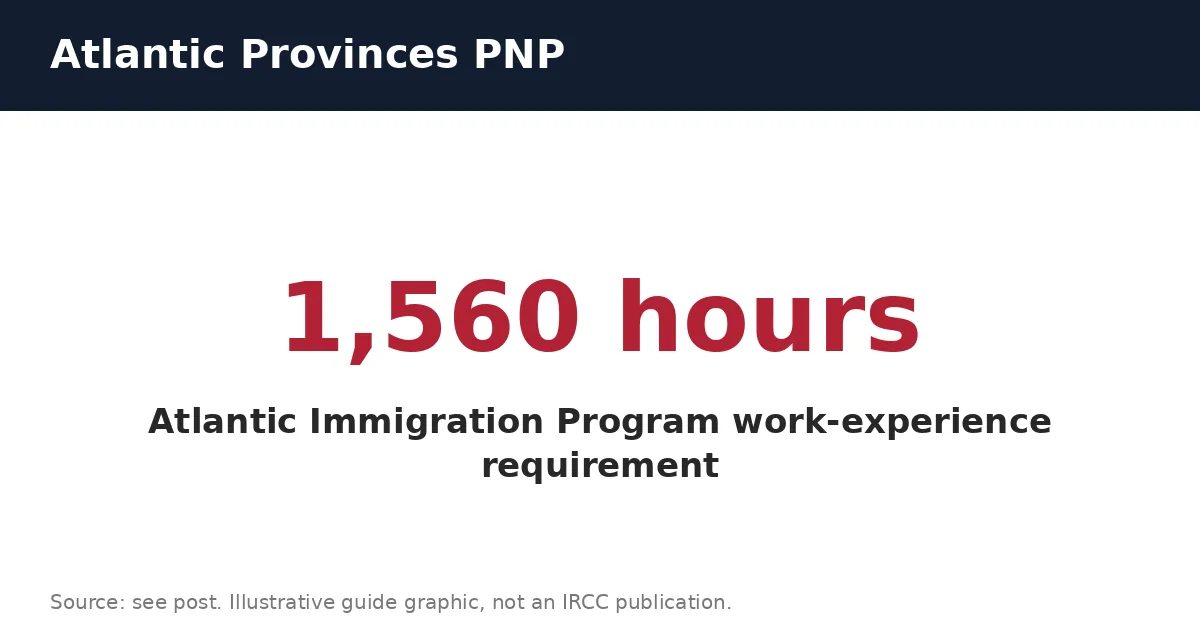
Your side of the Atlantic provinces PNP requirements: work experience of at least 1,560 hours within the last five years in a TEER 0–4 occupation, matching the offer’s skill level (an offer at TEER 0 accepts experience at TEER 0–4; TEER 1 accepts 1–4; TEER 2 accepts 2–4; TEER 3 accepts 3–4; TEER 4 accepts only TEER 4). Self-employment, unpaid or volunteer work, and work while a full-time student (except co-op) do not count. Recent international graduates from Atlantic Canada who meet the exemption criteria do not need the work experience. Language: CLB 5 for TEER 0–3, CLB 4 for TEER 4, on an approved test. Education: a minimum Canadian high school diploma or equivalent foreign credential with a valid ECA — Atlantic international graduates meeting the exemption do not need the ECA. Settlement funds are required unless you already live and work in Canada with a valid work permit, and a settlement plan plus provincial endorsement are also required.
Tip:
If your Atlantic employer is not designated, ask whether they will seek designation before you plan around the Atlantic Immigration Program. Designation takes effort on the employer’s side — it is not a form you fill in yourself.
Atlantic provinces PNP: which door fits your situation
Hold a designated employer’s offer? The Atlantic provinces PNP answer is the Atlantic Immigration Program door — it is LMIA-exempt and built for exactly that offer. Hold a non-designated employer’s offer? Take the job-offer PNP stream of that employer’s province. Hold an Express Entry profile and no offer? Look at the Express Entry-linked PNP streams, and check your federal position in the CRS calculator — a nomination adds 600 points, which changes the federal maths completely. Graduated in the region? Look at the graduate streams and the Atlantic graduate exemption. Running a business? Look at the entrepreneur streams, and budget for the fact that business streams are the slowest and most document-heavy of all. Physician or priority-occupation worker? Look at the physician and priority streams first, because they are designed to skip the general queue.
Real cases
Real case: offer from a non-designated employer (forum thread, 2024)
A candidate with a job offer in Atlantic Canada assumed the Atlantic Immigration Program applied, but the employer was not designated. Posters explained the distinction: without designation, the PNP job-offer stream of that province was the route, not the federal program. Outcome: no outcome was reported.
Real case: graduate weighing PEI vs Nova Scotia (forum thread, 2023)
A graduate of an Atlantic institution debated between two provinces’ graduate routes. The thread advice was to follow the graduation province’s retention streams first, since those are built for local graduates. Outcome: no outcome was reported.
Real case: Express Entry profile, no offer (forum thread, 2024)
A candidate with a federal profile but no Atlantic job offer asked whether the Atlantic region was open to them. Posters pointed to the Express Entry-linked PNP streams and the 600-point nomination, rather than the employer-driven federal program. Outcome: no outcome was reported.
Real case: the designated employer who was not (forum thread, 2023)
A candidate discovered late that their employer’s designation was for a different Atlantic province than the job location. Posters noted designation must be in the province where the candidate will work. Outcome: no outcome was reported.
Frequently Asked Questions
Which Atlantic province PNP is easiest?
There is no easiest Atlantic provinces PNP. Each province fits a different situation: a job offer, an Express Entry profile, a graduation, an entrepreneurial plan, or a priority occupation. Match your situation to the province, not the other way around. A graduate, a physician, or a priority-occupation worker each has a different best door in the region.
What is the Atlantic Immigration Program?
A federal employer-driven program across all four Atlantic provinces. It needs a job offer from an employer designated by an Atlantic province, plus provincial endorsement, language, education, and settlement requirements. Designation belongs to the employer, and it must be in the province where you will actually work.
Is the Atlantic Immigration Program the same as a provincial nomination?
No. The Atlantic Immigration Program is a federal program with provincial designation and endorsement. A provincial nomination is a separate route that can add 600 CRS points for Express Entry-linked streams. Provincial endorsement sits inside the federal program, while a nomination is a separate provincial decision.
Do I need a job offer for an Atlantic PNP?
Most Atlantic provinces PNP streams are job-offer-based, but Express Entry-linked streams and graduate streams offer routes without a traditional employer offer. Check each province’s current stream criteria. Check each province’s current stream criteria, because job-offer rules and graduate routes change over time.
What language level does the Atlantic Immigration Program require?
CLB 5 for TEER 0–3 jobs and CLB 4 for TEER 4 jobs, on an approved test. The level follows the skill level of the job offer. The level follows the skill level of the job offer, on an approved language test.
Does an Atlantic PNP nomination add CRS points?
Yes, for Express Entry-linked Atlantic provinces PNP streams: a provincial nomination adds 600 CRS points. Base (paper-based) nominations do not use the CRS score. Base nominations go through a paper-based federal stage instead, and never touch the CRS score or a federal draw.
Should I choose a PNP stream or the Atlantic Immigration Program?
If you hold a designated employer’s job offer, the Atlantic Immigration Program is built for you. If you hold an Express Entry profile or a provincial tie without a designated offer, a PNP stream may fit better. A provincial tie without a designated offer points the other way, toward a PNP stream instead.
Final Thoughts
The Atlantic provinces PNP region rewards fit, not force. A designated offer, a local graduation, a priority occupation, or an Express Entry profile with a provincial connection — each opens a specific door, and the fastest route is the door you already qualify for. Do not spend months pushing on a province’s general stream when another province’s targeted stream was built for your exact situation.
Compare the wider Atlantic provinces PNP paths on how to immigrate to Canada and check your federal score in the CRS calculator. Then confirm the current stream criteria on the official provincial page before you apply — Atlantic streams change, and the official page is the only version that matters. If your case mixes a designated offer, a graduation, and an Express Entry profile, talk to a licensed consultant (RCIC) or lawyer to pick the door before you file.
Sources
This guide was checked against official IRCC and provincial sources and real applicant reports. This is general information, not legal advice. For your own case, talk to a licensed consultant (RCIC) or lawyer.
Last reviewed: October 29, 2026