Express Entry Guide · Updated October 2026
Your score is too low for a general round, so which door is actually open to you — a province, the Canadian Experience Class, or a category draw? Here is how to decide. Use this PNP vs CEC vs category draw comparison to find the door that is actually open to you, and the shortest path to the next one.
By Aria Sterling · Checked against IRCC rules · 11 min read
Low-score candidates usually ask the wrong question. They ask “what score do I need?” when the useful question is “which round am I even eligible for?” A score in the 300s or low 400s loses a general round, but it can win a round where most candidates are not competing — a category you qualify for, or a PNP round after a nomination. The routes are not interchangeable, and picking the wrong one wastes the months you could spend qualifying for the right one.
This post compares the three routes side by side: what each one requires, what it adds, and what it costs. It does not print cutoff numbers, because they change every round — for current figures, see our latest Express Entry draws and CRS cutoffs page.
Evidence base: IRCC’s programme pages for CEC and category-based selection, provincial programme information, and public forum threads from low-score candidates weighing provinces. This is general information, not legal advice.
Quick answer
Quick answer:
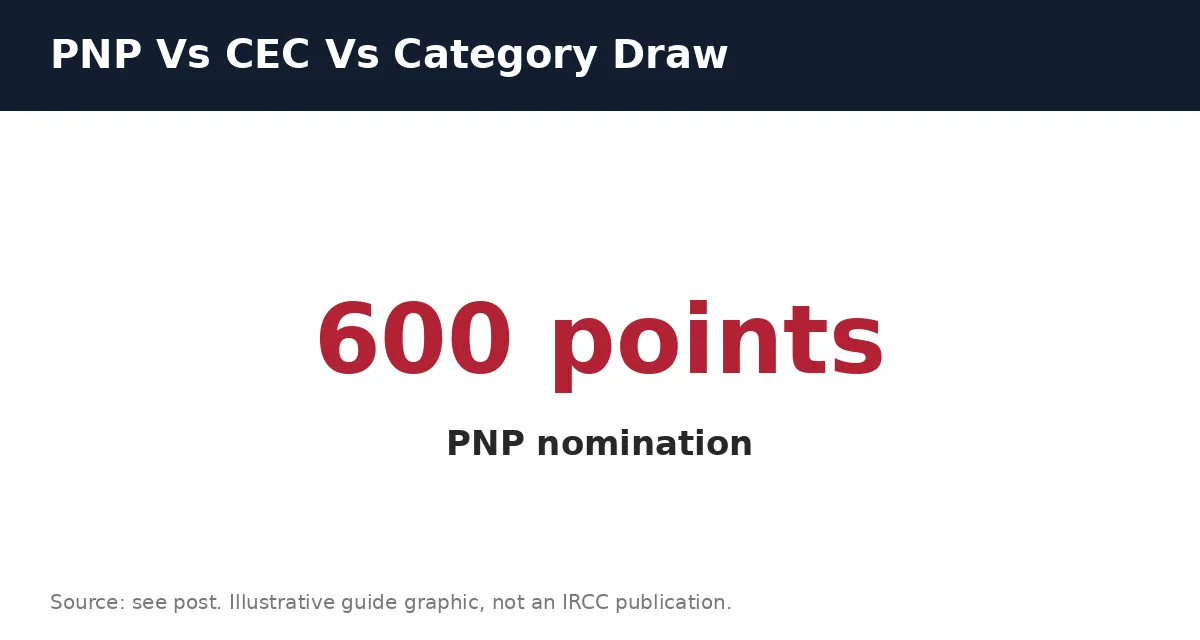
If you already have 12 months of skilled Canadian work experience, CEC is your most direct route. If you have French at NCLC 7 or an occupation on a category list with 12 months in it, a category round is your cheapest door. If you have neither, a provincial nomination — worth 600 points — is usually the strongest move, but it is a separate application, not a profile setting. Run the PNP vs CEC vs category draw comparison in that order — CEC, categories, province — and spend your months on the route that opens.
Key takeaways
The three routes in a PNP vs CEC vs category draw comparison
Canadian Experience Class | Provincial Nominee Program | Category-based draw | |
|---|---|---|---|
What it is | A federal programme | A provincial nomination added to your profile | A round type with its own eligibility rule |
Core requirement | 12 months skilled Canadian work in 3 years | Meeting a province’s stream rules | Category rule (occupation experience or French) |
What it adds to your score | Nothing directly — it is eligibility | 600 points | Nothing directly — it narrows who you compete with |
Job offer needed? | No | Some streams yes, some no | No (except where the occupation itself implies one) |
Proof of funds? | No | Depends on the stream and programme | Depends on the underlying programme |
Biggest risk | Counting student or self-employed work | Applying to a stream you do not fit | Your NOC leaving the category list |
Programme rules from IRCC’s CEC and category-based selection pages and provincial programme information. Stream rules vary by province; check the province’s official site.
Route 1: Canadian Experience Class
Start any PNP vs CEC vs category draw comparison with CEC if you already have Canadian skilled work experience. CEC is built for people already working in Canada. You need at least 12 months (1,560 hours, counted at up to 30 hours a week) of paid, skilled work in TEER 0, 1, 2 or 3, gained in the three years before you apply, while authorised to work. Language minimums are CLB 7 in all four abilities for TEER 0 or 1 work and CLB 5 for TEER 2 or 3 work. There is no education requirement and no proof-of-funds requirement.
The traps are specific. Work gained while you were a full-time student does not count, including co-op terms. Self-employment does not count. And the work must be skilled: TEER 4 or 5 work does not qualify, however long you did it. If your twelve months include any of those, CEC sees fewer months than you do.
Tip:
CEC candidates also remain eligible for category rounds and PNP rounds. CEC is a programme, not a round — it puts you in the pool, and the rounds then decide which pool members get invited.
Route 2: Provincial Nominee Program
A PNP vs CEC vs category draw comparison usually puts a provincial nomination first on points, but last on simplicity. A provincial nomination is the only lever that transforms a low score overnight: 600 points, added when you accept the nomination in your Express Entry account. After that, your score is competitive in any round you are eligible for, including PNP rounds themselves.
The price is a second application. Each province runs its own streams with its own targets: some select candidates directly from the Express Entry pool, some need a job offer in the province, some reward a connection such as previous work or study there, and some target specific occupations. The right province is the one whose stream fits your facts, not the one with the lowest advertised score. Our BC PNP calculator and Alberta PNP calculator show how two provinces score candidates; every other province needs the same kind of check on its official site.
Warning:
A nomination tied to a province usually comes with an expectation that you intend to live there. Taking a nomination for a province you have no intention of settling in can cause problems later. Choose a province you can genuinely commit to.
Route 3: Category-based draws
In a PNP vs CEC vs category draw comparison, category rounds are the cheapest door when your occupation is listed. Category draws change who you compete with. Instead of the whole pool, you compete only against candidates who meet the category rule. That is why a score that loses generally can win in a category round.
For occupation categories in 2026, the rule is at least 12 months of work experience in an eligible occupation within the past three years — raised from six months in February 2026. The experience can be from Canada or abroad, unless the specific category requires Canadian experience. For the French-language category, the rule is NCLC 7 or higher in all four French abilities, with no occupation requirement at all.
The risk with categories is movement: lists change between versions. An occupation on the list this year may not be on it next year, and a candidate who built a plan around one NOC should check the current list before counting on it. See our category-based draws page for the current picture.
Choosing in order: a PNP vs CEC vs category draw decision
Run each scenario through our CRS calculator and our is my CRS score good guide before you commit to a route.
Real cases
Real case: score around 350, asking which provinces are possible (forum thread, 2026)
A candidate with a score around 350 asked which provinces were actually possible, naming several at once. The useful answer was not a list of provinces but a filter: which streams accept a candidate with that occupation, that work history and no job offer in the province? Provinces are not interchangeable, and applying to all of them wastes the effort that one well-matched application needs. No outcome was reported.
Real case: one profile for FSW and PNP, or separate accounts? (forum thread, 2026)
A candidate asked whether the Express Entry profile covers both FSW and PNP or whether separate provincial accounts are needed. The answer is both: one Express Entry profile can express interest in multiple programmes, but a provincial nomination itself requires an application to the province. The profile is the pool; the province is a separate door. No outcome was reported.
Real case: low score, which category fits? (forum discussion, 2026)
Candidates repeatedly asked which occupations qualify for healthcare, trades, transport, STEM and other categories, and what experience each requires. The recurring mistake in those threads was assuming a job title qualifies you: the category test is your NOC and your months in it, checked against the current list. No outcome was reported.
Frequently Asked Questions
What is the difference between PNP, CEC and a category draw?
A PNP vs CEC vs category draw comparison starts with three different things: CEC is a program you qualify for through Canadian skilled work experience. A PNP nomination is awarded by a province and adds 600 points to your profile. A category draw is a round type that invites only candidates who meet that category’s rule, such as French ability or an occupation.
Can I be eligible for PNP, CEC and a category draw at the same time?
Yes. One Express Entry profile can qualify you for several routes at once, which is the point of a PNP vs CEC vs category draw comparison: you do not choose one route and abandon the others. You do not choose one route and abandon the others. The profile sits in the pool and is considered for every round type you are eligible for.
Does a PNP nomination guarantee an invitation?
It comes very close. A nomination adds 600 points, which puts your score far above the scores of non-nominated candidates. You must still be invited in a round and meet the program requirements, but a nominated score is rarely left behind.
Do I need a job offer for a PNP nomination?
It depends on the stream. Some provincial streams require a job offer in the province. Others, including some Express Entry-linked streams, select candidates directly from the pool without a job offer. Check the province’s official stream rules. Before you apply, read the stream’s official criteria line by line, because a stream that looks open may require a specific occupation, a job offer, or previous ties to the province.
What does CEC require that other routes do not?
At least 12 months of paid, skilled Canadian work experience in TEER 0, 1, 2 or 3, gained in the three years before you apply, while authorised to work. CEC has no education requirement and no proof-of-funds requirement, which sets it apart from the Federal Skilled Worker Program.
How much experience do category draws require in 2026?
For occupation categories in 2026, at least 12 months of work experience in an eligible occupation within the past three years. IRCC raised this from six months in February 2026. The French-language category instead requires NCLC 7 or higher in all four French abilities.
Can I apply to a province and stay in Express Entry?
Yes. A provincial application runs alongside your Express Entry profile. If the province nominates you, you accept the nomination in your Express Entry account and the 600 points are added to your profile. You can also hold an Expression of Interest with a province while your federal profile sits in the pool, so the two processes run in parallel rather than in sequence.
What if my score is low and I qualify for nothing yet?
Then the work is to become eligible for something: complete 12 months of qualifying work, reach NCLC 7 in French, or build a provincial connection such as a job offer or study in the province. Waiting in the pool without a route is not a plan.
Final Thoughts
At a low score, the question is never “how do I get more points in general?” It is “which round can I already enter, and what is the shortest path to the next one?” Answer that in order — CEC, categories, province — and spend your months on the route that opens, not on the score in the abstract. Answer the PNP vs CEC vs category draw question in order, and spend your months on the route that opens.
If your history involves a previous refusal, a complex work pattern or a provincial stream with conditions you do not fully understand, talk to a licensed consultant (RCIC) or lawyer before you apply.
Sources
We build free Express Entry tools and track every IRCC draw. This guide was checked against official IRCC sources and real applicant reports. Last reviewed: October 29, 2026. This is general information, not legal advice. For your own case, talk to a licensed consultant (RCIC) or lawyer.