Express Entry Guide · Updated October 2026
You earned NCLC 7 in French, you expected 50 French bonus points, and the calculator gave you 25. The missing 25 points have nothing to do with your French — they are about your English.
By Aria Sterling · Checked against IRCC rules · 11 min read
French bonus points are the most misunderstood points factor in Express Entry, and the confusion has a single cause: candidates look at their French level to explain their bonus, when French bonus points are decided by two levels — French and English together. French at NCLC 7 in all four abilities is the entry ticket. Whether the ticket is worth 25 or 50 points depends entirely on your English.
This post lays out the rule in full, including the case that confuses everyone (one English ability below CLB 5), the first-versus-second-language myth, and the second-language core points that sit alongside the bonus. Check your own combination in our CRS calculator.
Evidence base: IRCC’s CRS criteria page (modified June 22, 2026) and language-testing page, plus public forum threads from candidates who received 25 instead of 50. This is general information, not legal advice.
Quick answer
Quick answer:
French at NCLC 7 or higher in all four abilities earns a bonus of 50 points if your English is CLB 5 or higher in all four abilities, and 25 points if your English is below CLB 5 in at least one ability or you have no English test. If any French ability is below NCLC 7, French bonus points are zero. French bonus points do not depend on which language you call first.
Key takeaways
The French bonus points table
French level (all four abilities) | English level | Bonus points |
|---|---|---|
NCLC 7 or higher | CLB 5 or higher in all four abilities | 50 |
NCLC 7 or higher | CLB 4 or lower in at least one ability | 25 |
NCLC 7 or higher | No English test | 25 |
Below NCLC 7 in any ability | Any | 0 |
Points from IRCC’s CRS criteria page (modified June 22, 2026).
Read the table top to bottom and the logic becomes clear. The French condition is binary: all four abilities at NCLC 7 or higher, or nothing. The English condition is what splits 25 from 50. And the split is strict: “CLB 5 or higher in all four abilities” means all four. Three abilities at CLB 9 and one at CLB 4 gives you 25, not 50.
French bonus points and the second-language core points
French bonus points sit on top of second-language core points, which are calculated separately and often forgotten. For French as a second language, the points per ability are:
French level | Points per ability | Four abilities |
|---|---|---|
NCLC 5–6 | 1 | 4 |
NCLC 7–8 | 3 | 12 |
NCLC 9 or higher | 6 | 24 |
Points from IRCC’s CRS criteria page (modified June 22, 2026). Total second-language points are capped at 24 for a single applicant and 22 with an accompanying spouse.
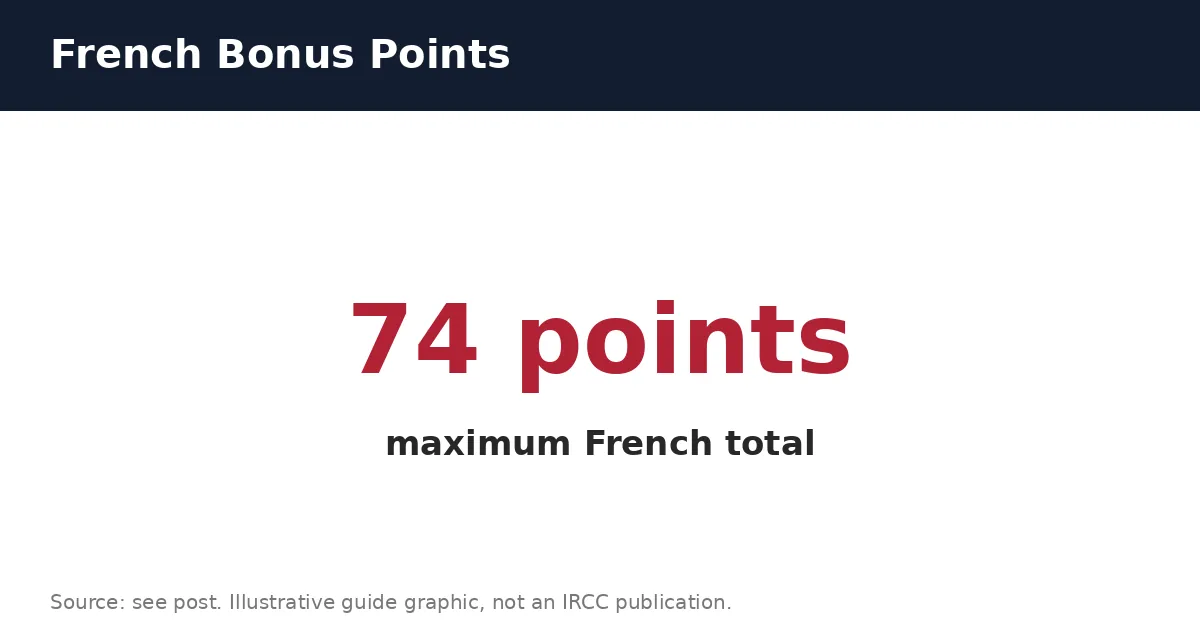
That gives the totals candidates actually see. At NCLC 7–8 with strong English: 12 core + 50 bonus = 62 points. At NCLC 7–8 with weaker English: 12 + 25 = 37 points. At NCLC 9+ with strong English: 24 + 50 = 74 points, the maximum French total. The 25-point gap between the two bonus levels is the same at every French level — it is purely the English condition.
Tip:
If you are at 25 bonus points because of one English ability, the cheapest 25 points in the whole system may be an English retake that lifts that one ability to CLB 5. Check the IELTS CLB 5 thresholds: listening 5.0, reading 4.0, writing 4.0, speaking 4.0.
French bonus points: first vs second language, the myth
The most persistent myth about the French bonus is that it depends on which language you declare first in your profile. It does not. The French bonus points rule looks at two facts — your French level and your English level — and nothing else. A candidate whose first language is French and whose English is CLB 5+ in all four abilities gets 50 points, exactly like a candidate whose first language is English and whose French is NCLC 7+ in all four.
What does change with first-versus-second is the core points. Your first language earns the larger core points (up to 34 per ability at CLB 10 for a single applicant), while your second language earns the smaller second-language points (up to 6 per ability). But the bonus itself — 25 or 50 — is calculated the same way for everyone. If a calculator or a forum post tells you the bonus depends on which language is “first”, it is wrong.
One related detail: the second-language cap is 24 points for a single applicant but 22 with an accompanying spouse. That cap affects the core points, not the bonus. French bonus points are 25 or 50 regardless of spouse status.
The confusion cases
Case 1: French NCLC 7 everywhere, English CLB 4 in writing only. Bonus: 25, not 50. The English condition needs all four abilities at CLB 5+. Fix: retake English with writing improved to CLB 5, or accept 25.
Case 2: French NCLC 7 everywhere except writing at NCLC 6. Bonus: 0. The French condition needs all four abilities at NCLC 7+. Fix: improve French writing and retake the full French test.
Case 3: French NCLC 8 everywhere, no English test at all. Bonus: 25. No English test counts as the weaker-English case, not as a failure. Fix: sit an English test and reach CLB 5 in all four abilities for 50.
Case 4: French-first candidate, English CLB 9 everywhere. Bonus: 50. First-language status does not change the bonus. The candidate’s French earns second-language core points at the French level, plus the 50-point bonus.
Warning:
Do not enter French results in your profile until all four abilities are at NCLC 7 or higher. Partial French results give partial second-language core points but zero bonus — and they can mislead you into thinking the bonus is broken when it is simply not yet earned.
Three worked combinations
Numbers make the rule stick, so here are three candidates and what each one actually receives.
Candidate A is English-first, with English at CLB 9 in all four abilities and French at NCLC 7 in all four. She receives 12 second-language core points plus the 50-point bonus, for 62 points from French.
Candidate B is also English-first, with English at CLB 9 in three abilities but CLB 4 in writing, and French at NCLC 7 in all four. She receives the same 12 core points but only the 25-point bonus, for 37 points — 25 points less than Candidate A, because of one English ability.
Candidate C is English-first, with English at CLB 9 in all four abilities and French at NCLC 9 in all four. She receives 24 second-language core points plus the 50-point bonus, for 74 points — the maximum French total. A French-first candidate with the same levels in reverse (French NCLC 9 as first language, English CLB 6 as second language) receives the same 50-point bonus, but only 4 second-language core points for English at CLB 6, because the second-language points follow the second language’s level, not the first. The pattern is consistent: the bonus is decided by the English condition, and the core points by the second-language level, whatever order the languages sit in.
Notice what Candidate B should do. Her French is already at the threshold, so studying more French gains her nothing. One English retake that lifts writing from CLB 4 to CLB 5 gains her 25 points — the single cheapest 25 points available to her. That is the practical value of understanding the rule: it tells you which test to retake, and it is usually not the one you expect.
Real cases
Real case: “Why 25, not 50?” (forum thread, 2026)
A candidate with French at NCLC 7 in all four abilities asked why the calculator showed 25 bonus points. The answer was in their English results: one ability below CLB 5. The bonus rule is two conditions, not one, and the English condition was the one that failed. No outcome was reported.
Real case: French-first candidate, bonus confusion (forum discussion, 2026)
French-first candidates asked whether the bonus applied to them at all, or whether it was only for English-first candidates learning French. It applies to both, on the same English condition. The language you grew up speaking does not change the rule. No outcome was reported.
Real case: one French skill below NCLC 7 (forum thread, 2026)
A candidate with three French skills at NCLC 7 and writing at NCLC 6 asked whether they got a partial bonus. They did not: the bonus needs all four abilities at NCLC 7, and the weakest skill decides. No outcome was reported.
Frequently Asked Questions
Why did I get 25 French bonus points instead of 50?
Because the 50-point bonus needs English at CLB 5 or higher in all four abilities. If even one English ability is below CLB 5, or you have no English test, the bonus is 25 points. The French level alone does not decide between 25 and 50.
What French level is needed for the bonus?
NCLC 7 or higher in all four French abilities. If any French ability is below NCLC 7, the bonus is zero, regardless of your English level. The French condition is all-or-nothing, so three abilities at NCLC 7 and one at NCLC 6 earns zero bonus, even if your English is perfect. Below that level, French bonus points are zero, whatever your English score.
Does it matter whether French is my first or second language?
No, not for the bonus. The bonus depends on your French level and your English level, not on which language you call first. A French-first candidate gets the bonus on the same English condition as an English-first candidate. What changes with first-versus-second language is the core points: a first language earns up to 34 points per ability, while a second language earns at most 6 per ability.
How do I go from 25 to 50 bonus points?
Raise every English ability to CLB 5 or higher. In IELTS General Training terms, that means listening 5.0 and reading, writing and speaking 4.0 each at minimum, though most candidates aiming for 50 already have higher English scores. Those IELTS figures are the minimum for CLB 5, so most candidates targeting the 50-point bonus will already exceed them, but the threshold itself is what the rule checks. That single English condition is what moves French bonus points from 25 to 50.
What are the second-language core points for French?
NCLC 5 to 6 earns 1 point per ability, NCLC 7 to 8 earns 3 per ability, and NCLC 9 or higher earns 6 per ability. The total is capped at 24 points for a single applicant and 22 with an accompanying spouse.
What is the maximum total from French?
At NCLC 9 or higher in French with strong English, the maximum is 74 points: 50 bonus points plus 24 second-language core points for a single applicant. At NCLC 7 to 8, the total is 62 points with strong English: 50 bonus plus 12 second-language points.
Final Thoughts
French bonus points come down to two conditions, not one: French at NCLC 7 in all four abilities, and then English at CLB 5 in all four for 50 points, or anything less for 25. If you received 25, your French is fine — check your English. If you received zero, check your weakest French skill. And if anyone tells you the bonus depends on which language is first, they are describing a rule that does not exist.
Check your exact combination in our CRS calculator, and talk to a licensed consultant (RCIC) or lawyer if your history involves a refusal or a disputed language result.
Sources
We build free Express Entry tools and track every IRCC draw. This guide was checked against official IRCC sources and real applicant reports. Last reviewed: October 29, 2026. This is general information, not legal advice. For your own case, talk to a licensed consultant (RCIC) or lawyer.