Express Entry Guide · Updated October 2026
Almost every guide to Canadian immigration talks about Ontario, British Columbia and Alberta — and almost none of them mention the territories. The Yukon Northwest Territories PNP routes are the exception this guide covers.
By Aria Sterling · Checked against IRCC rules · 12 min read
If your CRS score is stuck below the cutoffs you keep seeing, and every province you research feels crowded, the Yukon Northwest Territories PNP routes deserve a serious look. They are not shortcuts. They are small, employer-driven programs that reward one thing above all else: a genuine job offer from an employer in Whitehorse, Yellowknife, or a smaller northern community.
This guide explains both territories in plain language: which streams exist, who each one fits, what language level you need, how the Northwest Territories scores your Expression of Interest, and the mistakes that waste months. It does not promise you an easier road. It shows you a different road, and how to tell whether it is yours.
Evidence and sources: This post is based on the official program pages at yukon.ca and the Government of the Northwest Territories nominee program pages, plus IRCC’s Express Entry rules. Where a detail comes from a program guide or a third-party summary rather than the official page itself, the text says so. This is general information, not legal advice.
Quick answer
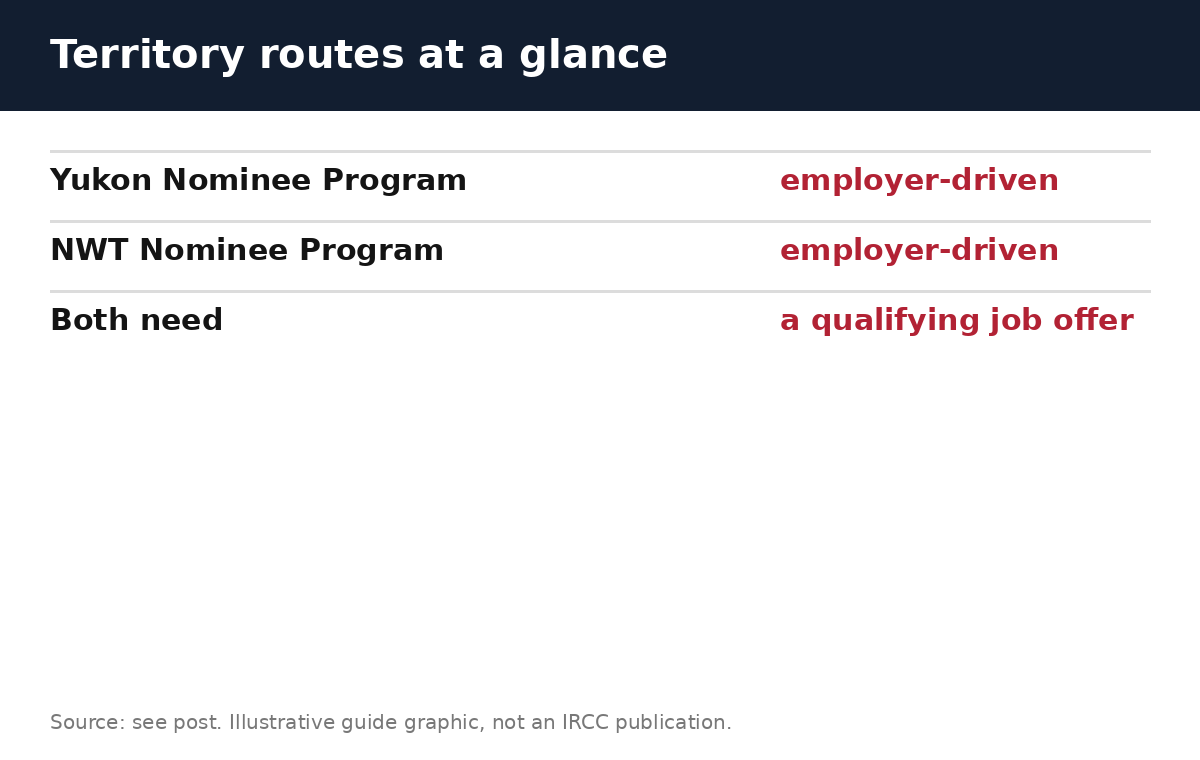
Both territories nominate workers through employer-driven streams, which means you need a real full-time job offer from a territorial employer before anything else happens. Yukon runs three worker streams, and the employer submits the application on your behalf. The Northwest Territories runs an employer-driven stream with an Expression of Interest system, and a nomination through its Express Entry stream adds 600 CRS points to your profile. If you cannot get a northern employer to hire you, neither route opens — but if you can, the competition is far smaller than in the big provinces.
Both territories run employer-driven programs, so the Yukon Northwest Territories PNP path always starts with a real job offer.
Key takeaways
Why the Yukon Northwest Territories PNP routes are different
Most provincial programs let you submit an Expression of Interest yourself and wait to be picked. The territories work the other way around. The employer is involved from the start, and in Yukon the employer actually submits the application. That changes the whole strategy: your first task is not paperwork, it is a job search in a labour market with a few thousand employers, not a few million.
That employer-first design is what makes the Yukon Northwest Territories PNP routes different from most provincial programs.
In the Yukon Northwest Territories PNP model, the employer drives the application, not the candidate.
The upside is real. Fewer people apply, so a strong candidate with a real offer is not buried under tens of thousands of profiles. The downside is equally real. Intake is small, processing depends on your employer’s cooperation, and if the job falls through, the nomination usually falls with it. Treat a territory route as a job-led move, not as a lottery ticket you buy while waiting for a big-province draw.
Warning:
Never pay anyone for a territorial job offer or a nomination. A bought offer is not a shortcut; officers check that offers are genuine, and a fake one can end your application and damage future ones. If an “agent” offers you a guaranteed Yukon or NWT nomination for a fee, walk away.
The Yukon Nominee Program in 2026
Yukon’s 2026 program is built around three worker streams. All three are employer-driven, and all three require a job offer from a Yukon employer. The difference is the level of the job and whether you are already in the federal Express Entry pool.
Yukon’s three worker streams all sit inside the Yukon Northwest Territories PNP system, and all three need a territorial employer.
Check the current stream rules on yukon.ca before you apply, because Yukon Northwest Territories PNP details change.
Stream | Who it fits | Key points |
|---|---|---|
Critical Impact Worker | Entry-level jobs, TEER 4 or 5 | For lower-skilled roles such as food service, cleaning, and general labour. Employer submits the application. |
Skilled Worker | Higher-level jobs, TEER 0 to 3 | For professional, technical and skilled trade roles. Relevant experience of around 12 months is generally expected. |
Express Entry | People accepted into the IRCC Express Entry pool | A Yukon nomination adds 600 CRS points to your Express Entry profile. |
Source: Yukon Nominee Program pages on yukon.ca, read October 2026. Experience and language figures below come from program guidance summaries; verify them on yukon.ca at application time.
Language is where many applicants trip up. As a rough guide, Yukon generally expects CLB 6 for TEER 0 and 1 roles, CLB 5 for TEER 2 and 3, and CLB 4 for TEER 4 and 5, with a language test taken in the last two years. The level follows the job, not your preference, so a cook and a civil engineer face different bars. Entry-level workers in the Critical Impact Worker stream generally need around six months of relevant experience; skilled workers generally need around twelve months. Check the current program page before you rely on either figure, because territorial pages are updated without fanfare.
Yukon also runs a separate Business Nominee Program for entrepreneurs who want to start or buy a business in the territory. It is a different route with different rules, and it is not covered in depth here — if you are an entrepreneur, read that program page on its own rather than trying to fit a business plan into a worker stream.
How a Yukon application actually works
The order matters, because it is not the order most applicants expect:
Follow the Yukon Northwest Territories PNP order carefully: employer first, then nomination, then the federal stage.
The Yukon Northwest Territories PNP order surprises applicants who expect to file first themselves.
The practical lesson: your relationship with the employer is the application. Keep your documents ready, answer the employer’s questions fast, and never let a recruiter or middleman sit between you and the employer without you knowing exactly what is being filed in your name.
Tip:
Before you accept a Yukon offer, check your score with our CRS calculator. If you are going through the Express Entry stream, those 600 nomination points change everything — run the numbers so you know what your profile looks like with and without them.
The Northwest Territories Employer-Driven stream
The Northwest Territories Nominee Program (NTNP) runs an Employer-Driven stream with three categories. Like Yukon, it starts with a job offer from a territorial employer. Unlike Yukon, it adds a scored Expression of Interest step before you can apply.
The NWT Employer-Driven stream is the Northwest Territories side of the Yukon Northwest Territories PNP picture.
Category | Who it fits | Key points |
|---|---|---|
Skilled Worker | TEER 0 to 3 jobs | Full-time job offer from an NWT employer in a skilled occupation. |
Entry Level / Semi-Skilled | TEER 4 to 5 jobs | You must have worked full-time in the same role for the same NWT employer for at least six months. Language level CLB 4. |
NWT Express Entry | People in the federal Express Entry pool | A nomination adds 600 CRS points to your profile. |
Source: Government of the Northwest Territories nominee program pages, read October 2026.
The territory also runs Francophone and Business streams outside the Employer-Driven process. If you are a French speaker or an entrepreneur, those are worth a separate look — but do not confuse them with the worker categories above, because their rules and intake are different.
The NWT Expression of Interest, explained
In February 2026, the Northwest Territories replaced first-come, first-served intake for the Employer-Driven stream with an Expression of Interest system. You submit a profile, it is scored, and the territory invites the highest-scoring candidates when it runs a selection. Profiles stay active for 12 months, so a profile that is not picked in one round can still be picked in a later one.
Since February 2026, the Yukon Northwest Territories PNP intake in the NWT runs on Expression of Interest scores, not first-come order.
Your Expression of Interest stays active for 12 months under the Yukon Northwest Territories PNP system — use that window to strengthen connections.
Factor | Maximum points | What it rewards |
|---|---|---|
Skills and Experience | 375 | Your education, work experience, and language ability. |
Connections to the NWT | 340 | Previous work, study, or family ties in the territory, and a job offer from an NWT employer. |
Likelihood of Settling | 130 | Signs you will actually stay: local ties, a realistic settlement plan, community connections. |
Total | 845 |
Source: Government of the Northwest Territories nominee program announcements and program guides, 2026. Confirm the current scoring grid on the official NTNP page before submitting.
Read that table twice, because it tells you the strategy. Connections to the territory are worth almost as much as skills and experience. Someone already working in Yellowknife, with a local employer behind them, starts far ahead of a stronger resume with no northern ties at all. If you have no connection to the NWT, your realistic path is to build one: a genuine job offer, and ideally time working in the territory, before you expect a selection.
Do not plan around a draw date. Selection rounds are not on a fixed public calendar, and third-party reports of past rounds are not a schedule. Keep your profile active and current, and update it the moment your job, language score, or family situation changes.
Yukon Northwest Territories PNP: which territory fits you
Question | Yukon | Northwest Territories |
|---|---|---|
Who applies? | Your employer submits the application | You submit an Expression of Interest, then apply if invited |
Entry-level jobs (TEER 4–5) | Yes — Critical Impact Worker | Yes — Entry Level / Semi-Skilled, after six months with the same employer |
Express Entry route | Yes — nomination adds 600 CRS points | Yes — nomination adds 600 CRS points |
Scored ranking before applying? | No | Yes — EOI scored out of 845 |
Biggest bottleneck | Finding an employer willing to apply for you | Scoring high enough on connections to the territory |
If you already have a Yukon employer ready to file, Yukon is the more direct path. If you are already working in the NWT, or you have family or study history there, the NWT scoring system rewards you for it. If you have neither a job offer nor a connection, neither territory is your first step — the job search is.
Choosing between the two sides of the Yukon Northwest Territories PNP comes down to where your employer and connections are.
Common mistakes in a Yukon Northwest Territories PNP application
Real cases
Real case: The hotel worker who found her employer first (2025)
A hospitality worker already employed in Whitehorse asked her employer about the Critical Impact Worker stream instead of applying to a big-province program she had no connection to. The employer agreed to submit the application. No outcome was reported.
Most Yukon Northwest Territories PNP delays come from applying before the employer is ready to file.
Real case: The skilled tradesperson with the wrong TEER (2026)
A tradesperson assumed his job was TEER 2 and prepared a Skilled Worker file, but his actual duties matched a TEER 4 description. Re-checking the NOC before filing saved him from a refusal on stream eligibility. No outcome was reported.
Real case: The NWT worker whose connections did the heavy lifting (2026)
A worker with a year of employment in Yellowknife and a local employer scored strongly on the connections factor of the NWT Expression of Interest, even though a candidate abroad had a higher degree. The profile was invited in a later selection round. No outcome was reported.
Real case: The applicant who waited for a draw date that never came (2026)
An applicant abroad kept delaying his NWT profile because he was waiting for an announced draw date. NWT selections are not on a fixed calendar, so the delay bought him nothing — his profile would simply have sat active for its 12-month window. No outcome was reported.
Frequently Asked Questions
Final Thoughts
The Yukon Northwest Territories PNP routes reward a specific kind of applicant: someone willing to build a life in the North, with a real employer behind them. If that is you, the small size of these programs is an advantage — you are competing against hundreds of serious candidates, not hundreds of thousands of profiles. If it is not you, no amount of paperwork will make it so, and your time is better spent on a province where you already have ties. If you go this route, start with the Yukon Northwest Territories PNP streams that match your job offer, not with the draw schedule.
Start with the job search, not the forms. Talk to northern employers, be honest about needing their cooperation for the application, and keep your language test current. And before you commit, run your numbers: check your CRS score, check your NOC, and read the current program page on yukon.ca or the NTNP site on the day you decide. For the latest invitation rounds across all programs, see our latest Express Entry draws page.
Sources
Disclaimer: This article is general information only and is not legal or immigration advice. Immigration rules change often, and territorial programs change quietly. For advice about your own situation, talk to a licensed immigration consultant (RCIC) or an immigration lawyer, and always confirm current requirements on the official program page before applying.
Last reviewed: October 29, 2026