Express Entry Guide · Updated October 2026
If you searched for the Ontario Masters Graduate stream or an Employer Job Offer stream, the Ontario Workforce Priority stream is the program you need to understand now — and any guide that describes the old streams as open is out of date.
By Aria Sterling · Checked against IRCC rules · 13 min read
Ontario OINP streams used to be the province’s quiet alternative to the big Express Entry draws: a Masters or PhD from an Ontario university could open a stream with no job offer at all, and an employer with a real vacancy could sponsor a worker through a dedicated job-offer stream. In 2026, Ontario redesigned the program and closed those streams. This post explains what each one was, who it fit, what replaced it, and where you should look now — so you do not waste months preparing an application for a stream that no longer exists.
Evidence and sources: This post is based on ontario.ca’s 2026 OINP updates page and the archived stream pages, which mark the old streams as closed, plus the current Ontario Workforce Priority stream page. Old-stream rules below are described as they stood when the streams closed, not as current eligibility. This is general information, not legal advice.
Quick answer
As part of the 2026 Ontario Immigrant Nominee Program redesign, Ontario closed the Employer Job Offer: Foreign Worker, Employer Job Offer: In-Demand Skills, and Employer Job Offer: International Student streams, the Masters Graduate and PhD Graduate streams, and the Express Entry-linked Human Capital Priorities, French-speaking Skilled Worker, and Skilled Trades streams. The replacement is the Ontario Workforce Priority stream: an employer-driven stream built around a full-time, permanent job offer that can be in any occupation and any Ontario location. If you were planning around one of the old streams, your plan needs to change — but for many people, the new stream covers the same ground through a job offer.
Key takeaways
What the Ontario Workforce Priority change did in 2026
Ontario’s redesign replaced a patchwork of narrow streams with a single employer-driven stream. The old system had a separate door for almost every situation: graduates, foreign workers, international students, in-demand trades, French speakers, skilled trades. The new system has one main door — a job offer — and different requirements depending on whether the job is TEER 0 to 3 or TEER 4 to 5.
That is a genuine loss for one group in particular: Ontario graduates. Under the old Masters Graduate stream, a Master’s from an eligible Ontario university could lead to a nomination with no job offer and no work experience. Nothing in the new design reproduces that. If you are an Ontario graduate without a job offer, you need a federal route or an employer, not a graduate stream — and anyone who tells you otherwise is working from an old guide.
Warning:
Do not pay a consultant to “apply under the Masters stream” in late 2026. The stream is closed. If someone offers to file under a closed stream name, they are either mistaken or selling you something that cannot be filed.
The old Ontario OINP streams, one by one
Understanding what these streams were helps you see which parts of your profile still matter. Everything in this section is history, not current eligibility.
Masters Graduate (closed)
This was Ontario’s most graduate-friendly stream. You needed a Master’s degree from an eligible Ontario university — the list ran from Algoma and Brock through Toronto, Waterloo, Western, York and the rest of the province’s universities — with at least one academic year of full-time study, and you had to apply within two years of completing the degree requirements. You needed CLB 7 in English or French, to have lived in Ontario for at least 12 months in the last 24, settlement funds, and an intention to live in Ontario. No job offer was required, and no work experience was required. College Graduate Certificate programs did not qualify, which tripped up a surprising number of applicants.
PhD Graduate (closed)
The PhD stream was even more distinctive: you could apply while still enrolled in a PhD at an eligible Ontario university, or within two years of graduating. Like the Masters stream, it needed no job offer and no work experience, and it required CLB 7 and an intention to reside in Ontario. For doctoral students, it was one of the few nomination routes in Canada that did not wait for graduation.
Employer Job Offer: Foreign Worker (closed)
The main employer stream for skilled jobs. The job had to be TEER 0 to 3, you needed at least two years of cumulative paid full-time experience in the same occupation in the last five years, and the wage had to be at or above the median wage for that occupation in that Ontario region. If the occupation was regulated, you needed the licence in hand when you applied.
Employer Job Offer: International Student (closed)
For recent graduates of an eligible Canadian college or university. You had to apply within two years of graduating, no work experience was required, and the wage had to be at or above the low wage level for the occupation in that region — a lower wage bar than the Foreign Worker stream, reflecting that these were early-career hires.
Employer Job Offer: In-Demand Skills (closed)
The stream for TEER 4 and 5 jobs in occupations Ontario could not fill. It covered roles such as home support workers and caregivers, meat cutters and fishmongers, construction trades helpers and labourers, specialized livestock workers and farm machinery operators, livestock labourers, harvesting labourers, and nursery and greenhouse labourers anywhere in Ontario, plus a longer list — including shippers and receivers, material handlers, dry cleaning and laundry workers, railway yard and track maintenance workers, fish and seafood plant workers, and motor vehicle assemblers — outside the Greater Toronto Area only. You needed nine months of paid full-time Ontario work experience in the same in-demand occupation, CLB 4, and a Canadian secondary school diploma or equivalent.
Old stream | Job offer needed? | Who it fit |
|---|---|---|
Masters Graduate | No | Ontario Master’s graduates within 2 years, CLB 7 |
PhD Graduate | No | Ontario PhD students and recent graduates, CLB 7 |
Employer Job Offer: Foreign Worker | Yes | Skilled workers, TEER 0–3, 2 years’ experience |
Employer Job Offer: International Student | Yes | Recent Canadian graduates, no experience needed |
Employer Job Offer: In-Demand Skills | Yes | TEER 4–5 workers in listed occupations, 9 months’ Ontario experience |
Source: archived ontario.ca stream pages and the 2026 OINP updates page, read October 2026. These rules describe the streams as they stood at closure.
If you already applied under a closed stream
Closure does not cancel applications that were already filed. Applications submitted under a closed stream are assessed under the rules in force on the day they were submitted. If that is you, do not withdraw your application in a panic, and do not re-file under the new stream “just in case” without advice — a duplicate filing can complicate the file you already have. Your job now is to keep your documents current, respond to any Ontario request promptly, and keep your contact details up to date with the program.
The replacement: Ontario Workforce Priority
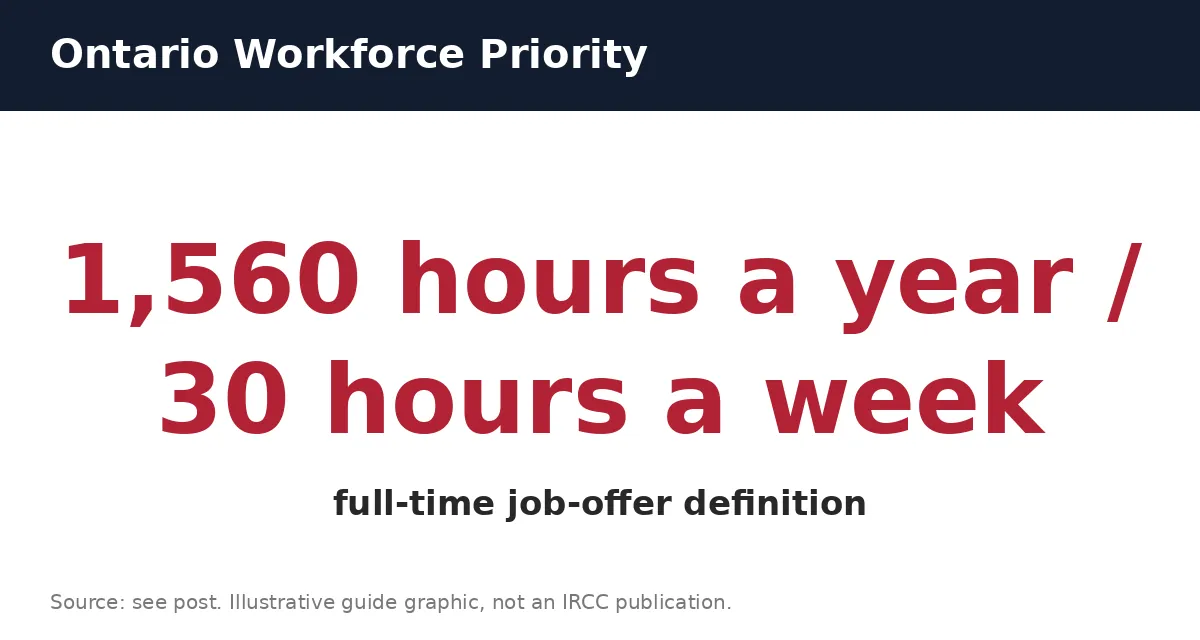
The Ontario Workforce Priority stream is the current employer-driven route. Its most important feature is its breadth: the job offer can be in any occupation and any Ontario location, and it must be full-time and permanent — at least 1,560 hours a year, at least 30 hours a week of paid work, with no end date — and urgently necessary to the employer’s business. Seasonal and contract roles do not qualify. Any change to the employment terms must be reported to the program immediately.
Requirement | TEER 0–3 pathway | TEER 4–5 pathway |
|---|---|---|
Work experience | One of: 6 months consecutive in the last 12 months in the job offer position with the job offer employer; 3 months consecutive in the last 12 months for recent Ontario graduates (graduated from an eligible Ontario institution within the last 3 years with a 2+ year degree/diploma, Ontario College Graduate Certificate, Master’s or PhD); or 2 years cumulative in the last 5 years in the occupation. Licensed applicants may be exempt. | 9 months cumulative in the last 2 years in the job offer position with the job offer employer |
Language | CLB 6, or CLB 5 for certain occupations | CLB 4 |
Minimum education | Post-secondary degree or diploma | Canadian secondary school diploma or equivalent |
Source: ontario.ca, Ontario Workforce Priority stream page, read October 2026.
Self-employed physicians are the exception to the job-offer rule: a physician in good standing with the College of Physicians and Surgeons of Ontario, holding a valid certificate of registration in an eligible class and eligible to bill through OHIP, may qualify without a job offer.
The process, and why the clock matters
That sequence is the single biggest practical change from the old streams. Under the old system, you largely controlled your own filing. Under Ontario Workforce Priority, your employer’s speed is part of your application. Before you register an Expression of Interest, have a direct conversation with your employer about the 14-day deadline — and get a named contact, not just a general promise.
Tip:
While you wait for an Ontario decision, keep your federal options warm. Check your CRS score with our CRS calculator, and watch our latest draws page — a provincial nomination adds 600 points, but a federal category round may invite you first.
Where each old Ontario OINP stream applicant goes now
If you were aiming for… | Look at now |
|---|---|
Masters Graduate | Ontario Workforce Priority if you have a qualifying job offer; otherwise federal Express Entry (your Ontario degree still boosts your CRS score) |
PhD Graduate | Ontario Workforce Priority with a job offer; federal researcher category if you have Canadian research experience; Express Entry general rounds |
Foreign Worker | Ontario Workforce Priority TEER 0–3 pathway — the closest direct successor |
International Student | Ontario Workforce Priority; recent Ontario graduates get the shorter 3-month experience option |
In-Demand Skills | Ontario Workforce Priority TEER 4–5 pathway — same job levels, broader occupation coverage |
Human Capital Priorities / French-speaking / Skilled Trades (Express Entry streams, also closed) | Federal category draws: French-language, trades, and general rounds — see our category draws guide |
Notice what survives: your degree, your Ontario work experience, your language score, and your employer relationship all still count. What disappeared is the dedicated door each one used to open. The strategy now is to assemble the same strengths behind a job offer, or behind a federal category you qualify for.
Common mistakes
Real cases
Real case: The Master’s graduate who found out too late (2026)
A graduate of an Ontario university spent months assembling a Masters Graduate file from a 2025 guide, only to learn the stream had closed. She pivoted to a job offer from her internship employer and is now assessing the Workforce Priority route. No outcome was reported.
Real case: The employer who missed the 14-day window (2026)
A candidate was invited under the new stream, but his employer’s application went in late because no one in the company owned the deadline. The job offer was withdrawn and the Expression of Interest removed. He is re-starting the process with a named company contact this time. No outcome was reported.
Real case: The in-demand worker whose occupation is now covered anyway (2026)
A food processing worker who would have fit the old In-Demand Skills list discovered that Workforce Priority’s any-occupation coverage includes his job, and his nine months with the same employer already met the TEER 4–5 experience rule. No outcome was reported.
Real case: The French speaker who stopped waiting for Ontario (2026)
A bilingual applicant who had been waiting for an Ontario French-speaking stream invitation switched focus to federal French-language category draws after learning the Ontario stream had closed — a route with regular rounds and no Ontario employer requirement. No outcome was reported.
Frequently Asked Questions
Final Thoughts
Ontario’s redesign is bad news for graduates without job offers and good news for workers whose employers will stand behind them — the new stream covers any occupation, anywhere in the province, without a restricted occupation list. The worst outcome is not the closure itself; it is spending six months on a closed stream because an old guide said it was open. Check ontario.ca, confirm your employer’s willingness to meet the 14-day deadline, and build your plan around the stream that exists today. If you need to lift your federal score while you wait, our guide to improving your CRS score covers the levers that actually move the number. If you take one name from this guide, make it the Ontario Workforce Priority stream — that is the only Ontario door still open.
Sources
Disclaimer: This article is general information only and is not legal or immigration advice. Ontario’s program changed significantly in 2026, and stream rules can change again. For advice about your own situation, talk to a licensed immigration consultant (RCIC) or an immigration lawyer, and always confirm current requirements on ontario.ca before applying.
Last reviewed: October 29, 2026