
Express Entry Guide · Updated October 2026
“Can I add both?” is the question every candidate asks about the new factor — and the answer is no, but the reason matters more than the answer. This post answers it with the Labour Market Integration factor, explained through five worked examples.
By Aria Sterling · Checked against IRCC rules · 13 min read
From November 3, 2026, Express Entry gains a new Labour Market Integration factor. In plain terms: a job offer in an eligible high-wage occupation can earn 50, 70 or 100 CRS points under the new Labour Market Integration factor, with no LMIA needed. The same factor also covers Canadian work experience — you get points for one or the other, whichever is higher, not both. That single sentence is the whole factor, but most of the confusion — and most of the bad advice — comes from people who have not worked through what “whichever is higher” does to real profiles.
This post does exactly that, with worked examples and exact points. Read it before November 3 if you want to understand the change; use it after November 3 to check your own number.
Evidence and sources: This post is based on IRCC’s official changes page and the high-wage occupation list on canada.ca, read October 2026. Every point value below comes from those pages. Until November 3, 2026, the old rules apply: a job offer earns 0 CRS points today. This is general information, not legal advice.
Hold notice: This article describes rules that take effect on November 3, 2026. It is prepared for review and must not be published before that date.
Quick answer
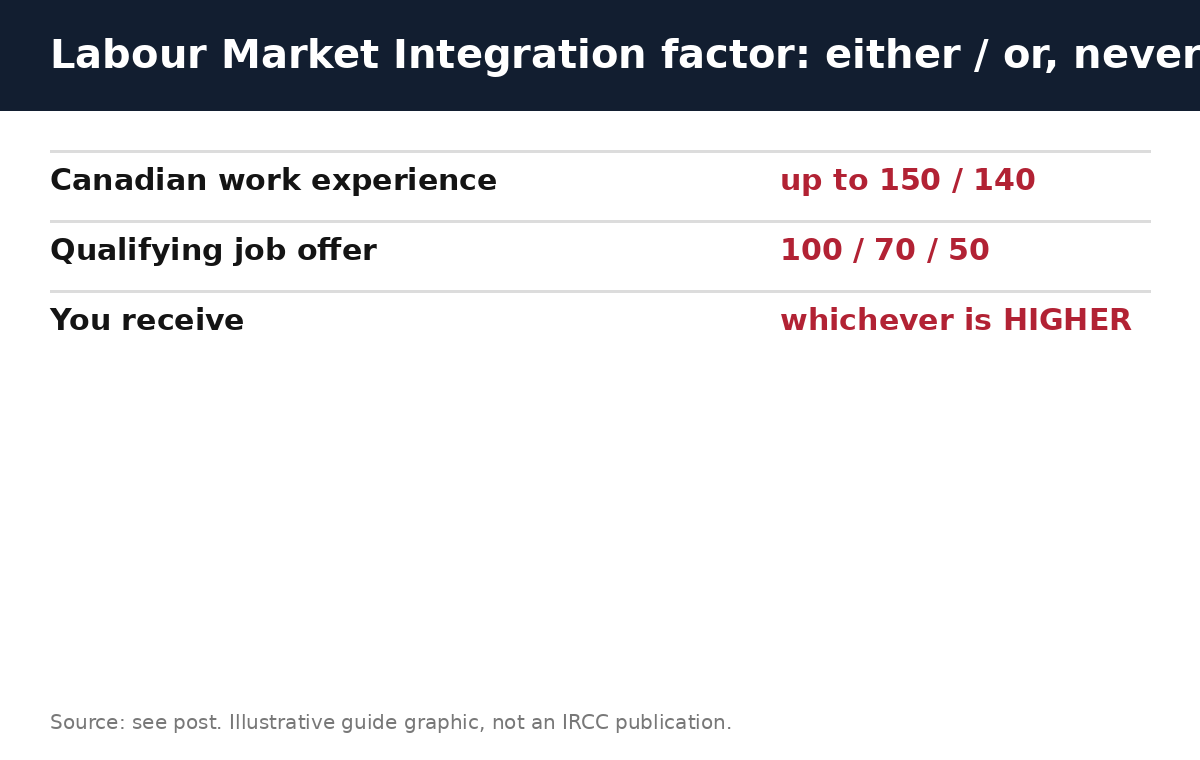
The Labour Market Integration factor gives you one number: either your Canadian work experience points or your qualifying job offer points, whichever is higher. The work experience side combines a work-length amount (up to 80 points without a spouse, 70 with one) with a high-wage supplement (70, 40, or 20) if you have at least 12 months in an eligible high-wage occupation. The job offer side gives 100, 70, or 50 points depending on your occupation’s tier. The whole factor is capped at 150 points without a spouse or common-law partner, or 140 with one. You never add the two sides together.
Key takeaways
The two sides of the Labour Market Integration factor
Think of the factor as a fork in the road with a sign at the end: IRCC calculates both numbers for you, then keeps the bigger one. If your work experience side comes to 93 and your job offer side comes to 70, your factor is 93. If your work experience side is 0 because you have never worked in Canada, and your job offer side is 50, your factor is 50. There is no version of this calculation where you keep both numbers.
That fork is the whole Labour Market Integration factor in one image: two numbers in, one number out.
That design surprises people who remember the old arranged-employment points, which stacked on top of other factors. The new factor replaces that stacking. It also explains why experienced workers in Canada usually gain more from the work experience side than from any offer: years of Canadian work plus a high-wage supplement add up to more than a single offer’s points.
Side one: Canadian work experience points
The work experience side has two parts: a work-length amount that grows with your years of Canadian experience, and a high-wage supplement that applies only if you have at least 12 months in an eligible high-wage occupation.
The work experience side of the Labour Market Integration factor rewards time in Canada, plus a supplement for high-wage work.
Canadian experience | Without spouse | With spouse |
|---|---|---|
1 year | 40 | 35 |
2 years | 53 | 46 |
3 years | 64 | 56 |
4 years | 72 | 63 |
5+ years | 80 | 70 |
Occupation tier | Supplement |
|---|---|
Occupation median at least twice the average median wage | 70 |
At least 1.5 times the average median wage | 40 |
At least 1.3 times the average median wage | 20 |
Source: IRCC Express Entry changes page and high-wage occupation list, canada.ca, read October 2026. The factor total is capped at 150 (single) or 140 (with spouse).
One important boundary: skills transferability is unchanged and still uses work-length points only, not the high-wage supplement. If you see a calculator or a guide adding the supplement into transferability, it is wrong.
Side two: job offer points
Occupation tier | Job offer points |
|---|---|
Occupation median at least twice the average median wage | 100 |
At least 1.5 times the average median wage | 70 |
At least 1.3 times the average median wage | 50 |
Occupation not on the high-wage list | 0 |
Source: IRCC Express Entry changes page and high-wage occupation list, canada.ca, read October 2026.
The job offer side of the Labour Market Integration factor needs no LMIA, but the offer must be genuine and the occupation listed.
Two conditions matter. First, no LMIA is needed for these points — that is a genuine break from the old system, where an LMIA-backed offer was the route to arranged-employment points. Second, genuineness still matters: officers check that the employer is real, has a genuine need, and can meet the offer’s terms, and that you can do the job. Paying for a job offer is not a legitimate way to gain points — officers check that every job offer is genuine, and a bought offer can get your application refused.
Five worked examples under the Labour Market Integration factor
These are the numbers candidates actually argue about. Work through them slowly, because each one isolates a different trap.
Example | Work experience side | Job offer side | Factor total |
|---|---|---|---|
A: Single, 5+ years in a top-tier occupation | 80 + 70 = 150 | 100 | 150 (experience wins; capped) |
B: With spouse, 5+ years in a top-tier occupation | 70 + 70 = 140 | 100 | 140 (experience wins; capped) |
C: Single, 2 years in a middle-tier occupation | 53 + 40 = 93 | 70 | 93 (experience wins) |
D: No Canadian experience, offer in a lowest-tier occupation | 0 | 50 | 50 (offer wins) |
E: 1 year in a non-listed occupation | 40 | 0 | 40 (experience wins) |
Example A is the one that breaks people’s intuition: 80 + 70 is exactly the 150 cap, so the job offer adds nothing at all. Example C is the most common real-world case — two years in, middle tier — and the answer is 93, not 163. Example E is the quiet warning: a year of Canadian work in an occupation that is not on the high-wage list still earns 40 points from work length, while the offer in that same occupation earns nothing. The list, not the job, decides the offer side.
Tip:
Run your own numbers with our CRS calculator and read how we calculate your score to see where this factor sits inside your total. If your factor number looks like the sum of both sides, something is wrong — re-check it.
Why the tier is not your salary
The tier of your occupation is set by comparing the occupation’s national median wage — the median wage of everyone in Canada doing that job — with the average median wage of the whole Canadian workforce. If the occupation’s median is at least twice the average, it is the top tier. At least 1.5 times, the middle tier. At least 1.3 times, the lowest tier. Below that, the occupation is not on the list.
Remember the tier rule when you read the Labour Market Integration factor: occupation medians decide, not your salary.
Your own salary never enters that calculation. A nurse practitioner earning a modest salary in a top-tier occupation is in the top tier; a retail manager earning a high salary in a non-listed occupation is not on the list at all. That is also why two people with the same job title can sit in different tiers if their occupations differ — the NOC, not the title, decides. Check whether your occupation is listed, and at which tier, on IRCC’s high-wage occupation list before you count any points from it.
One more protection is built in: if the list changes after you receive an invitation, IRCC keeps using the tier that applied on your invitation date — whether your occupation moves tiers, is removed, or is added afterwards. Your invitation-date tier is locked in.
Common mistakes with the Labour Market Integration factor
Real cases
Real case: The worker who expected 250 points (2026)
A candidate with five years of Canadian experience and a job offer in a top-tier occupation added 150 and 100 together and told friends his score would jump by 250. The correct factor total is 150 — the experience side alone, capped — and the offer adds nothing on top. No outcome was reported.
Real case: The newcomer whose offer was the whole factor (2026)
A candidate with no Canadian experience and a job offer in a lowest-tier occupation correctly counted 50 points from the offer side — the factor total, since the experience side was zero. She did not invent experience points she did not have. No outcome was reported.
Real case: The high earner in a non-listed job (2026)
A manager earning well above his occupation’s median assumed his salary would place him in a high tier. His occupation was not on the high-wage list at all, so his offer earned 0 points — while his one year of Canadian experience still earned 40. No outcome was reported.
Real case: The couple who forgot the spouse cap (2026)
A couple calculated 80 plus 70 and expected 150, but with a spouse the work-length figure is 70, not 80, and the cap is 140. Their correct factor total was 140. Checking the spouse column first would have saved the confusion. No outcome was reported.
Frequently Asked Questions
Can I add Canadian work experience points and job offer points together?
No. The Labour Market Integration factor covers Canadian work experience or a qualifying job offer, whichever is higher, never both. You get one number from this factor, not the sum of two, and the cap is 150 points without a spouse or 140 with one.
How many points can the Labour Market Integration factor give?
At most 150 points without a spouse or common-law partner, or 140 points with one. That cap applies to the whole Labour Market Integration factor, whichever side of it gives you the higher number, and no combination inside the factor can exceed it.
How are job offer points decided?
Under the Labour Market Integration factor, by your occupation’s tier on IRCC’s high-wage list: 100 points at the top tier, 70 at the middle tier, and 50 at the lowest tier. The tier is set by the occupation’s national median wage, never by the salary in your offer, so a high salary cannot lift a lower-tier occupation.
Do I need an LMIA for job offer points from November 3, 2026?
No. Under the new factor, a job offer in an eligible high-wage occupation can earn points with no LMIA needed. Officers still check that the offer is genuine, that the employer is real, and that you can do the job.
What if my occupation is not on the high-wage list?
A job offer in an occupation that is not on the list earns 0 job-offer points. But the same offer may still count for Federal Skilled Worker eligibility in a TEER 0 to 3 occupation, which is a separate question from CRS points — eligibility and points are not the same thing.
How do the work experience points work?
They combine a work-length amount based on your years of Canadian experience with a high-wage supplement if you have at least 12 months in an eligible high-wage occupation. The supplement is 70, 40 or 20 points depending on the occupation’s tier, and the total is capped.
Is a higher salary in my offer worth more points?
No. The tier is set by the occupation’s national median wage compared with the average median wage, not by the salary in your offer. A high salary in a lower-tier occupation does not move you up a tier, and a modest salary in a top-tier occupation does not move you down.
Final Thoughts
The Labour Market Integration factor is simpler than it looks once you accept the either/or rule — and more generous than the old system for experienced workers in Canada, who can now reach 150 points from experience alone. Work your own numbers through the five examples above before you believe any total someone quotes you, check your occupation’s tier on IRCC’s high-wage list, and remember the two things that cost people the most: adding both sides together, and assuming a salary decides a tier. If you want to see where this factor sits in your full score, run our CRS calculator and read how we calculate your score.
Sources
Disclaimer: This article is general information only and is not legal or immigration advice. It describes rules that take effect on November 3, 2026; until then, the old rules apply. For advice about your own situation, talk to a licensed immigration consultant (RCIC) or an immigration lawyer, and always confirm current requirements on canada.ca before relying on them.
Last reviewed: October 29, 2026