Express Entry Guide · Updated October 2026
Your account says “updated” — but nothing changed. And your file has sat untouched for months. This post explains the ghost update GCMS pattern: what it means, what your notes say, and when silence is normal.
By Aria Sterling · Checked against IRCC rules
After you submit a permanent residence application, IRCC’s account page becomes the most-checked page in your life, and also the least informative. A vague “updated” notice — the classic ghost update GCMS pattern — plus months of silence and a tracker that disagrees with your account, can drive anyone to refresh the page ten times a day.
This post separates what is actually happening from what applicants fear is happening, starting with the ghost update GCMS pattern: what it is, the stages your file passes through, how to read your own file through GCMS notes, and the one situation — comprehensive security screening — where a long silence is, unfortunately, normal.
Evidence line: we checked IRCC’s guidance on application status, ATIP requests and processing, plus public forum threads from applicants describing ghost updates and screening waits. This is general information, not legal advice.
Quick answer: A ghost update GCMS entry means something touched your file internally; it is not an official IRCC term and it does not by itself mean a decision is near. If you want to know what is really on your file, order your GCMS notes through an ATIP request — free under the Privacy Act for your own information, $5 under the Access to Information Act when someone requests on your behalf, with a legislated 30-day response period that is often extended. And if everything else has passed but your file has sat for 12 months or more, comprehensive security screening is the likely explanation.
Key takeaways
Ghost Update GCMS: What They Are and What They Are Not
“Ghost update” is a term applicants invented, not one IRCC uses — and a ghost update GCMS note describes the moment your account shows “Application/profile updated” while nothing visible — no new message, no changed status line, no new document request — has actually changed.
What usually happened is mundane: an officer or a system process opened, touched or re-saved your file, and the account flagged the touch. That touch might be the start of a review, a routine transfer between offices, or nothing more than a system update. It might precede a decision by days, or it might precede nothing at all for months. The threads are full of both stories, which is exactly why a ghost update cannot be read as a countdown.
The practical rule is simple: note the date of the ghost update GCMS entry, then stop refreshing. Check your account once a week and your email (including spam) for real messages. A ghost update with no message is not a message.
Warning:
Do not send IRCC a web form asking “what was the ghost update?” You will almost certainly receive a generic reply that your file is in process, and you will have spent the one useful tool — the web form — on a question IRCC does not answer in substance.
The Stages Your File Actually Passes Through
Applicants talk about MEP (medical exam passed), IP1 and IP2 (two phases of background processing), ADR (additional document request), AOR (acknowledgement of receipt) and PPR/COPR (passport request / confirmation of permanent residence). Only some of these are IRCC’s own terms. AOR, ADR and PPR/COPR are real. MEP, IP1 and IP2 are community shorthand for patterns people observe — useful for comparing notes in forums, but not a precise map of your file, and different applicants use them slightly differently.
Behind the account page, officers record separate assessments: eligibility (do you meet the program and did you have the points at invitation?), criminality (police certificates and background checks), medicals, and security. These do not move in a fixed order, and one can sit untouched for months while another is finished. That is why “eligibility passed but nothing else moved” and “everything passed except security” are both normal-looking states, not signs that something broke.
Ghost Update GCMS Notes: How to Order Your Own File
When a ghost update GCMS entry leaves you guessing, GCMS (Global Case Management System) notes are the internal entries on your file: what officers and analysts wrote, what assessments were recorded, what correspondence went in and out, and — after a decision — why it was made. For a refused or stalled file, they are the difference between guessing and knowing.
Route | Who can use it | Fee | Response period |
|---|---|---|---|
Privacy Act request (your own information) | You, from anywhere in the world | Free | 30 days legislated; extensions common |
Access to Information Act request | Someone in Canada requesting on your behalf, with your signed consent (form IMM 5744) | $5 | 30 days legislated; extensions common |
Source note: the routes, fees and 30-day period are the legislated ATIP rules. The practical notes (extensions, consent form) reflect how those requests work in practice.
File through the federal ATIP Online Request tool, select Immigration, Refugees and Citizenship Canada, and include your UCI and application number exactly as they appear on your documents. Ask for the full record, not an abridged summary, especially if you are planning a reapplication or answering a procedural fairness letter. Expect a long PDF — dozens of pages, mostly forms and system logs, with the officer notes buried inside. Ordering notes does not delay your application: ATIP requests are handled by a separate team, and they do not move you back in the queue. They also do not speed anything up.
Reading Notes Without Fooling Yourself
Three reading traps catch almost everyone. First, “eligibility passed by an analyst” is not a final decision. An analyst recommends; an officer decides. Notes can show an analyst’s pass with no officer remarks yet, and that means the file is still waiting for the officer, not that it is approved.
Second, “ready to finalize” or similar wording in notes does not mean a decision lands tomorrow. Files marked ready can still wait for security results, for a final review, or simply for an officer’s workload to reach them.
Third, a new medical expiry date in the tracker, or eligibility and background showing as completed on the tracker while GCKey shows nothing new, does not mean two different things are happening. The tracker and the account page draw on the same file at different refresh rhythms. Trust the notes over either display.
Tip:
When your ghost update GCMS notes arrive, read the last few pages of officer entries first, then work backwards. The most recent assessment is the one that determines what happens next; the early pages are mostly your own submitted forms.
Security Screening Limbo: When Silence Is Normal
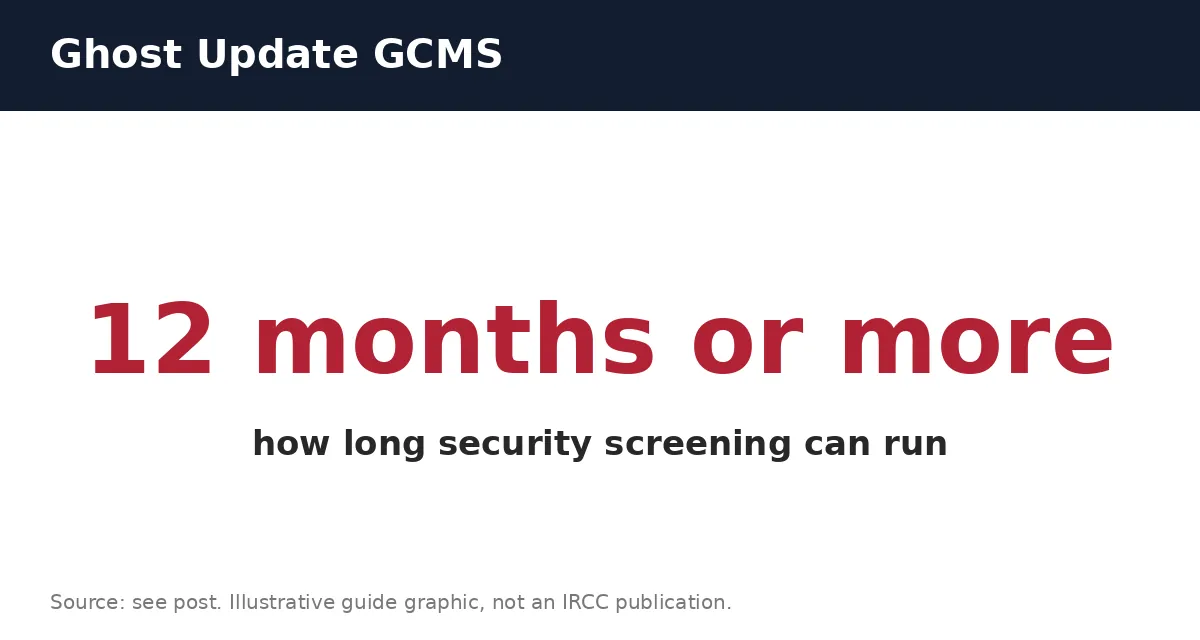
Most files clear security without drama. A small share are referred for comprehensive security screening, a deeper check involving other agencies. When that happens, the pattern is distinctive and miserable: eligibility passed, criminality passed, medicals passed, notes say “ready to finalize” — and then nothing, for 12 months or more.
There is very little an applicant can do to speed this up. IRCC gives few updates during screening, web forms return generic replies, and ordering more GCMS notes will mostly show the same “security in progress” entry. What you can do is keep your contact details current, respond instantly to any request, and avoid actions that complicate the file, such as withdrawing and reapplying without advice — a new file does not skip the same check.
The legal remedy people mention is mandamus: a Federal Court application asking a judge to order IRCC to decide an unreasonably delayed file. It is a last resort, it needs an immigration lawyer, and it only makes sense after a long, unexplained delay on a complete file — not after a few slow months, and not while a document request is outstanding. Talk to a lawyer before even considering it; a premature mandamus application can cost money and achieve nothing.
Real Cases From Public Threads
Real case: ghost update, then nothing for months (2023)
An applicant described the classic sequence: account showed “updated”, nothing visible changed, and no message followed for months. The thread’s consensus — which matches the evidence — was that the touch was routine file activity, not a decision signal. No outcome was reported.
Real case: 12+ months in comprehensive screening (2025)
A thread described a file stuck in comprehensive security screening for over a year, with eligibility, criminality and medical all passed and notes showing the file ready to finalize. Other posters in similar positions reported the same pattern: no updates, generic web-form replies, and no way to accelerate the check. No outcome was reported.
Real case: notes revealed the real problem (2022)
An applicant whose file had stalled ordered GCMS notes and found an analyst entry flagging a document gap that no message had ever mentioned. With the gap identified, they could address it through the proper channel instead of guessing. No outcome was reported, but the case shows why notes beat refreshing the account page.
Real case: tracker vs account disagreement (2024)
A candidate reported eligibility and background showing as completed on the tracker, plus a new medical expiry date, while GCKey showed no change at all. The explanation is unglamorous: two displays of the same file refreshing at different times. The notes, when ordered, are the tie-breaker. No outcome was reported.
Frequently Asked Questions
What is a ghost update?
It is an applicant-community term, not an IRCC term — a ghost update GCMS entry. Your account shows Application/profile updated but nothing visible has changed. It usually means something touched your file internally, and it does not by itself mean a decision is near. Note the date, then check your account weekly instead of refreshing it daily.
Does a ghost update mean I will get my passport request soon?
Not necessarily. A ghost update GCMS entry happens at many stages, including routine file touches. Some applicants do receive a decision soon after one, but many do not, so treat it as activity, not as a promise. Only a real message in your account — a document request, a decision letter — counts as news.
How do I order GCMS notes?
Through an ATIP request to IRCC. A Privacy Act request for your own personal information is free; an Access to Information request, used when someone requests on your behalf, costs $5. Include your UCI and application number so IRCC finds the right file.
Does ordering GCMS notes delay my application?
No. ATIP requests are handled by a separate team from the officers deciding your file, and ordering notes does not move you back in the queue. It also does not speed the file up — it only shows you what is on it.
What do GCMS notes show?
A ghost update GCMS notes request shows the officer’s and analyst’s entries, eligibility and admissibility assessments, security and background screening entries, correspondence logs and the reasoning behind a decision. They are the closest thing to reading your file from the inside. After a refusal, the notes are also the best basis for deciding whether reconsideration or a court challenge makes sense.
What does eligibility passed by an analyst mean?
It means an analyst recommended that eligibility be passed, but the file still needs an officer’s decision. Until an officer signs off, eligibility is not final, which is why notes can show passed by an analyst with no officer remarks yet.
What is comprehensive security screening?
It is a deeper security check involving other agencies, used for a small share of files. It can run for 12 months or more even when eligibility, criminality and medicals have all passed, and IRCC gives few updates while it runs.
When should I consider a mandamus application?
Mandamus is a Federal Court application asking a judge to order IRCC to decide an unreasonably delayed file. It is a last resort, it needs a lawyer, and it is only sensible after a long, unexplained delay with a complete file — not after a few slow months.
Final Thoughts
The account page is a poor instrument for measuring progress after a ghost update GCMS entry, and the forums are worse — they amplify the cases where a ghost update preceded good news and forget the cases where it preceded nothing. If you need to know where your file stands, order the notes. If everything has passed and only security remains, accept that the wait may be long, and resist the urge to disturb a file that is simply queued behind a check you cannot influence.
For anything beyond waiting — a procedural fairness letter, a refusal, a delay that has stretched past a year with no explanation — talk to a licensed consultant (RCIC) or lawyer. They can read the notes properly and tell you whether action will help or merely cost money.
Sources
This guide was checked against official IRCC sources and real applicant reports. This is general information, not legal advice. For your own case, talk to a licensed consultant (RCIC) or lawyer.
Last reviewed: October 29, 2026