Express Entry Guide · Updated October 2026
Someone is offering you a Canadian job — for a fee. That fee is the mark of a Canada job offer scam. Here is how to spot it, verify the people involved, and protect yourself.
By Aria Sterling · Checked against IRCC rules
Every year, people who want to move to Canada are sold something that does not exist: a job offer, an LMIA, a guaranteed visa. The pitch is polished, the documents look official, and the price feels small compared with a new life in Canada. Then the money is gone, the offer collapses at the first officer’s check, and the victim is left with a refusal — or worse, a misrepresentation finding — on top of the loss.
This post explains the law in plain terms, the red flags that appear in almost every scam, how to verify a consultant properly, and what to do if you have already paid. It is the post to send to anyone who has just been offered a Canadian job for a fee.
Evidence line: we checked IRCC’s fraud warnings and employer compliance rules, plus public threads from people who encountered sold LMIAs and ghost consultants. This is general information, not legal advice.
Quick answer: It is illegal for an employer to charge a worker for a job offer or an LMIA — the employer pays the LMIA fee and cannot recover it from the worker. Buying an offer is not a legitimate way to gain immigration points, and as of October 2026 a job offer adds zero CRS points anyway, so any “LMIA for points” pitch is stale. Verify any consultant through the College of Immigration and Citizenship Consultants (CICC) public register, insist on a video interview with a real, verifiable employer, and never pay for a job offer.
Key takeaways
The Law: Who Pays for What
The rule is simple and absolute. An employer who wants to hire a foreign worker through the Temporary Foreign Worker Program applies for a Labour Market Impact Assessment (LMIA) and pays the processing fee. The employer cannot charge that fee — or any fee for the job offer itself — to the worker, and cannot recover it from the worker’s wages. Any arrangement where the worker pays for the offer, the LMIA or the “processing” of the job is not a normal hiring cost. It is the pattern IRCC and Employment and Social Development Canada treat as fraud.
That absolute rule is the legal backbone of every Canada job offer scam warning: the employer pays, never the worker.
No legitimate employer in a Canada job offer scam story ever charges the worker — that charge is the tell.
The same logic applies to Express Entry points. As of October 2026, a job offer adds zero CRS points — the points were removed in March 2025. From 3 November 2026, a job offer in an eligible high-wage occupation can earn 50, 70 or 100 CRS points under the new Labour Market Integration factor, with no LMIA needed. The same factor also covers Canadian work experience — you get points for one or the other, whichever is higher, not both. That future change does not make a paid offer legitimate, and it does not make a fake offer genuine. Officers check genuineness regardless of the points regime, and a bought offer can get an application refused.
Warning:
Paying for a job offer is not a legitimate way to gain points. Officers check that every job offer is genuine, and a bought offer can get your application refused — and a fake document submitted with it can lead to a misrepresentation finding and five years of inadmissibility.
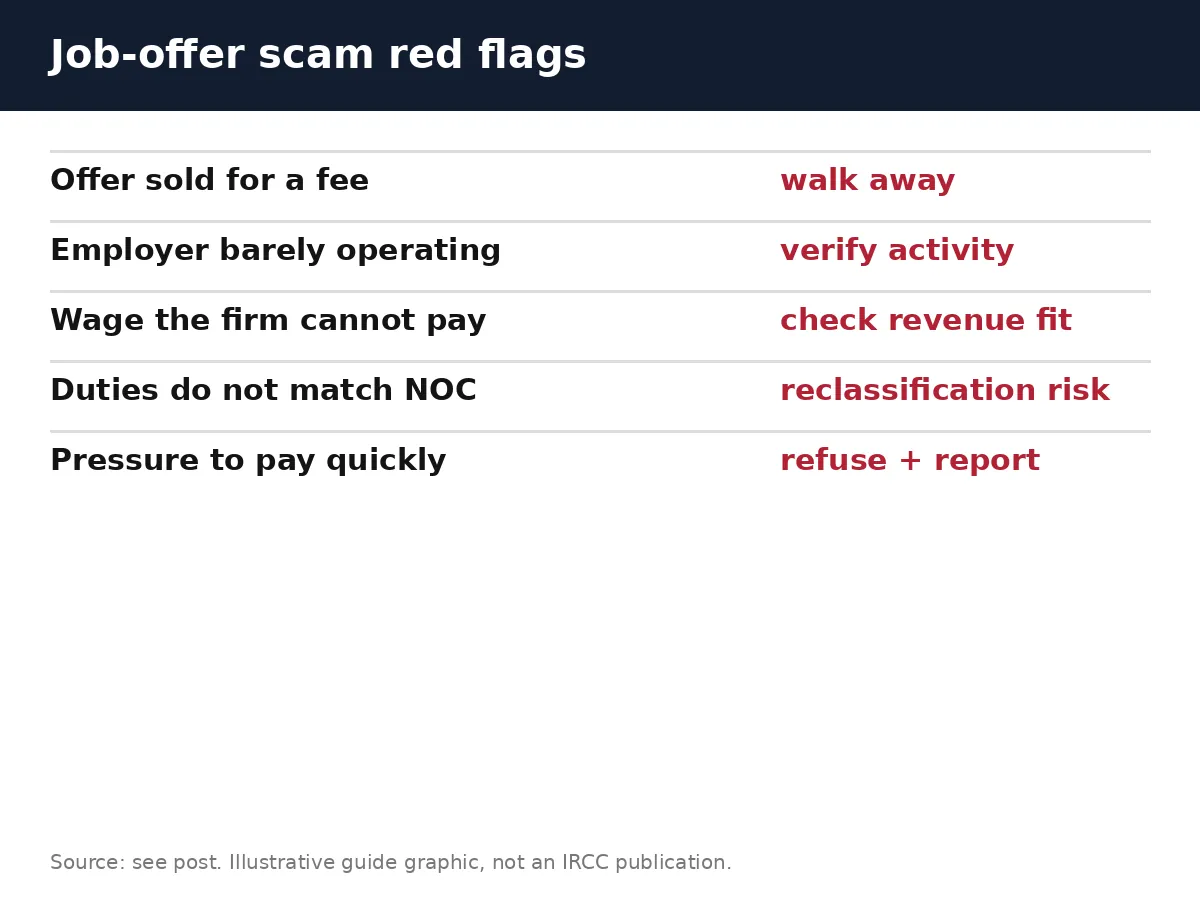
Canada Job Offer Scam Red Flags: The Pattern That Repeats
Red flag | What it looks like | What a real employer does instead |
|---|---|---|
Fee for the offer | “Pay $X for the LMIA / job offer / processing” | Pays its own LMIA fee; never charges the worker |
Chat-only interview | WhatsApp or Telegram messages only, no video call, no office visit | Video interview, verifiable office, real hiring manager |
Pressure to pay fast | “Offer expires today”, “someone else will take it” | Gives time to consider and verify |
No qualifications needed | High salary for a job anyone could do, no experience asked | Matches the role’s real requirements |
Unverifiable employer | No website, no business registration, free email address | Registered business with a traceable history |
Guaranteed visa | “100% guaranteed PR / work permit” | Never guarantees an outcome — only IRCC decides |
Ghost consultant | Advisor not named on your application | Licensed representative named on the application |
Source note: the red-flag pattern is drawn from IRCC fraud warnings and public scam reports; the fee rule is the official employer-compliance position.
Any one of these flags should stop a Canada job offer scam in its tracks — do not pay first and verify later.
If two or more flags appear together, treat the offer as a Canada job offer scam until proven otherwise.
Two subtler flags deserve attention. The first is the consultant who asks you to sign blank forms, or who refuses to give you copies of what was submitted in your name. You are responsible for everything submitted on your behalf, even if you never saw it. The second is the offer that arrives without an application — a “job offer” sent to you out of nowhere, for a job you never applied for, from a company you never contacted. Real employers do not recruit that way.
Verifying People in a Canada Job Offer Scam: RCICs, Lawyers, Ghost Consultants
Only two kinds of paid representatives can legally represent you before IRCC: licensed immigration consultants and lawyers. A licensed consultant — a Regulated Canadian Immigration Consultant (RCIC) — is licensed by the College of Immigration and Citizenship Consultants (CICC) and appears on its public register. Check the register yourself, and match the licence number and name to the person you are dealing with, not just to the firm’s website. A firm that claims a licence belonging to someone else, or that cannot produce a licence number, is a reason to walk away.
Verifying a representative is the single best defence against a Canada job offer scam.
A licence number you can match on the public register is what separates a real consultant from a Canada job offer scam.
Lawyers are verified differently: through the law society of the province where they practise. The same principle applies — check the register, match the name, and do not take the firm’s word for it.
A ghost consultant is someone who prepares or advises on your application but is not named on it and is not licensed. The danger is accountability: if the application contains an error or a false document, IRCC has no licensed representative to contact, and you carry the full consequence. If someone offers to “help quietly” without appearing on the application, that quiet is the warning. Insist that any paid representative be named on the application, and get copies of everything submitted.
Tip:
Verification takes five minutes and costs nothing. Search the CICC public register for a consultant, or the provincial law society for a lawyer, before you pay anything or sign anything. A legitimate professional expects you to check.
How Officers Check Whether an Offer Is Genuine
Officers do not take a job offer letter at face value. They check that the employer is active and operating, that the business can actually fulfil the offer (premises, payroll, business activity), that the job is real and matches the occupation claimed, and that the worker is qualified for it and likely to accept it. A paper offer from a business with no activity behind it — no employees, no premises, no revenue — does not survive that check, and the failure is not treated as a paperwork problem. It is treated as a genuineness problem, which can mean refusal and, where documents were misrepresented, a misrepresentation finding.
Officers test every offer the way this post describes, which is why a Canada job offer scam rarely survives scrutiny.
A paper offer with no business behind it is exactly what officers reject — and exactly what a Canada job offer scam sells.
The same scrutiny applies to the documents around the offer. A reference letter, a contract or a pay record that does not verify with the employer, or that contradicts other documents on file, becomes a new problem on top of the offer itself. This is why submitting anything you cannot verify as genuine is so dangerous: the document you were sold can become the reason you are banned, not just refused.
If You Already Paid a Canada Job Offer Scam: Stop, Keep, Report
Real Cases From Public Threads
Real case: chat-only interview, fee demanded, offer vanished (2023)
A jobseeker described a WhatsApp-only “interview” for a warehouse role in Canada, followed by a demand for a fee to process the LMIA. When they asked for a video call and the company’s registration details, contact stopped. No money was reported lost in that thread, but the pattern — chat-only, fee, disappearance on verification — is the textbook scam shape.
Real case: paid for an LMIA, application refused (2022)
Another thread described a worker who paid a substantial sum for an LMIA-backed offer, only for the application to fail when the employer could not demonstrate genuine business activity. The money was not recovered. No outcome beyond the refusal was reported, but the case shows the two losses stacking: the fee and the refusal.
Real case: ghost consultant, errors discovered too late (2024)
An applicant learned after a refusal that their unnamed “helper” had submitted inconsistent employment dates across forms. Because no licensed representative was on the application, there was no one accountable to correct the record, and the applicant carried the refusal alone. No outcome was reported beyond that.
Frequently Asked Questions
Is it legal to pay for a job offer or an LMIA in Canada?
No. An employer cannot charge a worker for a job offer or an LMIA, and a worker cannot buy one — paying for either is a Canada job offer scam. The employer pays the LMIA processing fee and cannot recover it from the worker. Paying for an offer is not a legitimate way to gain immigration points.
Do job offers give Express Entry points right now?
No. As of October 2026, a job offer adds zero CRS points — that has been the rule since the points were removed in March 2025. From 3 November 2026, a job offer in an eligible high-wage occupation can earn points under the new Labour Market Integration factor, but that is a future change, not today’s rule.
What are the red flags of a job offer scam?
A Canada job offer scam often starts with a chat-only interview with no video call, a fee demanded before any work, pressure to pay quickly, a job that needs no qualifications, an employer who cannot be found online, and a contract full of spelling errors or a free email address. Any one of these is a reason to stop and verify.
How do I verify an immigration consultant?
Check that the consultant is licensed with the College of Immigration and Citizenship Consultants (CICC) and appears on its public register, with a licence number you can match to the person you are dealing with. Lawyers are verified through their provincial law society instead.
What is a ghost consultant?
A ghost consultant is someone who prepares or advises on your application but is not named on it and is not licensed to practise. If your representative is not on the application, IRCC has no one accountable to contact, and you carry the full risk of their errors.
What happens if I submit a fake document?
It can lead to a misrepresentation finding, refusal, and five years of inadmissibility from Canada. A document you know is false, or that you should have known was false, is treated the same as a lie on the application itself.
I already paid a scammer. What should I do?
Stop paying, keep every message, receipt and bank record, report the fraud to local police and to the Canadian Anti-Fraud Centre, and talk to a licensed consultant or lawyer before submitting anything the scammer prepared. Do not submit documents you cannot verify are genuine.
Final Thoughts
The simplest rule in this whole post is also the most protective: a real Canadian employer never charges you for a job. If money flows from you to the employer for the offer, the LMIA or the “processing”, you are not being hired — you are being sold. Walk away, verify the people involved, and report it. If a deal looks like a Canada job offer scam, treat it as one: walk away, verify, and report.
And if you are already in the middle of something that feels wrong, stop and get advice from a licensed consultant or lawyer before you submit anything or pay anything more. The fee you have already lost is recoverable in theory and rarely in practice — but a refusal or a misrepresentation finding is a far heavier price, and it is the one you can still avoid.
Sources
This guide was checked against official IRCC sources and real applicant reports. This is general information, not legal advice. For your own case, talk to a licensed consultant (RCIC) or lawyer.
Last reviewed: October 29, 2026