
Express Entry Guide · Updated October 2026
“Where can we actually afford to land?” is the question every new PR asks — and the answer is never just the rent. Here is the honest cost of living Canada comparison.
By Aria Sterling · Checked against IRCC rules
The question behind this cost of living Canada post is practical, not academic. You have permanent residence, you have savings, and you need to choose a city where those savings last until the first paycheques arrive — and where the paycheques, when they come, cover the rent. Rent dominates that calculation, but it is not the whole calculation: transport, taxes, childcare, winter costs and the job market in your field all shift the answer.
One honesty note before the numbers. Every figure in this post is our rough illustrative estimate, not an official figure and not a market survey. Rents move month to month and vary enormously by neighbourhood, building age and whether you share. Use the ranges here to compare cities and to plan a budget, then check current listings in the neighbourhoods you are actually considering before you commit to anything.
Evidence line: we compared city cost discussions in newcomer guides and public threads, and cross-checked the shape of the comparison — which cities are expensive, which are cheaper, and why — against widely reported rental patterns. This is general information, not financial advice.
Quick answer: For rent alone, the order from most to least expensive is roughly Vancouver, Toronto, Calgary, Montreal, then Halifax — with Montreal’s lower rents partly offset by Quebec’s language reality, and Calgary’s mid-range rents offset by no provincial sales tax. A single newcomer sharing or renting small might plan on roughly $2,200 to $3,500 a month all-in in Toronto or Vancouver, $1,900 to $2,900 in Calgary, and $1,700 to $2,700 in Montreal or Halifax. A family of four should plan roughly $6,500 to $8,500 in the two expensive cities, $5,500 to $7,000 in Calgary, and $4,500 to $5,500 in Montreal or Halifax. All of these are our rough illustrative estimates — check current listings.
Key takeaways
Cost of Living Canada: Five Cities at a Glance
City | One-bedroom rent (illustrative) | Single newcomer, all-in (illustrative) | Family of four, all-in (illustrative) | Transit / car note |
|---|---|---|---|---|
Vancouver | $2,000–$2,700 | $2,400–$3,500 | $6,800–$8,500 | Good transit in core; rain, not snow, is the weather cost |
Toronto | $1,900–$2,600 | $2,200–$3,400 | $6,500–$8,200 | Extensive transit; car optional in core |
Calgary | $1,500–$2,000 | $1,900–$2,900 | $5,500–$7,000 | Car helpful outside core; no provincial sales tax |
Montreal | $1,200–$1,700 | $1,700–$2,700 | $4,500–$5,500 | Good transit; French matters for work and services |
Halifax | $1,100–$1,600 | $1,700–$2,600 | $4,500–$5,400 | Smaller transit network; car helpful outside core |
Source note: all figures are our rough illustrative estimates for planning purposes only, not official statistics and not a rental survey. “All-in” means rent plus groceries, transport, phone, utilities and basic household costs, excluding childcare and debt payments. Verify against current listings in your target neighbourhood.
Read the table as a cost of living Canada ranking, not a price list. The exact rent you pay depends on the neighbourhood, the building, and whether you share — a shared room in Toronto can cost less than a one-bedroom in Halifax. What the table reliably shows is the order of magnitude: the expensive cities cost roughly double the cheaper ones for the same kind of home, and that gap compounds every month you live there.
Cost of Living Canada, City by City: What the Numbers Do Not Show
Vancouver. The most expensive city in this cost of living Canada comparison for rent, and the mildest climate — rain instead of snow, which saves on winter costs but not on rent. The job market is strong in tech, film, construction and port logistics, and the newcomer community is large. The trade-off is stark: beautiful, mild, and very expensive, with the rent gap swallowing much of a salary advantage.
Toronto. Nearly as expensive as Vancouver, with the largest job market in the country and the largest newcomer communities — which means more employers familiar with foreign credentials, more settlement services, and more competition for housing. Transit is extensive in the core, and many newcomers manage without a car. If your field’s jobs are concentrated in Toronto, the rent premium may be worth paying for the first year.
Calgary. The middle city in this comparison, with a real advantage that does not show in rent alone: Alberta has no provincial sales tax, so everyday prices run lower. Energy, engineering, construction and trades are strong, and the city is younger and more car-dependent than Toronto or Vancouver. Winters are cold but sunny, and the commute from affordable suburbs is longer than the rent saving suggests.
Montreal. The cheapest big city for rent in this comparison, with excellent transit and a distinctive culture — and a language reality that must be weighed honestly. Daily life, schooling and many jobs operate in French, and Quebec’s immigration and settlement systems differ from the rest of Canada. A newcomer without French can manage in parts of Montreal, but the language question matters more for work than for rent, and it should be part of the decision, not an afterthought.
Halifax. The cheapest city in this cost of living Canada comparison, with a smaller job market, a smaller newcomer community, and a slower pace that suits some families very well. The Atlantic provinces also run their own immigration programs, and the smaller market means fewer employers in any given niche — so check that your field has real openings before choosing Halifax for the rent alone.
Cost of Living Canada: The Hidden Costs Newcomers Miss
Monthly rent is not the first month’s cost. The first month typically includes a damage deposit, first and last month’s rent in some provinces, tenant insurance, a phone plan, winter clothing if you arrive in autumn, and — if you need a car — the car, insurance and registration. Then there is the gap before the first paycheque, which can be weeks even with a job lined up, because payroll cycles and credential checks take time.
Childcare is the largest hidden cost for families, and it varies enormously by province and by whether subsidized spaces are available. It is deliberately excluded from the table above because a single number would mislead — research childcare in your target city separately, before you choose. The same applies to any debt payments, remittances to family, and professional licensing fees.
Tip:
Before landing, price ten current rental listings in each neighbourhood you are considering, and add the deposit, insurance and first-month essentials to the monthly figure. That one exercise turns a guide’s ranges into your budget.
Cost of Living Canada: Choosing Beyond Rent
The right city for cost of living Canada is the cheapest city that has work in your field, a community you can build a life in, and services your family needs. A newcomer in a regulated profession should weigh licensing timelines and employer familiarity with foreign credentials. A family should weigh schools, childcare availability and language. A single newcomer should weigh the job market and the cost of sharing — because sharing a home in an expensive city often beats a one-bedroom in a cheap city with no work.
One more rule: federal Express Entry does not tie you to a city. You can land in any province except Quebec (which has its own selection system) and move afterwards. But if you were nominated by a province, you are expected to live in that province, and choosing another province’s city on arrival undermines the nomination’s purpose. Check your nomination conditions before you book the flight.
Real Cases From Public Threads
Real case: Toronto rent shock, then sharing (2023)
A newcomer described arriving in Toronto expecting a one-bedroom within budget, discovering the market price was far above the plan, and switching to a shared home for the first year while building a Canadian work history. The shared arrangement cut the monthly cost roughly in half and bought time to find better-paid work. No outcome was reported beyond that.
Real case: Halifax chosen for rent, job market thin (2024)
A family that chose Halifax for its lower rents described the trade-off plainly: housing was affordable, but openings in their field were few, and the job search took longer than expected. The thread’s lesson was to check job postings before choosing a city for rent alone. No outcome was reported.
Real case: Calgary’s no-sales-tax surprise (2022)
A newcomer in Calgary noted that the absence of provincial sales tax made everyday shopping noticeably cheaper than in Ontario or British Columbia, partly offsetting the car costs of a more spread-out city. No outcome was reported, but the case shows why a city’s tax structure belongs in the comparison.
Frequently Asked Questions
Which Canadian city is cheapest for new immigrants?
Of the five cities compared in this cost of living Canada guide, Halifax and Montreal are generally the most affordable for rent, while Toronto and Vancouver are the most expensive. The right answer depends on your job, because a cheaper city with no work in your field is not cheaper in practice.
How much rent should a new PR budget for?
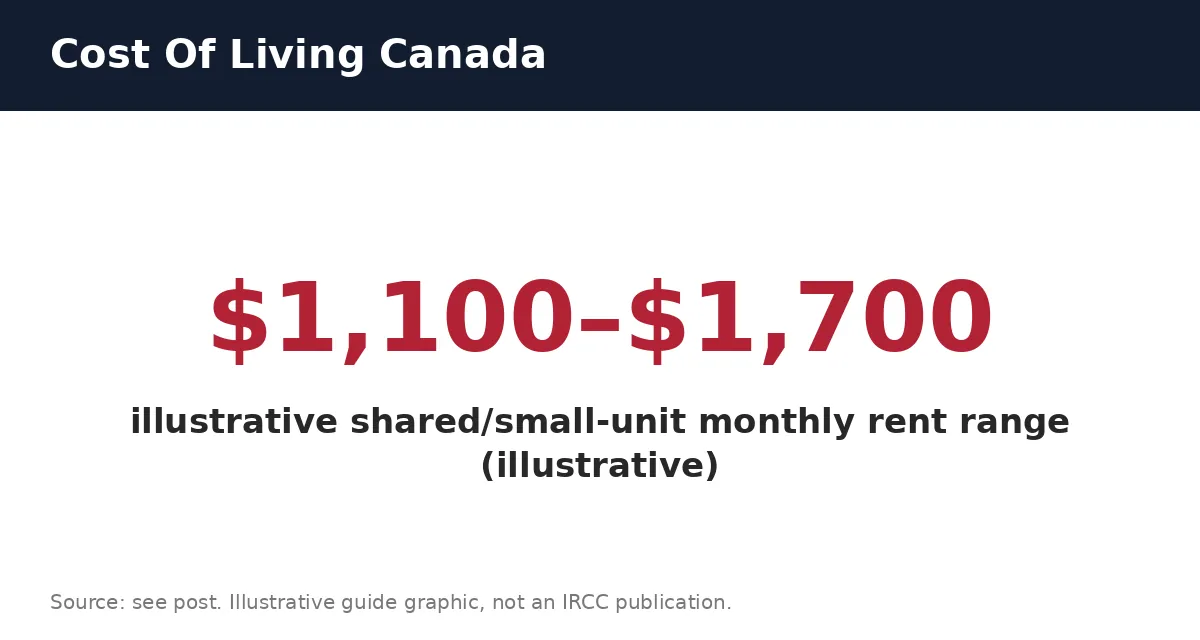
For cost of living Canada, it varies enormously by city and by whether you share. Our illustrative ranges run from roughly $1,100 to $1,700 a month for a shared or small unit in Halifax or Montreal, up to $1,900 to $2,600 for a one-bedroom in Toronto or Vancouver. Check current listings before deciding.
Is Calgary cheaper than Toronto and Vancouver?
Generally yes for rent, and Alberta has no provincial sales tax, which lowers everyday prices. Calgary’s illustrative one-bedroom range sits between the expensive coastal cities and the cheaper eastern ones, and its job market is strong in energy, engineering and trades.
How much should a family of four budget monthly?
Our illustrative ranges run from roughly $4,500 to $5,500 a month in Halifax or Montreal, $5,500 to $7,000 in Calgary, and $6,500 to $8,500 in Toronto or Vancouver, excluding childcare and debt payments. These are planning ranges, not official figures — check current prices.
Is Montreal affordable if I do not speak French?
Rent is lower than in Toronto or Vancouver, but daily life, schooling and many jobs in Quebec operate in French. A newcomer without French can manage in parts of Montreal, but the language question matters more for work than for rent.
How do I check current rents before landing?
Browse current listings on major rental platforms for the neighbourhoods you are considering, and compare at least ten listings rather than trusting one. Rents move quickly, and a guide written months ago is not a substitute for today’s listings. Note whether utilities, parking and laundry are included, since those extras change the real monthly cost.
What hidden costs catch new immigrants?
Damage deposits and first-and-last-month rent, tenant insurance, winter clothing, a car and insurance if needed, phone plans, and the gap before the first paycheque. Budget a settlement buffer beyond the monthly figures in this post. For families, childcare deserves its own research line, since subsidized spaces vary enormously by city.
Final Thoughts
The cost of living Canada question has no single answer, because it is really three questions: what does housing cost, what does work pay, and what does your family need? The ranges in this post answer the first question in rough terms. The other two are yours to answer with job postings, childcare research and a hard look at your own priorities.
Do the listing exercise before you land: ten current listings per neighbourhood, plus deposits and first-month essentials, plus a settlement buffer. That single afternoon of research will do more for your first year in Canada than any guide — including this one.
Sources
This guide was checked against official IRCC sources and real newcomer reports. All cost figures are our rough illustrative estimates, not official figures. This is general information, not financial advice. For your own case, talk to a licensed consultant (RCIC) or lawyer.
Last reviewed: October 29, 2026