Express Entry Guide · Updated October 2026
You have seen the ranges tables. What you need is a path: a dated sequence of moves, with the exact points each one adds, that takes a real profile from the high 300s past 470. This CRS 380 to 470 journey is a dated sequence of moves, with the exact points each one adds.
By Aria Sterling · Checked against IRCC rules · 12 min read
Ranges tables tell you where scores sit. They do not tell you how to move. This post follows one illustrative profile — built from IRCC’s grid, not copied from any real person — through three dated steps, with the arithmetic shown at every stage. The profile is single, 29 years old, with a bachelor’s degree assessed by an ECA, English at CLB 8 in all four abilities, and one year of skilled Canadian work experience. Its starting score is 387, which is what “about 380” means in practice.
Every point figure below comes from IRCC’s CRS criteria page. Every date is our plan, not IRCC’s — timelines vary, and this post says so wherever a date appears. For current cutoffs, see our latest Express Entry draws and CRS cutoffs page.
Evidence base: IRCC’s CRS criteria page (modified June 22, 2026). The journey profile is an illustrative worked example; the forum cases at the end are paraphrased public threads. This is general information, not legal advice.
Quick answer
Quick answer:
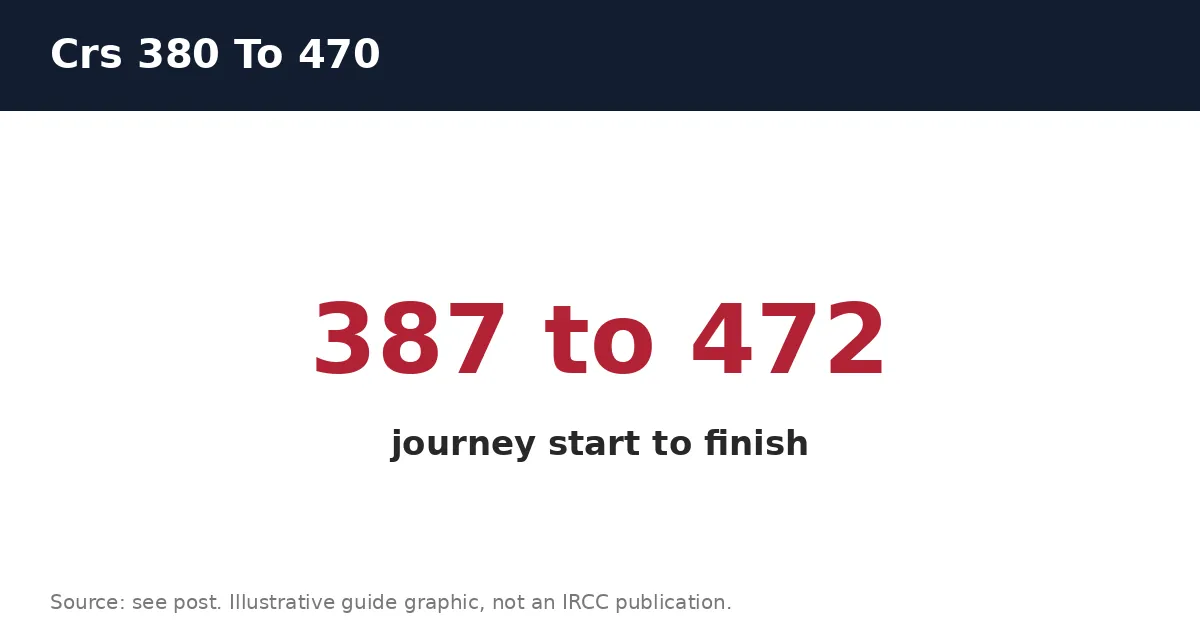
Three moves take this profile from 387 to 472: a language retake to CLB 9 (+57 points), a second year of Canadian work experience (+13), and sibling points (+15). The language retake is two-thirds of the journey. Without it, the other two steps together only reach 415. Without the language retake, this CRS 380 to 470 journey stalls at 415, so language comes first.
Key takeaways
The starting profile: 387 points
Factor | Points | How the figure is reached |
|---|---|---|
Age (29) | 110 | Maximum band, ages 20 to 29 |
Education (bachelor’s, ECA done) | 120 | Bachelor’s degree, single applicant |
First language (CLB 8, all four) | 92 | 23 points per ability × 4 |
Canadian work experience (1 year) | 40 | One year, skilled, TEER 0–3 |
Skill transferability (education + CLB 8) | 25 | Post-secondary credential with CLB 7–8 |
Total | 387 |
Points from IRCC’s CRS criteria page (modified June 22, 2026). The profile is illustrative; your own factors will differ.
Notice what is missing: no spouse factors, no second language, no sibling points, no Canadian education, no nomination. That is deliberate — the journey adds one lever at a time so you can see what each one is worth.
Step 1: language to CLB 9 (+57) — months 1 to 3
The CRS 380 to 470 journey starts with language because it is worth the most points. The profile’s English is CLB 8 in all four abilities. In IELTS General Training terms, that typically means listening 7.5 and 6.5 in reading, writing and speaking. CLB 9 needs listening 8.0 and 7.0 in the other three — the “8777” shorthand. The gap is usually one skill, most often writing.
The plan is narrow: diagnose which ability is below CLB 9, study only that ability for two to three months, then retake the full test. (Express Entry requires all four abilities from one sitting, so a single-skill retake cannot be used — see our post on that rule.) When the retake lands at CLB 9 in all four abilities, two things change at once. Core language points rise from 92 to 124, a gain of 32. And the education-and-language transferability combination rises from 25 to 50, a gain of 25. Total gain: 57 points. New total: 444.
Tip:
Do not retake blind. Take a marked practice test first, find the one ability below the threshold, and spend the whole study block there. Improving a skill that is already at CLB 9 while another sits at CLB 8 wastes the retake.
Step 2: a second year in Canada (+13) — months 4 to 14
The CRS 380 to 470 journey continues with a second year of Canadian work, which accrues while you do everything else. While the language work is fresh, the profile keeps working. Canadian skilled work experience rises with each year: one year is worth 40 points, two years 53. The second year therefore adds 13 points, taking the profile from 444 to 457. Nothing else changes in this step — same age band (still 29), same degree, same language results.
This is the slowest step and the least glamorous, which is exactly why it belongs in the plan: it happens while you are doing everything else, provided the work stays skilled, paid, and authorised. Check the TEER of the job before counting the year, and keep pay slips and the reference letter current as you go.
Step 3: sibling points (+15) — alongside, months 6 to 14
The CRS 380 to 470 journey finishes with sibling points, the only fixed-gain step. The profile has a sister who is a Canadian citizen living in Canada. A sibling in Canada adds 15 CRS points, if the relationship and her residence can be proved. The documents take weeks to gather — birth certificates showing the shared parent, her citizenship or permanent residence proof, and residence evidence such as a lease, tax documents or utility bills in her name — so the work starts in month 6, not month 14.
When the proof is ready and the profile is updated, the score rises from 457 to 472. The milestone is crossed: 387 to 472 in about fourteen months, with no nomination, no new degree and no job offer involved.
The full CRS 380 to 470 timeline
When | Move | Score after |
|---|---|---|
Month 0 | Starting profile | 387 |
Months 1–3 | Language study (weakest ability) + full retake to CLB 9 | 444 |
Months 4–14 | Second year of skilled Canadian work | 457 |
Months 6–14 | Sibling documents gathered and added | 472 |
Point changes from IRCC’s CRS criteria page. Dates are our planning illustration, not IRCC timelines.
Traps on a CRS 380 to 470 journey
A birthday inside the journey. Age points fall each year after 29: 105 at 30, 99 at 31, 94 at 32. If the profile turns 30 during the fourteen months, subtract 5 points from the final total (467, still past the milestone in this example, but the margin matters).
An expiring language test. Results must be less than two years old at profile creation and at application. If the original CLB 8 results expire before the retake lands, the profile loses its language points entirely until the new results are entered.
A job offer that promises points today. A job offer adds 0 CRS points as of October 2026. From 3 November 2026, a job offer in an eligible high-wage occupation can earn 50, 70 or 100 CRS points under the new Labour Market Integration factor, with no LMIA needed. The same factor also covers Canadian work experience — you get points for one or the other, whichever is higher, not both. Do not pay for an offer on the strength of points it does not yet give.
A new profile. Update the existing profile at each step. A new profile resets the creation date used as the tie-breaker.
Real cases
Real case: mid-300s, asking what to do first (forum thread, 2026)
A candidate in the mid-300s with CLB 8 asked what would actually improve their score. The journey above is the priced version of the answer that thread needed: language first, because it is worth 57 points here, not because it sounds good. No outcome was reported.
Real case: high-460s, just under the cutoff (forum thread, 2026)
A candidate in the high-460s asked whether they would be invited. The journey’s last step is the relevant lesson: at that distance, one small lever — sibling points, a spouse test, one more year of experience — is worth more than any grand plan. No outcome was reported.
Real case: “show me a real path, not ranges” (forum discussion, 2026)
Candidates repeatedly asked for a path with dates rather than another ranges table. This post is built for that request: dated steps, exact arithmetic, and the traps labelled. Ranges tell you where you stand; only a dated plan tells you what to do on Monday. No outcome was reported.
Frequently Asked Questions
Is it realistic to go from CRS 380 to 470?
Yes, but not by waiting. This CRS 380 to 470 journey needs three moves: a language retake to CLB 9, a second year of Canadian work experience, and sibling points. Together they add 85 points. Without at least one big lever, a score in the high 300s does not drift to 470 on its own.
How long does a CRS 380 to 470 journey take?
In this CRS 380 to 470 journey, about fourteen months: a few months of language study and a retake, then a second year of Canadian work, with sibling documents gathered alongside. Timelines vary with your starting level and your work history, so treat the dates as a plan, not a promise.
What is the biggest single step in the journey?
The language retake to CLB 9. For a single applicant it adds 32 core points and raises the education-and-language transferability combination from 25 to 50 points, for a total gain of 57 points in the worked example. No other step comes close: the second year of Canadian work adds only 13 points, and sibling points add a fixed 15.
Do I need a provincial nomination to reach 470?
No. The worked journey reaches past 470 without one. A nomination adds 600 points and would end the journey immediately, but it is a separate provincial application, not a step every candidate needs. A nomination would also change your timeline completely, because it adds 600 points at once, but it requires a separate provincial application with its own criteria and processing time.
What if I have no sibling in Canada?
Then replace the 15 sibling points with another lever: a spouse language test, a Canadian education credential, or French. The journey’s structure stays the same, but the final step changes. Run each alternative through the CRS calculator before committing. A spouse language test can add up to 20 points, a one-year Canadian credential adds 15, and French at NCLC 7 can add far more, so price each option before choosing.
Does the journey work with a spouse?
The steps are the same but the numbers differ, because spouse-factor points replace some core points. With an accompanying spouse, language points per ability are lower and the spouse’s own results can add up to 40 points. Always run both versions of the profile.
Will my score drop on my birthday during the journey?
Possibly. For a single applicant, age points are 110 from age 20 to 29, then fall each year: 105 at 30, 99 at 31, 94 at 32. If a birthday falls inside your journey, subtract the drop from the plan so the final total is honest.
Final Thoughts
The journey works because it is priced and dated. Language first, because it is worth 57 points here. Work experience second, because it accrues while you do everything else. Sibling points last, because documents take weeks and the gain is fixed at 15. Copy the structure of this CRS 380 to 470 journey, replace the numbers with your own, and check each step in our CRS calculator before you spend money or months on it.
If your history involves a refusal, a complex work pattern or documents you cannot obtain, talk to a licensed consultant (RCIC) or lawyer before you rely on this plan.
Sources
We build free Express Entry tools and track every IRCC draw. This guide was checked against official IRCC sources and real applicant reports. Last reviewed: October 29, 2026. This is general information, not legal advice. For your own case, talk to a licensed consultant (RCIC) or lawyer.