Express Entry Guide · Updated October 2026
You work in Canada and hold a job offer — so does the proof of funds exemption apply to you, or is that the most misunderstood waiver in Express Entry?
By Aria Sterling · Checked against IRCC rules · 12 min read
Ask ten people in Canada on a work permit whether they need proof of funds, and you will get ten confident answers — most of them wrong. “I work here, so I’m exempt.” “I have a job offer, so I’m exempt.” “My spouse is a permanent resident, so I’m exempt.” Only some of those people are right, and the ones who are wrong find out the hard way: an application returned as incomplete, or a refusal, because the funds they never prepared were required after all.
This post settles the proof of funds exemption Express Entry question properly. It names the two exemption routes, explains why the work-permit route is misunderstood, exposes the program trap that catches CEC-eligible people invited under another program, and tells you exactly what to upload if you are genuinely exempt.
We checked this guide against IRCC’s proof of funds requirements and the CRS criteria page on canada.ca, plus public forum threads about the work-permit exemption. This is general information, not legal advice.
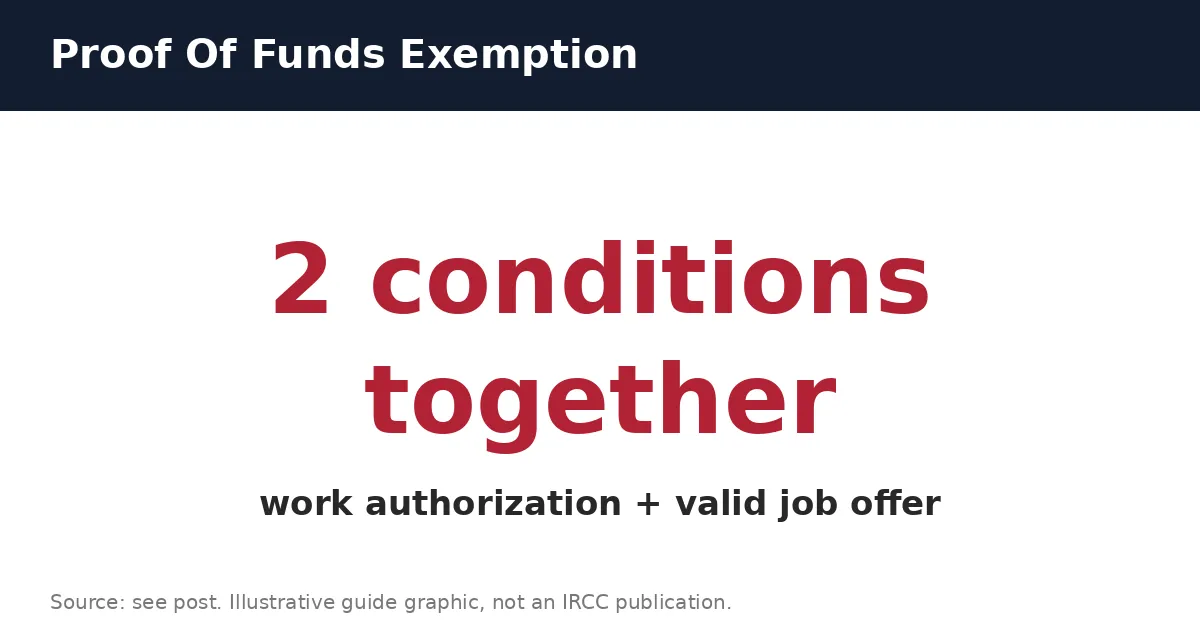
Quick answer: The proof of funds exemption applies if you are invited under the Canadian Experience Class, or if you are authorized to work in Canada AND hold a valid job offer — both conditions together. Working in Canada alone is not an exemption. A job offer alone is not an exemption. And the program on your invitation, not the program you hoped for, decides.
Key takeaways
The two proof of funds exemption routes
Situation | Proof of funds required? |
|---|---|
Invited under the Canadian Experience Class | No — exempt |
Authorized to work in Canada AND holding a valid job offer | No — exempt (both conditions together) |
Invited under the Federal Skilled Worker Program, without both exemption conditions | Yes — full family-size amount |
Invited under the Federal Skilled Trades Program, without both exemption conditions | Yes — full family-size amount |
Working in Canada but no valid job offer | Yes |
Valid job offer but not authorized to work in Canada | Yes |
Provincial nomination (any stream) | Depends on program and exemption conditions — the nomination itself does not exempt you |
Source: our summary of IRCC’s proof of funds requirements (canada.ca). The table’s wording is our summary, not IRCC’s text.
The logic behind the proof of funds exemption is simple once you see it. The funds rule exists because a new immigrant needs money to settle. If you are already working in Canada with a job to go to, or if you built your qualifying experience inside Canada under the Canadian Experience Class, IRCC treats the settlement risk as already covered. Everyone else must show the money. That is the whole theory — and it explains why the conditions are so specific.
The misunderstood waiver: work permit plus job offer
The most common misunderstanding in the forums is treating one half of the second route as the whole route. “I am authorized to work in Canada” is not the exemption. “I have a valid job offer” is not the exemption. The proof of funds exemption is the pair. A candidate on an open work permit with no job offer must show funds. A candidate abroad with a valid job offer but no work authorization must show funds. Only the candidate who has both, at the time they apply, is exempt.
The second misunderstanding is the word “valid.” A valid job offer for this purpose is a specific thing: it must meet IRCC’s definition, which includes the employer, the occupation, and the terms of the offer. An informal promise, a letter of intent, or an offer from an employer who cannot meet the requirements does not count. If you are relying on this exemption, check the offer against IRCC’s valid-job-offer requirements before you rely on it — and keep the offer letter in your documents even though you are not uploading funds proof.
Warning:
Do not confuse this exemption with the November 3, 2026 scoring change. Today, job offers add 0 CRS points. From November 3, 2026, a job offer in an eligible high-wage occupation can earn 50, 70 or 100 CRS points under the new Labour Market Integration factor, with no LMIA needed. The same factor also covers Canadian work experience — you get points for one or the other, whichever is higher, not both. That scoring change does not change who must show proof of funds.
The program trap: CEC-eligible, FSW-invited
Here is the trap that catches careful people. You qualify under more than one program — say, the Canadian Experience Class and the Federal Skilled Worker Program. You enter the pool. Your invitation arrives, but it is a Federal Skilled Worker invitation, not a Canadian Experience Class one. You are now an FSW applicant for funds purposes, and you must show the full family-size amount. Your CEC eligibility does not travel with you into an FSW invitation.
This happens more often than people expect, because category-based and program-specific rounds invite from overlapping pools. The practical lesson is blunt: if you qualify under multiple programs, prepare a funds package anyway, even if you expect a CEC invitation. If the invitation that arrives is CEC, you will not need it. If it is FSW, you will be glad you prepared it. The 60-day application window is no time to start assembling bank letters.
When a proof of funds exemption disappears
Exemptions are not permanent. They are assessed when you apply, and your situation between profile and application can change them. The three changes that matter most: your work permit expires or is not renewed; your job offer is withdrawn or the employer closes; your invitation arrives under a different program than you expected. Any one of these can turn an exempt applicant into a funds-required applicant overnight.
IRCC recommends keeping your settlement-funds information current in your profile even if you expect an exemption, and that advice is worth following literally. Enter your funds figure honestly in the profile even when you believe you will not need to prove it. If your situation changes, the profile already reflects reality, and you are not scrambling to document money you have not organized.
What to upload if you are exempt
Exempt does not mean “upload nothing.” The system will still ask for a document in the proof-of-funds slot, and an empty slot is an incomplete application. Upload a short letter, one page, stating the facts: your name, your application number, the program you were invited under, and the exemption you rely on. For a CEC invitation, say so plainly. For the work route, state that you are authorized to work in Canada and hold a valid job offer, and attach the work permit and the offer letter as supporting documents. Sign and date it. That letter is the difference between “exempt” and “missing document” in an officer’s file.
And remember the real-life caveat: exempt from the document does not mean exempt from needing money. You still have to live, eat, and pay rent while you settle. The exemption removes a paperwork requirement, not a real-world need. Arrive with a buffer, even if IRCC never asked to see it.
Real cases
Real case: the work permit without a job offer (forum thread, 2024)
A candidate on an open work permit assumed the permit alone exempted them, and submitted without funds proof. Other posters corrected them: without a valid job offer alongside the authorization, the exemption does not apply. The candidate prepared a funds package before the deadline. Outcome: corrected before submission; no refusal resulted.
Real case: the CEC hope, the FSW invitation (forum thread, 2023)
A candidate qualified under both the Canadian Experience Class and the Federal Skilled Worker Program, expected a CEC invitation, and received an FSW one. The thread’s advice was that the invitation’s program governs, so funds were required. The candidate had not prepared a package and faced a rushed 60-day scramble. Outcome: no final outcome was reported.
Real case: the empty upload slot (forum thread, 2024)
An exempt candidate left the proof-of-funds upload slot empty, reasoning that exemption meant nothing to upload. Other posters warned that the system treats an empty required slot as incomplete, and the candidate added an exemption letter. Outcome: no outcome was reported, but the letter is the standard fix.
Real case: the job offer that vanished (forum thread, 2023)
A candidate’s employer withdrew the job offer between invitation and application. The candidate’s exemption depended on that offer, so the withdrawal removed it. The thread advised showing funds instead of arguing the exemption. Outcome: no outcome was reported.
Frequently Asked Questions
Who is exempt from proof of funds in Express Entry?
Canadian Experience Class applicants qualify for the proof of funds exemption. So are applicants who are authorized to work in Canada and hold a valid job offer, but both conditions must apply together, not just one. Everyone else must show the full family-size amount, so check your own situation against both routes before you assume.
I work in Canada. Am I automatically exempt from proof of funds?
No. Working in Canada alone is not enough. You also need a valid job offer. Without both conditions, there is no proof of funds exemption, and you must show settlement funds for your family size. The exemption is the pair of conditions together, and losing either one removes it entirely.
I have a valid job offer but no work permit. Am I exempt?
No. The exemption needs both parts: authorization to work in Canada and a valid job offer. A job offer alone, without work authorization, does not exempt you. Work authorization means a valid permit or authorization to work, not merely an offer of employment.
I am CEC-eligible but was invited under the Federal Skilled Worker Program. Do I need funds?
Yes. The program on your invitation decides. A CEC-eligible candidate invited under FSW must show settlement funds, even though a CEC invitation would not have required them. Prepare a funds package even if you expect a CEC invitation, because the invitation’s program is what counts.
What should I upload if I am exempt from proof of funds?
Upload a short letter explaining the proof of funds exemption: that you were invited under the Canadian Experience Class, or that you are authorized to work in Canada and hold a valid job offer. Do not leave the upload slot empty. Attach your work permit and offer letter as supporting documents when you rely on the work route.
What if my work permit expires before I apply?
Then the exemption is at risk. The work-authorization condition must hold when you apply. If it lapses, you must show settlement funds instead, so prepare the funds package in advance. Renewal timelines are slow, so start the funds package before the permit’s expiry date approaches.
Can the exemption change between my profile and my invitation?
Yes. If you lose work authorization or your job offer is withdrawn before you apply, the exemption is lost. Keep your settlement-funds information current in your profile even if you expect to be exempt. A withdrawn offer or an expired permit between profile and application changes the answer overnight.
Final Thoughts
The proof of funds exemption is narrow on purpose: a CEC invitation, or work authorization plus a valid job offer together. Everything else — working in Canada alone, a job offer alone, a spouse’s status, a provincial nomination — does not exempt you. Check your situation against the table above, not against what a forum poster told you, and prepare a funds package even if you expect to be exempt. It costs nothing to prepare and can save an invitation.
Before you rely on the proof of funds exemption, check how your CRS score is calculated and run your profile through the CRS calculator. And if your situation is on the edge — a permit about to expire, an offer in doubt, an invitation under an unexpected program — talk to a licensed consultant (RCIC) or lawyer before the 60-day clock forces a guess.
Sources
This guide was checked against official IRCC sources and real applicant reports. This is general information, not legal advice. For your own case, talk to a licensed consultant (RCIC) or lawyer.
Last reviewed: October 29, 2026