Express Entry Guide · Updated October 2026
The 2026 transport category draw is not the transport draw you remember. If your plan was built on an agriculture category draw, or on the old transport list, your plan is built on categories that no longer exist in that form.
By Aria Sterling · Checked against IRCC rules · 13 min read
A transport agriculture category draw Express Entry search brings up a confusing mix of old guides, because 2026 changed both halves of this topic. Transport returned as a brand-new, revamped category focused on aviation roles. Agriculture and agri-food did not return at all — it was retired from the 2026 list. This post separates the two stories cleanly: what the new transport category draw actually covers, what the 12-month rule requires, and what former agriculture-category workers should do now instead of waiting for a round that is not coming.
Evidence and sources: This post is based on IRCC’s February 18, 2026 category announcement and the 2026 category list, plus the site’s own category draws page, which tracks rounds actually held. The full transport occupation list is not reproduced here because it could not be verified in full against canada.ca at writing time — check IRCC’s current list for your exact NOC. This is general information, not legal advice.
Quick answer
The 2026 transport category draw is a new, aviation-focused list — pilots, aircraft mechanics and inspectors are the roles at its core — and it requires at least 12 months of full-time experience (or the part-time equivalent) in a single listed transport occupation within the last three years, gained in Canada or abroad, plus eligibility under the Federal Skilled Worker Program, the Canadian Experience Class, or the Federal Skilled Trades Program. The agriculture and agri-food category was retired for 2026: there is no agriculture category draw this year, and workers in agriculture occupations must compete in general rounds, in another category if their occupation appears there, or through a provincial program. Do not use the old transport list or the old agriculture list to judge 2026 eligibility.
Key takeaways
A short history: why the old lists mislead you
Category-based selection started in 2023 with six categories, including transport and agriculture and agri-food. Transport was then discontinued, as IRCC shifted emphasis toward Canadian Experience Class invitations. In February 2026, the transport category draw returned — but as a different list, built around high-skill aviation roles rather than the broader driving and logistics occupations of the original list. Agriculture, meanwhile, was simply not renewed: the 2026 list has ten categories, and agriculture is not one of them.
That history matters because most of the content ranking for these topics was written in 2023 or 2024. A guide that lists truck drivers under transport, or butchers and farm labourers under an agriculture category, is describing a system that no longer exists. If the guide you are reading does not mention the 2026 renewal, stop trusting it for eligibility decisions.
Warning:
Never pay for a “guaranteed category invitation” in transport or agriculture. Categories do not work that way, rounds are not sold, and anyone promising you a spot in a round that has not been announced is selling air.
The 2026 transport category draw, in full
Requirement | 2026 rule |
|---|---|
Occupation | A listed transport occupation on IRCC’s current 2026 list — aviation-focused roles such as pilots, aircraft mechanics and inspectors |
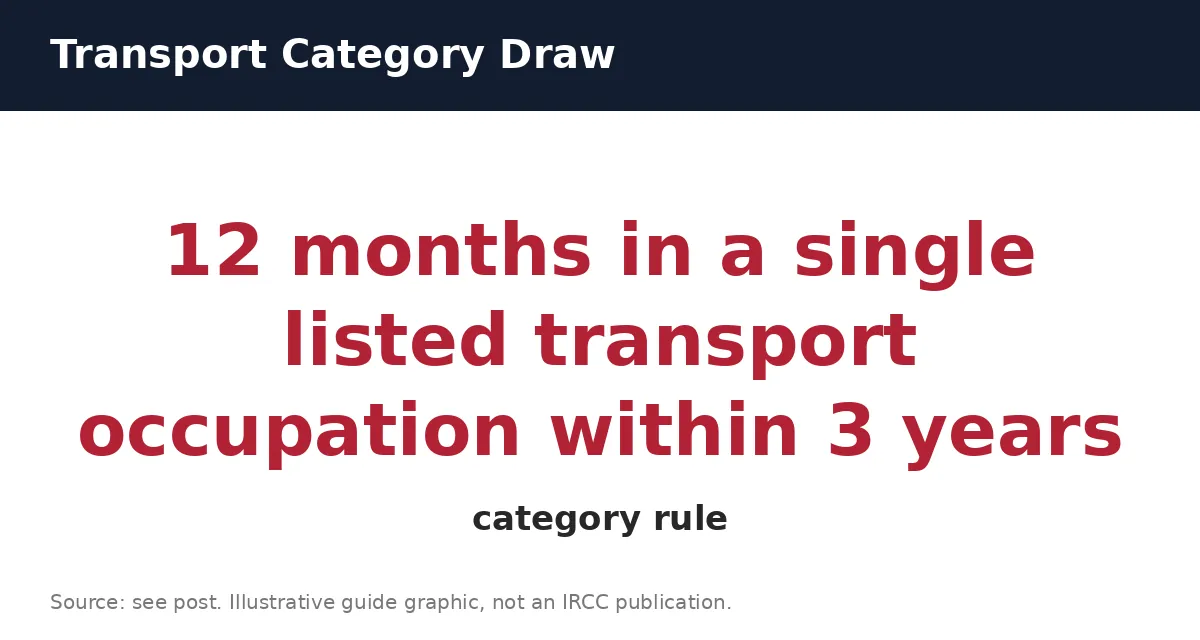
Work experience | At least 12 months full-time (or equal part-time) in a single listed transport occupation, within the last 3 years |
Continuous? | No — the 12 months do not need to be continuous |
Where gained | Canada or abroad — either counts for transport |
Program eligibility | Must also qualify under FSW, CEC, or FSTP |
Single occupation | The 12 months must be in one listed occupation, not split across two |
Source: IRCC category-based selection announcements for 2026 and 2026 program coverage, read October 2026. Verify your exact NOC on canada.ca’s current transport list.
Two practical points follow. First, because the list is aviation-focused, most driving and logistics workers who qualified under the original transport category draw will not qualify under the 2026 one. A transport truck driver should not assume coverage — check the list, and if your NOC is absent, build a plan that does not depend on this category. Second, because very few transport rounds have been held so far in 2026, there is no pattern to time your profile around. Keep your profile current, keep your documents valid, and let the rounds come to you rather than pausing your life for a schedule that does not exist.
For pilots, mechanics, and inspectors, the category is genuinely valuable: the eligible pool is small, and category rounds invite from that small pool rather than from the whole Express Entry system. If that is you, confirm your NOC, bank your twelve months, and make sure your program eligibility underneath is solid — a category invitation cannot rescue a profile that fails FSW, CEC, or FSTP.
Tip:
Check your duties against the NOC description with our NOC and TEER finder before you count on any category. “Aircraft mechanic” as a job title and the listed aircraft mechanic occupation are only the same thing if your duties match.
Agriculture category draw retired: what it means, concretely
Retired means retired: IRCC did not hold agriculture draws in 2026, and there is no agriculture category to be invited through. The occupations that used to sit in the agriculture list — industrial butchers, retail butchers, fish and seafood plant workers, farm supervisors, specialized livestock workers, harvesting labourers, food and beverage processing labourers, and nursery and greenhouse labourers, among others — are historical examples only. They describe who the old category covered, not who any current category covers.
That distinction bites in two places. First, some of those occupations appear in other current contexts — trades-related lists, for example — but appearance elsewhere is not automatic: each category has its own list, and your NOC must be on that category’s list, not merely similar to something on it. Second, provincial programs remain open to many agriculture workers. Provinces with food processing and farming labour needs run their own streams, and those streams do not depend on the federal category list at all.
Options for former agriculture-category workers
Common transport category draw mistakes
Real cases
Real case: The truck driver on the old list (2026)
A long-haul driver planned his application around a 2024 transport guide, then learned the 2026 transport list is aviation-focused and does not include his occupation. He is now pursuing a provincial stream in the province where he already works. No outcome was reported.
Real case: The aircraft mechanic who qualified (2026)
An aircraft mechanic confirmed his NOC on the current transport list, completed twelve months in the role, and entered the pool with his program eligibility already verified. He is waiting for a round with a provincial backup plan in place. No outcome was reported.
Real case: The food processing worker who waited too long (2026)
A food processing worker spent months expecting an agriculture round that never came, because the guides she read predated the 2026 renewal. Once she learned the category was retired, she shifted to a provincial stream and general rounds. No outcome was reported.
Real case: The farm supervisor who checked every list (2026)
A farm supervisor checked his exact NOC against all ten 2026 category lists instead of assuming his old agriculture coverage carried over. He found no current category fit and rebuilt his plan around his CRS score and a provincial nomination. No outcome was reported.
Frequently Asked Questions
Is there an agriculture category draw in 2026?
No. Agriculture and agri-food was not renewed for 2026 and is not on the 2026 category list. Workers in agriculture occupations now compete in general rounds, other categories if their occupation appears there, or provincial programs. Do not wait for a round that is not scheduled to happen.
What jobs does the 2026 transport category draw cover?
The revamped 2026 transport category draw is built around aviation roles such as pilots, aircraft mechanics and inspectors. It does not use the old transport occupation list, so check IRCC’s current list for your exact NOC before assuming you qualify. Your duties, not your title, decide whether your NOC is listed.
How much experience do I need for the transport category draw?
For the transport category draw, at least 12 months of full-time work experience, or the part-time equivalent, in a single listed transport occupation within the last three years. The experience does not need to be continuous, and it may be gained in Canada or abroad.
Can transport experience be from outside Canada?
Yes. For transport, qualifying experience may be gained in Canada or abroad. That differs from the physician, senior manager and researcher categories, which require Canadian experience, so do not mix up the two sets of rules. What matters is the occupation, the twelve months, and the three-year window.
Do I need to qualify under a federal program as well?
Yes. Category eligibility alone is not enough. You must also meet the requirements of the Federal Skilled Worker Program, the Canadian Experience Class, or the Federal Skilled Trades Program, or a category invitation cannot lead anywhere. Keep that underlying eligibility valid while you wait for a round.
I worked in agriculture. What are my options now?
General Express Entry rounds, provincial nominee programs, and any other category your occupation appears in. Some former agriculture occupations also appear in trades-related lists, so check your exact NOC against every current category list, not just the retired one. Start with the provinces where food processing and farming employers actually hire.
Was transport a category before 2026?
Yes, but the old transport category was discontinued, and the 2026 version is a different, revamped list focused on aviation roles. Do not use the old transport occupation list to judge your 2026 eligibility — the two lists are not the same.
Final Thoughts
Transport and agriculture in 2026 are a lesson in checking the year on everything you read. Transport came back as something new and narrow; agriculture did not come back at all. If you are a pilot, mechanic, or inspector, confirm your NOC and get your twelve months banked — the category is small and that is your advantage. If you worked in agriculture, stop waiting for a round that does not exist and put the same energy into general rounds, provincial streams, and French
The candidates who lose years in category changes are not the ones with the weakest profiles; they are the ones reading last year’s lists. For the current picture across all ten .categories, see our category draws guide and our latest draws page. Check the current transport category draw list before you build a plan around it — last year’s list will mislead you.
Sources
Disclaimer: This article is general information only and is not legal or immigration advice. Category lists and experience rules change annually, and a wrong NOC can cost you an invitation. For advice about your own situation, talk to a licensed immigration consultant (RCIC) or an immigration lawyer, and always confirm the current occupation list on canada.ca before relying on it.
Last reviewed: October 29, 2026