Express Entry Guide · Updated October 2026
You and your spouse have similar profiles — so who should be primary applicant in Express Entry, and how many points does the wrong choice actually cost? This guide settles the primary applicant spouse question with a worked example in both directions.
By Aria Sterling · Checked against IRCC rules · 13 min read
Every week, a couple posts the same question in different words: both partners have a Master’s degree, one is under 29, the other has more work experience — who should lead? The answers they get are usually vibes: “the younger one,” “the one with more experience,” “whoever has better English.” None of those answers is a calculation, and the CRS does not run on vibes. It runs on tables, and the tables give a definite answer for each couple — but only if you run the maths in both directions.
This post does that maths for you, with a worked example you can copy. It also kills three myths: that 40 points “automatically go” to the spouse, that a spouse’s job offer helps, and that a spouse who is already a permanent resident adds points. That last one is the PR-spouse trap, and it has cost couples real invitations.
We checked this guide against IRCC’s CRS criteria page on canada.ca (education, language, age, work experience and spouse-factor tables), plus public forum threads about primary-applicant choice. This is general information, not legal advice.
Quick answer: The right primary applicant spouse choice is the partner whose profile scores higher as principal with the other as accompanying spouse. Run both directions with the tables below. The primary applicant spouse difference comes from age, language per ability, education, Canadian work experience, and the 500-versus-460 core switch — never from “40 points automatically going to the spouse.”
Key takeaways
The primary applicant spouse tables you need
Four tables decide almost every couple’s answer. First, the principal’s own factors, which are lower with a spouse than without — that is the 500-to-460 switch in action. Age 20–29 is worth 110 without a spouse and 100 with one; age 32 is 94 without and 85 with; age 35 is 77 without and 70 with.
Education: a Bachelor’s degree is 120 without a spouse and 112 with one; a Master’s is 135 without and 126 with one; a doctorate is 150 without and 140 with one. First language is scored per ability: CLB 9 is 31 without a spouse and 29 with one, per ability; CLB 8 is 23 without and 22 with one; CLB 10 or higher is 34 without and 32 with one. Canadian work experience: one year is 40 without a spouse and 35 with one; two years 53 and 46; three years 64 and 56; five or more years 80 and 70.
Spouse factor | Points |
|---|---|
Education: Master’s or professional degree / doctorate | 10 |
Education: two or more credentials (one 3+ years) | 9 |
Education: Bachelor’s or 3+ year program | 8 |
Education: two-year program | 7 |
Education: one-year program | 6 |
Education: secondary school | 2 |
Education: less than secondary | 0 |
Language, per ability: CLB 9+ | 5 |
Language, per ability: CLB 7–8 | 3 |
Language, per ability: CLB 5–6 | 1 |
Language, per ability: CLB 4 or less | 0 |
Canadian work experience: 1 year / 2 years / 3 years / 4 years / 5+ years | 5 / 7 / 8 / 9 / 10 |
Source: IRCC CRS criteria page (canada.ca). Spouse education points require an ECA for foreign credentials. Spouse language points require an approved test. These are the tables as published; transferability and additional points (such as a provincial nomination) sit on top of these core figures and are not included in the worked example below.
Primary applicant spouse worked example: both directions
Meet a fictional couple, Amira and Daniel. Amira is 32, holds a Bachelor’s degree, scores CLB 9 in all four abilities, and has one year of Canadian work experience. Daniel is 28, holds a Master’s degree, scores CLB 8 in all four abilities, and has no Canadian work experience. Both degrees are foreign, so both need an ECA to count. Here is the maths, core plus spouse factors only, in both directions.
Factor | Amira principal, Daniel accompanying | Daniel principal, Amira accompanying |
|---|---|---|
Principal age | 85 (age 32, with spouse) | 100 (age 28, with spouse) |
Principal education | 112 (Bachelor’s, with spouse) | 126 (Master’s, with spouse) |
Principal language (4 abilities) | 116 (CLB 9 × 4 at 29 each) | 88 (CLB 8 × 4 at 22 each) |
Principal Canadian work experience | 35 (1 year, with spouse) | 0 (none) |
Principal core subtotal | 348 | 314 |
Spouse education | 10 (Daniel’s Master’s) | 8 (Amira’s Bachelor’s) |
Spouse language (4 abilities) | 12 (CLB 8 × 4 at 3 each) | 20 (CLB 9 × 4 at 5 each) |
Spouse Canadian work experience | 0 | 5 (Amira’s 1 year) |
Spouse factors subtotal | 22 | 33 |
Total (core + spouse) | 370 | 347 |
Source: our arithmetic from the IRCC CRS criteria tables above. Transferability and additional points are excluded from both totals, so the comparison is like-for-like. Check your own figures in the CRS calculator.
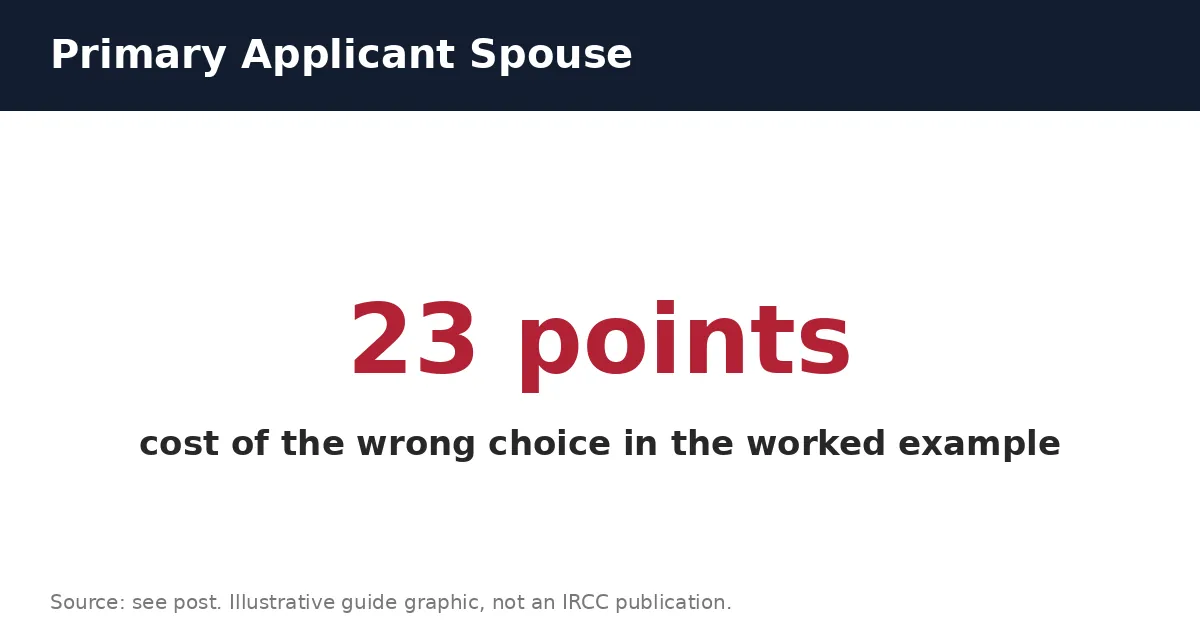
Amira as principal wins by 23 points, even though Daniel is younger and holds the higher degree. Why? Because Amira’s CLB 9 language (116) beats Daniel’s CLB 8 (88) by 28 points, and her Canadian year adds 35 core points while Daniel’s spouse-factor version of the same year is worth only 5. Daniel’s youth (100 vs 85) and Master’s (126 vs 112) claw back 29 points, and his spouse factors are lower (22 vs 33) — but not enough. The lesson is not “language beats age.” The lesson is that no single factor decides; only the full addition does. Run both directions for your own couple before you choose.
Tip:
The cheapest points in this whole exercise are usually a language retest for the principal. Moving one ability from CLB 8 to CLB 9 is worth 7 points per ability with a spouse (29 minus 22) — and the same retest for the spouse is worth only 2 points per ability (5 minus 3). Spend the retest where the table pays most.
The PR-spouse trap
Now change one fact: Daniel is already a Canadian permanent resident. Amira’s forum post would say “the calculator shows a higher score with his CLB score, but my profile does not.” The explanation is the scale rule: when your spouse is already a citizen or permanent resident, you are scored on the without-spouse scale throughout, and you get zero spouse factors. Amira as principal, Daniel as a PR spouse, scores: age 32 without spouse 94, Bachelor’s 120, CLB 9 × 4 at 31 each = 124, one year Canadian experience 40 — total 378, with 0 spouse factors.
That 378 is actually higher than the 370 from the accompanying-spouse version, because the without-spouse scale is more generous. So where is the trap? The trap is the false total: 378 plus Daniel’s 22 spouse points = 400, a number IRCC will never give you. Candidates who plan around 400 — waiting for a round they think they will clear, declining to improve language because “we already have 400” — are planning around points that do not exist. The same rule applies to a non-accompanying spouse: without-spouse scale, zero spouse factors. The gain, if any, is the scale switch, not extra points.
Primary applicant spouse myths that cost points
Myth one: “40 points automatically go to the spouse.” No. Forty is the ceiling of the spouse-factor section, and it is earned ability by ability. A spouse with no language test and no assessed credential adds zero, while the principal’s own core still drops by 40 points on the with-spouse scale. A weak accompanying spouse can make the couple’s total lower than the principal’s single-scale score — which is why the non-accompanying question comes up at all, and why it carries the risks our companion guide explains.
Myth two: “My spouse’s job offer gives us points.” No, if your spouse is not the principal applicant. Only the principal applicant’s factors are scored. A spouse’s job offer can matter for a provincial program or for settlement, but it adds zero CRS points. If the spouse’s job offer is the couple’s strongest card, consider whether the spouse should be the principal instead — and run the maths.
Myth three: “We should both apply separately to double our chances.” Model both directions, then submit the stronger one, declaring the other partner as spouse. Creating extra profiles as a strategy is not something to improvise: check IRCC’s current guidance before creating any second profile, because duplicate profiles can cause problems. The safe move is one strong profile, built on the better direction, with both partners’ documents ready.
Real cases
Real case: similar education, different experience (forum thread, 2024)
A couple both held Master’s degrees, but one partner was under 29 and the other had four more years of experience. Posters debated age versus experience, and the thread’s useful advice was to run both directions in a calculator rather than argue from one factor. Outcome: no outcome was reported.
Real case: the PR-spouse surprise (forum thread, 2024)
A candidate whose wife already held permanent residence found the calculator showed a higher score when her language results were entered, but the profile did not. The thread answer was the scale rule: a spouse who is already a permanent resident contributes zero spouse factors, and the principal is scored without a spouse. Outcome: clarified in the thread; no final score was reported.
Real case: spouse’s job offer, zero points (forum thread, 2023)
A candidate asked whether a spouse’s job offer adds points when the spouse is not the principal applicant. The answer in the thread was no — only the principal applicant’s factors count — and the couple reconsidered who should lead. Outcome: no outcome was reported.
Real case: the spouse ECA that was never done (forum thread, 2024)
A couple counted the spouse’s foreign Master’s degree at 10 points, but no ECA had been obtained for it. Posters pointed out that without an assessment, the spouse education points were zero, and the couple’s real total was 10 points lower than planned. Outcome: no outcome was reported.
Frequently Asked Questions
Who should be the primary applicant in Express Entry?
The primary applicant spouse choice is the partner whose profile scores higher as principal, with the other as accompanying spouse. Run the maths both ways using the CRS tables: age, education, language per ability, Canadian work experience, and the 40 spouse-factor points. Include only points you have actually earned, with an ECA done and a language test taken, before you compare.
Do 40 points automatically go to the spouse?
No. Forty is the maximum for spouse factors, not an entitlement. Spouse factors are earned: up to 10 for education, 20 for language, and 10 for Canadian work experience. A spouse with no test and no credential adds zero. A spouse with no test and no assessed credential adds zero, while the principal’s core still drops by 40.
What happens if my spouse is already a permanent resident?
You are scored on the higher without-spouse scale throughout, and you get zero spouse factors. Do not add your spouse’s language or education points on top of the single scale — that total is not real. The false total comes from adding spouse points to the single scale, which IRCC never does.
Does my spouse’s job offer give me CRS points?
No, not if your spouse is not the principal applicant. Only the principal applicant’s factors are scored. A dependent spouse’s job offer adds no CRS points. If the spouse’s offer is your strongest card, run the maths with the spouse as principal instead.
Does my spouse need an ECA for their foreign degree to count?
Yes. A foreign credential only counts toward spouse education points if it has been assessed as equivalent to a Canadian credential. Without an ECA, those points are zero. Without an assessment, a foreign degree earns no spouse education points at all.
Does a non-accompanying spouse change the score?
Yes. With a non-accompanying spouse, the primary applicant spouse is scored on the without-spouse scale, with no spouse factors. The gain is the scale switch, not extra points, and it comes with medical and funds obligations. The gain is the scale switch alone, and it comes with medical and funds obligations for the spouse.
How much can a spouse’s language test add?
Up to 20 points for the primary applicant spouse: 5 per ability at CLB 9 or above, 3 per ability at CLB 7–8, and 1 per ability at CLB 5–6. At CLB 4 or below, a spouse’s language adds nothing. At CLB 4 or below, a spouse’s language test adds nothing, so a retest must clear CLB 5 to matter.
Final Thoughts
Choosing a primary applicant spouse is arithmetic, not instinct. Run both directions with the real tables, include the spouse factors you have actually earned (ECA done, test taken), and watch for the scale switch when a spouse is a permanent resident or non-accompanying. In our primary applicant spouse example the wrong choice cost 23 points. In your case it could cost more — or nothing at all. Either way, you will know, instead of guessing.
Run your own couple through the CRS calculator in both directions, and read how your CRS score is calculated before you lock the choice. And if the non-accompanying route tempts you for the scale gain, read the risks first — and talk to a licensed consultant (RCIC) or lawyer before you declare anything you cannot prove.
Sources
This guide was checked against official IRCC sources and real applicant reports. This is general information, not legal advice. For your own case, talk to a licensed consultant (RCIC) or lawyer.
Last reviewed: October 29, 2026