Express Entry Guide · Updated October 2026
You live in Toronto, you work from your Toronto apartment, and your salary lands in a Canadian bank account — but your employer is in another country. Is that Canadian experience?
By Aria Sterling · Checked against IRCC rules · 11 min read
Remote work experience for Express Entry in Canada is a trap disguised as common sense. It feels obvious that work done in Canada should count as Canadian experience. IRCC disagrees — and the disagreement costs people invitations, because a profile that claims Canadian experience for remote foreign work gets recalculated at the application stage, when the points disappear. That is the remote contractor Canada trap in one sentence.
This post explains the two tests IRCC applies to remote contractor Canada cases, why both must pass, what remote foreign work can still count for, and how to document it so the months you did work are not wasted. It covers employees and contractors, and the mirror-image case: working for a Canadian employer from abroad.
Evidence base: IRCC’s Canadian Experience Class guidance and Help Centre answers on canada.ca, plus paraphrased reports from public applicant threads. This is general information, not legal advice.
Quick answer:
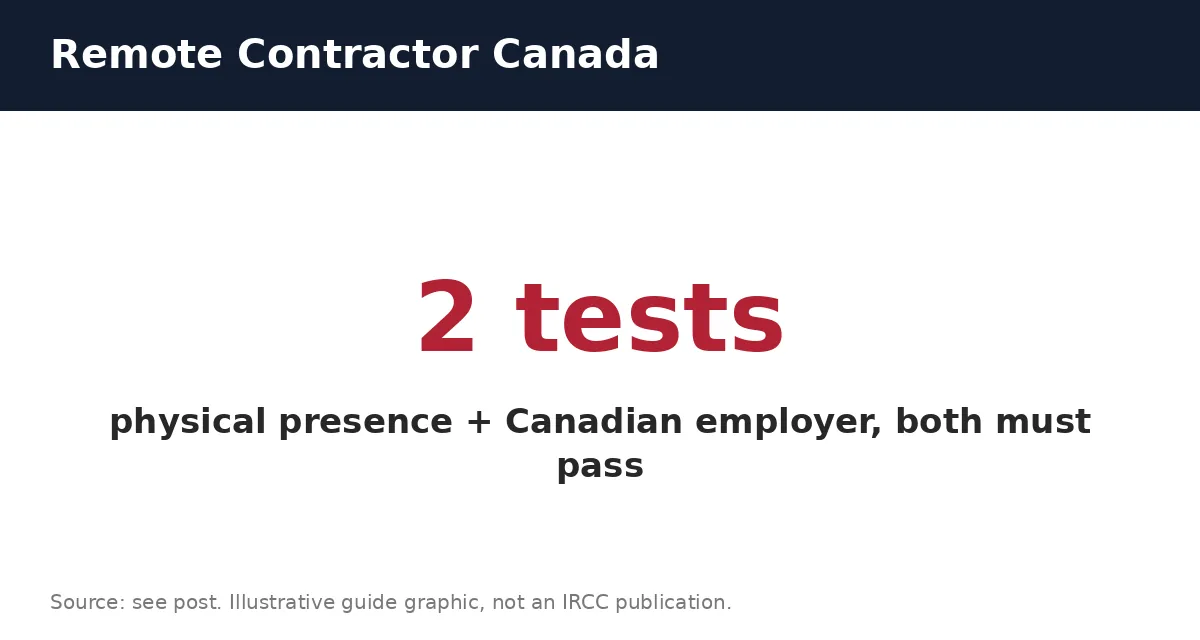
Canadian experience needs two things at once: you were physically in Canada, and you worked for a Canadian employer, while authorised to work, in third-party employment. Remote work for a foreign employer while living in Canada fails the employer test, so it is treated as foreign experience — useful for FSW eligibility and CRS foreign experience if paid and skilled, but worth nothing as Canadian experience for CEC. That is the remote contractor Canada rule in one paragraph.
Key takeaways
Remote Contractor Canada: The Two Tests for Canadian Experience
CEC qualifying work must be skilled work in Canada, in a TEER 0, 1, 2 or 3 occupation, done while authorised to work, through employment by a third party. IRCC’s guidance breaks the location question into two parts that are easy to state and easy to get wrong. First, where was the worker? The worker must have been physically in Canada while doing the work. Second, who was the employer? The employer must be a Canadian employer — the work must be for an employer in Canada, with the usual evidence of that relationship (T4 slips, Notices of Assessment, employer letter).
Both tests exist for a reason. The location test stops people from claiming Canadian experience while living abroad. The employer test stops people from claiming Canadian experience while working for an employer with no Canadian presence, payroll or tax footprint. Remote work breaks the second test even when it passes the first: your body is in Canada, but your employment relationship is not Canadian.
Authorisation is a third, separate condition that catches remote workers too. CEC requires the work to be done while authorised to work in Canada. Work done without authorisation does not count, and work done while a full-time student (including co-op) does not count toward CEC either. A remote worker on a study permit who works part-time for a foreign company is therefore doubly excluded: student work and foreign-employer work. That is how the two tests treat every remote contractor Canada case.
The Four Combinations, Mapped
Every remote-work situation falls into one of four boxes. Only one of them is Canadian experience.
Where you are | Who employs you | Counts as |
|---|---|---|
In Canada | Canadian employer (employee) | Canadian experience — CEC and CRS Canadian points, if authorised, skilled and third-party |
In Canada | Foreign employer (employee or contractor) | Foreign experience — FSW and CRS foreign points, if paid and skilled; 0 CEC |
Abroad | Canadian employer | Foreign experience — the location test fails; 0 CEC |
Abroad | Foreign employer | Foreign experience — the ordinary case |
Source: IRCC’s CEC guidance on canada.ca. This table is our summary of that guidance, not IRCC text.
The second row is the one that surprises people, and the third row surprises them almost as much. A Canadian who works remotely for a Toronto company from another country does not build Canadian experience either — the employer is Canadian, but the worker was not in Canada. Both tests must pass together; one out of two is foreign experience.
Contractors add a further layer. Contractor or self-employed work inside Canada yields 0 CEC points even when the clients are Canadian, because CEC requires third-party employment. So a contractor in Toronto serving Toronto clients fails on the employment-relationship test, while an employee of a foreign company in Toronto fails on the employer test. Different reasons, same result: neither builds CEC eligibility. Neither combination helps a remote contractor Canada claim for CEC.
Remote Contractor Canada: What Remote Foreign Work Is Still Worth
Foreign experience is not a consolation prize — it is a real, valuable part of the system. Paid, skilled remote work for a foreign employer can count toward FSW eligibility (one year of continuous skilled work) and toward CRS foreign work experience points, including the transferability combinations that pair foreign experience with strong language scores. For a candidate abroad, or for one whose FSW route is the main route, remote work for a foreign company is fully useful work.
The value changes with your route. If you are already in Canada and CEC is your plan, remote foreign work does not move you toward it — and every month spent on it is a month not spent building CEC eligibility. That is a strategic decision, not a judgement about the work: the same year of remote work that is worthless for CEC can be worth a great deal for FSW, and for a provincial stream with different rules. Check the route before you judge the work.
There is one more practical point. A future change is coming on 3 November 2026: a job offer in an eligible high-wage occupation can earn 50, 70 or 100 CRS points under the new Labour Market Integration factor, with no LMIA needed. The same factor also covers Canadian work experience — you get points for one or the other, whichever is higher, not both. That change is about job offers and Canadian work experience, not about reclassifying remote foreign work as Canadian — do not read it as a fix for the remote-worker problem. A remote contractor Canada file should still claim every foreign-experience point it has earned.
How to Prove Remote Work
Remote work proof looks like ordinary employed proof, with one extra emphasis: the employer’s location and identity must be clear. A reference letter that states duties, dates, hours and pay but never says where the employer is based leaves the key question unanswered. Make sure the letter, contract or company details show the employer’s country and, where relevant, the absence of a Canadian payroll presence. Honesty here helps you: a letter that is transparent about a foreign employer supports a foreign-experience claim cleanly, while a vague letter invites an officer to guess — and officers who guess tend to guess against the claim.
Keep the usual chain: contract, pay records, tax documents, and the employer letter. If you were paid into a Canadian bank account by a foreign employer, bank statements help prove payment but do not prove Canadian experience — the employer’s identity, not the bank’s location, is what the test looks at. If you moved countries mid-job, keep evidence of the move (travel records, lease, visa stamps) so the timeline of where you were is provable, not just asserted. That timeline is what makes a remote contractor Canada file provable.
Remote Contractor Canada Traps and Mistakes
Every trap above starts with calling remote contractor Canada work Canadian experience.
Real Cases
Real case: Remote developer in Toronto for a US company (2023)
A developer living in Toronto, working remotely for a US employer, asked whether the work counted as Canadian experience. The thread’s answer was consistent: no, because the employer was not Canadian, even though the work was physically done in Canada. The advice was to claim it as foreign experience and, if CEC was the goal, to plan a move to a Canadian employer. No outcome was reported.
Real case: Canadian employer, working from abroad (2022)
A candidate who had worked for a Canadian company while living outside Canada asked the mirror-image question. Posters pointed out the same two-test logic from the other side: the employer was Canadian, but the worker was not in Canada, so the months were foreign experience, not Canadian. No outcome was reported.
Real case: Contractor for Canadian clients, in Canada (2024)
A contractor in Canada with only Canadian clients asked whether the client list made the work Canadian for CEC. The thread’s answer drew the employment-relationship line: contractor work in Canada is self-employment for CEC purposes, so it did not count, regardless of where the clients were based. No outcome was reported.
Real case: Mid-job move, same foreign employer (2023)
A candidate who had moved to Canada mid-employment and kept the same foreign employer asked how the months split. The thread’s view was that the move did not change the classification: before and after the move, the employer was foreign, so the whole period was foreign experience for CEC purposes. No outcome was reported.
Frequently Asked Questions
I work remotely in Canada for a foreign company. Is that Canadian work experience?
No, not for CEC or CRS Canadian experience. Canadian experience requires both: physically in Canada and working for a Canadian employer. Remote work for a foreign employer while living in Canada is treated as foreign experience, because the employer test fails even though the location test passes — and both tests must pass together for the work to count as Canadian. That two-test failure is the whole remote contractor Canada story.
Can remote work for a foreign employer count for anything?
Yes. If it was paid and skilled in a TEER 0, 1, 2 or 3 occupation, it can count toward Federal Skilled Worker eligibility and toward CRS foreign work experience and transferability, provided you can document it. Foreign experience is not a consolation prize: for FSW-route candidates it is the main work-experience asset, and transferability combinations can add significant points on top of strong language scores.
What if I work for a Canadian employer but from abroad?
That is also not Canadian experience. The physical-location test fails: you were not in Canada while doing the work, even though the employer is Canadian. It may still count as foreign experience, which is useful for FSW and CRS foreign points, but it builds no CEC eligibility. The mirror image of the remote-worker case proves the same rule from the other side: one test out of two is not enough.
Does it matter whether I am an employee or a contractor?
Yes, twice over. Contractor or self-employed work in Canada does not count for CEC even with Canadian clients, because CEC requires third-party employment. And contractor work for a foreign employer is assessed as foreign experience, not Canadian, regardless of where you live. Employment relationship and employer location are separate tests, and remote contractors can fail either or both. That double test is why remote contractor Canada cases turn on paperwork, not job titles.
How do I prove remote foreign work?
With the employer’s letter (duties, dates, hours, pay), the contract, pay records and tax documents, plus evidence of where you were working if location is ever questioned. A letter that omits the employer location leaves the key question unanswered, so make sure the employer’s country and identity are clear. Honesty helps here: a transparent foreign-employer letter supports a clean foreign-experience claim.
I moved to Canada mid-job and kept the same foreign employer. How is that split?
The work before you moved is foreign experience in the ordinary sense; the work after you moved, for the same foreign employer, is still treated as foreign experience for CEC purposes, because the employer test fails even though the location test passes. Keep evidence of the move — travel records, lease, visa stamps — so the timeline is provable, not just asserted, if an officer asks.
Does my work permit status affect remote work counting?
Yes. CEC requires the work to be done while authorised to work in Canada. Unauthorised work does not count, and work done on a study permit while a full-time student does not count toward CEC either. A remote worker on a study permit doing part-time work for a foreign company is therefore doubly excluded: student work and foreign-employer work both fail, whatever the skill level.
Final Thoughts
Remote work is not wasted work — it is mislabelled work that causes the damage. Claim it for what it is: foreign experience, valuable for FSW and for CRS foreign points, but not Canadian experience for CEC. If CEC is your route, the fix is not a better argument about your remote job — it is a Canadian employer, in Canada, for at least a year. That is the remote contractor Canada lesson in one line.
Before you build a profile around remote work, test both versions of your score in the CRS calculator — once with the months as Canadian experience, once as foreign — and plan around the honest version. And if your history mixes remote work, moves and contracting, talk to a licensed consultant (RCIC) or lawyer before you submit. A mixed remote contractor Canada history deserves that second pair of eyes.
Sources
We build free Express Entry tools and track every IRCC draw. This guide was checked against official IRCC sources and real applicant reports. This is general information, not legal advice. For your own case, talk to a licensed consultant (RCIC) or lawyer.
Last reviewed: October 29, 2026
Additional Details — Name: Remote Contractor Canada in 2026: What Counts · Description: Remote contractor Canada in 2026: working remotely in Canada for a foreign employer counts as foreign experience. Learn the two tests.