Express Entry Guide · Updated October 2026
The ECA body is waiting, your university is silent, and your whole Express Entry timeline is stuck on one office that will not answer the phone — what actually works?
By Aria Sterling · Checked against IRCC rules · 12 min read
A university transcripts WES problem — a university that will not send transcripts to WES or IQAS — is the most common reason ECAs stall — and the most fixable, because the bottleneck is almost never “impossible”. It is usually one of four things: you asked the wrong office, you asked for the wrong format, nobody with authority has seen your request, or the institution has a process you have not followed. Each has a different fix, and this post works through them in the order that gets documents moving fastest.
One warning first on university transcripts WES: never solve this problem with a falsified document, a backdated letter or a paid shortcut that invents an institutional record. A fake document can lead to refusal and a five-year misrepresentation ban. Every step below is legitimate, documented and repeatable — and that is precisely why it works with ECA bodies and with IRCC.
Evidence base: IRCC’s ECA document guidance on canada.ca and the designated bodies’ published document requirements, plus paraphrased reports from public applicant threads. This is general information, not legal advice.
Quick answer:
For university transcripts WES, first, confirm the exact document format your body requires for your institution. Then send a precise written request to the registrar or transcript office quoting your ECA reference number. If there is no reply, escalate in writing to senior administration, then use an in-person visit or an authorised representative. If the institution genuinely cannot meet that body’s route, switch to a designated body whose route it can meet. Keep a paper trail of everything — it is your evidence for escalation, for a body switch, and for IRCC if the delay ever needs explaining.
Key takeaways
University Transcripts WES, Step 1: Confirm Exactly What Is Required
Before you chase anyone in a university transcripts WES case, read the document checklist your ECA body publishes for your country and institution. Requirements differ by body and by country: most bodies require sealed transcripts or verified documents sent by the institution, but the exact format — sealed envelope, institution-sent electronic transmission, attested copies, verification through a partner service — varies. A request that asks for “transcripts for WES” when the body actually requires a specific sealed format, or a specific accompanying form, will be bounced or ignored by an office that processes hundreds of such requests.
Your request to the institution in a university transcripts WES case should therefore be precise. Name the body, quote your ECA reference number, state the exact documents required (transcripts, degree certificate, or both), state the exact destination (the body’s address or electronic route), and ask for confirmation in writing once sent, with a tracking number if posted. Attach the body’s document checklist or requirement page for your institution, so the office does not have to guess what you need. A request an office can fulfil without a follow-up question is a request that gets fulfilled.
Also check who should send what for university transcripts WES. In many systems, the university sends transcripts while a separate board or affiliating body issues degree verification. Sending the request to the wrong half of the system is the most common cause of months of silence — the office that received it cannot help, and never tells you so.
University Transcripts WES, Step 2: The Escalation Ladder
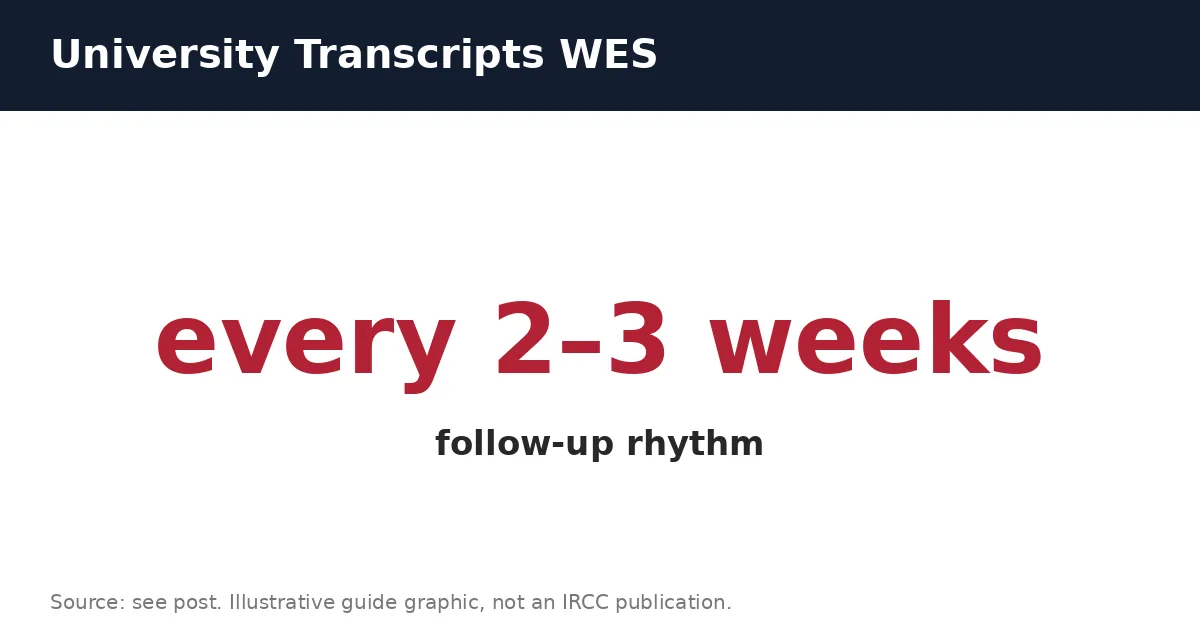
If the first request goes unanswered in a university transcripts WES case, escalate in writing, one rung at a time, on a regular rhythm — a polite, dated follow-up every two to three weeks, each one referencing the previous messages. The ladder looks like this:
Rung | Action | Why it works |
|---|---|---|
1. Transcript office | Precise written request with reference number and checklist | Most requests succeed here if they are precise and complete |
2. Registrar’s office | Written escalation quoting the original request date and silence | The registrar oversees the transcript function in most institutions |
3. Senior administration | Written request to the vice-chancellor’s or director’s office, attaching the trail | Senior offices resolve stuck files because the paper trail is now visible |
4. In-person visit | Visit the transcript office yourself, with identification and copies | A person at the counter is harder to ignore than an email in a queue |
5. Authorised representative | Send a trusted person with a signed authorisation letter and your ID copies | Same effect as a visit, when you are abroad |
6. Grievance / regulator | Formal grievance through the institution, or the education authority, where available | Creates an official record and a deadline the institution must answer |
Source: our synthesis of applicant reports and institutional practice. This ladder is a practical guide, not an IRCC or institutional rule — adapt the rung names to your institution’s actual structure.
Two habits make the university transcripts WES ladder work. First, keep everything: every request, every reply, receipts, courier tracking, your ECA reference number, and the body’s checklist. Second, stay factual and polite in every message. An angry email gets deprioritised; a dated, factual trail with a clear ask gets actioned, because it is easy for the next person in the chain to pick up and resolve.
Tip:
If you visit in person, bring two copies of everything and ask the office to stamp one as received, with a date. That stamped copy is your proof of submission if the file stalls again — and it is the document that makes rung 3 and rung 6 work.
Closed Institutions, In-Person Visits and Representatives
Closed institutions need a different first step for university transcripts WES: find who holds the records. A closed college’s records usually sit with its successor institution, its affiliating university, or the education authority that regulated it. Contact those bodies directly, explain the closure, and ask what verification they can provide. Then tell the ECA body about the closure and ask what alternative verification it accepts — bodies deal with closed institutions regularly and have routes for them, but you have to ask rather than assume.
For representatives: most institutions allow an authorised person to collect or submit documents on your behalf, but the authorisation requirements vary — a signed letter, copies of your identification, sometimes a specific institutional form. Confirm the exact requirements before sending anyone, or the trip is wasted. And if you use any paid service to help with the process, use only verifiable, legitimate channels, keep receipts, and never let anyone submit a document on your behalf that you have not seen and verified.
Step 3: When to Switch Bodies
Switching ECA bodies for university transcripts WES is not defeat — it is a legitimate, recognised backup. Different designated bodies have different document routes, and a body whose route your institution can meet is worth more than a body whose route it cannot. The right time to switch is when you have escalated properly and the institution still cannot meet the first body’s route, or when the first body’s route is structurally incompatible with how your institution issues documents.
Switch on documents, not on hoped-for points, in a university transcripts WES case: all general bodies are accepted equally for Express Entry, and the points come from the assessed credential, not the body. Tell the new body honestly that a previous application exists, and keep the paper trail from the first attempt — it shows diligence, and it helps the new body understand what has already been tried. Do not run two applications in parallel with contradictory document sets; one clean application at a time is faster than two confused ones.
Traps and Mistakes
Real Cases
Real case: Months of silence, solved by a visit (2022)
A candidate whose university had not answered emails for months asked what else could be done. The thread’s most repeated advice was an in-person visit — or an authorised representative for candidates abroad — with identification, the ECA reference number and the body’s checklist in hand. Counter visits resolve the “unseen request” problem that email cannot. No outcome was reported.
Real case: University refused sealed transcripts (2023)
A candidate reported that the university would issue transcripts to the student but would not send sealed transcripts directly to the assessment body. Posters advised checking whether the body’s checklist for that country allowed an alternative route — such as institution-verified documents or electronic transmission — and, if not, considering a different designated body whose route the institution could meet. No outcome was reported.
Real case: Closed institution, records elsewhere (2021)
A candidate whose college had closed asked where transcripts could come from at all. The thread’s answer was to trace the records to the successor or affiliating institution, and to tell the ECA body about the closure so the body could advise on its alternative verification route. No outcome was reported.
Real case: Switched bodies over documents (2024)
A candidate who had stalled for months with one body asked whether switching was allowed. The thread confirmed it was, and that the right reason to switch is a document route the institution can actually meet — not a hope of more points, since all general bodies are accepted equally. No outcome was reported.
Frequently Asked Questions
My university will not send transcripts to WES. What do I do first?
Confirm exactly what the body requires for your country and institution, and put a precise written request to the right office — usually the registrar or transcript office — quoting your reference number and the exact document format required. A request an office can fulfil without a follow-up question is a request that gets fulfilled, while a vague request for transcripts in general is easy to ignore or misroute. For university transcripts WES, precision in the first request matters more than speed.
What if the university never replies to emails?
Escalate in writing to the registrar, then to senior administration, and use an in-person visit or an authorised representative if you can. Keep every message, because a documented paper trail supports both escalation and a switch to another body. A polite, dated follow-up every two to three weeks keeps the file alive, while months of silence without follow-up looks like abandonment to the office holding it.
Can I send the transcripts myself?
Usually not in the form most bodies require: sealed transcripts or verified documents sent by the institution are the standard route. Check your body’s checklist, because some bodies accept institution-sent electronic transmission or verification instead. Sending documents yourself in a format the body does not accept wastes the postage and the weeks, so confirm the accepted route before sending anything.
Should I switch ECA bodies if my university will not cooperate?
It is a legitimate backup. Different bodies have different document routes, and a body whose route your institution can meet is worth more than a body whose route it cannot. Switch on documents, not on hoped-for points, since all general bodies are accepted equally for Express Entry. Tell the new body honestly that a previous application exists, and keep the paper trail from the first attempt. Switching bodies is a legitimate backup for university transcripts WES.
My university has closed. How do I get transcripts?
Contact the successor institution, the affiliating university, or the education authority that holds the closed institution’s records. Explain the closure to the ECA body and ask what alternative verification it accepts, because bodies deal with closed institutions regularly and have routes for them. You have to ask rather than assume: the alternative route exists, but it is not applied automatically to a stalled file.
Can someone else collect transcripts on my behalf?
Many institutions allow an authorised representative with a signed authorisation letter and copies of your identification. Confirm the institution’s exact authorisation requirements before sending anyone, so the trip is not wasted. Bring two copies of everything and ask the office to stamp one as received, with a date — that stamped copy is your proof of submission if the file stalls again.
How long should I wait before escalating?
Follow the institution’s own published timeline first, then escalate once it has passed with no response. Waiting months without a written follow-up helps no one; a polite, dated, written escalation every two to three weeks keeps the file alive. Escalation is not rudeness — it is the normal way files move in large institutions, and offices expect it after their own timeline has passed.
Can I enter the Express Entry pool while waiting for transcripts?
You can create a profile, but you cannot claim foreign education points without the ECA report number. Entering the pool without those points means competing at a lower score until the assessment is complete, which may mean waiting through draws you would otherwise have qualified for. Test the honest score first, so you know whether waiting or another route serves you better.
Final Thoughts
University transcripts WES delays feel personal — one office, one unanswered email, one stalled file — but they are a process problem, and process problems respond to process: the exact requirement, the precise written request, the dated escalation ladder, and, when needed, the body switch. Work the ladder, keep the paper trail, and do not let a single office decide your timeline by default.
If your ECA is stalled by university transcripts WES, start today with step one: pull up your body’s document checklist for your institution and compare it, line by line, with what you actually asked for. That comparison alone resolves a surprising number of stalls. And if the gap in your score while you wait is worrying you, test the honest version in the CRS calculator — and talk to a licensed consultant (RCIC) or lawyer if the institution is closed or the delay threatens an invitation deadline.
Sources
We build free Express Entry tools and track every IRCC draw. This guide was checked against official IRCC sources and real applicant reports. This is general information, not legal advice. For your own case, talk to a licensed consultant (RCIC) or lawyer.
Last reviewed: October 29, 2026
Additional Details — Name: University Transcripts WES in 2026: How to Fix Delays · Description: University transcripts WES in 2026: your university is slow or silent — here are the escalation steps that actually get documents moving.