Work Experience Guide · Updated September 2026
1560 Hours Express Entry Rule: How IRCC Counts Your Work Experience (Real Cases)
The 30-hour weekly cap, part-time math, overtime, leave, student work and the month-count ITA trap, explained with real applicant cases.
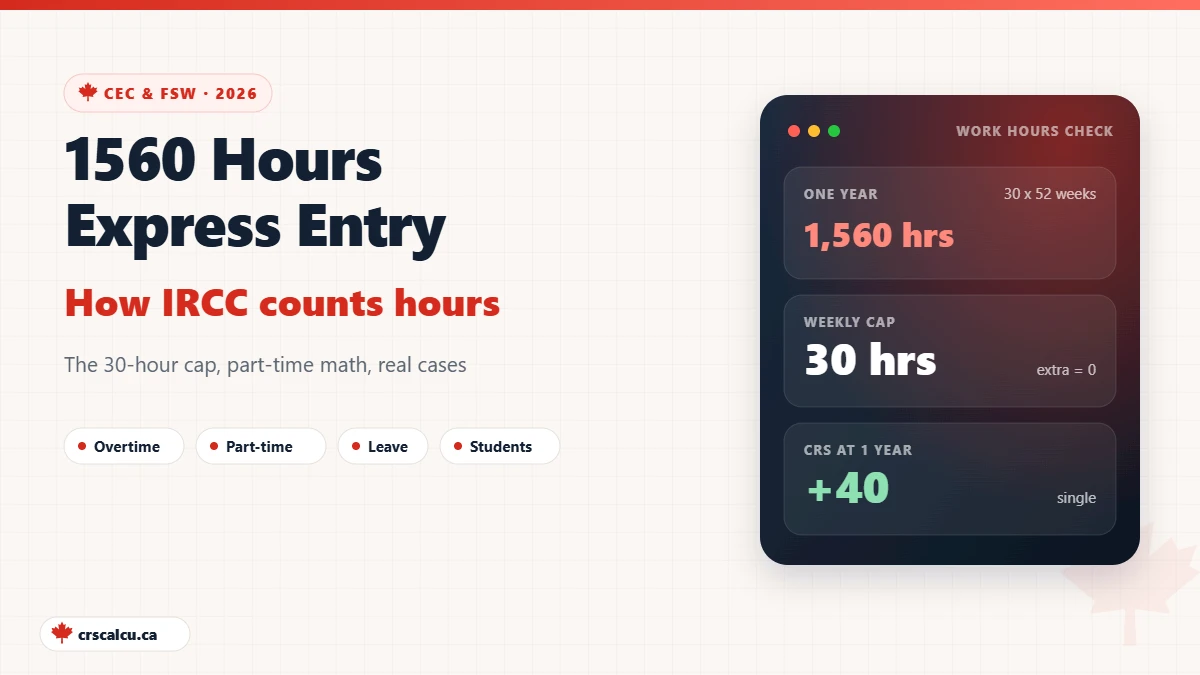
The 1560 hours Express Entry rule looks simple. Work 1,560 hours and you have one year of experience. But the real rule has a cap, a calendar test and a long list of hours that do not count.
We read 24 threads on a large Canadian immigration forum, from 2011 to 2026, plus IRCC’s own rules and officer instructions. People worked 50-hour weeks and were still not eligible. Others got an ITA a month too early and had to decide what to do.
This guide shows you how IRCC really counts your hours, how long part-time work takes, and when your CRS score goes up.
Quick answer: what is the 1560 hours Express Entry rule?
One year of skilled work for Express Entry means 1,560 hours, which is 30 hours a week for 52 weeks. IRCC does not count hours above 30 a week, so overtime does not get you there faster. Part-time work counts if it adds up to 1,560 hours. For the CEC, the work must be paid, in Canada, in TEER 0 to 3, and within the last 3 years.
Key takeaways on 1560 hours for Express Entry
What Is the 1560 Hours Express Entry Rule?
IRCC’s Canadian Experience Class page says you need “at least 1 year of work or 1,560 hours total (30 hours per week)” in the 3 years before you apply. The Federal Skilled Worker page uses the same 1,560 number, but gives you 10 years and lets the work be in Canada or abroad.
Where does 1,560 come from? It is 30 hours times 52 weeks. IRCC’s Ministerial Instructions define full-time as “at least 30 hours of work per week.” So 30 is both the full-time line and the most you can count in one week.
The work must be paid, through wages or commission. Volunteer work and unpaid internships never count. It must also be in a skilled job, meaning TEER 0, 1, 2 or 3. Not sure about your job? Look it up in our NOC TEER finder.
Rule | Canadian Experience Class (CEC) | Federal Skilled Worker (FSW) |
|---|---|---|
Minimum | 1 year or 1,560 hours | 1 year continuous or 1,560 hours |
Time window | Last 3 years before you apply | Last 10 years |
Where | In Canada, with work authorization | In Canada or abroad |
Skill level | TEER 0, 1, 2 or 3 (can mix) | TEER 0, 1, 2 or 3, same NOC as main job |
Weekly cap | 30 hours | 30 hours |
Work during full-time study | Does not count | Can count if paid and continuous |
Self-employment | Does not count | Can count |
Paid only? | Yes | Yes |
Source: IRCC CEC and FSW eligibility pages and the IRCC Help Centre.
The 30-Hour Weekly Cap: Why Overtime Does Not Help
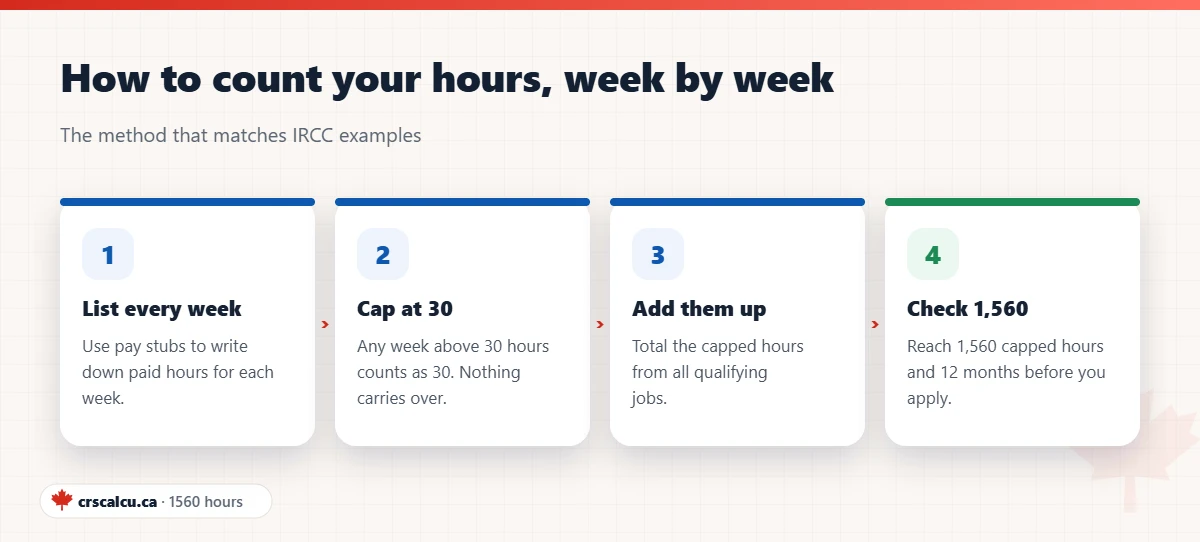
This is the part of the 1560 hours Express Entry rule that surprises most people. The FSW eligibility page says it plainly: “We don’t count any hours you work above 30 hours/week.” The CEC page uses the same 30-hour limit. A 50-hour week still counts as 30.
So you need two things at once: 1,560 capped hours and 12 months of work. A week of 60 hours cannot fill in for a week you missed.
Real case: 1,560 hours in 8 months, still not eligible
In April 2017, an applicant had logged more than 1,560 hours in about 8 months, averaging 58 hours a week. Members explained that any week of 30 hours or more counts as one week, and weeks under 30 count as total hours divided by 30. They still needed 12 months. In July 2019, another member asked if the extra hours could count toward a second year. The answer was no.
In June 2018, a casual licensed practical nurse with 8 to 40+ hours a week had 1,700+ hours after 14 months. They feared “losing” over 200 hours. They were right: those hours were above the weekly cap. The good news from that thread: paid training hours on your pay stubs do count.
Worked example: overtime
Say you work 45 hours a week for 9 months, about 39 weeks. That is 1,755 real hours. But only 39 x 30 = 1,170 hours count. You still need 13 more full-time weeks to reach 52 weeks and 1,560 hours.
Rotating shifts and variable schedules
In April 2019, a geologist on a 15-days-on, 13-days-off rotation had 2,240 hours in a year. But under the weekly-cap method, the off weeks pulled the count below 52 full weeks. If your schedule rotates, count week by week and keep every pay stub.
Part-Time Math: How Many Months You Need
Part-time work counts toward the 1560 hours Express Entry total. IRCC’s own example is “15 hours a week for 24 months” to equal one year full time. The formula is easy: divide 1,560 by the hours you work each week, up to 30. That gives you the weeks you need.
Your job title does not matter for the 1560 hours Express Entry count. In April 2023, a member whose employer called them “part-time” worked 30 hours a week for 52 weeks. Replies said 30 hours a week is full time for immigration, whatever the employer’s label says.
Hours per week | Countable hours | Weeks to 1,560 hours | About how many months |
|---|---|---|---|
30 or more (37.5, 40, 50) | 30 | 52 | 12 |
25 | 25 | 63 (1,575 hours) | 14.5 |
20 | 20 | 78 | 18 |
15 | 15 | 104 | 24 |
12 | 12 | 130 | 30 |
10 | 10 | 156 | 36 (the whole CEC window) |
Months = weeks / 52 x 12. Overtime above 30 hours a week is ignored.
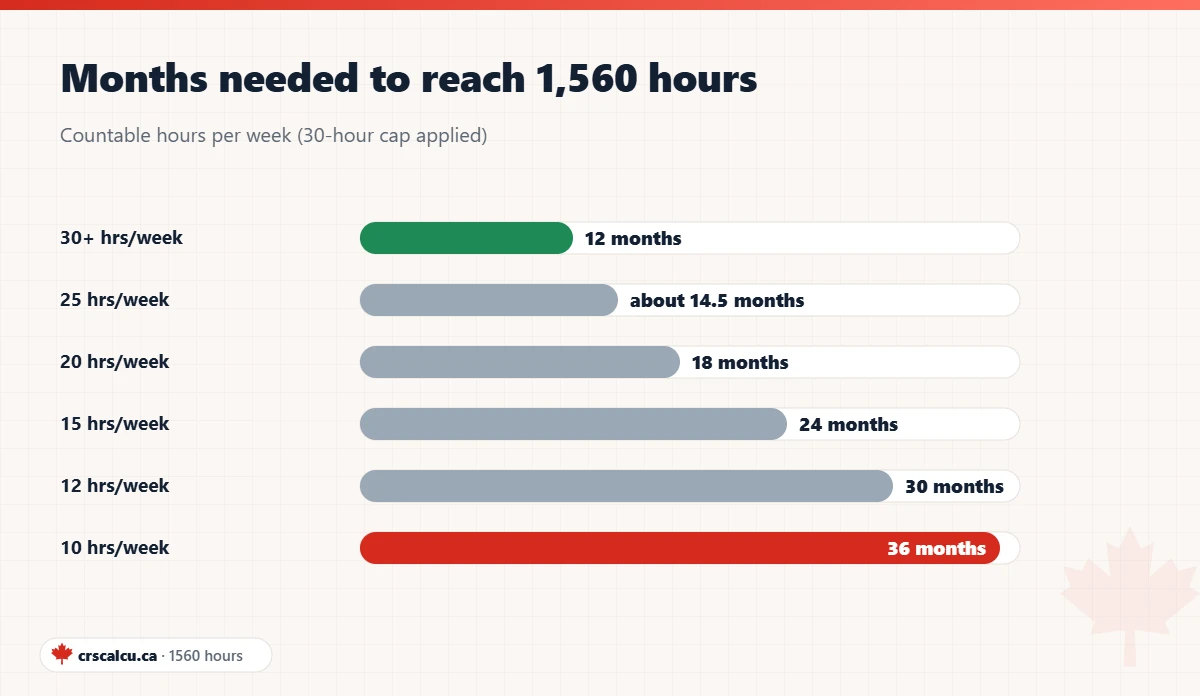
Look at the last row. At 10 hours a week, you need all 36 months of the CEC window with no gaps. For 1560 hours Express Entry purposes, that pace is almost out of reach.
Worked example: part-time, then full-time
Real case: a lawyer said part-time counts “half”
In September 2017, an applicant worked 26.25 hours a week for 15 weeks (393.75 hours), then 37.5 hours a week from December 2016. A law firm told them every week had to be 30+ hours. Members disagreed and pointed to IRCC’s “15 hours a week for 24 months” example. The math: 393.75 / 30 = 13.125 full-time weeks, plus 40 full-time weeks = 53.125 weeks. That is more than 52, so they were advised to go ahead.
Two or More Jobs at the Same Time
You can add hours from more than one job to meet the 1560 hours Express Entry minimum. But the CEC page says the limit is “up to 30 hours a week combined across more than 1 job.” A second job helps only if the first one is under 30 hours.
Example: Job 1 is 18 hours and Job 2 is 20 hours. That is 38 hours a week, but only 30 count. You still need 52 weeks, the same as one full-time job. For the CEC, both jobs must be TEER 0 to 3. Hours from a TEER 4 or 5 job do not count.
Real case: two part-time jobs and an ITA
In April 2017, a video editor on an IEC permit had two casual jobs in the same NOC, about 25 and 10 hours a week. Together they passed 1,560 hours over about 16 months. After the ITA, they worried about how their profile showed the hours. Members confirmed the combined hours count, capped at 30, and suggested declining the ITA to fix the profile, calling the help line and adding an explanation letter.
The lesson: your profile must match your real hours.
Paid Vacation, Unpaid Leave and Maternity Leave
IRCC’s officer instructions allow “a reasonable period of vacation time.” They give the example of “a 2-week period of paid vacation leave within a given 52-week period.”
Unpaid leave is different. Under the 1560 hours Express Entry rule, those weeks do not count, so your one-year date moves back. If you took 4 weeks of unpaid leave while full-time, you need about 56 calendar weeks, almost 13 months.
Real case: 2 months of unpaid leave
In June 2018, a VFX artist on an LMIA work permit had worked 5 months, then took about 2 months of unpaid leave for vacation and medical reasons. The reply: you need 52 separate weeks of 30+ hours, and overtime cannot replace missed weeks. Their eligibility slipped to around December 2018 or January 2019. With a CRS of 413, they planned an IELTS retake.
In March 2021, a supervisor with about 2,000 total hours had taken 2 weeks of unpaid leave. They counted 51 full-time weeks plus 2 weeks at 15 to 20 hours, for 1,563 capped hours. Even the replies were unsure. With 3 hours to spare, it was risky.
Maternity and parental leave follow the same logic. In October 2024, a bookkeeper who had worked full-time for 8 months before maternity leave was told the leave does not count toward her hours.
Tip: add a buffer of 2 to 4 weeks
In May 2026, a member had 1,560 hours at 37.5 hours a week but was 2 days short of 52 calendar weeks. The reply warned that “2 days can get you refused.” In January 2022, another member was told to add a buffer of about 120 hours, or 4 weeks. Do not apply on the exact day you think you qualify.
Student Work and Self-Employment: CEC vs FSW
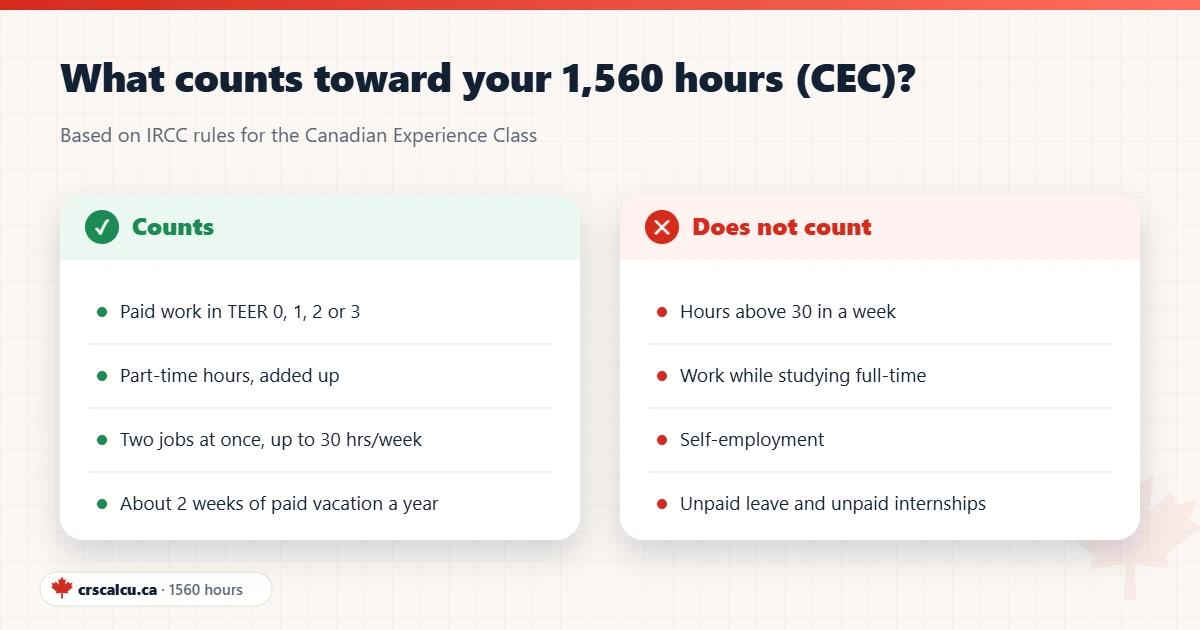
This is where the 1560 hours Express Entry rule differs most between programs. IRCC’s Help Centre says student work can count for FSW if it was paid and continuous. For the CEC and the skilled trades program, it does not count.
Work while studying
The CEC page says work while studying full-time does not count, and names co-op terms directly. In December 2016, a member with 3 co-op terms, a full 12 months, was told none of it counted. They needed a year after graduation. For CRS points, Canadian work done as a full-time student also earns nothing, though foreign work while studying can count.
In April 2024, a full-time student with an open work permit was told by a consultant that the work counted. IRCC’s instructions exclude any work during full-time study, whatever permit you hold.
Part-time study terms are a grey area. In October 2024, a member asked about 20-hour weeks worked while studying part-time. Nobody replied. Keep your enrolment letters.
Self-employment and contractors
IRCC’s instructions say “Any period of self-employment shall not be included” for the CEC. The only exception is some physicians under a public policy from April 25, 2023. Self-employment can count for FSW.
Real case: refused for being self-employed
In April 2011, a Canadian graduate worked as a chef for 6 months, then opened their own restaurant. Their CEC application was refused because the restaurant time was self-employment. Members suggested FSW instead.
Contractors are harder. In 2020, one reply said a T4 slip is what matters. Another member said they got CEC approval as a contractor with a letter showing duties, hourly rate, weekly hours and an employer-set schedule.
When You Hit 1, 2 and 3 Years for CRS Points
The 1560 hours Express Entry rule also shapes your CRS points, but eligibility and points are separate tests. The same 30-hour cap applies to both. Each band of Canadian experience is another 1,560 hours.
Years | Capped hours needed | Points (no spouse) | Points (with spouse) |
|---|---|---|---|
Less than 1 | Under 1,560 | 0 | 0 |
1 year | 1,560 | 40 | 35 |
2 years | 3,120 | 53 | 46 |
3 years | 4,680 | 64 | 56 |
4 years | 6,240 | 72 | 63 |
5+ years | 7,800 | 80 | 70 |
Source: IRCC Comprehensive Ranking System criteria. Hours assume the 30-hour weekly cap.
The jump from 0 to 40 at one year is the biggest single step. Part-time slows this down too. At 20 hours a week, you reach one year of CRS credit after 18 months and two years after 36 months.
Canadian experience also adds skill transferability points, and your spouse’s Canadian work adds up to 10 more. Enter your dates in our CRS calculator to see the exact change.
The Month-Count Problem: Getting an ITA Too Early
Here is a trap competitors rarely explain. Your Express Entry profile only asks for the month and year of each job. Members report that the system can count 12 months, and give you the points, before you truly have 52 weeks. This is what members reported, not written IRCC policy.
Say you started on June 26, 2024 and entered “06/2024 to present.” On June 1, 2025, the profile may show one year. Your real one-year date is June 26, 2025.
Real case: CRS jumped before the real 2-year date
In May 2020, a PGWP holder working full-time since June 26, 2018 saw their CRS go from 434 on April 30 to 459 on May 1. The system counted 2 years by month. They got an ITA before their true date of June 26, 2020. The advice: submit only after June 26, before the ITA deadline, as the officer compares your score at submission with the round’s cutoff. They later landed on June 1, 2021.
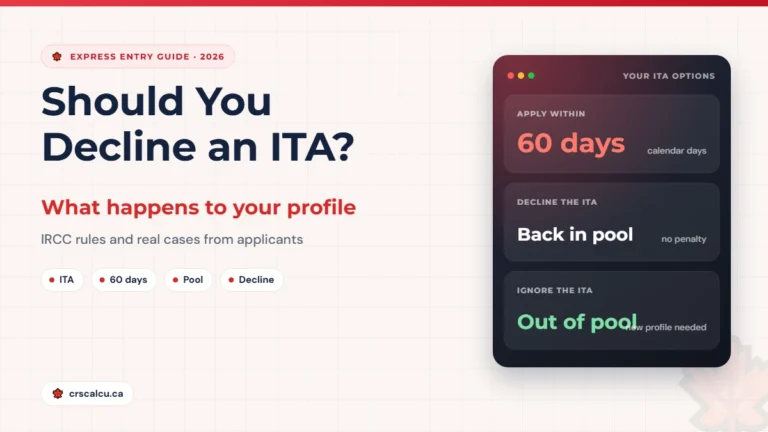
In August 2020, a member got an ITA about a month before their 12 months. They reported that IRCC replied the system counts by month and the officer decides, and that the onus is on the applicant. They declined. In February 2021, a member said IRCC had posted on social media that you may accept the ITA but submit only after completing the year. Several success stories followed.
The riskier case: in January 2021, an applicant got an ITA at 473 points while 3 months short of 2 years. Members said if you are under 1 year at the ITA, you must decline. If you are over 1 year, you can wait to submit only if your score still clears the cutoff. They warned that misrepresentation can bring a 5-year ban. The consensus was to decline. Compare your score with the latest CRS cutoffs before you decide.
What to do if you get an ITA before your true 1560 hours date
Employment Letters: Proving Your 1560 Hours for Express Entry
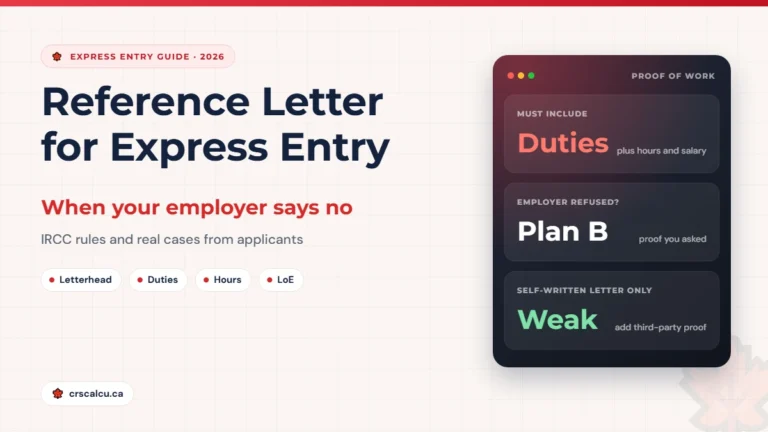
IRCC asks for “proof of work experience (such as a reference or experience letter from an employer).” In our cases, refusals came from weak letters more than wrong math. A good letter shows your job title, duties, start and end dates, hours per week and salary, on company letterhead with a signature.
Real case: refused because the letter did not prove 1 year
In October 2021, an applicant with 414 points uploaded a 6-month-old employment letter. It had a start date but no end date, because the newer letter left out duties. IRCC refused the application, saying it was not satisfied the year was complete. Members advised a webform with a new letter and T4 slips.
Duties matter too. In October 2018, an applicant with 487 points was refused because the officer was not satisfied they performed the main NOC duties. The letter had no duties and no salary. In December 2022, another applicant was refused even with a 2-page duties letter, because the duties did not match the NOC.
What to include with your work proof
2026 Update: Category-Based Draws Now Need 12 Months
If you hope for a category draw, the 1560 hours Express Entry math matters there too. IRCC’s category-based selection page now asks for “at least 12 months of full-time work experience (or an equal amount of part-time experience)” in the category occupation, within the past 3 years. It used to be 6 months. The 12 months do not need to be continuous.
The physician, senior manager and researcher categories need Canadian experience only. Also, job offer CRS points were removed as of March 25, 2025. See our category-based draws 2026 guide for the full list.
Common Mistakes With the 1560 Hours Express Entry Rule
Mistakes real applicants made
Most were easy to avoid with a simple week-by-week count of your 1560 hours for Express Entry before creating the profile. If you are applying under the CEC, read our Canadian Experience Class guide.
Quick Check: Are You Ready to Claim One Year?
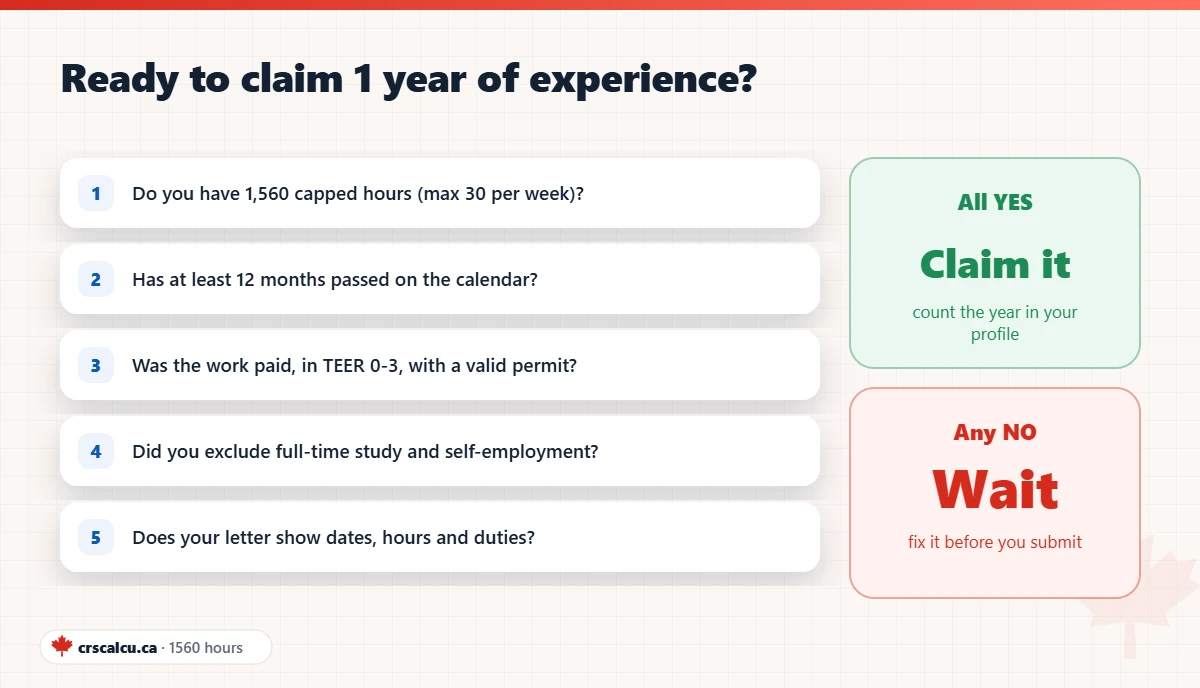
If you answered “yes” to all five, you likely meet the 1560 hours Express Entry rule. If any answer is “no,” wait and fix it first. Claiming experience you do not have yet can lead to a refusal, or a finding of misrepresentation.
Frequently Asked Questions
Does overtime count toward the 1,560 hours?
No. IRCC does not count hours above 30 a week, so overtime does not help you reach 1,560 hours sooner.
If I work 40 hours a week, can I qualify for the CEC in less than 12 months?
No. Each week counts as 30 hours at most, so you need 52 weeks to reach 1,560 hours.
Can I combine two part-time jobs to reach 1,560 hours?
Yes. The hours from both jobs are added, but the combined total is capped at 30 hours a week, and both jobs must be TEER 0 to 3 for the CEC.
How many months do I need at 20 hours a week?
You need 78 weeks, which is about 18 months. At 25 hours a week it takes about 14.5 months.
Do I need 52 weeks and 1,560 hours, or just 1,560 hours?
You need both for the 1560 hours Express Entry test. Members on the forum were told that 1,560 hours in fewer than 12 months is not enough.
Does paid vacation count toward my work experience?
IRCC generally allows a reasonable vacation, such as 2 weeks of paid vacation in a 52-week period. Unpaid leave and maternity leave do not count.
Does work while I was a student count for Express Entry?
Not for the CEC or CRS points if you were a full-time student, and co-op terms are excluded. For FSW, paid and continuous student work can count.
Does self-employment count for the CEC?
No, except for some physicians under a temporary public policy. Self-employment can count for FSW.
I got an ITA but I am a few weeks short of 1 year. What should I do?
Do not submit before your real one-year date. If you will not meet the minimum in time, decline the ITA and update your profile.
My employer calls me part-time but I work 30 hours. Is that full time?
Yes. For immigration, 30 hours a week is full time, no matter what your employer calls the job.
See your CRS score at 1, 2 and 3 years
Enter your work dates in our free calculator to see what each year of Canadian experience adds.
Final Thoughts
The 1560 hours Express Entry rule comes down to two checks: 1,560 capped hours and 12 real months of paid, skilled work. Overtime, extra jobs and a profile that counts by month can all make you think you are ready before you are.
Count your hours week by week, add a small buffer, and get a letter that shows your hours and duties. Then claim the year with confidence.