Express Entry Guide · Updated October 2026
Reference Letter for Express Entry: What to Do When Your Employer Says No (Real Cases)
Your work experience is worth nothing in Express Entry until you can prove it. Here is what the letter must say, and what real applicants sent when the company would not help.
You finally got the invitation. Then HR tells you the company “does not issue letters with job duties.” Now the reference letter Express Entry asks for looks like the hardest document in the whole file.
This is one of the most common problems people post about. We went through threads on a large Canadian immigration forum from 2017 to 2022 and a dozen Quora questions with answers from applicants who made it through.
The good news: people do get approved without a perfect letter. The bad news: people with a perfect-looking letter also get refused when it is missing one thing. Let’s look at both.
Quick answer: reference letter Express Entry rules
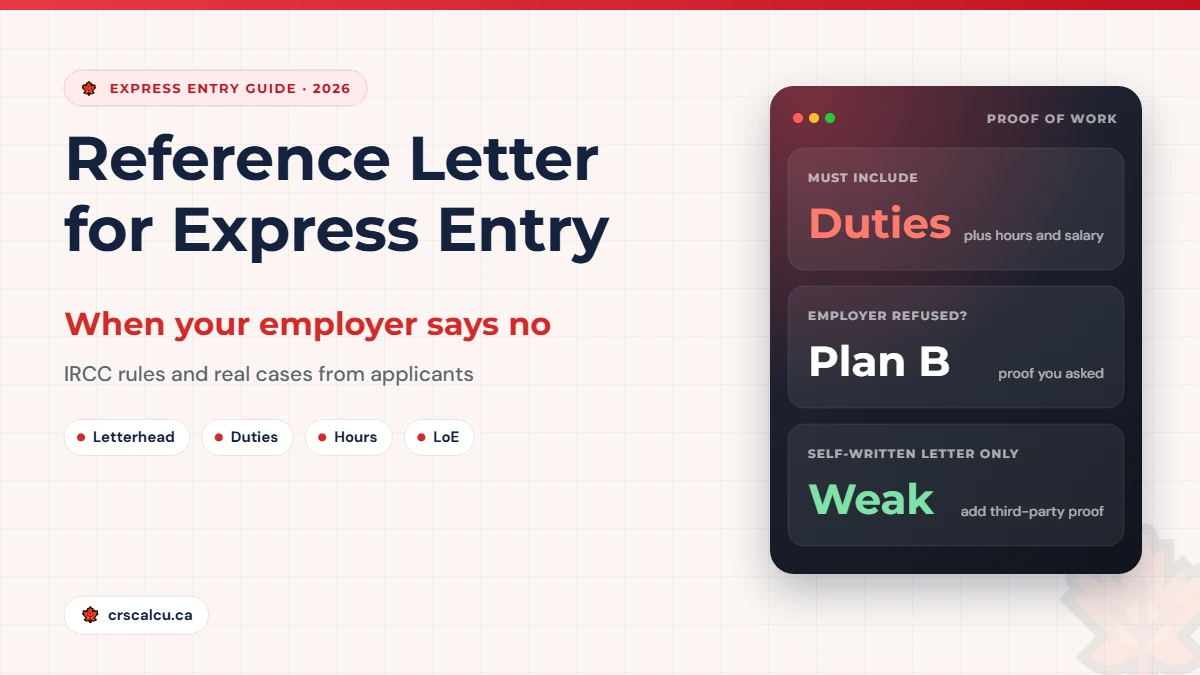
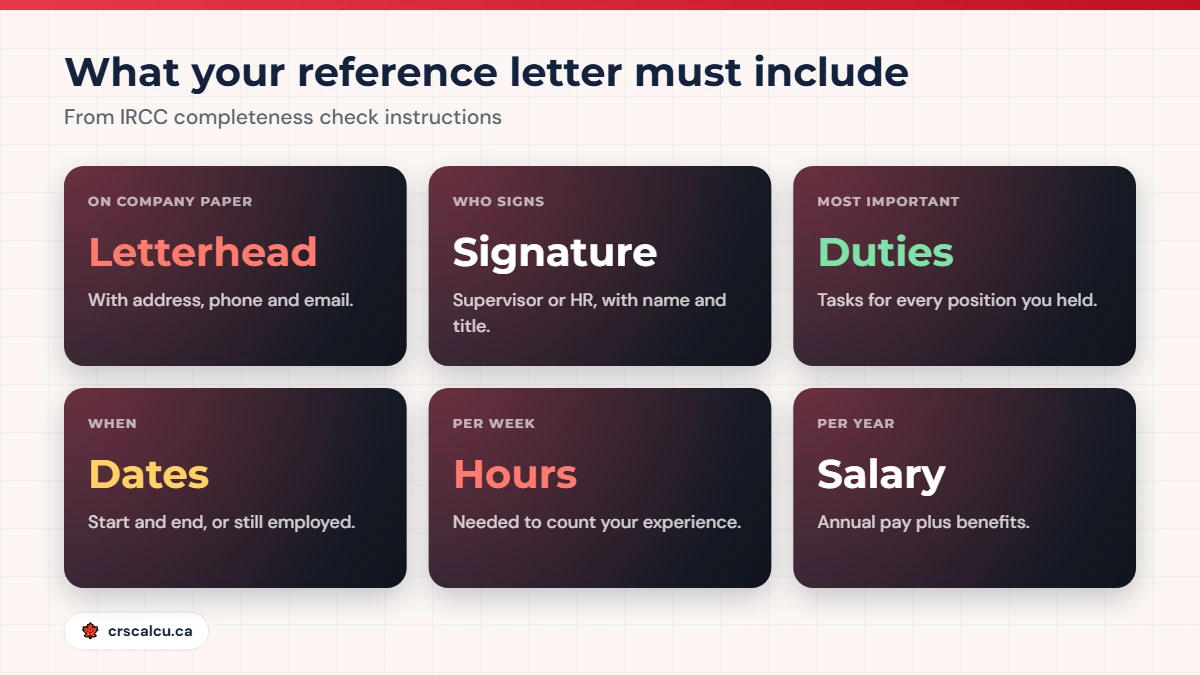
IRCC wants a letter on company letterhead for each job you declare. It must show your name, the company’s contact details, and the name, title and signature of your supervisor or an HR officer. It must list your job title, duties, dates, hours per week and annual salary plus benefits. If your employer refuses, send proof that you asked, a letter of explanation, and other evidence such as contracts, pay stubs and a signed statement from a supervisor or colleague.
Key takeaways
What IRCC Wants in a Reference Letter for Express Entry
The list of what a reference letter Express Entry officers accept must contain is not a secret. It is in IRCC’s completeness check instructions for Express Entry applications. Officers use it to decide if your file is complete.
Your letter should have all of these
For work in Canada, IRCC also mentions T4 slips and notices of assessment as supporting proof. For self-employed work, it asks for things like articles of incorporation, proof of income and documents from third parties showing the services you provided.
Why duties matter more than the title
In a reference letter Express Entry officers skip past your job title. It means very little. Officers read the duties and compare them with the lead statement and main duties of the NOC code you chose. If they do not line up, your points for that job can disappear.
Real case: CRS 571, refused over the duties
In December 2022, a Canadian Experience Class applicant shared a refusal. They had 571 points, an ITA from July 2022, and passed medicals and biometrics. The officer wrote that the employment letter did not describe the main duties of the NOC they had declared. The applicant said the letter was two pages long. Colleagues had used the same template before. It still failed. A long letter is not the same as a letter that matches your NOC.
Tip: do not copy the NOC word for word
Officers have seen thousands of letters that paste the NOC description. Describe what you really did, in your company’s words, and make sure the real duties cover most of the NOC’s main duties. Use our NOC TEER finder to read your code first.
Why Employers Refuse (and Why It Is Not Personal)
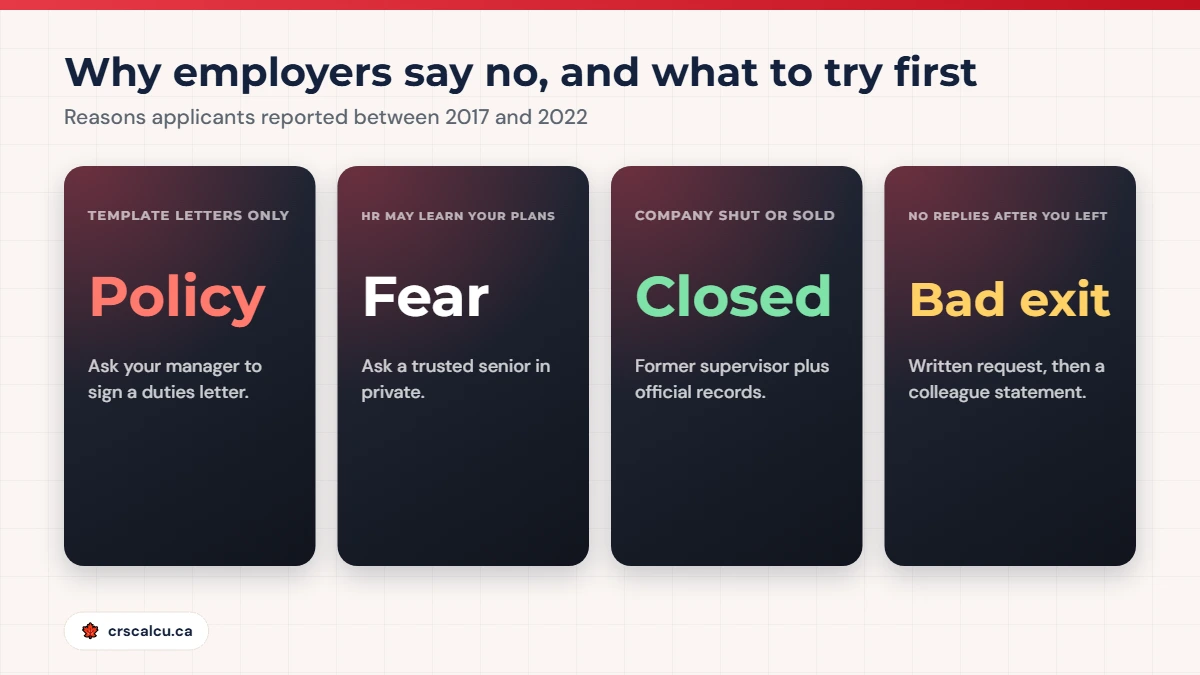
When a company will not write a reference letter Express Entry applicants often take it personally. Most refusals have nothing to do with you. The reasons people reported fall into a few groups.
Reason | What applicants reported | First thing to try |
|---|---|---|
Company policy | HR only prints a standard template with title and dates | Ask your direct manager for a signed letter |
Fear you are leaving | Staff worried HR would learn about their PR plans | Ask a trusted senior, not HR |
Bad exit | Contract ended and the employer stopped replying | Written request, then colleague statement |
Company closed or sold | No one left to sign | Former supervisor plus official records |
Mass layoff | One member lost a job of 27 years, no references for anyone | Tax and pay records plus explanation |
From forum threads between 2017 and 2022 and Quora answers.
In March 2022, forum members pointed out something many newcomers do not know. A Canadian employer has no legal obligation to write a reference letter. So pressure does not work. A polite, clear request with a draft attached works much better.
Employer Refused? Your Backup Plan
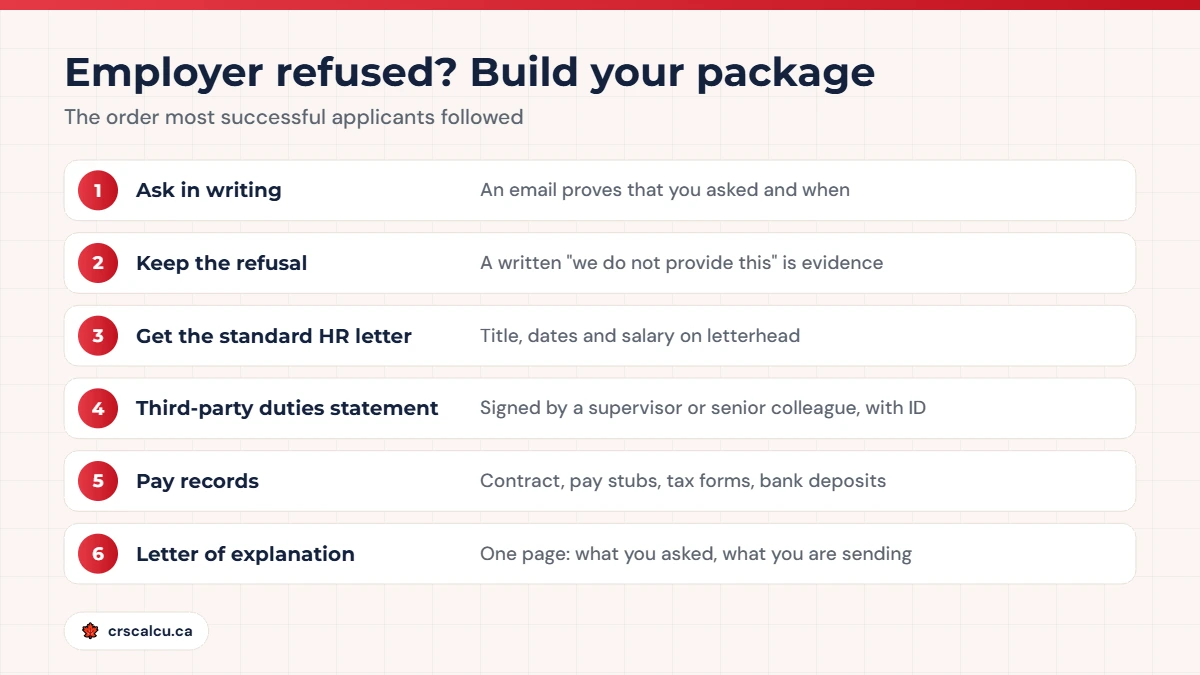
When the standard reference letter Express Entry asks for is impossible, your goal changes. You are now trying to show an officer two things: you really tried, and the job was real. Here is the order most successful applicants followed.
Build your package step by step
Real case: colleague’s letter, approved
In September 2019, a member reported that they could not get a letter in the standard format. They submitted a personal reference from a colleague with a copy of the colleague’s business ID. They added promotion letters and salary statements. In August 2019 they received their passport request, which means approval.
Real case: a senior signed on plain paper
In May 2017, an employee with no direct manager asked a senior to sign a description of their job on plain paper. The senior agreed. The applicant stayed away from HR to avoid trouble at work. The split that members described was simple: use the official letter to prove you were employed, and use the signed statement to prove what you did.
In December 2017, another member shared that a friend got PR after sending a company note that said it could not provide reference letters, plus pay stubs and bank statements. No questions were asked. That is one report about a missing reference letter Express Entry officers accepted, not a promise. Officers have discretion, and a different officer may ask for more.
What Does Not Work Well
Some shortcuts around the reference letter Express Entry requires come up in every thread. They carry more risk than people think.
Weak or risky choices
There is one fair option if you have points to spare. You can keep the job in your history but not claim points for it. A forum member suggested this in 2017 for people with a strong score. Check first that you still meet the minimum experience for your program. Our guides on foreign work experience points and the 1,560 hours rule show what you need.
How to Ask So That You Get a Yes
With a reference letter Express Entry timing is tight, so ask well the first time. A lot of “no” answers are really “I do not know what you want and I am scared to sign it.” Make it easy.
Make the request easy to approve
One Quora writer, a permanent resident since 2017, described this exact approach with a large IT company that only used templates. A supervisor signed a plain-paper letter, and it worked.
Special Cases: Closed Companies, Current Jobs and Canadian Work
The company no longer exists
In May 2017, a member’s former employer had shut down. They got a letter from a former colleague and added tax slips and old emails. Add anything official that shows the company existed: registration records, your contract, tax filings.
You still work there
You need a reference letter Express Entry officers can check for your current job too, and it should say the job is ongoing. If you fear for your job, start with your direct manager in private.
Your work was in Canada
For Canadian jobs, the reference letter Express Entry needs is easier to back up. T4 slips, notices of assessment, a record of employment and pay stubs all help. But they still do not list duties, so the duties statement matters here as well. If you are applying under the Canadian Experience Class, your whole application rests on this one job.
Frequently Asked Questions
Is a reference letter mandatory for Express Entry?
Yes. IRCC lists a reference or experience letter as a mandatory document for each work experience you declare.
What must the reference letter include?
Your name, company contact details, the signer’s name, title and signature, your job title, duties, dates, hours per week and annual salary plus benefits, on company letterhead.
My employer refuses to list my duties. What can I do?
Get the standard HR letter, then add a signed statement from a supervisor or senior colleague that lists your duties. Include proof that you asked and a letter of explanation.
Can a colleague write my reference letter?
A colleague or supervisor can sign a statement about your duties. It works best with their contact details, a business card or staff ID, and official records like pay stubs.
Can I write and sign the letter myself?
A self-declaration alone is weak because nobody else confirms it. Use it only with strong third-party evidence.
Are salary slips enough without a letter?
No. Pay slips prove payment but not duties. Officers need to see what you did to match it with your NOC code.
Do I need a letter for a job I am not claiming points for?
You still have to list the job in your history. If you claim no points for it, the letter matters less, but keep basic proof in case IRCC asks.
When should I ask for the letter?
Before you get an ITA. You only have 60 days to apply, and many companies take weeks to answer.
Make sure the job you are proving is in the right NOC
Find your code, read the main duties and check your points before you ask anyone to sign a letter.
Final Thoughts
The reference letter Express Entry officers want is simple on paper and hard in real life. If you can get the full letter, get it early and make sure the duties are true and match your NOC.
If you cannot, do not panic and do not invent. Show that you asked, explain what happened, and let pay records and a signed statement tell the same story.