CRS Points Guide · Updated September 2026
Foreign Work Experience Express Entry Points: How Many CRS Points You Really Get (Real Cases)
The two skill transferability tables, why year 2 adds nothing, how remote work is judged, and the real cases where applicants lost these points.
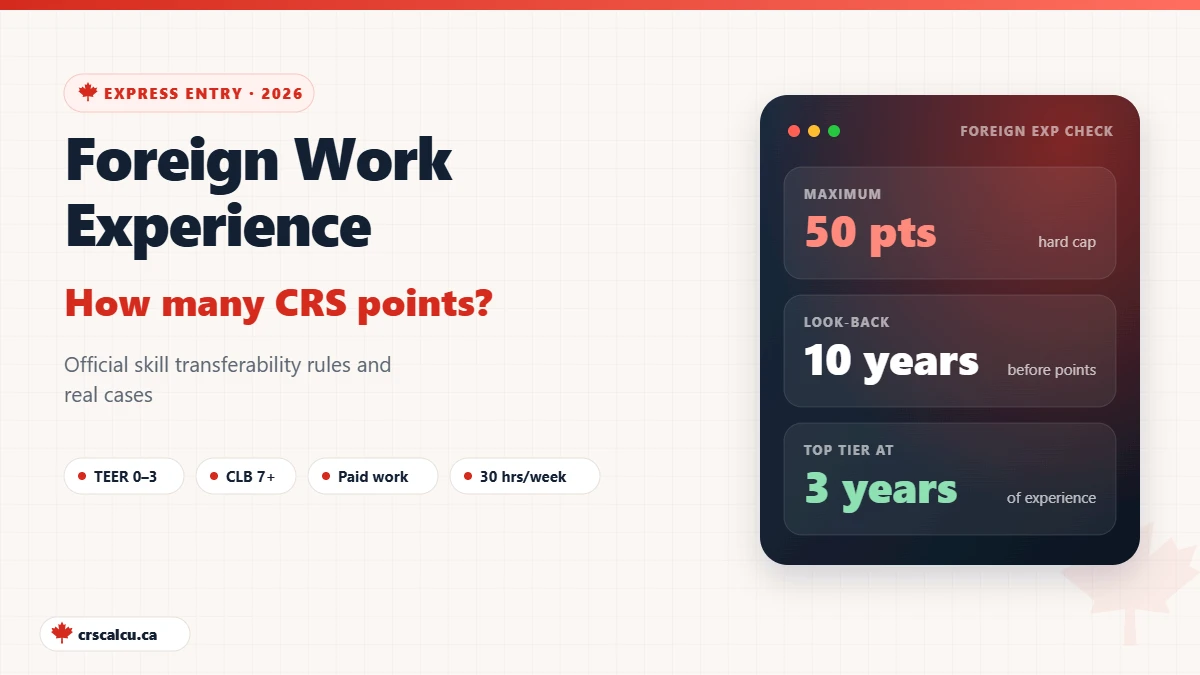
Foreign work experience Express Entry points can add up to 50 to your CRS score. But foreign experience never scores on its own. It only counts when you pair it with strong language results or with Canadian work experience. That surprises a lot of people who see “0” in their profile.
We read more than 20 threads on a large Canadian immigration forum, from 2013 to 2026. We found people who lost 25 points to a typo, people refused over a thin reference letter, and people who thought remote work from Canada was “foreign.” Their cases are below, next to the official rules.
You will also find both points tables, worked examples and the documents that hold up.
Quick answer: how many CRS points is foreign work experience worth?
Foreign work experience Express Entry points come only from skill transferability. With CLB 7+, 1–2 years abroad gives 13 points (25 at CLB 9+). With 3+ years you get 25 (50 at CLB 9+). A second table pairs it with Canadian experience for up to 50. Both tables together are capped at 50 points. On its own, foreign experience scores 0.
Key takeaways
What Counts as Foreign Work Experience?
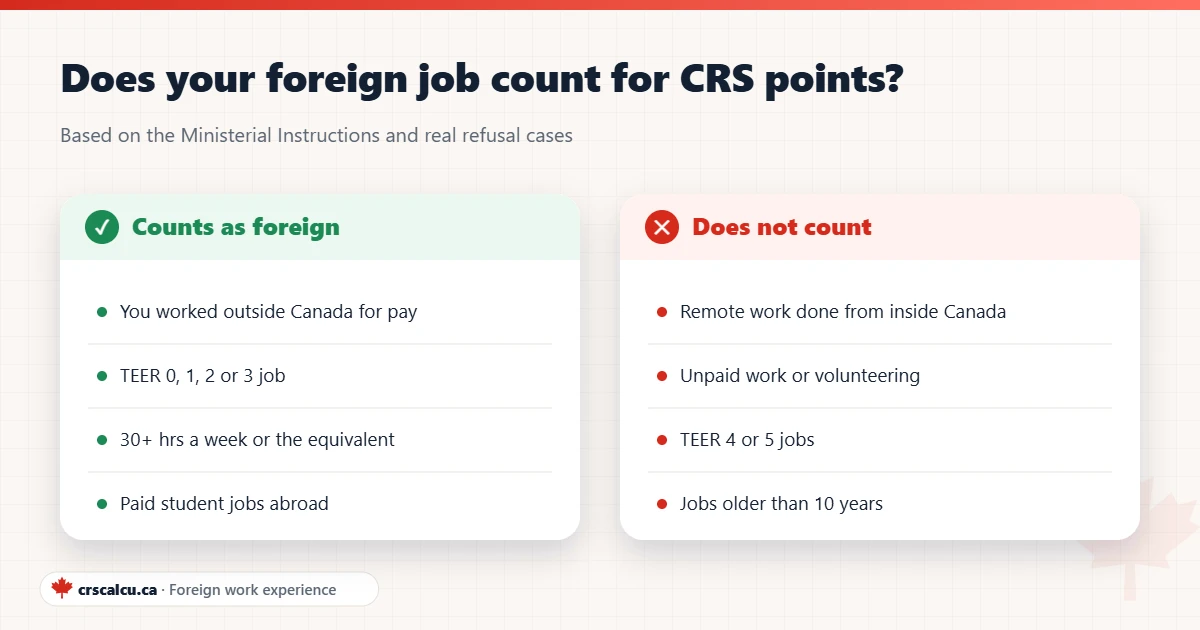
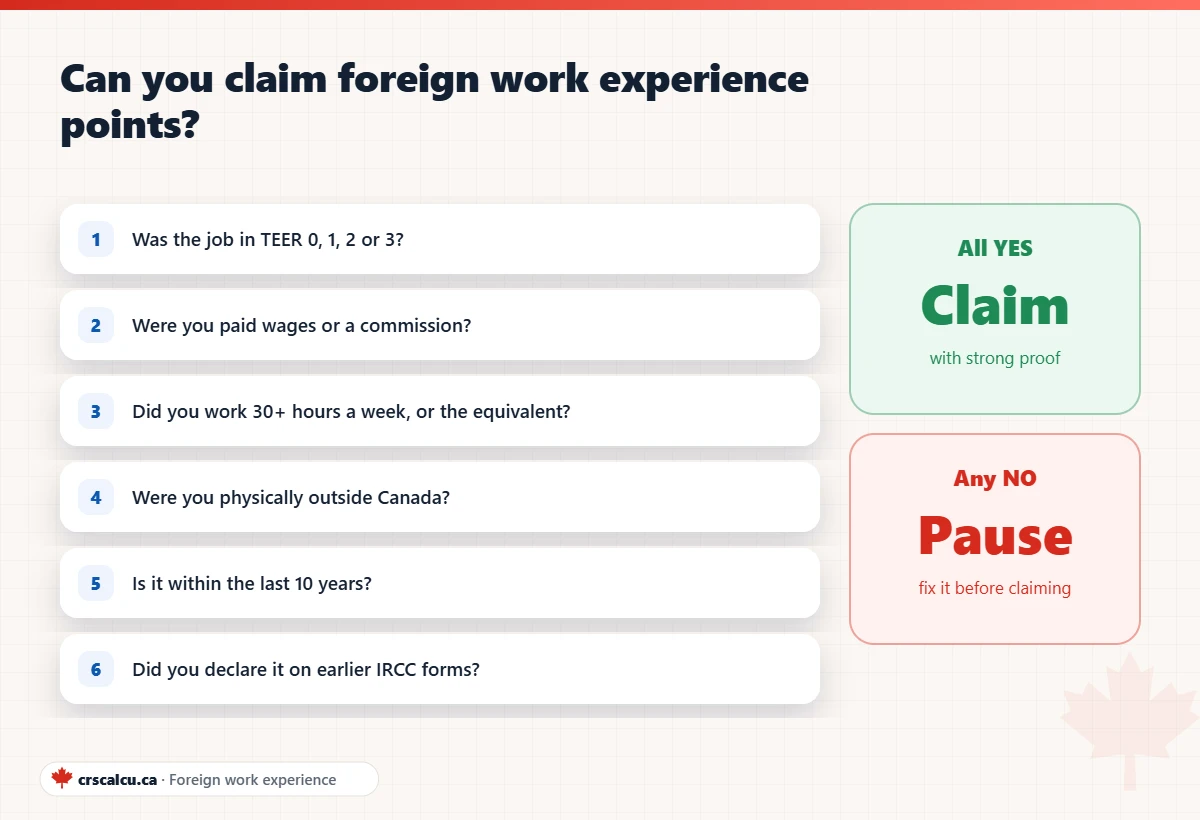
The legal definition sits in the Ministerial Instructions for Express Entry, section 25. It says foreign experience is work “acquired by a foreign national outside Canada” in one or more TEER 0, 1, 2 or 3 occupations. It must be within the 10 years before the day your points are assigned.
The same section says the work must be “remunerated by the payment of wages or a commission.” So unpaid internships and volunteering do not count. You also need to name the NOC code for each job and show that you did the actions in its lead statement. Use our NOC TEER finder to check your code before you pick one.
The 30-hour rule and part-time work
Full-time means at least 30 hours a week. Part-time work can add up to the same total: 1,560 hours for one year. Extra hours do not count twice, so two jobs at once cannot give you two years in one calendar year. Our 1,560 hours guide shows how to count your hours.
Student jobs abroad count for CRS
IRCC’s Help Centre says Canadian student work does not count toward your CRS score, but foreign student work does. In March 2026, one applicant had about 1,600 hours as a user support technician in the US, at 20 hours a week on a study visa. Agents said it would not count. A senior member said it could be claimed, which matches IRCC’s answer.
Does it need to be continuous?
Not for CRS points. Section 25 does not use the word “continuous.” Continuity is an FSW eligibility rule. From 2022 to 2025, a CEC candidate with 11 months at one foreign employer and 2 months at another got mixed answers. A consultant finally noted that continuity is an FSW rule only. The applicant still skipped the claim, being about 30 days short.
Foreign Work Experience Express Entry Points at a Glance
Foreign work experience lives in the “skill transferability” part of the CRS. One table pairs your foreign years with your language level. The other pairs them with Canadian work experience. You can score in both, but the total stops at 50.
Rule | What it means |
|---|---|
Maximum points | 50 (both tables together) |
Points on its own | 0, it only scores in combination |
Needed to score | CLB 7+ in all four abilities, or Canadian work experience |
Occupation level | TEER 0, 1, 2 or 3 |
Hours | 30+ hours a week, or 1,560 hours part-time per year |
Pay | Wages or commission; unpaid work does not count |
Where | Physically outside Canada |
Time window | Last 10 years before points are assigned |
Brackets | 1–2 years, then 3+ years |
Source: IRCC CRS criteria and Ministerial Instructions for Express Entry, s. 25.
Table A: foreign experience + language
Foreign work experience | CLB 7+ (at least one ability under CLB 9) | CLB 9+ in all four abilities |
|---|---|---|
None | 0 | 0 |
1 or 2 years | 13 | 25 |
3 years or more | 25 | 50 |
Source: IRCC Comprehensive Ranking System criteria.
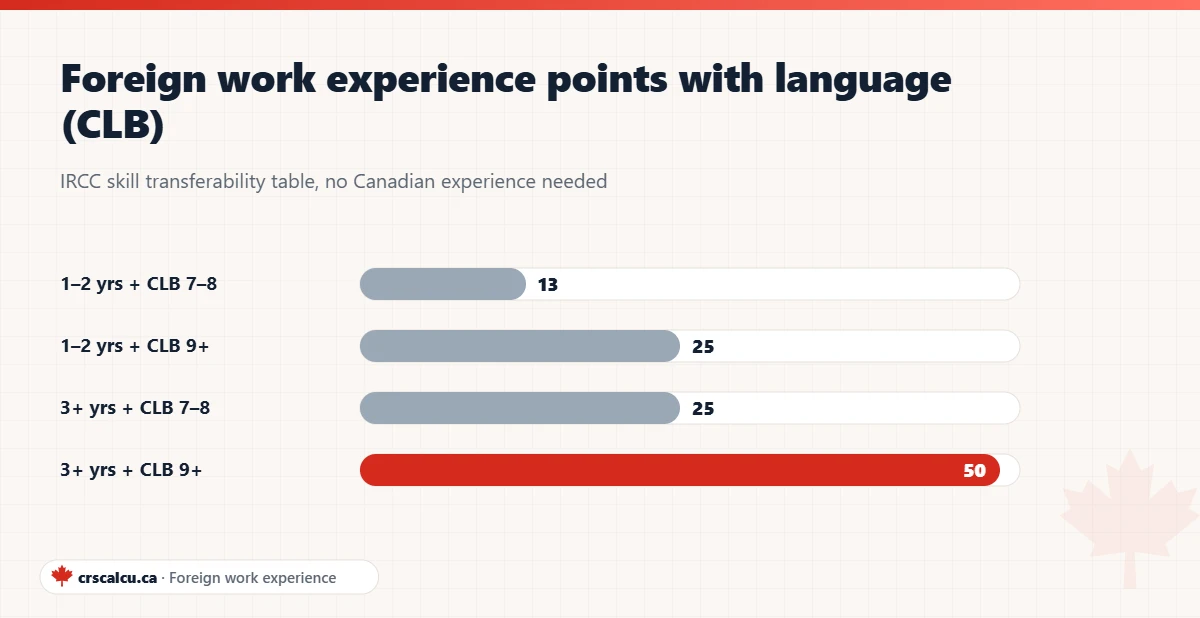
Table B: foreign experience + Canadian experience
Foreign work experience | 1 year Canadian | 2+ years Canadian |
|---|---|---|
1 or 2 years | 13 | 25 |
3 years or more | 25 | 50 |
Source: IRCC Comprehensive Ranking System criteria.
The whole skill transferability section, including education combinations, is capped at 100 points.
Worked Examples: How the Points Add Up
The tables are easier to read with real numbers. Each row below adds Table A and Table B, then applies the 50-point cap. “CLB 7–8” means CLB 7 or higher in all four abilities, with at least one ability under CLB 9.
Your profile | Table A | Table B | Foreign exp points |
|---|---|---|---|
3 yrs foreign, CLB 9+, no Canadian | 50 | 0 | 50 |
2 yrs foreign, CLB 9+, no Canadian | 25 | 0 | 25 |
2 yrs foreign, CLB 7–8, 1 yr Canadian | 13 | 13 | 26 |
3 yrs foreign, CLB 7–8, 1 yr Canadian | 25 | 25 | 50 |
1 yr foreign, CLB 9+, 2 yrs Canadian | 25 | 25 | 50 |
3 yrs foreign, CLB 9+, 2 yrs Canadian | 50 | 50 | 50 (cap) |
3 yrs foreign, CLB 6, 1 yr Canadian | 0 | 25 | 25 |
3 yrs foreign, CLB 6, no Canadian | 0 | 0 | 0 |
Calculated from the IRCC skill transferability tables. Your full CRS score also depends on age, education and other factors.
Look at the last two rows. The same three years abroad give 25 points to a CEC candidate with one Canadian year, and 0 to someone with CLB 6 and no Canadian job. Check your language level with our CLB calculator first.
Why Year 2 Adds Nothing and Year 3 Adds Up to 25
Foreign work experience Express Entry tables use brackets, not a sliding scale. One year and two years sit in the same row. Only the third year moves you to the next row. After that, a fourth or tenth year adds nothing.
For a CLB 9+ applicant with no Canadian experience, that third year is worth 25 extra points: from 25 to 50. For someone at CLB 7–8, it is worth 12: from 13 to 25.
Real case: 25 points instead of 50
Back in 2016, an applicant with CLB 10 claimed 4 years abroad in NOC 2171, across two employers with a gap. They expected 478 points, but the profile showed 453, with 25 instead of 50 for foreign experience. Members suspected the gap. In the end, the applicant withdrew the profile and created it again. It showed 478. It was a data-entry error.
Be careful near the edge of a year
The jump only happens when you truly reach the full year. In a 2025 thread, members discussed a case with 355 days, about 10 days short of 12 months. They warned the profile might still show the points, but the PR application could be refused. If you are short, wait until you pass the date.
The 10-Year Window: When Old Experience Drops Off
Section 25 counts only experience within the 10 years before the day points are assigned. IRCC’s Help Centre also asks you to list your work for the last 10 years in your profile. The window keeps moving while you wait.
Say your three foreign years ran from 2016 to 2019. Today, in September 2026, all of them are inside the window. But as months pass, the oldest months fall out. Once less than 3 years are left inside the window, your foreign work experience Express Entry points drop from the 3+ bracket to the 1–2 bracket. At CLB 9+, that is 25 points gone without you changing anything.
How to protect your foreign work experience Express Entry points
Remote Work: Where You Worked Matters, Not Your Employer
Remote work is the fastest-growing foreign work experience Express Entry question. Foreign experience must be “acquired … outside Canada.” It is about where you sat when you did the work, not where your employer is based.
Real case: FSW refused for remote work done from Canada
In 2023, one applicant was refused under FSW. They had worked remotely for a foreign employer in 2022 and 2023 while studying full-time in Canada. The officer found they were not outside Canada during the claimed foreign experience. Members pointed to the Ministerial Instructions wording.
Where you worked | Employer | Result |
|---|---|---|
Abroad | Foreign company | Foreign experience |
Abroad | Canadian company | Grey area, see the 2023 case below |
In Canada | Foreign company | Not foreign experience (refused in 2023) |
In Canada | Canadian company | Canadian experience rules apply |
Based on MI s. 25, the IRCC CRS criteria and forum cases from 2023 to 2024.
The grey area is real. In 2023, one applicant had worked 7 months remotely from abroad for a Canadian company before getting a work permit: 491 points with those months, 467 without. A consultant first called it self-employment, then changed their mind after seeing the offer, employment letter and payments. Another member warned IRCC might remove the points.
Risky advice we saw
In December 2024, an IT worker living in Canada asked about contract work for a US company. Claiming it as foreign would lift the score from 470 to 508, and some replies said it could count. That conflicts with the “outside Canada” rule and the 2023 refusal above. Don’t do it.
Foreign Work Experience Express Entry Proof: Reference Letters
IRCC’s documents page says you need “proof of work experience (such as a reference or experience letter from an employer).” The full list appears in your personal checklist in the PR portal after an ITA. For foreign work experience Express Entry claims, applicants and practitioners consistently include the items below.
What a strong reference letter includes
Duties fail most often. In September 2024, a member with five jobs had one certificate with no duties. Replies said duties are needed to prove the NOC match, and a letter without letterhead or contact details is “a huge red flag.” A 2022 CEC refusal at 571 points came down to duties that did not match the NOC.
Real case: refused over a one-line duties statement
In January 2023, an applicant with 1 year of experience in India and no reference letter asked about claiming it: 467 points without it, 505 with it. In the same thread, another member said their PR was refused because the Indian letter had only “one generic statement” about duties. An affidavit did not fix it. They reapplied without the foreign experience.
Officers also check that the employer exists. In a 2022 case, an officer could not confirm a Canadian employer “through an open web search.” The same check can happen for foreign companies.
What If Your Employer Won’t Give a Reference Letter?
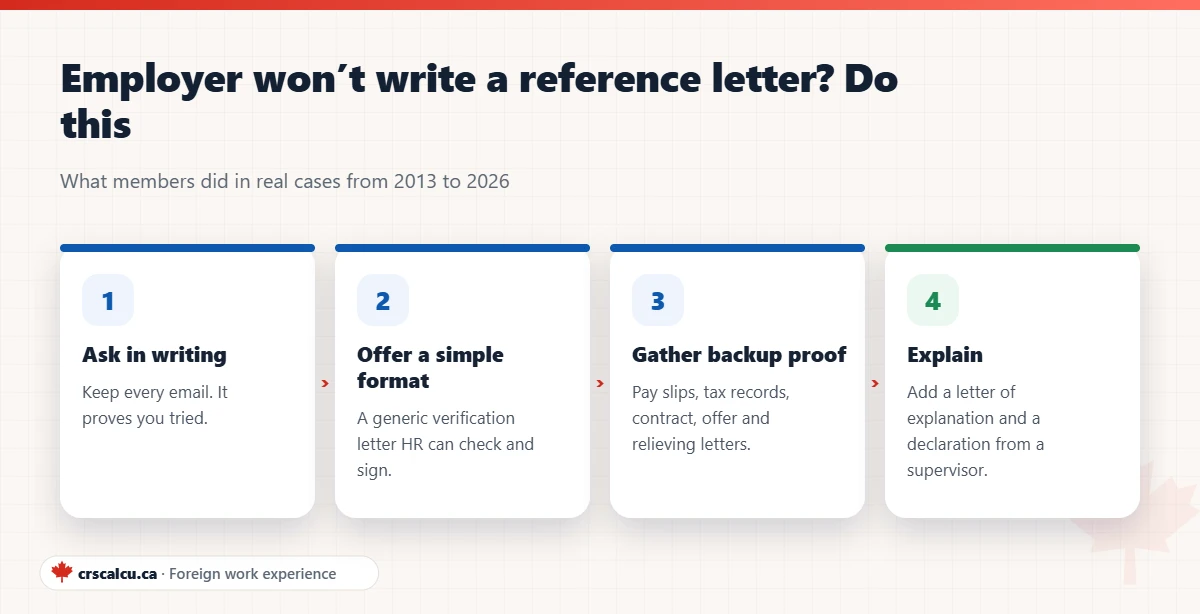
This is common with public-sector employers. In 2017, an applicant with 75 days left on their ITA had an Indian public-sector employer with a no-detailed-letters policy. They only had a relieving letter, offer letters and pay slips.
Real case: employer refused, 2 years at stake
In June 2026, a CEC candidate with an ITA had 2 years of customer service experience in India. They had an offer letter, relieving letter, pay slips, bank statements and tax forms, but no reference letter. Members said to upload it all plus the contract, with a letter of explanation and proof of their attempts. The TEER needs checking too: many customer service roles are TEER 4, which scores 0.
There is no official “backup list” from IRCC. Here is what members used when the letter was missing.
Document | What it proves |
|---|---|
Offer letter or contract | Job title, start date, hours, pay |
Relieving or experience certificate | End date and title |
Pay slips and bank statements | That you were paid |
Tax or provident fund records | Paid employment, from a third party |
Declaration from a former supervisor | Your duties, in their words |
Letter of explanation + emails | Why the letter is missing and that you tried |
Based on member advice from 2013 to 2026. This lowers the risk but does not guarantee approval.
Threads from 2013 and 2014 suggested asking HR for a generic “to whom it may concern” verification letter, and offering a draft for them to check and sign. Never write a letter yourself and present it as your employer’s.
Self-Employment and Freelance Work Abroad
Self-employment is clearly allowed for FSW eligibility. The FSW page says part-time jobs, self-employment and work while studying can count if all other criteria are met.
For foreign work experience Express Entry points, it is less clear. Section 25 requires work “remunerated by the payment of wages or a commission.” It does not directly exclude self-employment, but that wording makes it a grey area. We found no official IRCC statement either way.
In a 2020 thread, members listed the proof people use: proof of ownership such as articles of incorporation, self-employment income records, and third-party documents showing services and payments.
Consistency With Your Earlier IRCC Applications
Officers compare your Express Entry work history with every form you filed before: visitor visas, study permits, work permits and PGWP. A job that suddenly appears now can look like an attempt to add points.
Real case: a hidden job worth 25 points
In July 2019, an applicant had 1 year of NOC B experience from 2011 that was not on their earlier study and work permit forms. Their score was 442, or 467 if they claimed it. Some replies said to claim it with a letter of explanation. Others said people in the same spot got procedural fairness letters, and one was found to have committed misrepresentation. The applicant decided not to claim it.
It is still happening. In August 2026, an applicant stuck at 490 had a cash-paid job abroad in 2021 and 2022 that was not on their study permit. Members were split on whether that omission is misrepresentation, and several advised seeing a licensed lawyer first.
In 2025, a member had about 1,800 hours of paid research abroad that was left off their PGWP form for lack of space. They sent a webform updating their history, with an explanation, before claiming it.
Consistency check before a foreign work experience Express Entry claim
Job titles matter too. In 2023, a member got a procedural fairness letter after two different titles for the same job appeared in their submissions.
Why Your Profile Shows Different Points Than the Calculator
Foreign work experience Express Entry mismatches between a calculator and your IRCC profile are common. Nearly every one we read came from how the data was entered, not from a hidden rule.
Real case: expected 26, got 0
In August 2018, an applicant saw 0 for foreign work skill transferability, while a calculator had shown 26. Replies pointed out they had no foreign experience at all, so there was nothing to combine. The calculator input was wrong, not the profile.
Why your foreign work experience points do not match
Run your numbers in our CRS calculator with the exact dates and all four CLB levels.
Will the 2026 Express Entry Review Change These Points?
Policy watch (as of September 26, 2026)
In April 2026, IRCC opened a consultation on changes to the federal high-skilled programs and the CRS. It talks about focusing the CRS on factors linked to strong economic outcomes. Nothing has changed yet. The page does not say what will happen to foreign work skill transferability points, so treat any rumour as unconfirmed until IRCC announces it.
Common Foreign Work Experience Express Entry Mistakes
Mistakes real applicants made
Each of these came from a real thread. Most could have been avoided by checking documents before adding the job to the profile. If you are also counting Canadian work, see our Canadian Experience Class guide.
Frequently Asked Questions
How many CRS points do I get for foreign work experience?
Up to 50. With CLB 7+ you get 13 for 1–2 years or 25 for 3+ years; at CLB 9+ it becomes 25 or 50.
Do I get foreign experience points without Canadian work experience?
Yes, if you have CLB 7 or higher in all four abilities. Without CLB 7 and without Canadian experience, foreign experience gives 0 points.
Is there a difference between 1 and 2 years of foreign experience?
No. Both sit in the same bracket. Only the third year moves you to the higher row.
Does foreign work experience have to be continuous?
Not for CRS points. FSW eligibility, however, needs one year of continuous work.
Does part-time or student work abroad count?
Yes, if it is paid, TEER 0 to 3, and adds up to the full-time equivalent. IRCC says foreign student work counts toward the CRS.
Does remote work for a foreign company count if I live in Canada?
No. Foreign experience must be done outside Canada. One applicant was refused in 2023 for claiming remote work done from Canada.
What if my foreign employer will not give a reference letter?
Upload your contract, pay slips, tax records and relieving letter with a letter of explanation. This is weaker than a proper letter.
Can I claim self-employed foreign experience for CRS points?
Self-employment counts for FSW eligibility. For CRS points it is a grey area, because the rules say work paid by wages or commission.
Can I claim a job I did not declare on my study permit?
It is risky. Officers compare your forms, and members have received procedural fairness letters. Speak to a licensed lawyer or RCIC before you claim it.
How far back can foreign work experience go?
Only the last 10 years before your points are assigned count. Older months drop out, so your points can fall while you wait in the pool.
See what your foreign experience is worth
Enter your foreign years, Canadian years and CLB levels to see your foreign work experience Express Entry points and full CRS score.
Final Thoughts
Foreign work experience Express Entry points are some of the easiest to misread. They never count alone, the brackets hide a big jump at year 3, and the 10-year window keeps moving. Get those three things right and you know what your experience is really worth.
Then focus on proof. A clear letter with duties, hours and pay, plus a work history that matches your older forms, is what turns points in a profile into an approved PR.