Express Entry Guide · Updated October 2026
You entered the pool expecting a general round, and 2026 has not delivered one. Here is what replaced it, what it costs you to wait, and which route fits your profile instead. If you are waiting on a general round, this guide to the no general express entry draw problem in 2026 shows what replaced it and which route fits your profile instead.
By Aria Sterling · Checked against IRCC rules · 11 min read
For years, the mental model of Express Entry was simple: get into the pool, watch the score, wait for a general draw. In 2026 that model broke. The rounds that have actually happened are program-specific rounds — Canadian Experience Class, Provincial Nominee Program — and category-based rounds — French-language, healthcare, trades, transport, education and the smaller occupation categories. If your whole plan is “wait for a general draw”, you are waiting for a round type that has not come.
This post does not print cutoff numbers, because they change with every round and any number here would rot. For current rounds, see our latest Express Entry draws and CRS cutoffs and next draw prediction pages. What this post does is answer the strategy question: wait, or move?
Evidence base: IRCC’s rounds of invitations page and category-based selection pages, plus public forum threads from candidates waiting through 2026. This is general information, not legal advice.
Quick answer
Quick answer:
Do not build your plan around a general draw returning. In 2026, invitations have gone to candidates who fit a specific round: CEC, PNP, French-language, or an occupation category. Check which of those you already qualify for, and if you qualify for none of them, your best move is usually a provincial nomination application or raising your score — not waiting. That is the whole no general express entry draw strategy: fit a round that runs, instead of waiting for one that does not.
Key takeaways
What a general draw is, and what replaced it
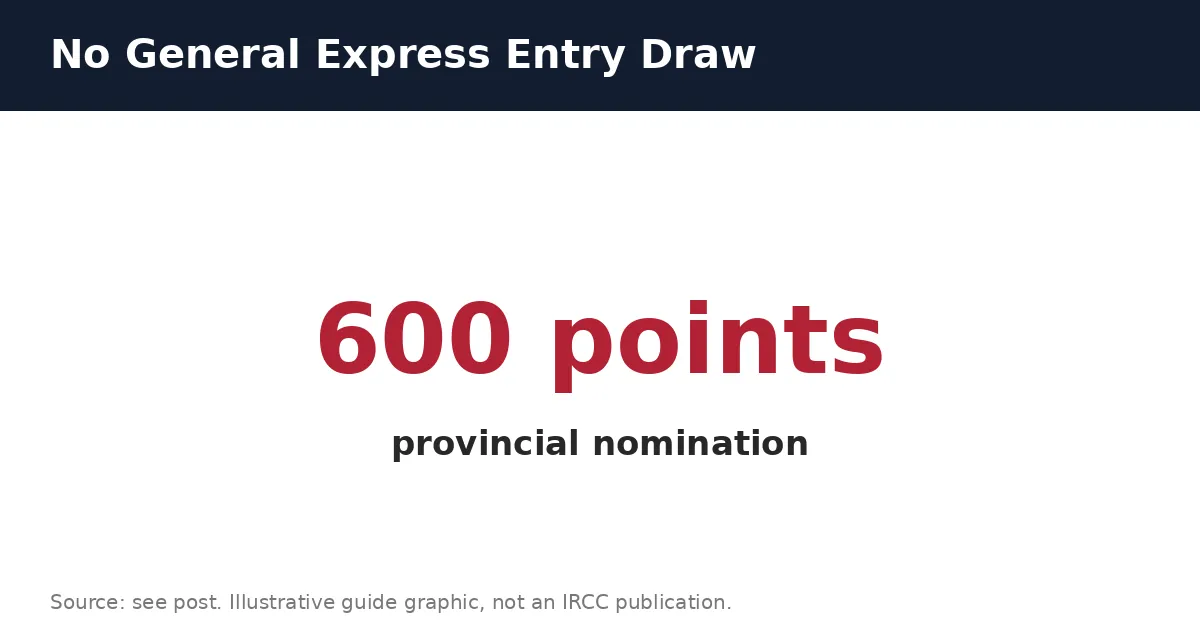
Understanding the no general express entry draw pattern starts with what a general round actually was. A general draw ranks everyone in the pool by CRS score and invites from the top down, whatever programme they qualify under. A programme-specific draw does the same thing but only within one programme — for example, only CEC candidates, or only PNP candidates (whose scores already include 600 nomination points, which is why PNP cutoffs look so high).
A category-based draw adds a second filter: you must meet the category’s own rule as well as ranking high enough. For occupation categories in 2026, that rule is at least 12 months of work experience in an eligible occupation within the past three years — a requirement IRCC raised from six months in February 2026. For the French-language category, the rule is NCLC 7 or higher in all four French abilities. Category lists change between versions, so always check your exact NOC against the current category list on canada.ca, not against an older article.
Round type | Who competes | Extra rule beyond CRS rank |
|---|---|---|
Canadian Experience Class | CEC-eligible candidates | 12 months of skilled Canadian experience |
Provincial Nominee Program | Nominees in the pool | A nomination already accepted (+600 points) |
French-language proficiency | French speakers | NCLC 7 or higher in all four abilities |
Occupation categories | Listed occupations | 12 months in an eligible occupation (2026 rule) |
General | Everyone in the pool | None — rank only |
Round types and category rules from IRCC’s rounds of invitations and category-based selection pages. For current rounds and cutoffs, see our latest-draws page.
What waiting costs with no general express entry draw
The no general express entry draw pattern makes waiting expensive: age points fall and documents expire. Waiting feels passive, but three clocks run against you while you wait. First, age points: for a single applicant, the CRS age score is 110 from age 20 to 29, then falls every year — 105 at 30, 99 at 31, 94 at 32, and so on. A birthday during a long wait can cost more than a small score improvement gains.
Second, language results expire. Results must be less than two years old when you create your profile and when you submit your application. A candidate who waits a year and then gets invited can discover the test has expired and the invitation cannot be used as-is.
Third, the profile itself expires after 12 months in the pool. An expired profile is removed, and rebuilding it costs you your original creation date — the tie-breaker when candidates share a score.
Warning:
Do not withdraw and recreate your profile during a waiting period just to “refresh” it. A new profile gets a new creation date, which hurts you in a tie. Update the existing profile instead.
Which route fits your profile with no general express entry draw
With no general express entry draw, your route is the round you already qualify for. If you have 12 months of skilled Canadian work experience, you are CEC-eligible (assuming the language minimums for your TEER are met: CLB 7 for TEER 0 or 1 work, CLB 5 for TEER 2 or 3). CEC rounds have run through 2026, and they are the closest thing to a general round for people already working in Canada.
If you have NCLC 7 in all four French abilities, you are eligible for French-language rounds regardless of where you live. French is the only category that does not depend on your occupation.
If your occupation is on a category list and you have 12 months in it, you are eligible for that category’s rounds. Check the current list: occupations move between versions, and a NOC that qualified last year may not qualify now.
If none of those apply, your realistic routes are a provincial nomination or a higher score. A nomination adds 600 points and puts you at the top of PNP rounds. A higher score comes cheapest from a language retake or, for many candidates, from French. See our guide to how to calculate a CRS score and our pool statistics page for where your score sits in the distribution.
A decision framework, in order
Apply this no general express entry draw framework in order, and do not skip to the last step first.
Real cases
Real case: waiting for a general round that does not come (forum discussion, 2026)
Candidates through 2026 repeatedly asked whether to keep waiting for a general round, noting that each round type seemed to have its own cutoff and that no single “Express Entry cutoff” existed anymore. The practical answer in those threads was consistent: a candidate who qualifies for no specific round is not waiting, they are stuck, and the fix is a new eligibility, not more patience. No outcome was reported.
Real case: PNP cutoffs look impossibly high (forum discussion, 2026)
Candidates puzzled over PNP cutoffs far above other rounds. The explanation is arithmetic, not difficulty: PNP candidates already carry 600 nomination points, so their cutoffs sit roughly 600 points above the underlying score. Comparing a PNP cutoff with a CEC cutoff is comparing two different scales. No outcome was reported.
Real case: draws feel irregular and unplannable (forum discussion, 2026)
Candidates asked how to plan a timeline around rounds they cannot forecast. The honest answer is that you cannot forecast rounds, so you plan around what you control: eligibility, score, documents and expiry dates. Rounds are IRCC’s decision; readiness is yours. No outcome was reported.
Frequently Asked Questions
What is a general Express Entry draw?
A general draw invites the highest-ranked candidates in the pool regardless of program or occupation. It is the round most candidates picture when they think of Express Entry, because it is the only round where your CRS score alone decides whether you are invited.
Has there been a general Express Entry draw in 2026?
No. There has been no general express entry draw in 2026. Rounds in 2026 have been program-specific or category-based, such as Canadian Experience Class, Provincial Nominee Program and French-language rounds, plus occupation categories. Check IRCC’s rounds page and our latest-draws page for the current picture rather than relying on any single figure here.
If there is no general draw, how do people get invited?
Through program-specific rounds, such as CEC and PNP rounds, and category-based rounds, such as French-language, healthcare, trades, transport and education rounds. Each round has its own eligibility rules, and you compete only against candidates eligible for that round. That is why eligibility matters more than raw score in 2026: a candidate who fits a category competes in a much smaller pool than the whole Express Entry pool.
Should I wait in the pool for a general draw?
With no general express entry draw in 2026, waiting is only free if nothing in your profile changes. Every month you wait, you age, your language results move closer to expiry, and your profile moves closer to its 12-month expiry. If you qualify for a program-specific or category round, that route is usually better than waiting.
Does a provincial nomination help if there is no general draw?
Yes, more than ever. A nomination adds 600 points to your profile, which puts you at the top of any round you are eligible for, including PNP rounds. It is a separate provincial application with its own rules. A nomination also changes which rounds you can win, because PNP rounds invite nominated candidates specifically, and your score after nomination is usually far above their cutoffs.
What should I do while waiting for a draw?
Raise the score where it is cheapest, usually a language retake or a spouse test, keep every document in date, and check whether you qualify for a category or provincial stream you have not applied to. Waiting without improving is the one strategy that is guaranteed to lose ground.
Final Thoughts
A general draw may return, and it may not. Either way, the candidates who get invited in 2026 are the ones who fit a round that actually runs. Find your round, keep your documents in date, and improve the score where it is cheapest. Waiting is a plan only if something is going to change while you wait — so make sure something does. In a year with no general express entry draw, the plan is simple: find your round, keep documents in date, and improve where it is cheapest.
If your situation involves a work permit expiry, a complicated status history or a previous refusal, talk to a licensed consultant (RCIC) or lawyer before you rely on this guide.
Sources
We build free Express Entry tools and track every IRCC draw. This guide was checked against official IRCC sources and real applicant reports. Last reviewed: October 29, 2026. This is general information, not legal advice. For your own case, talk to a licensed consultant (RCIC) or lawyer.