Express Entry Guide · Updated October 2026
Your listening, reading and speaking are at CLB 9, but writing sits at 6.5 and holds your whole profile back. Here is what the examiners are actually marking, and how to fix the one skill that is stuck. This IELTS writing CLB 9 guide shows what the examiners actually mark, and how to fix the one skill that is stuck.
By Aria Sterling · Checked against IRCC rules · 11 min read
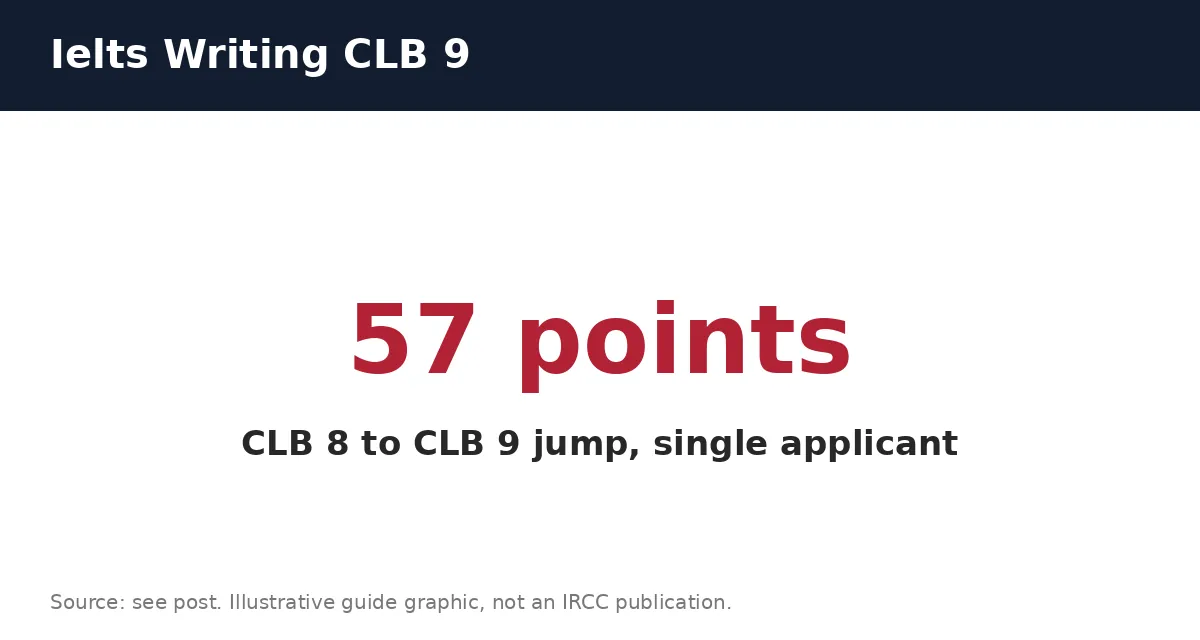
Writing at 6.5 is the single most common language complaint in Express Entry forums, and it is not a mystery. Writing 6.5 is CLB 8; writing 7.0 is CLB 9. The gap is half a band, and half a band in writing can cost you up to 57 CRS points — 32 core points plus 25 transferability points — because the whole profile waits on the weakest ability. That is why this post exists: not to tell you to “practise more”, but to show you what is marked and which of the four criteria is holding you down.
One rule first, because it shapes everything else: Express Entry requires IELTS General Training, not Academic, and it does not accept the One Skill Retake. If writing is your weak skill, the fix is a full retake with better writing — not a single-skill shortcut. See our CLB calculator to convert any score.
Evidence base: IRCC’s language-testing page and CRS criteria page, IELTS test structure as published by the test providers, and public forum threads from candidates stuck at writing 6.5. This is general information, not legal advice.
Quick answer
Quick answer:
Get your last two writing tasks marked against the four IELTS criteria by someone qualified, find the one criterion below band 7, and spend your whole study block on it. Most 6.5 writers do not have a general writing problem — they have one specific problem, usually task response or grammar range, and generic practice never touches it. An IELTS writing CLB 9 result comes from fixing one criterion, not from writing more essays.
Key takeaways
Where 6.5 sits on the CLB map
CLB level | Listening | Reading | Writing | Speaking |
|---|---|---|---|---|
CLB 7 | 6.0 | 6.0 | 6.0 | 6.0 |
CLB 8 | 7.5 | 6.5 | 6.5 | 6.5 |
CLB 9 | 8.0 | 7.0 | 7.0 | 7.0 |
CLB 10 | 8.5 | 8.0 | 7.5 | 7.5 |
Conversions from IRCC’s language-testing page. Use our CLB calculator for other tests.
The table also explains why writing feels unfair: reading jumps from 6.5 to 7.0, but listening needs 8.0 for CLB 9. Every ability has its own threshold, and the profile’s CLB is the lowest ability, not the average. One ability at CLB 8 keeps the whole first-language score at CLB 8 levels.
The four marking criteria
Every IELTS writing CLB 9 result comes down to four criteria averaged together. Every IELTS writing task is marked on four criteria, each on a 1 to 9 scale, and the band is the average. Understanding them is the whole game, because most candidates prepare for a test that does not exist — they practise vocabulary and handwriting, while the marks are lost elsewhere.
Task achievement (Task 1) and task response (Task 2). Did you answer the exact question, cover all parts of it, and develop the answer? For Task 1, a letter of at least 150 words, did you include everything the prompt asked for? For Task 2, an essay of at least 250 words, did you take a clear position and support it? An essay on a nearby topic scores poorly here, however well written.
Coherence and cohesion. Does the writing flow logically? Are paragraphs organised around one idea each, linked with connectors used correctly rather than sprinkled at random? A wall of text with no paragraphing, or paragraphs that change topic mid-way, loses marks here.
Lexical resource. Is the vocabulary wide, precise and natural? This is not about rare words — it is about the right word, spelled correctly, used in the right collocation. Repeated basic words and frequent spelling errors hold this down.
Grammatical range and accuracy. Do you use a mix of sentence types — simple, compound and complex — with few errors? A writer who only uses short simple sentences, or who makes the same error repeatedly, is capped here even if the ideas are strong.
Diagnose which criterion is holding you down
An IELTS writing CLB 9 diagnosis starts with marked practice tasks, not more unmarked writing.
Warning:
Do not buy a “guaranteed band 7” course or template pack. Memorised essays are easy for examiners to spot, and a memorised answer that does not match the question loses task response marks — the opposite of what you paid for.
An eight-week IELTS writing CLB 9 plan
Week | Focus | What you do |
|---|---|---|
1 | Diagnose | Two timed tasks, marked against all four criteria |
2–3 | Weakest criterion | Daily targeted exercises on that one criterion only |
4 | Re-test | Two more timed tasks, marked again — is the criterion at 7? |
5–6 | Second-weakest criterion | Same targeted work, plus full timed practice twice a week |
7 | Exam conditions | Full writing section, 60 minutes, both tasks, marked |
8 | Book and sit | Retake the full General Training test |
Plan structure from standard IELTS preparation practice. Test structure (Task 1 letter, Task 2 essay, 60 minutes) from the test providers.
Three practical rules make the plan work. First, write by hand if you will sit the paper test, and on a keyboard if you will sit the computer test — the medium changes your speed. Second, always write to the word minimums (150 and 250) and check the count; a Task 2 under 250 words is penalised on task response before anything else is read. Third, spend the last five minutes of each task proofreading for the errors you personally repeat — most writers have two or three, and catching them is free marks.
Mistakes that keep IELTS writing CLB 9 out of reach
Real cases
Real case: writing 6.5 while other skills are higher (forum thread, 2026)
A candidate with three skills at CLB 9 and writing at 6.5 asked what to do. The thread’s advice converged on the diagnosis step: find which criterion is below 7 before spending money on another test. No outcome was reported.
Real case: retaking the whole test for one skill (forum discussion, 2026)
Candidates repeatedly asked whether they could retake only writing. The answer, confirmed on IRCC’s language-testing page, is no for Express Entry: the One Skill Retake is not accepted, so the retake must be the full General Training test. No outcome was reported.
Real case: switching tests instead of skills (forum discussion, 2026)
Some candidates who struggled with IELTS writing asked about CELPIP, whose scores map directly to CLB levels and whose writing is typed. The sensible advice was to take a CELPIP practice test before switching — a different test is only better if your writing is actually better in it. No outcome was reported.
Frequently Asked Questions
What IELTS writing score is CLB 9?
IELTS writing CLB 9 means writing 7.0. Writing 6.5 is CLB 8. The full CLB 9 profile, often written as 8777, is listening 8.0 and reading, writing and speaking 7.0 each. For comparison, CLB 8 is listening 7.5 and 6.5 in the other three skills, so the jump to CLB 9 usually means lifting listening by half a band and the other skills by half a band each.
Why is writing stuck at 6.5 when my other skills are higher?
Because writing is marked on four criteria at once, and a single weak criterion holds the band down. Many candidates write fluently but lose marks on task response or grammar range, which reading and listening never test. The fix is therefore specific, not general: get your writing marked against the four criteria, find the one below band 7, and spend your study time on that criterion alone.
What are the four IELTS writing marking criteria?
Task achievement for Task 1 and task response for Task 2, coherence and cohesion, lexical resource, and grammatical range and accuracy. Each is marked on the same 1 to 9 scale, and the band is the average. Knowing the criteria matters because each one is scored separately, so a strong vocabulary cannot rescue a weak task response, and fluent ideas cannot rescue repeated grammar errors.
Can I retake just IELTS writing for Express Entry?
No. IRCC does not accept the IELTS One Skill Retake for Express Entry. You must retake the full General Training test, and all four abilities on your profile come from one sitting. That rule applies even when only one skill is weak, which is why candidates with three skills at CLB 9 and writing at CLB 8 must still retake the full test.
How many points is the CLB 8 to CLB 9 jump worth?
For a single applicant chasing IELTS writing CLB 9, core language points rise from 92 to 124, a gain of 32, and the education-and-language transferability combination can rise from 25 to 50, a further 25. Together that is up to 57 points. The 57-point figure assumes a post-secondary credential behind the language score; without a credential, the gain is the 32 core points alone, which is still substantial.
What is the most common writing mistake at 6.5?
Answering a different question from the one asked. Candidates write a good essay on a nearby topic instead of the exact question, and lose task response marks that no amount of vocabulary can recover. Before you write, underline every part of the question and check your finished essay against each part, because an unanswered part costs task response marks immediately.
Final Thoughts
Writing 6.5 is not a verdict on your English. It is a diagnosis waiting to happen: one criterion below 7, hiding inside an average. Find it, fix it, and retake the full test for your IELTS writing CLB 9 result. The points on the other side — up to 57 for a single applicant — are the cheapest large gain in the whole CRS system, because they cost study time, not years.
Check your new score in our CRS calculator before you update your profile, and keep the result sheet safe: results must be less than two years old at application.
Sources
We build free Express Entry tools and track every IRCC draw. This guide was checked against official IRCC sources and real applicant reports. Last reviewed: October 29, 2026. This is general information, not legal advice. For your own case, talk to a licensed consultant (RCIC) or lawyer.