Express Entry Guide · Updated October 2026
You keep hearing that French NCLC 7 is worth up to 74 points and opens a whole separate draw category. Nobody tells you how long it takes, what to study in which order, or when to book the test. Here is the plan.
By Aria Sterling · Checked against IRCC rules · 12 min read
French is the only language lever that does three things at once: it adds second-language core points, it adds a bonus of 25 or 50 points, and it makes you eligible for French-language proficiency draws, where you compete only against other French speakers. That is why so many low-score candidates ask the same question: “how long, how many hours, in what order?”
There is no official answer to the timeline question. IRCC sets the level — French NCLC 7 in all four abilities — and says nothing about how long learning takes. This post gives you our roadmap, labelled honestly as our rough guide based on learner reports, not an IRCC figure, and the rules underneath it, which are IRCC’s. The timeline below assumes roughly 8 to 12 hours of study a week; fewer hours means a longer road, not a lower target.
Evidence base: IRCC’s CRS criteria and language-testing pages, TEF Canada and TCF Canada test information, and public forum threads from learners working toward NCLC 7. This is general information, not legal advice.
Quick answer: French NCLC 7
Quick answer:
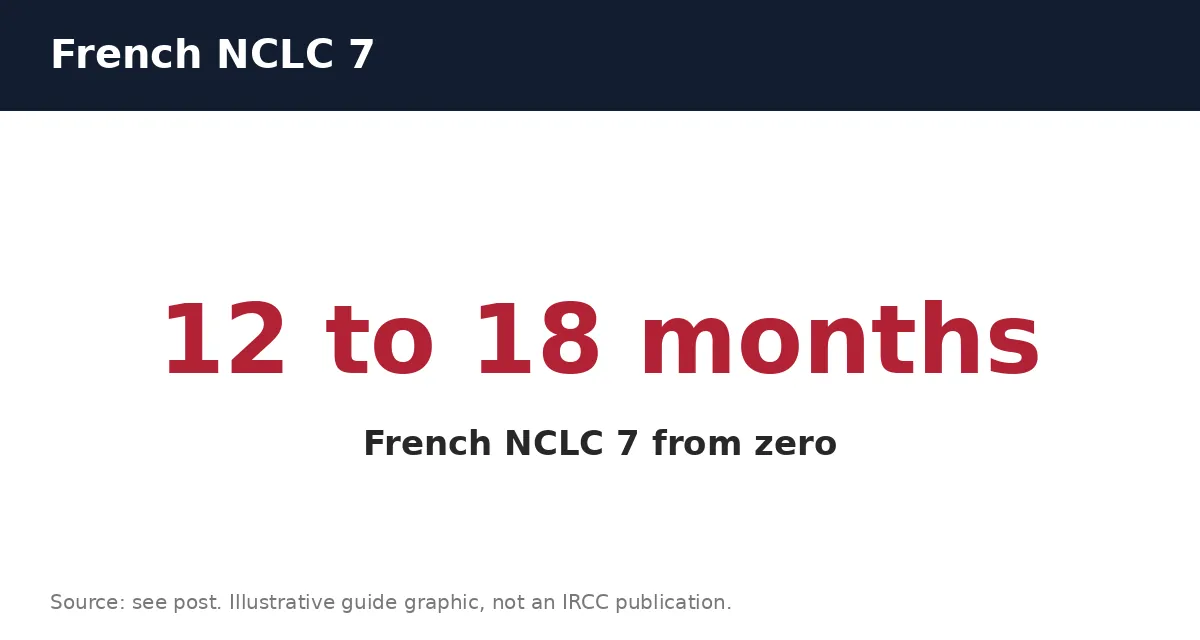
From zero, plan on 12 to 18 months at 8 to 12 hours a week — our rough guide, not an IRCC figure — working through four phases: foundations (months 1–4), intermediate grammar and vocabulary (months 5–9), all-skills fluency (months 10–14), and test preparation (months 15–18). Book the test only when a practice test puts you at French NCLC 7 in all four skills.
Key takeaways
Why French NCLC 7 is worth the effort
Component | Points | Condition |
|---|---|---|
Second-language core points | 12 | NCLC 7–8: 3 points per ability × 4 |
French bonus (strong English) | 50 | English CLB 5+ in all four abilities |
French bonus (weaker or no English) | 25 | English CLB 4 or lower in at least one ability, or no English test |
Total with strong English | 62 | 12 + 50 |
Total with weaker English | 37 | 12 + 25 |
Points from IRCC’s CRS criteria page (modified June 22, 2026). The 74-point figure sometimes quoted is 50 bonus + 24 second-language points for a candidate at NCLC 9+ in French; at NCLC 7–8 the second-language total is 12.
Beyond the points, French NCLC 7 in all four abilities makes you eligible for French-language proficiency draws, which are category rounds: you compete only against other candidates who meet the same French requirement. That eligibility is often worth more than the points themselves, because it is a separate door, not just a higher score.
The French NCLC 7 month-by-month roadmap
Phase | Months | Goal | What you do |
|---|---|---|---|
Foundations | 1–4 | Survival French | Pronunciation, present tense, everyday vocabulary, listening to slow French daily |
Intermediate | 5–9 | Connected French | Past and future tenses, connectors, reading news articles, writing short texts weekly |
Fluency | 10–14 | All-skills French | Weekly conversation practice, longer writing, listening to native-speed media, reading opinion pieces |
Test preparation | 15–18 | Exam-ready French | Practice tests in TEF or TCF format, timed writing, speaking mock tests |
Phases and durations are our rough guide based on learner reports, not IRCC figures. Timelines vary with study hours and prior language experience.
The phases matter because learners usually study in the wrong order. The most common error is spending a year on grammar books and never speaking, then discovering that speaking is the skill furthest from NCLC 7. Speaking practice belongs in the plan from month 1, even if it is only fifteen minutes a week with a tutor or a language partner. The skill you practise least is the skill that fails you.
The four-skill plan
Listening. Start with slow, clear French (learner podcasts, news in slow French), and move to native speed by month 10. The test’s listening sections use recordings at natural speed, so slow French alone will not get you there.
Reading. Read a short news article every day from month 3. At NCLC 7 you need to follow argument and opinion, not just facts, so opinion pieces and editorials matter more than simple texts as you advance.
Writing. Write something every week from month 2, even a few sentences. Writing is the skill most learners leave last, and it is the one that needs the most correction — a tutor or teacher marking your texts is worth more than any app.
Speaking. Speak every week from month 1. Record yourself answering a question, listen back, and fix the pronunciation and grammar you hear. By the test phase, you should be doing full mock speaking tests under time pressure.
Tip:
If you already speak another Romance language (Spanish, Italian, Portuguese, Romanian), your vocabulary will come faster, but your grammar will still need the same work. Do not skip phases because the vocabulary feels easy — the test measures all four skills, not just word recognition.
Choosing the test for French NCLC 7
Both TEF Canada and TCF Canada are accepted by IRCC, and neither gives an advantage. The choice is practical: which format suits you, and which centre is available near you. TEF Canada’s reading is scored out of 300, listening out of 360, and writing and speaking out of 450 each. TCF Canada’s listening and reading are scored out of 699, and writing and speaking out of 20. The formats differ in task types and timing, so take a practice test in each before you choose. Our full comparison is in our TEF vs TCF Canada guide (topic 10 in this series) — and remember the TEF trap: enter the “Équivalence ancien score” column in your profile, not the /699 column. Convert any French score with our CLB calculator.
Book the test only when a practice test scores you at French NCLC 7 or higher in all four skills. Testing early wastes the fee and, worse, uses up your confidence. And mind the validity clock: results must be less than two years old when you create your profile and when you submit your application, so do not test a year before you will use the results.
Warning:
Do not enter French results in your profile until you have NCLC 7 in all four abilities. A single skill below NCLC 7 means no bonus at all — entering partial French results does not give partial bonus points.
Mistakes that add months
Real cases
Real case: “How long does French take?” (forum discussion, 2026)
Candidates repeatedly asked for a timeline from zero to NCLC 7, and the honest answers all said the same thing: it depends on hours, and a year of casual study is not enough. The roadmap above is the structured version of that answer. No outcome was reported.
Real case: French bonus confusion (forum thread, 2026)
Candidates asked why they received 25 bonus points instead of 50, or no bonus at all. The answer was usually one of two things: an English ability below CLB 5 (which gives 25, not 50), or a French ability below NCLC 7 (which gives zero). Both rules are in the bonus table above. No outcome was reported.
Real case: learning French while working full-time (forum discussion, 2026)
Learners balancing full-time work asked how to fit French in. The practical answer was small daily habits — listening during a commute, one written text a week, one speaking session a week — sustained for over a year, rather than intense bursts that collapse. No outcome was reported.
Frequently Asked Questions
How long does it take to learn French to NCLC 7 from zero?
There is no official timeline, and anyone who promises one is guessing. As a rough guide based on learner reports, not an IRCC figure, many learners take 12 to 18 months of steady study from zero to reach NCLC 7 in all four skills. Your time depends on study hours, prior languages and consistency.
What is NCLC 7 in French?
NCLC 7 is an intermediate level on the Canadian Language Benchmarks for French. For Express Entry it is the threshold that unlocks the French bonus points and eligibility for French-language proficiency draws. You need NCLC 7 or higher in all four abilities: listening, reading, writing and speaking.
How many points is French at NCLC 7 worth?
Up to 74 points: second-language core points of 3 per ability, or 12 in total, plus a bonus of 25 points if your English is CLB 4 or lower in at least one ability, or 50 points if your English is CLB 5 or higher in all four abilities. Those 74 points are the headline reason French NCLC 7 is worth the work.
Which French test should I take, TEF Canada or TCF Canada?
Both are accepted by IRCC and neither gives an advantage. Choose by format: TEF Canada’s reading and listening use different scales and task types from TCF Canada’s, and centre availability differs by city. Take a practice test in each format before choosing.
Do I need NCLC 7 in all four skills, or just overall?
All four. A single skill below NCLC 7 means no French bonus at all and no eligibility for French-language draws. The weakest skill decides, exactly as with English. That rule is absolute: three skills at NCLC 7 and one at NCLC 6 gives no bonus and no category eligibility, so the weakest skill is the one that decides everything. There is no partial credit here: French NCLC 7 means all four skills, not an average.
How many hours a week should I study French?
As a rough guide, not an IRCC figure, learners aiming for NCLC 7 in 12 to 18 months typically study 8 to 12 hours a week, split across all four skills, with speaking practice every week. Fewer hours means a longer timeline, not a lower target.
When should I take the French test?
When a practice test scores you at NCLC 7 or higher in all four skills. Test results must be less than two years old at profile creation and at application, so do not test far ahead of when you will use the results.
What if I already speak some French?
Take a placement test first. Many learners overestimate their level, especially in writing and speaking, which are the skills most often below NCLC 7. A placement result tells you which months of this roadmap you can skip and which you cannot.
Final Thoughts
French NCLC 7 from zero is a year-plus project, not a shortcut, and that is exactly why it is valuable: most candidates will not do it, which is why French-language rounds exist. Start with speaking practice in week one, study all four skills every week, and book the test only when a practice test says you are ready. The points — and the separate draw category — are the reward for the months, not a substitute for them.
Check what French would add to your score in our CRS calculator, and talk to a licensed consultant (RCIC) or lawyer if your history involves a refusal or a complex status question.
Sources
We build free Express Entry tools and track every IRCC draw. This guide was checked against official IRCC sources and real applicant reports. Last reviewed: October 29, 2026. This is general information, not legal advice. For your own case, talk to a licensed consultant (RCIC) or lawyer.