Express Entry Guide · Updated October 2026
Two French tests, two score columns on one of them, and a trap that can cost you your application. Here is how to choose in TEF vs TCF Canada, what NCLC 7 looks like on each test, and which column to enter.
By Aria Sterling · Checked against IRCC rules · 11 min read
Every French-speaking Express Entry candidate faces the same fork: TEF Canada or TCF Canada. Both are accepted by IRCC. Neither gives an advantage. And yet forums are full of candidates asking which one is “easier” or “preferred”, and full of candidates who entered the wrong TEF score column and only discovered it when their application was in trouble.
This post settles both questions: the comparison, and the trap. It gives you the NCLC 7 scores for both tests, the formats side by side, and the exact column to use. Convert any result with our CLB calculator.
Evidence base: IRCC’s language-testing page and NCLC conversion tables, TEF vs TCF Canada test information, and public forum threads from candidates who hit the score-column problem. This is general information, not legal advice.
Quick answer
Quick answer:
Take the test whose format suits you and whose centre is available near you — IRCC accepts both equally. If you take TEF Canada, enter the “Équivalence ancien score” column in your profile, never the /699 column. Entering the /699 column gives IRCC the wrong numbers and can lead to refusal.
Key takeaways
TEF vs TCF Canada, side by side
Section | TEF Canada | TCF Canada |
|---|---|---|
Listening | 40 minutes | 35 minutes, 39 multiple-choice questions |
Reading | 60 minutes | 60 minutes, 39 multiple-choice questions |
Writing | 60 minutes | 60 minutes, 3 tasks (60–120, 120–150, 120–180 words) |
Speaking | About 15 minutes | About 12 minutes, 3 tasks with an examiner |
Total | About 2 hours 55 minutes | About 2 hours 47 minutes plus administration |
Formats from TEF vs TCF Canada test information. Total times exclude registration and breaks.
The formats differ in feel. TCF Canada’s listening and reading are multiple-choice, which suits candidates who are comfortable eliminating wrong answers under time pressure. TEF Canada’s sections use a wider mix of task types. TCF Canada’s speaking has three distinct tasks — a short guided interview, an interaction where you ask questions, and a point-of-view task — while TEF Canada’s speaking is a shorter face-to-face section. Neither format is objectively easier; each one suits a different candidate.
TEF Canada scores and the ancien score trap
TEF Canada results show two score columns, and this is where the trap lives. One column is the newer scale, which scores reading and listening out of 699. The other column is labelled “Équivalence ancien score” — the old-score equivalence — and it is the column IRCC uses to convert your results to NCLC levels.
Warning — the trap: Enter the Équivalence ancien score column in your Express Entry profile, NOT the /699 column. The /699 numbers look like scores, and the form will accept them, but they convert to the wrong NCLC levels. Candidates who entered the /699 column have had their language evidence questioned, and entering wrong levels can lead to refusal.
NCLC | Speaking (/450) | Listening (/360) | Reading (/300) | Writing (/450) |
|---|---|---|---|---|
10 | 393–450 | 316–360 | 263–300 | 393–450 |
9 | 371–392 | 298–315 | 248–262 | 371–392 |
8 | 349–370 | 280–297 | 233–247 | 349–370 |
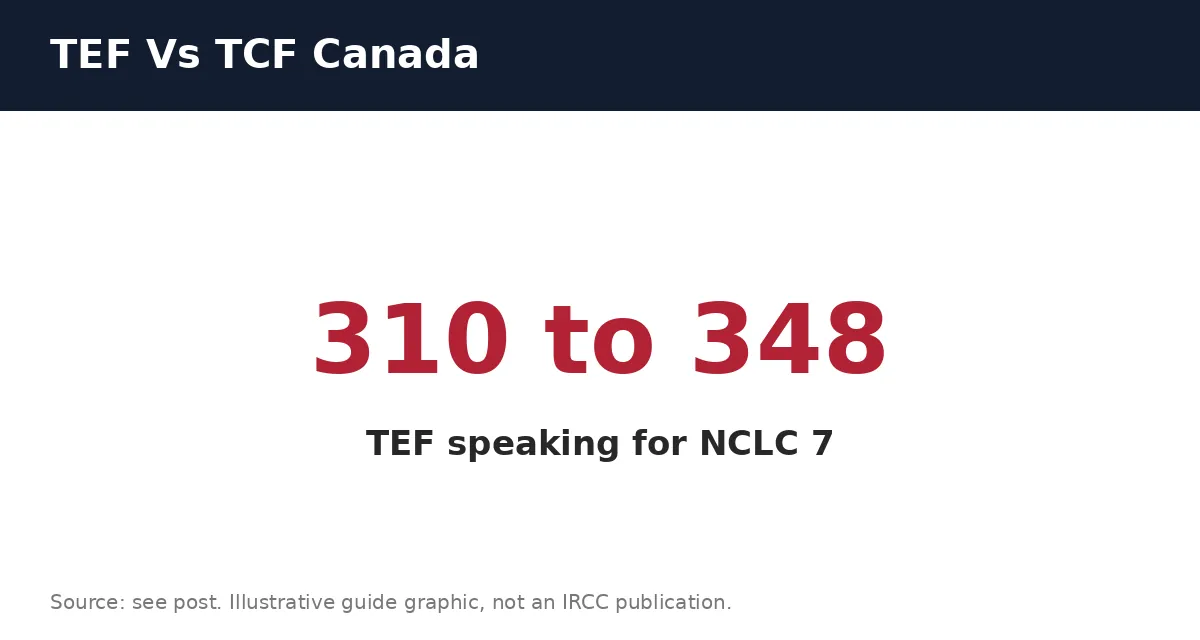
7 | 310–348 | 249–279 | 207–232 | 310–348 |
6 | 271–309 | 217–248 | 181–206 | 271–309 |
5 | 226–270 | 181–216 | 151–180 | 226–270 |
4 | 181–225 | 145–180 | 121–150 | 181–225 |
NCLC conversion from IRCC’s language-testing page (Équivalence ancien score column). Reading is scored out of 300, listening out of 360, writing and speaking out of 450 each.
Read the NCLC 7 row carefully: speaking and writing both need 310 or higher, but listening needs only 249 and reading only 207. The scales are different, so the raw numbers are not comparable across skills. A listening score of 260 is NCLC 7; a speaking score of 260 is NCLC 5. That is why the column matters, and why you should convert each skill separately rather than averaging anything.
TCF Canada scores
TCF Canada has no equivalent trap: its scores convert directly, with listening and reading out of 699 and speaking and writing out of 20.
NCLC | Listening (/699) | Reading (/699) | Speaking (/20) | Writing (/20) |
|---|---|---|---|---|
10 | 549–699 | 549–699 | 16–20 | 16–20 |
9 | 523–548 | 524–548 | 14–15 | 14–15 |
8 | 503–522 | 499–523 | 12–13 | 12–13 |
7 | 458–502 | 453–498 | 10–11 | 10–11 |
6 | 398–457 | 406–452 | 7–9 | 7–9 |
5 | 369–397 | 375–405 | 6 | 6 |
4 | 331–368 | 342–374 | 4–5 | 4–5 |
NCLC conversion from IRCC’s language-testing page. Listening and reading are scored out of 699; speaking and writing out of 20.
Note how narrow the TCF speaking and writing bands are: NCLC 7 is 10–11 out of 20, and NCLC 6 is 7–9. A single task’s performance can move you across a band, which is why TCF speaking and writing practice under exam conditions matters more than raw study time.
How to choose in TEF vs TCF Canada
Tip:
Whatever test you choose, your profile uses one test sitting for French in TEF vs TCF Canada, just as English uses one sitting. You cannot combine a TEF listening score with a TCF speaking score.
TEF vs TCF Canada: what to do if you entered the wrong column
If you took TEF Canada and you suspect you entered the /699 column, do not wait for IRCC to find it. Open your result sheet, find the column headed “Équivalence ancien score”, and convert each skill again from that column. Then update your Express Entry profile with the corrected NCLC levels before you receive an invitation or submit an application, whichever comes first. Correcting a profile is straightforward; correcting an application after submission is not.
If you have already submitted an application with the wrong column entered, talk to a licensed consultant (RCIC) or lawyer promptly about how to correct the record — do not simply hope the error goes unnoticed, because language evidence is checked against the test record, and a mismatch between what you entered and what the test centre holds is exactly the kind of discrepancy that triggers further questions.
The same advice applies in reverse: if you are unsure which column you used, check now. It takes five minutes with the result sheet in hand, and it is the cheapest insurance in this whole post. Candidates who discover the error themselves, before IRCC does, are in a far better position than candidates who discover it in a procedural fairness letter.
Real cases
Real case: two score columns, which one? (forum thread, 2026)
A candidate with TEF results asked which of the two columns to enter in the profile. The answer — the Équivalence ancien score column — is the single most valuable fact in this post, and it is the one most often missed, because the /699 column looks like the “real” score. No outcome was reported.
Real case: “Which test is easier?” (forum discussion, 2026)
Candidates repeatedly asked which test is easier. The honest answer is that neither is easier in general: the formats suit different candidates, and the only way to know is a practice test in each. Candidates who chose on forum reputation rather than practice often regretted it. No outcome was reported.
Real case: one skill below NCLC 7 (forum thread, 2026)
A candidate with three skills at NCLC 7 and one at NCLC 6 asked whether they still got partial French points. They did not: a single skill below NCLC 7 means no French bonus at all. The fix is to retake the full test with the weak skill improved. No outcome was reported.
Frequently Asked Questions
Which French test is better for Express Entry, TEF Canada or TCF Canada?
Neither. Both are accepted by IRCC, both convert to NCLC levels, and neither gives an advantage. Choose by format and centre availability, not by a supposed IRCC preference, because there is none. The practical differences are format, timing and centre availability, so the right choice is the test you practise better in and can actually book near you. That is the whole TEF vs TCF Canada decision: format and availability, not IRCC preference.
What is the TEF Canada ancien score trap?
TEF Canada results show two score columns. IRCC uses the Équivalence ancien score column. Entering the other column, which uses a /699 scale for reading and listening, gives IRCC the wrong numbers and can lead to refusal. The /699 column is a newer scale for reading and listening, and it looks like the natural score to enter, which is exactly why the mistake is so common.
What are the TEF Canada scores for NCLC 7?
Using the ancien score column: speaking 310 to 348, listening 249 to 279, reading 207 to 232, and writing 310 to 348. Reading is scored out of 300, listening out of 360, and writing and speaking out of 450 each.
What are the TCF Canada scores for NCLC 7?
Listening 458 to 502, reading 453 to 498, speaking 10 to 11, and writing 10 to 11. Listening and reading are scored out of 699, and speaking and writing out of 20. For comparison, NCLC 8 on TCF Canada is listening 503 to 522 and reading 499 to 523, with speaking and writing at 12 to 13, so the NCLC 7 bands are narrow.
How long are French test results valid for Express Entry?
Results must be less than two years old when you create your Express Entry profile and when you submit your permanent residence application. Expired results at application can mean refusal. Plan your test date backwards from when you will apply, so the results are still comfortably inside the two-year window at both profile creation and application.
What if one skill is below NCLC 7?
Then you get no French bonus at all and no French-category eligibility. The weakest skill decides, exactly as with English. You need NCLC 7 or higher in all four abilities. The only fix is to raise the weak skill to NCLC 7 and retake the full French test, because Express Entry has no partial bonus and no single-skill retake for French.
Where do I enter my French results in my profile?
In the language section of your Express Entry profile, using the NCLC levels your results convert to. For TEF Canada, convert from the Équivalence ancien score column, not the /699 column. Double-check the conversion for each skill separately, because the scales differ across skills, and a single misread number can change the NCLC level you claim. For TEF vs TCF Canada, the entry step is the same either way; the TEF column choice is where errors happen.
Final Thoughts
The choice in TEF vs TCF Canada is a format choice, not a strategy choice — take a practice test in each, pick the one that suits you, and check centre availability. The real strategy is the column: if you take TEF, use the Équivalence ancien score column, and double-check it before you submit. That one check is worth more than any amount of test preparation, because a correct test with the wrong column entered is a correct test wasted.
Check what your French results add in our CRS calculator, and talk to a licensed consultant (RCIC) or lawyer if your history involves a refusal or a disputed language result.
Sources
We build free Express Entry tools and track every IRCC draw. This guide was checked against official IRCC sources and real applicant reports. Last reviewed: October 29, 2026. This is general information, not legal advice. For your own case, talk to a licensed consultant (RCIC) or lawyer.