Express Entry Guide · Updated October 2026
You worked all through your degree — so why does one Express Entry program count those years and another throw them out?
By Aria Sterling · Checked against IRCC rules · 12 min read
Work while studying Canada is a classic split-rule problem. The same part-time job, done while you were a full-time student, counts toward one program’s requirements, counts for CRS points in one country but not the other, and counts for nothing in a third program. Candidates who do not know the split either under-claim (leaving FSW eligibility on the table) or over-claim (building a CEC application on months that will be deleted at the application stage).
This post maps the whole work while studying Canada split in one place: FSW versus CEC versus the Federal Skilled Trades Program, and eligibility versus CRS ranking points, and Canada versus abroad. Read it before you enter a single student job into your profile.
Evidence base: IRCC’s Help Centre answers and program instructions on canada.ca, plus paraphrased reports from public applicant threads. This is general information, not legal advice.
Quick answer:
For work while studying Canada, student work gained while studying in Canada or abroad counts toward FSW minimum requirements if it was paid by wages or commissions, continuous (no gaps), and meets all other program requirements — including co-op terms and apprenticeships. It does not count toward CEC or Federal Skilled Trades minimum requirements. For CRS ranking points, the split flips by location: Canadian work gained while a full-time student does not count, but foreign work gained while a full-time student does.
Key takeaways
The Full Split, in One Table
There are three questions hiding inside “does student work count?”, and each has a different answer. First: does it count toward a program’s minimum requirements (eligibility)? Second: does it count toward CRS ranking points? Third: where was the work done? Keep the three questions separate and the whole topic becomes manageable.
Question | Work in Canada while studying | Work abroad while studying |
|---|---|---|
Counts toward FSW minimum requirements? | Yes, if paid, continuous, skilled and otherwise qualifying | Yes, same conditions |
Counts toward CEC minimum requirements? | No — including co-op | Not Canadian experience at all |
Counts toward FST minimum requirements? | No | Not Canadian experience at all |
Counts toward CRS ranking points? | No — Canadian student work excluded | Yes — foreign student work counts |
Source: IRCC Help Centre answers on canada.ca (work experience gained while studying). This table is our summary of those answers, not IRCC text.
Work While Studying Canada: FSW, Where Student Work Counts
Under work while studying Canada rules, the Federal Skilled Worker Program’s work requirement is one year of continuous, paid, skilled work (TEER 0, 1, 2 or 3) in the last ten years. IRCC’s Help Centre confirms that work experience gained while you were a student counts toward the FSW minimum requirements, whether the study was in Canada or abroad, as long as it was paid by wages or commissions, was continuous (no gaps in employment), and meets all the other program requirements. That expressly includes co-op terms and apprenticeships.
Three conditions deserve emphasis for work while studying Canada. “Paid by wages or commissions” excludes unpaid internships and volunteer work, however skilled. “Continuous” means no gaps — a student job with a summer break in the middle may break the continuity FSW requires, depending on the exact pattern. And “meets all other program requirements” includes skill level: a part-time retail job while studying is not skilled work, so it does not help FSW even though it was paid and continuous. The student-work rule opens a door; it does not remove the other tests.
This is genuinely good news for a large group: international students who worked skilled part-time jobs abroad before coming to Canada, and students in Canada whose part-time work was skilled. That history can make you FSW-eligible even before you have a single post-graduation year in Canada. Test it properly: use the FSW points calculator and check your six-factor score, and remember that FSW eligibility also requires the 67-point grid, language minimums and settlement funds.
CEC and FST: Where Student Work Does Not Count
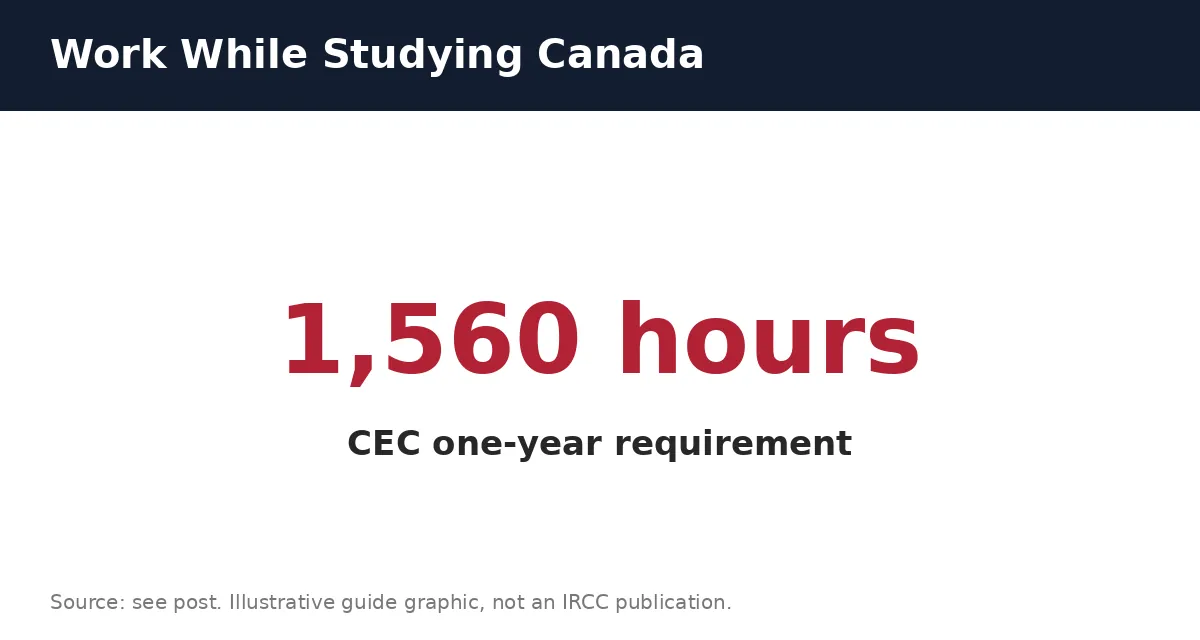
For work while studying Canada, the Canadian Experience Class requires at least one year (1,560 hours) of skilled work in Canada in the three years before applying, in TEER 0, 1, 2 or 3, while authorised to work, through third-party employment. IRCC’s guidance is explicit that work gained while a full-time student does not count toward CEC — and that includes co-op terms, even though co-op work is authorised and paid and often highly skilled. The same exclusion applies to the Federal Skilled Trades Program’s minimum requirements.
Why the work while studying Canada difference? The programs are designed for different people. FSW is a points-based selection system that rewards a history of skilled work wherever it happened. CEC is designed to reward people who have already worked in Canada after their studies, in the Canadian labour market, as graduates. Student work, in that design, is part of studying, not part of post-study Canadian work experience. You can disagree with the policy, but you cannot negotiate with it in your profile.
The practical consequence is timing. A student who graduates and immediately starts skilled work under a post-graduation work permit starts building CEC eligibility on day one of that job — the graduation line is the line that matters. Work before graduation, even in the same job with the same employer, does not count. If you stayed with the same employer across graduation, only the post-graduation months count for CEC.
Tip:
If you worked for the same employer before and after graduation, get the reference letter to separate the two periods explicitly, with the graduation date as the dividing line. A single merged period forces the officer to guess where student work ended — and guessing usually costs you months.
Work While Studying Canada: CRS Ranking Points and the Location Flip
Here is the part most people miss about work while studying Canada, because it feels backwards. For CRS ranking points — the score that decides invitations — Canadian work gained while a full-time student does not count, but foreign work gained while a full-time student does count. So a part-time skilled job done while studying abroad can add CRS foreign-experience points, while the identical job done while studying in Canada adds no Canadian-experience points.
This asymmetry is why the work while studying Canada question cannot be answered with a single yes or no. A candidate abroad with two years of part-time skilled work during a degree may already hold CRS foreign-experience points and transferability combinations. A candidate in Canada with the same two years holds none of that — but may hold FSW eligibility, and will start building CEC eligibility the day they graduate and start working. Both candidates are in a good position; they are just in different positions, and their strategies should differ.
Worked example for work while studying Canada, using our rough guide (not IRCC’s): consider two candidates, each with a bachelor’s degree and strong language scores. Candidate A worked part-time as a junior analyst while studying abroad for two years, then moved to Canada. Those two years can count as foreign work experience for CRS. Candidate B worked the same job while studying in Canada. Those two years count for FSW eligibility but add no CRS Canadian-experience points. Candidate B’s fastest route to a higher score is usually a post-graduation year of skilled Canadian work — which adds Canadian experience points and, with strong language, transferability points on top.
Traps and Mistakes
Real Cases
Real case: Co-op counted for nothing under CEC (2022)
A student who had completed multiple co-op terms in skilled roles asked whether the co-op months counted toward CEC. The thread’s answer was unanimous and correct: no, work gained while a full-time student, including co-op, does not count for CEC. The student’s CEC clock started only after graduation, under a post-graduation work permit. No outcome was reported.
Real case: Part-time work abroad during a degree (2023)
A candidate who had worked part-time in a skilled role while studying abroad asked whether those years were wasted. Posters pointed to the location flip: foreign student work counts toward CRS foreign experience, unlike Canadian student work. The candidate’s history was worth points, not nothing — but only as foreign experience, and only if paid and skilled. No outcome was reported.
Real case: Same employer, before and after graduation (2024)
A graduate who had stayed with the same employer across graduation asked how to present the history. The thread’s advice was to split the record at graduation: student months for FSW purposes, post-graduation months for CEC. A single merged employment period risked the officer treating the whole period as student work, or rejecting the split altogether. No outcome was reported.
Real case: FSW eligibility from student work alone (2021)
A candidate with a degree and skilled part-time work done while studying asked whether FSW was even open to them. The thread’s answer — that student work counts toward FSW minimum requirements if paid, continuous and skilled — surprised the candidate, who had assumed only post-graduation work counted anywhere. The candidate’s next step was the FSW points grid, not another year of waiting. No outcome was reported.
Frequently Asked Questions
Does work I did while studying count for Express Entry?
It depends on the program and where the work was done. Student work counts toward FSW minimum requirements if it was paid, continuous and otherwise qualifying, but it does not count toward CEC or Federal Skilled Trades minimum requirements. That three-way split is the whole topic in one sentence, and every student-work question should be answered by naming the program first, before judging the job. For work while studying Canada, naming the program first is the rule that keeps the answer straight.
Does co-op work count for the Canadian Experience Class?
No. Work gained while a full-time student, including co-op terms, does not count toward CEC. CEC requires skilled work in Canada after your studies, while authorised to work, through third-party employment. Co-op work is authorised, paid and often highly skilled, but it is still student work in the program’s design, so the CEC clock starts only after graduation, under a post-graduation work permit.
I worked part-time while studying abroad. Does it count for CRS points?
Yes, potentially. Foreign work gained while a full-time student does count toward the CRS ranking score, unlike Canadian work gained while a full-time student. It must still be paid and skilled in a TEER 0, 1, 2 or 3 occupation, and it must be documented like any other foreign experience — a part-time skilled job abroad during a degree is real CRS foreign experience, not a footnote. That is the work while studying Canada location flip in action.
I worked part-time while studying in Canada. Does it count for CRS points?
No, not as Canadian work experience for the ranking score. Canadian work gained while a full-time student is excluded from the CRS score, even though the same work might count toward FSW minimum requirements. The asymmetry feels backwards, but it is the rule: location flips the CRS treatment, so identical jobs in different countries produce different points, and your strategy should reflect that.
Does work after graduation on a post-graduation work permit count for CEC?
Yes. Once you are no longer a full-time student and are working under an open work permit after graduation, skilled, authorised, third-party work in Canada counts toward CEC normally. The graduation line is the line that matters: work before it does not count, work after it does, even with the same employer. Get the reference letter to separate the two periods explicitly at the graduation date.
Can student work help me meet the FSW one-year requirement?
Yes, if it was paid by wages or commissions, continuous with no gaps, skilled, and meets all other FSW requirements, including co-op terms and apprenticeships. Student work in Canada or abroad can both count for FSW, which surprises many candidates who assumed only post-graduation work counted anywhere. Unpaid internships do not count, however skilled, because FSW requires pay.
Do I need to have been authorised to work while studying?
Yes. Work done without authorisation does not count, and work on a study permit must respect the permit’s conditions. Unauthorised work is excluded even if it was paid and skilled, in every program, because authorisation is a threshold condition, not a scoring factor. Keep your permits, study records and employment records aligned so the authorisation question never becomes a dispute.
Should I list student jobs in my Express Entry profile?
Yes, honestly, in your work history. Listing a job is not the same as claiming it for points: jobs you list but do not claim do not need to meet the program tests, but hiding a job is misrepresentation. A complete, honest history with clearly claimed and unclaimed periods is easier for an officer to approve than a history with unexplained gaps that invite questions.
Final Thoughts
Student work is not wasted work — but under work while studying Canada it is program-specific work, and the program matters more than the job. If your history is mostly student work, FSW is your friend and CEC is not, yet. If your student work was abroad, it may already be worth CRS foreign-experience points. And the day you graduate, the rules change in your favour: post-graduation skilled work in Canada builds CEC eligibility from day one.
Map your own history against the work while studying Canada table in this post, split pre- and post-graduation employment at the graduation date, and test both routes — FSW and CEC — in the CRS calculator before you decide which program to build your profile around. For a history that mixes study, co-op and post-graduation work, talk to a licensed consultant (RCIC) or lawyer.
Sources
We build free Express Entry tools and track every IRCC draw. This guide was checked against official IRCC sources and real applicant reports. This is general information, not legal advice. For your own case, talk to a licensed consultant (RCIC) or lawyer.
Last reviewed: October 29, 2026
Additional Details — Name: Work While Studying Canada in 2026: FSW vs CEC Rules · Description: Work while studying Canada: student work counts for FSW but not CEC, and foreign student work counts for CRS points while Canadian work does not.