Express Entry Guide · Updated October 2026
Forums will tell you one ECA body is “better” than the others — but for Express Entry points, they are all equal. The real question is which one works best for your documents.
By Aria Sterling · Checked against IRCC rules · 12 min read
The WES vs IQAS question is the one candidates agonise over, mostly for the wrong reason: choosing between WES, IQAS, ICES and CES for an Educational Credential Assessment (ECA) is a decision worth getting right. The most common forum question, “which body gives more points?”, has a boring answer: none of them. IRCC accepts all five general designated organisations equally, and your CRS points depend on the assessed credential (a bachelor’s, a two-year diploma, two or more credentials), not on the logo on the report.
So the real WES vs IQAS comparison is practical: which body can actually assess your credential, with documents your institution will actually send, in a timeframe you can live with. This post compares all five general bodies — including ICAS, the fifth body most comparisons forget — plus the two profession-specific bodies, and gives you a decision framework instead of a ranking.
Evidence base: IRCC’s designated-organisations list and ECA guidance on canada.ca, plus paraphrased reports from public applicant threads. Fees and processing times are deliberately not stated here — they vary by body and change often; check the body’s own site.
Quick answer:
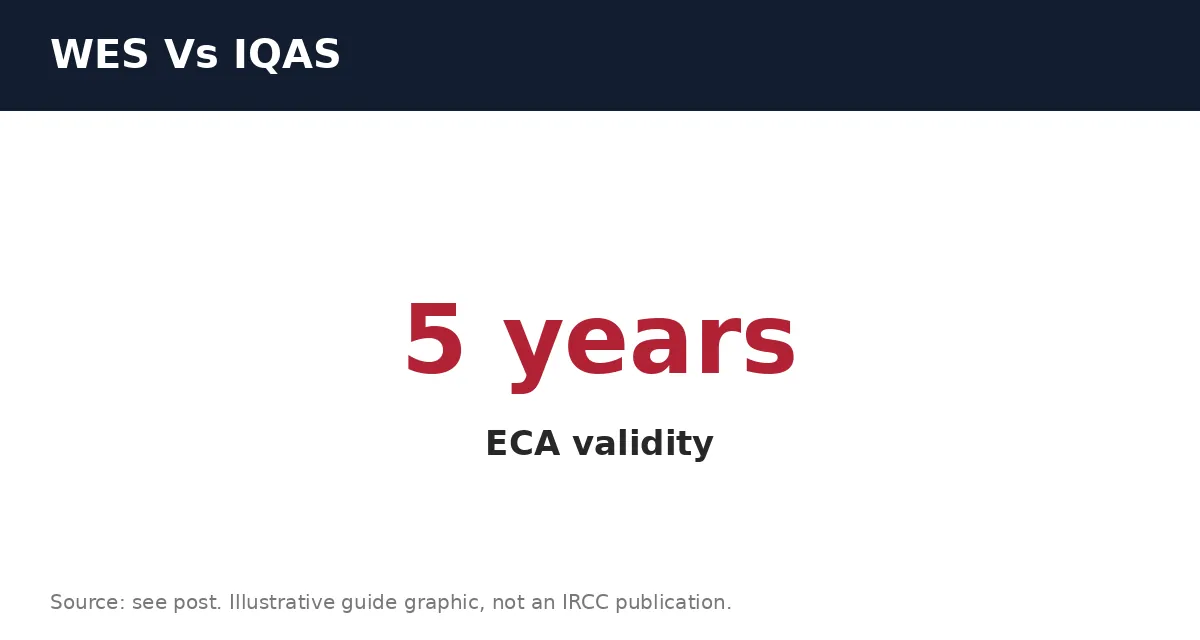
For WES vs IQAS, pick the body whose document requirements your university can meet, for the credential you are claiming. If you are a physician, use the Medical Council of Canada; if you are a pharmacist needing a licence, use the Pharmacy Examining Board of Canada — those are mandatory, not choices. For everyone else, all five general bodies are accepted equally, your ECA is valid for five years, and the points come from the assessed credential, not the body.
Key takeaways
The Five General Bodies, and the Two Special Ones
IRCC designates seven organisations for ECAs, and the WES vs IQAS comparison is the one most candidates start with. Five are general, meaning they assess a wide range of credentials from many countries: World Education Services (WES), the International Credential Assessment Service of Canada (ICAS), the International Qualifications Assessment Service (IQAS), the Comparative Education Service of the University of Toronto (CES), and the International Credential Evaluation Service (ICES). The other two are profession-specific: the Medical Council of Canada (MCC) for physicians and the Pharmacy Examining Board of Canada (PEBC) for pharmacists.
The distinction matters because the profession-specific bodies are not options — and that distinction sits outside the WES vs IQAS choice — they are requirements. A physician’s primary medical diploma must be assessed by the MCC (for the NOCs covering specialist physicians, general practitioners and family physicians, among others). A pharmacist who needs a licence to practise must use the PEBC. If you are in one of those professions, the WES-versus-IQAS debate does not apply to your main credential, and this post’s companion guide on doctors and pharmacists (post 21 in this series) covers the details.
For everyone else, the general bodies are interchangeable in IRCC’s eyes — which is why WES vs IQAS is a documents question, not a points question. An ECA report from any of them, assessing the same credential the same way, produces the same CRS education points. That is the single most important sentence in this post, because it kills the most expensive mistake in the ECA process: paying for a second assessment from another body in the hope of more points, when the first assessment was already correct.
WES vs IQAS: Comparing Them on What Actually Matters
Since points are equal, the WES vs IQAS comparison turns on practical factors. The table below is a qualitative comparison — fees and processing times are left out on purpose, because they vary by body, by country and by year, and any number printed here would be stale within months. Check the body’s own published information at the time you apply.
Body | Known for | Watch out for |
|---|---|---|
WES (World Education Services) | Largest volume, widely used, clear online document checklists by country | Strict document rules: sealed transcripts sent by the institution are typically required; incomplete documents stall the file |
ICAS (International Credential Assessment Service of Canada) | Long-established Canadian assessment service, broad credential coverage | Often the body people forget exists — worth checking when another body’s requirements do not fit your documents |
IQAS (International Qualifications Assessment Service) | Alberta-based, frequently chosen by candidates whose institutions struggle with other bodies’ routes | Document requirements differ from WES; do not assume one body’s checklist applies to another |
CES (Comparative Education Service, University of Toronto) | University-based assessment, strong for academic credentials | University processes can be slower at peak times; check current timelines before choosing on speed |
ICES (International Credential Evaluation Service) | British Columbia-based, another full general option | Same advice as the rest: the document checklist for your country and institution is what matters, not the body’s reputation |
Source: IRCC’s designated-organisations list on canada.ca. Body descriptions are our qualitative summary, not IRCC text. Fees and timelines: check each body’s own site — they change.
The factor that decides most ECA timelines in any WES vs IQAS choice is not the body at all — it is your institution. Every general body needs documents that come from, or are verified by, the institution that issued your credential: transcripts, degree certificates, or verification, depending on the body and the country. If your university is slow, uncooperative or closed, the ECA will be slow whatever body you chose. That is why this post’s companion guide on getting transcripts moving (post 22 in this series) matters more to your timeline than the body comparison itself.
Assessment outcomes can differ between bodies, so a WES vs IQAS decision can change your assessed level, especially for credentials that do not map neatly onto Canadian levels — three-year bachelor’s degrees, professional diplomas, and combined credentials are the classic examples. A difference is not automatically an error: bodies apply their own comparability frameworks. If a result looks wrong, use the body’s review or appeal route first, and get advice before paying for a second full assessment elsewhere. A second assessment that agrees with the first has cost you money and time for nothing.
A Decision Framework: WES vs IQAS and Which Body for You
Work through these questions in order, and the WES vs IQAS choice usually makes itself:
1. Are you a physician or a pharmacist needing a licence? If yes, the profession-specific body is mandatory for the main credential. Stop here.
2. Can your institution meet the body’s document requirements? Check each body’s document checklist for your country and institution. If your university will send sealed transcripts, most bodies work. If it will only verify documents another way, the body that accepts that route wins.
3. How many credentials are you claiming? If you are claiming “two or more certificates, diplomas or degrees”, every claimed credential needs assessment. Some candidates assess a bachelor’s with one body and a second diploma with the same body in one application — simpler than splitting across bodies.
4. Is a spouse’s education also being claimed? A spouse’s foreign education needs its own ECA for spouse points. The spouse’s body choice follows the same logic — documents first.
5. What is your timeline? Check current published processing information for the bodies that pass questions 1–4. Do not rely on forum timelines from other years; processing times move.
Tip:
Start the ECA before you do anything else in the profile. It is the longest document in most files, it cannot be rushed by IRCC, and you cannot enter the pool claiming foreign education points without the report number.
Traps and Mistakes
Real Cases
Real case: “Which body gives more points?” (2023)
A candidate asked the forum’s most common ECA question, hoping one body would assess a three-year degree more generously. The thread’s consistent answer was that all general bodies are accepted equally and points depend on the assessed credential. The candidate’s real decision was about documents, not points. No outcome was reported.
Real case: Switched bodies over documents, not points (2022)
A candidate whose university could not meet one body’s sealed-transcript requirement asked whether switching bodies was allowed. Posters confirmed it was — there is no rule binding you to the first body you try — and that the right reason to switch is a document route that fits your institution. No outcome was reported.
Real case: Two credentials, one body (2024)
A candidate with a bachelor’s degree and a separate postgraduate diploma asked whether both needed assessment for “two or more” points. The thread’s answer was yes for both claimed credentials, and that assessing both with the same body in one application was simpler than splitting them. No outcome was reported.
Real case: Spouse’s ECA forgotten until after the invitation (2021)
A candidate who had claimed spouse education points realised after receiving an invitation that the spouse’s ECA had never been completed. The thread’s warning was blunt: claimed points without the supporting ECA are points that disappear on recalculation, and the recalculated score may fall below the cutoff. No outcome was reported.
Frequently Asked Questions
Which ECA body is best for Express Entry?
There is no best body for CRS purposes: all five general designated organisations are accepted equally, and the points depend on the assessed credential, not on who assessed it. Choose on documents, your institution’s cooperation, and your own timeline, because — WES vs IQAS included — those are the factors that actually decide whether your assessment completes quickly or stalls for months on a document your university cannot provide.
What are the five general ECA bodies?
World Education Services (WES), International Credential Assessment Service of Canada (ICAS), International Qualifications Assessment Service (IQAS), Comparative Education Service of the University of Toronto (CES), and International Credential Evaluation Service (ICES). ICAS is the body most comparisons forget, which matters because it is a full general option that may fit your documents better than the four bodies everyone names. The WES vs IQAS pairing is the comparison most candidates ask about first.
Do doctors and pharmacists use these bodies too?
Not always. Physicians must use the Medical Council of Canada for the primary medical diploma, and pharmacists who need a licence must use the Pharmacy Examining Board of Canada. Those profession-specific bodies are mandatory where they apply, so a doctor or pharmacist who sends the main credential to a general body has paid for the wrong assessment and still needs the right one.
How long is an ECA valid?
Five years from the date of issue. It must be valid both when you complete your Express Entry profile and when you submit your permanent residence application. Five years sounds long, but a profile created in year four and an application submitted in year six is an expired ECA — check both dates, not just the profile date, before relying on an older report.
Can I get ECAs from two different bodies?
Yes, but it is usually unnecessary and expensive. One valid ECA per credential is enough, and you use the report that gives the clearest assessment of the credential you are claiming. A second assessment is worth considering only when the first result looks wrong or a different body’s framework is known to treat your credential type differently — not as a routine attempt to shop for more points.
Do I need an ECA for every credential I hold?
No. You need an ECA for the foreign education you claim for points, and for a spouse’s foreign education if you claim spouse education points. Unclaimed credentials do not need one, which saves real money: assess the credentials your points depend on, and leave the rest unassessed unless a future claim — such as two-or-more credentials — makes them relevant.
Does my university need to send documents directly?
Usually, yes, in some form — sealed transcripts or verified documents sent by the institution are the standard route for most bodies. Requirements differ by body and by country, so check your body’s document checklist for your institution before you apply. A request that asks the institution for the wrong format is the most common cause of months of silence from a university office.
How long does an ECA take?
Timelines vary by body, by country and by how quickly your institution responds, and they change over time. Check the body’s current published processing information rather than relying on forum timelines from other years. The factor that decides most timelines is not the body at all — it is your institution, so the document strategy in our transcripts post matters more than the body comparison itself.
Final Thoughts
Stop ranking ECA bodies by reputation — including in the WES vs IQAS debate — and start matching them to your documents. For most candidates, the best body is the one whose checklist your university can actually satisfy, for the credential you are claiming, within your timeline. Physicians and pharmacists are the exception — the profession-specific body is mandatory, not a choice.
Start the WES vs IQAS decision early, keep the report valid through both the profile and the application, and check what the assessed credential is worth in the CRS calculator before you build the rest of your profile around it. If your result looks wrong, or your institution will not cooperate, read the next two posts in this series — on “not comparable” results and on getting transcripts moving — before paying for a second assessment.
Sources
We build free Express Entry tools and track every IRCC draw. This guide was checked against official IRCC sources and real applicant reports. This is general information, not legal advice. For your own case, talk to a licensed consultant (RCIC) or lawyer.
Last reviewed: October 29, 2026
Additional Details — Name: WES vs IQAS in 2026: Best ECA Body for Canada · Description: WES vs IQAS in 2026: all five ECA bodies are accepted equally for Express Entry — so how do you choose the body that fits your documents?