Express Entry Guide · Updated October 2026
You are a doctor or a pharmacist, and every forum thread gives you a different answer about which assessment body to use — because for your professions, the answer really is different.
By Aria Sterling · Checked against IRCC rules · 12 min read
For most candidates, the ECA question is simple: pick any of the five general designated bodies. For doctors and pharmacists, the ECA doctors pharmacists question is not simple, because two profession-specific bodies exist and, where they apply, they are mandatory. A doctor who sends a medical diploma to a general body, or a pharmacist who does the same when a licence is required, has paid for the wrong assessment — and the right one still has to be done.
This post answers the ECA doctors pharmacists question, “MCC, WES, or both?”, properly: which body for which credential, when both are needed, and the crucial distinction between an immigration assessment and a licence to practise. That distinction is where doctors and pharmacists lose the most time.
Evidence base: IRCC’s designated-organisations list and profession-specific ECA guidance on canada.ca, plus paraphrased reports from public applicant threads. This is general information, not legal advice.
Quick answer:
On ECA doctors pharmacists: physicians must have their primary medical diploma assessed by the Medical Council of Canada (MCC) — a general body cannot substitute for it. Pharmacists who need a licence to practise must use the Pharmacy Examining Board of Canada (PEBC). “Both” applies when you hold additional credentials: the medical or pharmacy credential goes to the profession-specific body, and any other degree you claim (for example, a master’s) goes to a general body such as WES. Neither assessment is a licence to practise.
Key takeaways
Doctors: The MCC Requirement
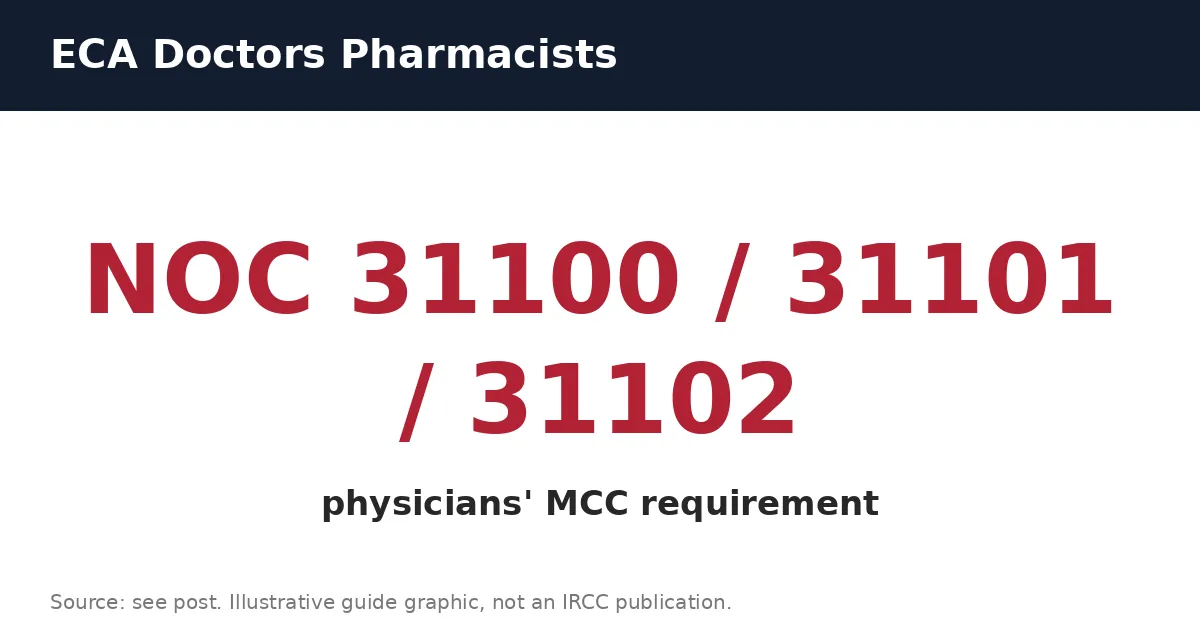
IRCC designates the Medical Council of Canada as the profession-specific ECA body for physicians — the first half of ECA doctors pharmacists. The rule is that the primary medical diploma — the medical degree itself — must be assessed by the MCC for physicians in the relevant NOCs, including specialist physicians (NOC 31100), general practitioners and family physicians (NOC 31101), and the related physician occupation (NOC 31102). A general body’s assessment of the same diploma does not satisfy the requirement for those occupations.
In practice, the MCC process in ECA doctors pharmacists involves source verification of your medical credentials — confirming with the issuing institution that the degree is genuine and complete. That verification is the slow part, and it is why doctors should start the MCC process before almost anything else in the file. The MCC assessment gives you the ECA report you need to claim education points for the medical diploma in an Express Entry profile, and it is the report IRCC expects to see for that credential.
One point that confuses doctors: the MCC assessment is about the diploma, not about your whole medical career. Residency training, fellowships and specialist qualifications are separate credentials with their own assessment questions. If you claim points for an additional degree beyond the primary medical diploma, that degree follows the general-body route described below.
Pharmacists: The PEBC Requirement
For pharmacists, the profession-specific body in ECA doctors pharmacists is the Pharmacy Examining Board of Canada. IRCC’s rule is that pharmacists who need a licence to practise must get their ECA from the PEBC (for NOC 31120). The licence condition is the key qualifier: a pharmacist whose immigration route requires licensure cannot substitute a general body’s assessment of the pharmacy degree for the PEBC assessment.
Pharmacists who do not need a licence for their particular route may be able to use a general designated body for ECA doctors pharmacists for the pharmacy degree. That distinction is route-specific, which is why this post does not give a single yes-or-no answer for pharmacists — it gives you the question to ask about your own route. If you are unsure whether your route requires licensure, get advice before choosing a body: the wrong choice costs months, because a PEBC assessment cannot be backdated to cover a period when you used the wrong body.
Like the MCC process, the PEBC pathway in ECA doctors pharmacists involves verification of pharmacy credentials and, as part of the broader licensing route, examinations. The ECA step is the immigration-facing part of that pathway; the examinations and provincial registration that follow are the licensure part, and they take considerably longer.
ECA Doctors Pharmacists: When “Both” Is the Answer
Credential you are claiming | Body to use |
|---|---|
Primary medical diploma (physician) | Medical Council of Canada (mandatory) |
Pharmacy degree, licence required (pharmacist) | Pharmacy Examining Board of Canada (mandatory) |
Pharmacy degree, no licence required for your route | General designated body may be possible — confirm your route first |
Any other degree (e.g., master’s, second bachelor’s) | General designated body (WES, ICAS, IQAS, CES or ICES) |
Spouse’s foreign education | General designated body (unless the spouse is also a physician/pharmacist with a mandatory-body credential) |
Source: IRCC’s designated-organisations list on canada.ca. This table is our summary of that list, not IRCC text.
The “both” scenario in ECA doctors pharmacists is common and completely normal: a doctor with an MCC-assessed medical diploma plus a master’s degree assessed by WES, claiming “two or more” credentials on the combination of the two valid reports. Each report covers its own credential, and the profile claims points on the combination. What “both” never means is two assessments of the same credential in the hope of a better answer — one valid report per credential is enough, and the profession-specific report is the one IRCC expects for the medical or pharmacy credential.
ECA Doctors Pharmacists: Assessment Is Not Licensure
The most expensive misunderstanding in ECA doctors pharmacists is confusing an ECA with a licence to practise. An MCC assessment lets you claim education points for your medical diploma in Express Entry. It does not let you practise medicine in Canada. Practising requires provincial licensure, which involves examinations, verification, and usually residency training — a process measured in years, not months, and entirely separate from the immigration file.
The same applies to pharmacy: a PEBC assessment is part of the licensing pathway, but it is not itself a licence. Provincial registration and the PEBC’s qualifying examinations sit between the assessment and practice. Candidates who plan around “arrive and practise” without understanding this gap arrive unprepared for the real timeline. For immigration purposes, focus on the ECA; for career purposes, research the regulator in your destination province separately, on the regulator’s own site, before you move.
Warning:
Do not promise an employer, or yourself, a start date for clinical practice based on an ECA timeline. The ECA is the immigration document. Licensure is a different clock, and it runs much longer.
Traps and Mistakes
Real Cases
Real case: Doctor who started with WES (2022)
A physician who had obtained a general-body assessment of a medical diploma asked whether it would satisfy IRCC. The thread’s answer was that the primary medical diploma requires the MCC assessment, and the general-body report did not substitute for it. The doctor’s next step was the MCC process, with the general-body report retained only for any non-medical credentials. No outcome was reported.
Real case: Pharmacist unsure about the licence condition (2023)
A pharmacist asked whether a general-body assessment would work, or whether the PEBC was required. Posters pointed to the licence condition: if a licence to practise is needed for the route, the PEBC is mandatory; if not, a general body may be possible. The thread’s advice was to confirm the route before paying for either assessment. No outcome was reported.
Real case: Doctor with a master’s degree, “both” (2024)
A physician holding a medical diploma and a separate master’s degree asked how to claim both. The thread’s answer was the “both” pattern: MCC for the medical diploma, a general body for the master’s, and a “two or more” claim on the combination of the two valid reports. No outcome was reported.
Real case: ECA mistaken for a licence (2021)
A physician who had received an MCC assessment asked when they could start practising. The thread’s correction was important: the assessment is an immigration document, and practising requires provincial licensure, examinations and residency — a separate process with a much longer timeline. No outcome was reported.
Frequently Asked Questions
Final Thoughts
For doctors, the ECA doctors pharmacists answer is MCC for the medical diploma, plus a general body for any other degree. For pharmacists, the answer turns on the licence question — PEBC when a licence is required, a general body possibly when it is not. In both cases, remember what the assessment is and is not: it is the immigration document that lets you claim education points, not the licence that lets you practise.
Start the ECA doctors pharmacists assessment early, get any second credential assessed with the right body, and test the combined claim in the CRS calculator. For a career plan that includes practising in Canada, research your provincial regulator separately — and talk to a licensed consultant (RCIC) or lawyer if your route, licence status or credential combination is unclear.
Sources
We build free Express Entry tools and track every IRCC draw. This guide was checked against official IRCC sources and real applicant reports. This is general information, not legal advice. For your own case, talk to a licensed consultant (RCIC) or lawyer.
Last reviewed: October 29, 2026
Additional Details — Name: ECA Doctors Pharmacists in 2026: MCC, WES or Both? · Description: ECA doctors pharmacists in 2026: doctors need the MCC and pharmacists need the PEBC — but do they also need WES? It depends on the credential.