Express Entry Guide · Updated October 2026
A procedural fairness letter from IRCC says the officer has concerns about your application. This is your one chance to answer them before a decision is made.
By Aria Sterling · Checked against IRCC rules
A procedural fairness letter (PFL) is the most frightening ordinary letter in Express Entry, and also the most useful one. Frightening, because it tells you refusal is on the table. Useful, because it tells you exactly why — and gives you the chance to change the officer’s mind before the decision is written.
Most procedural fairness letter replies fail for boring reasons: the reply ignores half the concerns, arrives late, or introduces a new contradiction. This post shows how to reply properly, what evidence actually helps, and what to do if the decision has already gone against you — reconsideration, and when to talk about judicial review instead.
Evidence line: we checked IRCC’s procedural fairness guidance, court commentary on fairness letters, and public threads from applicants who received one. This is general information, not legal advice — and for a PFL alleging misrepresentation, get professional help before you reply.
Quick answer: Read your procedural fairness letter for the deadline first — IRCC sets no standard response period, so the date in your letter is the only one that counts. Then answer every concern in the letter’s own order, with new, third-party evidence for each point, and submit before the deadline. If you need more time, ask in writing early. Never ignore a PFL, and never answer it with a new document that contradicts your file.
Key takeaways
What a Procedural Fairness Letter Actually Is
Canadian administrative law requires that before an officer decides against you on the basis of a concern, you must be told what the concern is and given a meaningful chance to answer it. The PFL is how IRCC does that. It sets out the officer’s concerns — a duty mismatch, a funds question, a document that looks altered, a possible misrepresentation — and invites you to respond with explanations and evidence.
That framing matters for your mindset. The officer has not decided yet. Officers issue PFLs precisely in cases where an answer could change the outcome. A PFL about a missing explanation is very different from a PFL alleging a fake document, but both share the same structure: concern, evidence, deadline, and your opportunity to be heard.
One caution from recent court decisions: procedural fairness does not generally require the officer to give you a second chance to answer concerns that arise from documents you supplied yourself. Treat the PFL reply as your one shot, and make it complete.
The Clock: Read Your Procedural Fairness Letter for the Date First
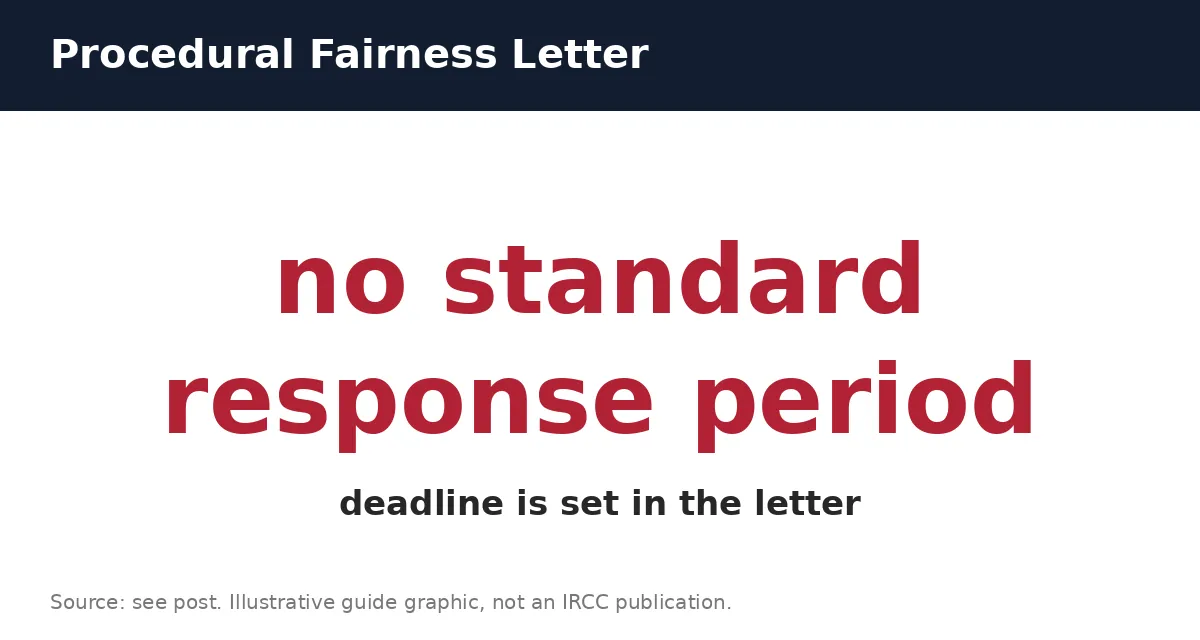
IRCC publishes no standard procedural fairness letter response period. The deadline is set case by case by the officer and written in your letter. Some letters give 30 days; others give more or less. There is no default to fall back on, so “I thought I had 30 days” is not a defence if your letter said 15.
The day the letter arrives, do three things: note the deadline in two places, check how the response must be sent (portal upload, web form or email, as the letter directs), and decide whether you need more time. If you do, ask in writing before the deadline passes, explain what you are waiting for, and keep proof of the request. An extension is not guaranteed, and silence must not be read as consent — but an early, reasoned request is far stronger than a late apology.
Warning:
Do not let a reconsideration or court deadline drift while you draft a PFL reply. If a refusal has already been issued, the clock for challenging it runs separately and is measured in weeks. Get legal advice immediately in that situation.
How to Reply to a Procedural Fairness Letter: The Anatomy of a Strong Response
Part | What to do | Why it matters |
|---|---|---|
Cover note | Identify the file, the letter’s date, and confirm you are answering every concern | Shows the officer nothing was skipped |
Point-by-point answers | Follow the letter’s own order and numbering; one section per concern | Officers work through letters systematically — make their job easy |
New evidence | Attach third-party, dated documents for each point; index them in the cover note | Assertions without evidence rarely change a mind |
Chronology | A short timeline of the events the officer questioned | Turns a pile of documents into a story the officer can follow |
Honest concessions | Where something was wrong, say so plainly and explain what is correct | A frank correction builds credibility; a denial that the evidence contradicts destroys it |
Closing ask | Ask the officer to accept the explanation and continue processing | Leaves no doubt about what you want decided |
Source note: the reply structure is our recommended practice, drawn from procedural fairness guidance and practitioner advice — not IRCC text. The deadline rule (set in the letter, no standard period) is the official position.
On evidence, be picky — in a procedural fairness letter reply, the documents that move officers are contemporaneous and third-party: pay slips and tax records for employment, bank records for funds, letters on company letterhead from people who can be contacted, dated correspondence that shows what happened when. A new letter from a friend that simply repeats your version of events, with nothing behind it, is weak. And never, ever submit a document you have altered or “improved” — a second problem (a fake document) is far worse than the first concern.
The Concerns That Trigger PFLs Most Often
Work experience and NOC duties. The officer doubts that your duties match the occupation you claimed, or that the employment was genuine, full-time and continuous. Answer with the duties evidence: a detailed employer letter, pay records, tax documents and a duties-to-NOC mapping, not a repeat of the job title.
Proof of funds. Unexplained large deposits, borrowed money, or funds that cannot be shown as available and unencumbered. Answer with the paper trail for each deposit — gift deed, sale deed, salary accumulation — and a clear statement of what is owed against the money.
Document authenticity. A certificate, letter or record that does not verify, or that conflicts with another document. Answer by explaining the discrepancy honestly and supplying the verifying record, not by producing a cleaner version of the same document.
Misrepresentation. The most serious procedural fairness letter trigger: the officer considers that information was withheld or misstated. Here the stakes include five years of inadmissibility if the finding is made. This is the category where professional help is not optional — your reply becomes part of the record on which that finding will be based.
Medical, criminality or security issues. These PFLs often ask for further information or explanation about a specific finding. Answer precisely, with the medical or legal documents requested, and do not volunteer unrelated history the letter did not ask about.
After a Refusal: Reconsideration vs Judicial Review
If the decision has already been made, two different doors exist, and confusing them wastes time.
Reconsideration is an administrative request to IRCC itself: you ask the office to reopen the file, usually because of an error in the decision or evidence that existed but was overlooked. It is discretionary — IRCC can say no — and it does not pause any court deadline. It works best where the error is concrete and demonstrable, such as a document that was on file but not considered.
Judicial review is a Federal Court challenge to whether the decision was reasonable and procedurally fair. It has strict, short deadlines measured in weeks from the decision, and it requires a lawyer in practice. It does not re-decide your application; it asks the court whether the officer’s decision can stand. If you are considering it, the first step is urgent legal advice, not a long letter to IRCC.
For most people, the practical sequence is: reconsideration request promptly if there is a clear error, while a lawyer assesses the court deadline in parallel. Never assume one path protects the other.
Real Cases From Public Threads
Real case: employment genuineness questioned, refused after reply (2024)
In a Federal Court case discussed publicly, an officer issued a PFL questioning whether claimed Canadian employment was genuine, citing inconsistencies in business records and the employer’s address history. The applicant replied with explanations and employer documents, but the officer remained unsatisfied, excluded the employment, and refused the application for failing to show one year of qualifying Canadian work experience. The court upheld the refusal.
The lesson is harsh but useful: a reply must answer the specific inconsistencies the officer named, with evidence that resolves them — not general reassurance that the job was real.
Real case: funds deposit explained, file continued (2021)
An applicant described a PFL asking about a large deposit shortly before submission. Their reply traced the deposit to a property sale with the sale deed and bank trail attached, in the letter’s order, with a short chronology. The file continued processing afterwards. No outcome beyond that was reported, but the case shows the right shape: paper trail first, explanation second.
Real case: the PFL that was ignored (2020)
Another thread described an applicant who set a PFL aside, meaning to answer it later, and missed the deadline in the letter. The refusal that followed cited the unanswered concerns. The applicant’s later reconsideration request was refused. No outcome was reported beyond that. The deadline in the letter is the whole story here.
Seven Mistakes in PFL Responses
Frequently Asked Questions
Is a procedural fairness letter a refusal?
No. A procedural fairness letter is a warning that an officer has concerns which could lead to refusal, and an invitation to answer them before a decision is made. A refusal comes only if your response does not satisfy the officer. Treat the letter as the most useful document in your file, because it tells you exactly what to answer.
How long do I have to respond to a PFL?
The deadline is in your letter — IRCC publishes no standard response period, so do not assume 30 days or any other number. Read the letter for the date first, then for the concerns, and ask in writing early if you need more time.
What should a PFL response contain?
A point-by-point answer to every concern in the letter, in the letter’s own order, with new evidence attached for each point, a short chronology, and an honest explanation where something was wrong. Address everything; do not cherry-pick the easy concerns.
What is a reconsideration request?
After a refusal, a reconsideration request asks IRCC to reopen the file, usually because of an error or new evidence that existed at decision time. It is discretionary, not a right of appeal, and it does not pause any court deadline.
Does a PFL about misrepresentation mean a five-year ban?
Not automatically. A PFL raising misrepresentation means the officer is considering that finding, which can carry five years of inadmissibility. A strong, honest, evidence-backed response is exactly what can prevent the finding from being made. That is why professional help before you reply is worth far more than help after a finding is made.
What evidence helps most in a PFL reply?
In a procedural fairness letter reply, contemporaneous, third-party evidence helps most: pay records, tax documents, employer letters on letterhead, bank records and dated correspondence. A fresh letter that merely repeats your claim, without anything behind it, rarely moves an officer. Index every attachment in your cover note, so the officer can match each document to the concern it answers.
What is the biggest mistake in a PFL response?
Ignoring it, answering only part of it, or submitting a new document that contradicts something already on file. Any of those can turn a concern the officer might have dropped into the reason for refusal. A careful, complete reply is what separates the files that recover from the files that do not.
Final Thoughts
A procedural fairness letter is bad news delivered in the most useful possible form: it tells you what the officer doubts, and it gives you the chance to answer. Most people who lose at this stage lose on process — a missed deadline, a half-answered letter, a new contradiction — rather than on the underlying facts.
Read the procedural fairness letter twice, answer everything in order, attach evidence that a stranger could verify, and meet the date in the letter. And if the letter alleges misrepresentation or inadmissibility, get a licensed consultant (RCIC) or lawyer involved before you send anything. That single decision is worth more than any paragraph you could write alone.
Sources
This guide was checked against official IRCC sources and real applicant reports. This is general information, not legal advice. For your own case, talk to a licensed consultant (RCIC) or lawyer.
Last reviewed: October 29, 2026