Express Entry Guide · Updated October 2026
You landed. The immigration part is done — and the practical part starts now. This life after PR Canada guide covers the first month, in the right order for newcomers.
By Aria Sterling · Checked against IRCC rules
Landing as a permanent resident feels like the finish line, but the first month of life after PR Canada is really a second application process — this time to the systems you will live inside: employment, healthcare, banking, housing and tax. Most of it is simple, but the order matters, because every employer, landlord and clinic will ask for the same three things first.
This checklist is organized the way the month actually unfolds: the first three days, the first two weeks, and the rest of the month. It covers the essentials and the traps, and it flags the places where the rules differ by province — because in Canada, the province often matters more than the federal government for the things you touch every day.
Evidence line: we checked Service Canada, IRCC and provincial health and licensing pages, plus newcomer guides and public threads from recent landers. This is general information, not legal or financial advice.
Quick answer: In your first days, confirm your address for the PR card, apply for your Social Insurance Number (SIN) through Service Canada, and apply for provincial health coverage. In the first two weeks, open a bank account, start your credit history, sort housing paperwork, and apply for a provincial driving licence if you drive. In the rest of the month, begin credential recognition for your profession, understand your first tax return, and set up the accounts — phone, utilities, insurance — that make the rest of life work.
Key takeaways
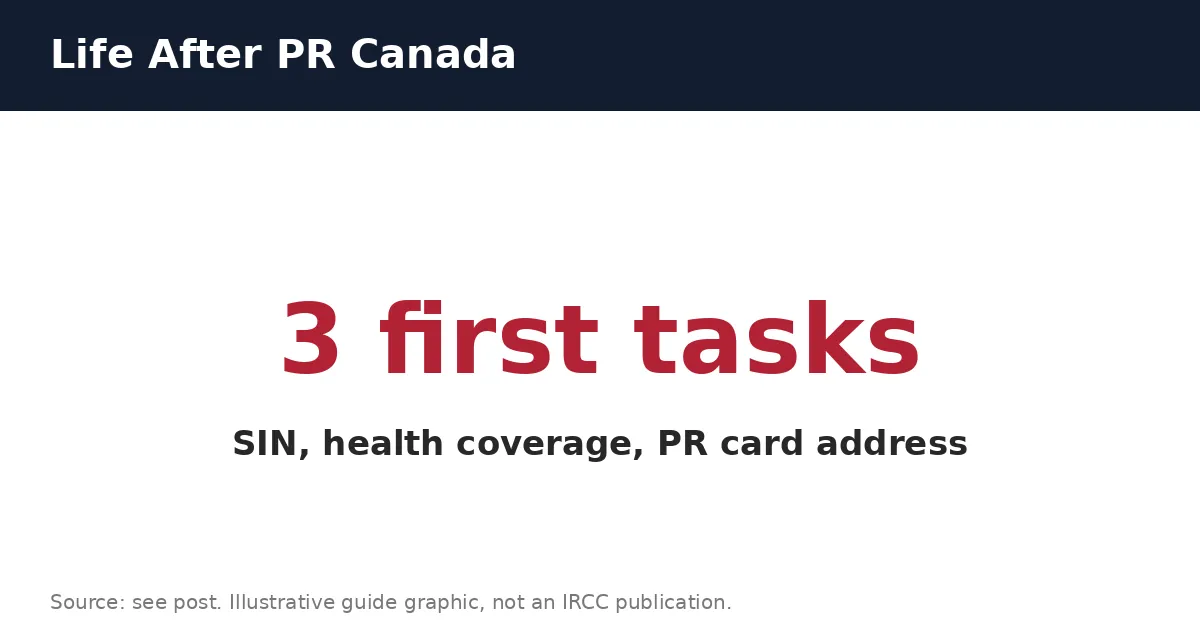
Life After PR Canada: The First Three Days (SIN, Health Card, PR Card)
Social Insurance Number. Apply through Service Canada, in person or online, with your Confirmation of Permanent Residence (COPR) and a valid identity document such as your passport. Your SIN is the number employers, banks and government programs use to identify you. It is not an identity card and it is not proof of status — but without it you cannot be paid legally or open most accounts. Guard it: share it only with employers, banks and government bodies that genuinely need it, and never by email to an unverified address.
Provincial health coverage. Apply to your province’s health plan as soon as you have an address. This is the single biggest provincial difference in the first month of life after PR Canada: eligibility, application steps and waiting periods vary by province, and some provinces do not cover you from day one. Check your province’s health plan page before you assume coverage, and consider temporary private health insurance for any gap — an uninsured hospital visit is the one first-month expense that can genuinely wreck a budget.
PR card address. Your PR card is mailed to the address you gave when you landed. If you move before it arrives — very common in the first month of life after PR Canada — update your address with IRCC promptly. A card sent to an old address is a replacement application you did not need, and travelling outside Canada without a valid PR card (or a travel document) creates a separate problem at re-entry.
Tip:
Photograph or scan your COPR, passport, SIN confirmation and health card application the day you receive each one, and store the copies separately from the originals. Newcomers lose paper more often than they lose anything else.
The First Two Weeks: Banking, Credit, Housing, Driving
Banking and credit. Most banks accept your COPR and passport as identity and will open an account before the PR card arrives, especially under newcomer packages that waive fees for an initial period. Open a chequing account, get a debit card, and start building credit deliberately: a secured credit card, used lightly and paid in full each month, builds a Canadian credit history faster than cash alone. That history is what landlords and lenders will ask about within months.
Housing paperwork. If you are renting, read the lease for the province’s rules on deposits, notice periods and rent increases — tenant protection varies by province, and the first lease you sign is the worst time to discover you misunderstood a clause. Keep copies of the lease, the move-in inspection and every payment receipt. If you are staying with family or friends first, use the time to visit neighbourhoods at different times of day before committing to a lease.
Driving licence. Licences are provincial, and so are the exchange agreements with foreign licences. Some provinces let you exchange a licence from certain countries directly; others require a road test. Some exchanges must be completed within a set window after landing, so check your province’s licensing authority early rather than discovering the deadline after it passed. Until you hold a valid provincial licence, your foreign licence’s validity window is the only thing keeping you legal behind the wheel.
The Rest of the Month: Credentials, Taxes, and the Accounts of Daily Life
Credential recognition. If your profession is regulated — engineering, nursing, teaching, accounting, trades and many others — start with your province’s regulatory body or credential assessment service in the first month of life after PR Canada. Some professions need licensing exams, Canadian experience or bridging programs before you can practise, and the process can take months or longer. Starting early is the difference between a job search that stalls and one that moves. For unregulated professions, a credential assessment can still help employers understand a foreign degree.
Taxes. If you are resident in Canada for tax purposes in the year you land, you generally file a return for that year the following spring, reporting worldwide income from the date you became resident. The first return is worth doing carefully — newcomer tax clinics and accountants who work with new immigrants handle it routinely, and mistakes on residency dates are the most common first-return error.
Daily-life accounts. Phone plan, internet, utilities, tenant or home insurance, and a family doctor if you can find one accepting patients. The family-doctor search deserves an early start: in many cities the wait is long, and a walk-in clinic is a poor substitute for a regular doctor when something chronic needs following up.
Warning:
Be wary of anyone who charges a fee to “register” you for a SIN, health card or PR card. These are free government services. Paid “newcomer packages” that bundle them are selling you something you can do yourself in an afternoon.
Life After PR Canada: The First-Month Checklist
When | Task | Needs | If you skip it |
|---|---|---|---|
Days 1–3 | Apply for SIN (Service Canada) | COPR + passport | Cannot be paid legally; most accounts blocked |
Days 1–3 | Apply for provincial health coverage | Address + ID | Possible uninsured gap; check your province’s waiting period |
Days 1–3 | Confirm PR card address with IRCC | Current address | Card mailed to the wrong place; replacement needed |
Week 1–2 | Open bank account; start credit | COPR + passport + SIN | No credit history when landlords ask |
Week 1–2 | Driving licence exchange (if you drive) | Foreign licence + province’s rules | Exchange window may close; road test required |
Week 2–4 | Begin credential recognition | Regulatory body for your profession | Licensing delay of months when job search starts |
Week 2–4 | Note first tax return (following spring) | Residency date + income records | Residency-date errors on the first return |
Week 2–4 | Phone, utilities, insurance, family doctor search | Address + ID | Daily life friction; long doctor wait |
Source note: the task list and order reflect Service Canada, IRCC and provincial guidance. Health and licence details vary by province — check your province’s own pages; no provincial waiting period is stated here because it was not verified for every province.
Real Cases From Public Threads
Real case: PR card sent to an old address (2023)
A new resident described moving within weeks of landing without updating the address with IRCC, then waiting months for a PR card that had been mailed to the previous address. The replacement process added further delay. No outcome was reported beyond that, but the lesson is simple: the address update is a five-minute task with months of consequences.
Real case: health gap discovered at a clinic (2024)
Another newcomer assumed health coverage began on landing day and learned at a clinic visit that their province’s coverage started later. The visit was paid out of pocket. The thread’s advice — check your province’s waiting period and buy temporary coverage for the gap — is the advice in this post. No outcome was reported.
Real case: credential recognition started too late (2022)
A regulated professional described beginning the licensing process only after months of job searching, then facing a further year of exams and bridging before being able to practise in their field. Starting in the first month would not have removed the process, but it would have removed the wasted months. No outcome was reported.
Six First-Month Mistakes
Frequently Asked Questions
What should I do first after landing as a permanent resident?
For life after PR Canada, confirm your address for the PR card, apply for a Social Insurance Number, and apply for provincial health coverage. Those three unlock work, pay and healthcare, so do them in the first days, before the shopping and settling-in tasks. Everything else in the first month of life after PR Canada gets easier once these three are done.
How do I get a SIN as a new permanent resident?
Apply through Service Canada, in person or online, with your Confirmation of Permanent Residence and a valid identity document. Your SIN is the number employers and government programs use, so keep it private and share it only where required. If you applied online, keep the confirmation safe until the number itself arrives.
Does health coverage start the day I land?
Life after PR Canada health coverage: it depends on the province. Coverage rules, application steps and waiting periods vary by province, so check your province’s health plan page before you assume you are covered, and consider temporary private insurance for any gap. An uninsured hospital visit is the one first-month expense that can genuinely wreck a budget.
When will my PR card arrive?
It is mailed to the address you gave at landing. If you move before it arrives, update your address with IRCC promptly, or the card may go to the wrong place and you will need a replacement. A card sent to an old address means a replacement application you did not need, and weeks of extra waiting.
Do I need to file a tax return in my first year?
If you are resident in Canada for tax purposes in the landing year, you generally file for that year the following spring, reporting worldwide income from the date you became resident. A newcomer-friendly tax clinic or accountant can help with the first return.
How do I get a driving licence as a new PR?
Driving licences are provincial, so the rules, tests and foreign-licence exchange agreements differ by province. Check your province’s licensing authority early, because some exchanges must be completed within a set window after landing. Until you hold a valid provincial licence, your foreign licence’s validity window is the only thing keeping you legal behind the wheel.
What about credential recognition for my profession?
Start with your province’s regulatory body or credential assessment service for your occupation. Some professions need licensing exams or Canadian experience before you can practise, so the process can take months — begin it in the first month of life after PR Canada, not after the job search stalls.
Final Thoughts
The first month of life after PR Canada is mostly administration, and administration rewards order. Do the three unlocks first — SIN, health coverage, PR card address — then banking, housing and driving, then the longer projects of credentials and taxes. Each task is small; the mistake is doing them in the wrong order or not at all.
One last piece of advice from the threads: ask for help early and locally. Settlement agencies, newcomer centres and community groups exist in every major city, they are free, and they have answered your exact question hundreds of times before. The first month of life after PR Canada is much easier with a guide who knows the local version of every rule in this post.
Sources
This guide was checked against official IRCC and Service Canada sources and real newcomer reports. This is general information, not legal or financial advice. For your own case, talk to a licensed consultant (RCIC) or lawyer.
Last reviewed: October 29, 2026