Express Entry Guide · Updated October 2026
How to Improve CRS Score: 9 Ways Ranked by Points (Real Cases)
Stuck a few points under the cut-off? Here is every lever on the CRS table, what it is worth today and what five real candidates did.
People who want to improve CRS score numbers usually start in the wrong place. They look for a trick: a job offer, a consultant’s shortcut, a new profile. The Comprehensive Ranking System does not have tricks. It has a table, and every point on it comes from one of a small number of facts about you.
Some of those facts cannot be changed, and one of them, your age, only moves against you. The rest can be improved with time, study or paperwork, and they are not equally rewarding. A language retake can be worth more than a second degree. French can be worth more than both.
We took the numbers from IRCC’s CRS criteria page (modified June 22, 2026) and read five public forum threads from 2019 to 2024 where candidates described what they tried. Examples marked “our arithmetic” are ours. This is general information, not legal advice.
Quick answer: what is the fastest way to raise a CRS score?
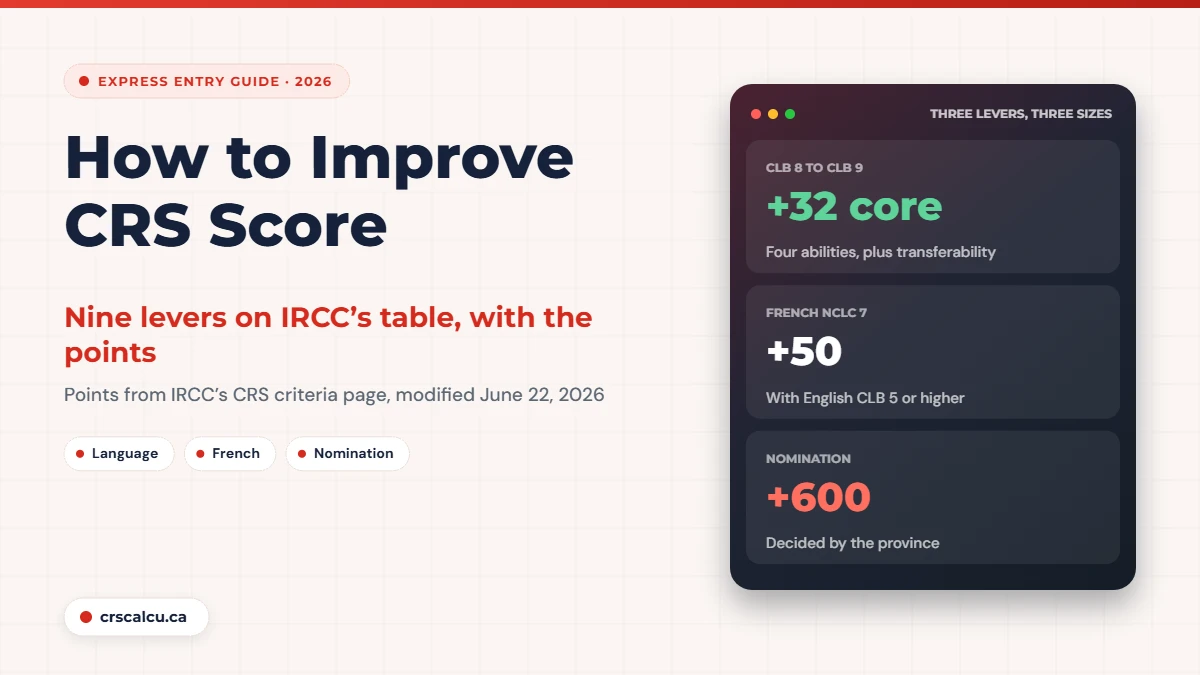
For most candidates, language. Each step up to CLB 9 adds core points in all four abilities and unlocks the higher band of skill transferability. After that, French at NCLC 7 in all four abilities adds 50 additional points if your English is CLB 5 or higher, and opens the French category rounds. A provincial nomination is worth 600 but is not in your hands. Run your own numbers in our CRS calculator to see which lever moves your score most.
Key takeaways
Where CRS points come from
IRCC’s CRS criteria page divides the score into four blocks: core factors (age, education, official languages and Canadian work experience), spouse or partner factors, skill transferability and additional points. To improve a score you have to move a line in one of those blocks. There is nowhere else for points to come from.
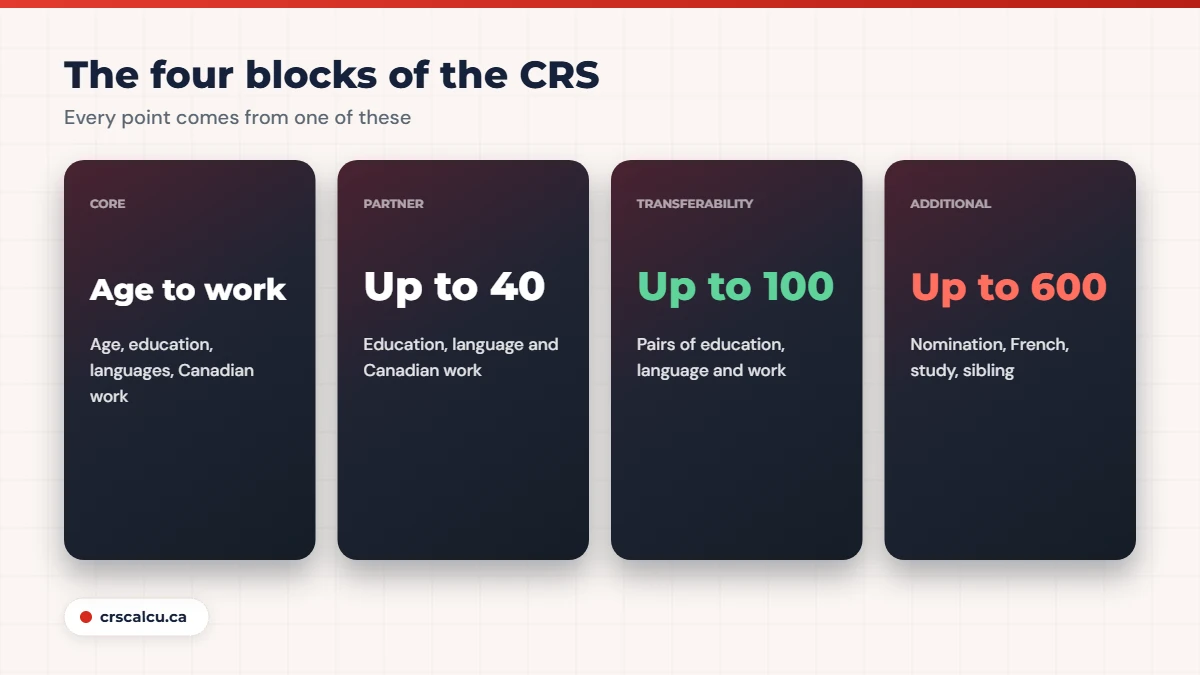
Two features of the table decide which efforts are worth it. First, skill transferability rewards combinations: education with language, education with Canadian work, foreign work with language, and foreign work with Canadian work. Each pair is worth 13, 25 or 50 depending on the levels, the education pairs are capped at 50 together, the foreign work pairs at 50 together, and the block at 100. Second, the language thresholds inside that block are CLB 7 and CLB 9. A candidate at CLB 8 gets the same transferability as one at CLB 7. That is why going from CLB 8 to CLB 9 is such a large jump.
Nine ways to improve CRS score, with the points
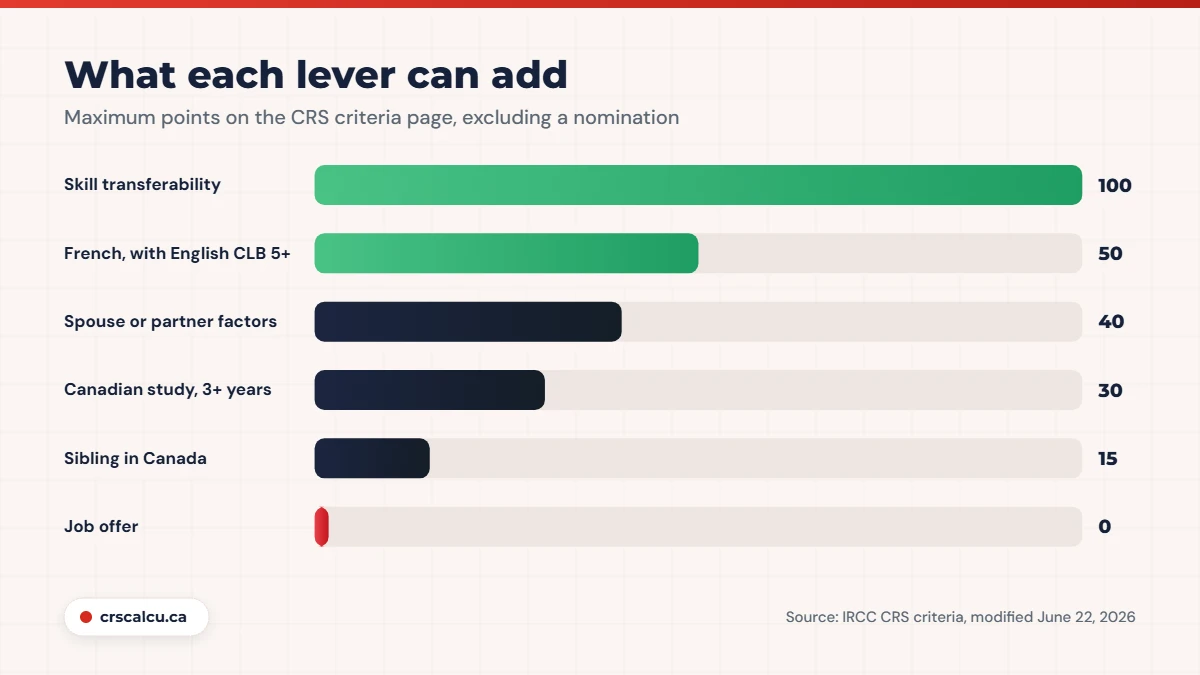
Lever | Points on the CRS criteria page | Time it tends to take |
|---|---|---|
1. Retake the language test | Up to 34 per ability at CLB 10; transferability steps at CLB 7 and CLB 9 | Weeks to months |
2. Add French | 25 or 50 additional points at NCLC 7; up to 6 per ability as a second language | Months to a year or more |
3. Another year of Canadian work | 40, 53, 64, 72, 80 for 1 to 5 years | A year |
4. Reach 3 years of foreign work | Foreign work pairs rise from 13 or 25 to 25 or 50 | Depends where you are |
5. Another credential | Bachelor’s 120; two or more credentials 128; master’s 135 | One to two years |
6. Study in Canada | 15 or 30 additional points | One to three years |
7. Spouse or partner factors | Up to 40; or switch who leads | Weeks to months |
8. Sibling in Canada | 15 additional points | Paperwork only |
9. Provincial nomination | 600 additional points | Not in your control |
Points from IRCC’s CRS criteria page (modified June 22, 2026), for a candidate without a spouse unless stated. The time column is our rough guide, not IRCC’s.
1. The language retake
A candidate without a spouse gets 17 points per ability at CLB 7, 23 at CLB 8, 31 at CLB 9 and 34 at CLB 10 or higher. Our arithmetic: moving all four abilities from CLB 8 to CLB 9 adds 32 core points. For someone with a bachelor’s degree and three years of foreign work, it also lifts the education and language pair from 13 to 25 and the foreign work and language pair from 25 to 50. That is 69 points for one better test day. Convert your results with our CLB calculator to see which ability is holding you back; one band short in one ability is enough to keep you in the lower tier.
2. French
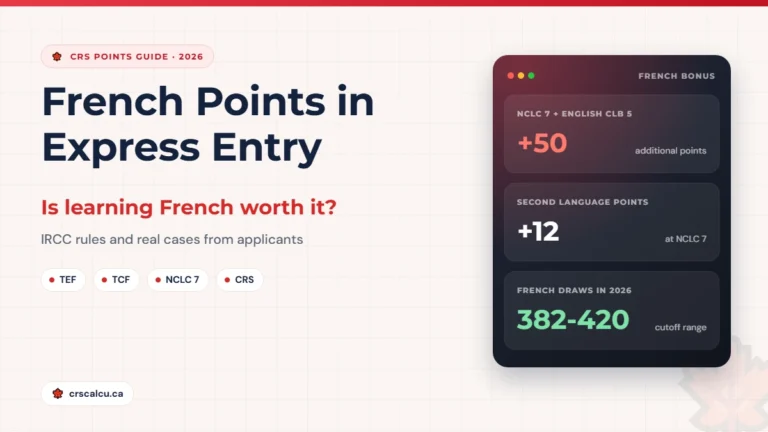
French counts in three places. As a second official language it earns up to 6 points per ability. As an additional factor, NCLC 7 or higher in all four French abilities adds 25 points if your English is CLB 4 or lower or untested, and 50 if your English is CLB 5 or higher in all four. And IRCC’s category-based selection page lists French-language proficiency as a category, with NCLC 7 in all four abilities as the test.
Real case: 449 to 520 with French (August 2021)
A candidate who had been at 449 in 2019 hesitated for six months and then decided to learn French. They studied for about six months with online tutoring, self-study, conversation practice with native speakers through apps and daily listening to slow-news broadcasts. Their test results were at the C1 level in three abilities and B2 in the fourth, and their score rose to 520. One reply added that French also helps with jobs and settling in. Others asked for the study resources. The post does not say when or whether an invitation followed.
Real case: French from zero in nine months (March 2023)
Another candidate described learning French from nothing in nine months: vocabulary apps first, then podcasts and television, then about 40 lessons with tutors focused on the exam, plus a habit of talking to themselves in French. Their results ranged from B2 in listening to C2 in reading. A native speaker replied that those scores are hard even for francophones. The poster had 484 points and was hoping for an invitation, with Quebec as a fallback; another member said they had been invited at the same score that month.
Those two are the success stories, and people who gave up do not write threads. Treat six to nine months as what two motivated people managed, not as a forecast.
Real case: French as a second language in a French round (March 2024)
Someone asked whether French had to be their first official language to be invited in a French-language round, or whether a second-language result at the required level would do. A member who had been through it said the ranking of the languages does not matter: the requirement is the French level itself. They suggested listing whichever language has the stronger results as the first language to maximize points, and said they had been invited in a French round with French as their second language.
That fits IRCC’s category page, which sets the French level and does not mention first or second language. See category-based draws for how those rounds work.
3 and 4. Work experience
Canadian work experience is scored directly: 40 points for one year, 53 for two, 64 for three, 72 for four and 80 for five or more, without a spouse. It also pairs with education and with foreign work in the transferability block. Foreign work has no core points at all; it only counts through the pairs, and the step that matters is the third year, where the pair values double. Our post on foreign work experience shows the table.
Real case: 420 at age 23 (March 2019)
A 23-year-old with a bachelor’s degree, between two and three years of work experience and top language scores had 420 points and saw no way up. Replies set out a plan with numbers: finishing the third year of work would take the score to about 441; a further one-year credential would take it to about 474; French could add more after a year or so of study. Everyone told them to enter the pool straight away, since there is no cost to waiting inside it, and to look at provincial programs. One member said they had been invited at 441 that January. No outcome was reported.
We re-ran that profile on today’s table and the steps hold up. Our arithmetic: age 23 is 110, a bachelor’s degree 120 and CLB 10 in four abilities 136, for 366 core points. With under three years of foreign work, the education pair and the foreign work pair give 25 each: 416. The third year of work lifts the foreign work pair to 50: 441. A second credential moves education from 120 to 128 and the education pair from 25 to 50: 474. That poster’s French estimate is out of date, though; the additional points for French are higher now than they were in 2019.
5 and 6. Education
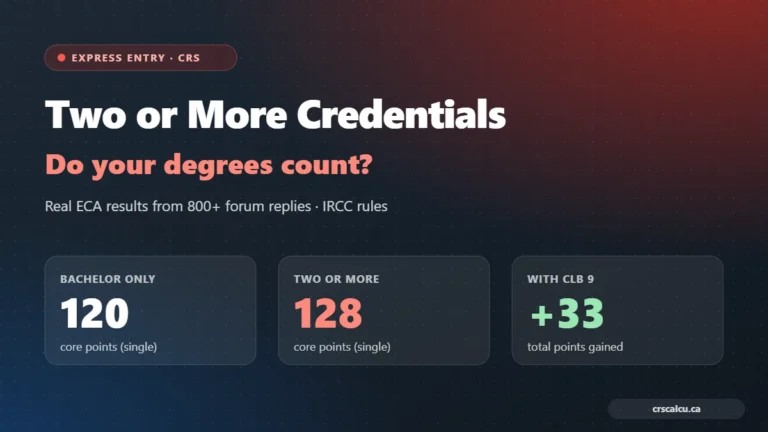
On its own line, one more credential is worth little: 8 points from a bachelor’s degree to two or more credentials, 15 to a master’s. The larger gain is in transferability, where two or more credentials or a master’s degree are worth 25 or 50 against 13 or 25 for a single credential. See two or more credentials. Studying in Canada adds 15 additional points for a one or two year credential and 30 for three years or more; details are in Canadian education points. Set that against the age points you lose while you study.
7. Your spouse or partner
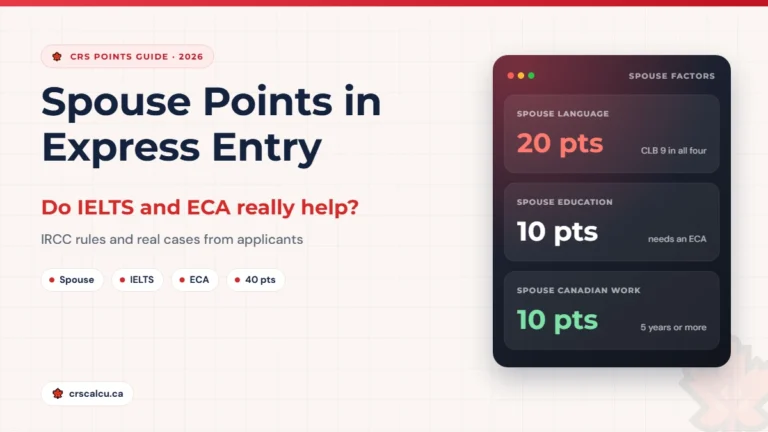
A partner can add up to 40 points: 10 for education, 20 for language, 10 for Canadian work. A partner who has never taken a language test is leaving up to 20 on the table. It is also worth checking whether the other partner would score higher in the lead; in principal applicant in Express Entry we show cases where that changed a score by more than 50.
8. A sibling in Canada
A brother or sister who is a citizen or permanent resident living in Canada is worth 15 points, and it is the only lever here that needs documents and nothing else. The conditions are in sibling points in Express Entry.
9. A provincial nomination
The 600 points for a nomination settle any round. The catch is that provinces choose whom to invite. Our BC PNP and Alberta calculators show how two of them score candidates.
Real case: five months in the pool at 435 (January 2019)
A candidate with 435 points and English at CLB 9 had been in the pool since July 2018 without an invitation and asked whether a provincial program was the answer. Replies noted that general cut-offs had stayed above 440 through 2018, and listed the options: push the language test to CLB 10, learn French, or pursue a nomination. One experienced member warned against deleting and recreating the profile, because a newer profile loses out under the tie-breaker. Another described one province’s selection as a black box. No outcome was reported.
The warning about recreating a profile is right; see the tie-breaking rule. When you do gain points, add them through an update, as described in update Express Entry profile.
The lever that only moves down
Age gives 110 points from 20 to 29 for a candidate without a spouse, then 105 at 30, 99 at 31, 94 at 32, and so on to zero at 45. A plan that takes two years costs a 31-year-old 11 age points before it earns anything. That does not make long plans wrong. It means the gain has to be measured net of the birthdays in between.
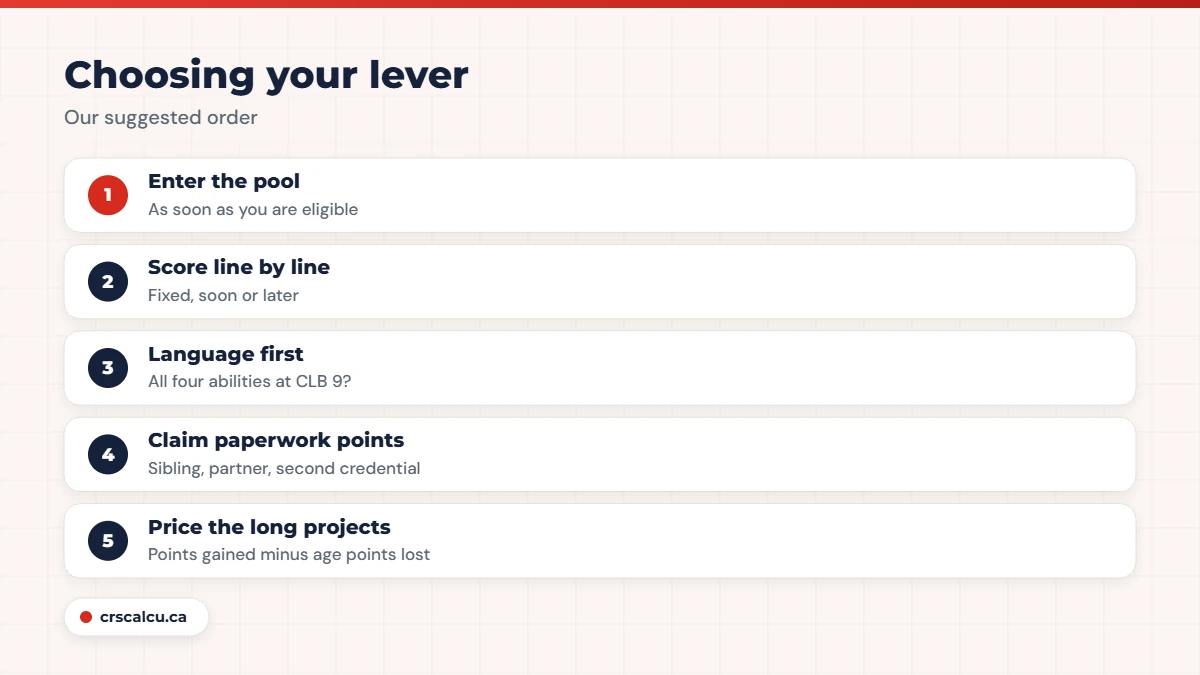
Choosing your lever (our suggested order)
Five mistakes people make trying to improve CRS score
Avoid these
What IRCC does not say
IRCC publishes the points, not a strategy. It does not say which lever suits which candidate, how long French takes to learn, or which scores will be invited in future rounds. The estimates of effort in this post come from forum accounts and our own arithmetic. For a sense of what scores have been enough, see what CRS score you need.
Frequently Asked Questions
What is the quickest way to improve CRS score results?
Usually a language retake. Moving all four abilities to CLB 9 adds core points and unlocks the higher band of skill transferability. Claiming sibling points or partner points you already qualify for is quicker still, where they apply.
How many points is French worth?
NCLC 7 or higher in all four French abilities adds 25 additional points, or 50 if your English is CLB 5 or higher. French as a second language also earns up to 6 points per ability, and it makes you eligible for French category rounds.
Does a job offer still add points?
Yes, if the job is in a high-wage occupation: as of 3 November 2026 a qualifying high-wage job offer earns 50, 70 or 100 CRS points under IRCC’s new Labour Market Integration factor, with no LMIA needed (announced 16 October 2026). Other job offers add 0 points.
Is a master’s degree worth it for points?
It adds 15 core points over a bachelor’s degree and raises the education pairs in skill transferability. Weigh that against the cost, the time and the age points lost while you study.
Should I create a new profile after improving my score?
No. Update the existing one. IRCC says updating does not change the date and time it received your profile, so you keep your rank in a tie-breaker.
Can my spouse’s language test raise my score?
Yes. A spouse or partner can add up to 20 points for language, 5 per ability at CLB 9 or higher, plus up to 10 for education and 10 for Canadian work.
Find your cheapest ten points
Change one input at a time in the calculator and watch which line moves your total most.
Final Thoughts
The honest way to improve CRS score totals is unglamorous: find the line on the table where you are furthest below the maximum and can still move, and work on that one. For most people that is language, then French, then the paperwork points they forgot to claim.
If your plan involves a study permit, a provincial program or switching the principal applicant, speak to a licensed immigration consultant or an immigration lawyer before you spend money on it.